

Managing digital marketing for a small or medium-sized business in 2026 is no longer a part-time job. Between content creation, paid campaigns, email sequences, analytics, and lead follow-up, the workload has quietly ballooned into something most teams weren’t built to handle. The good news? SMBs shifting to automated workflows are cutting execution time from 30 hours per week down to focused strategy oversight. This guide walks you through exactly how to build that workflow, step by step, so you can stop drowning in tasks and start driving real results.
Table of Contents
- Why rethink your digital marketing workflow in 2026?
- Key components of a modern digital marketing workflow
- How to set up and automate your workflow: A practical 60-day roadmap
- Integrating email campaigns and lead management
- Using analytics to optimize your marketing workflow
- Take your digital marketing workflow to the next level
- Frequently asked questions
Key Takeaways
| Point | Details |
|---|---|
| Automate the essentials | Start by automating repetitive tasks like email, analytics, and lead management for immediate time savings. |
| Keep human oversight | Use human review to safeguard brand voice and ensure automation quality in your marketing workflow. |
| Measure beyond ROAS | Track incrementality and GEO visibility, not just last-click ROI, to optimize long-term workflow performance. |
| Roadmap for success | Implement your new workflow in a phased, 60-day process, and revisit your automation setup frequently. |
Why rethink your digital marketing workflow in 2026?
The old approach to digital marketing was built on manual effort. Someone writes a post, someone else schedules it, another person checks the analytics, and the cycle repeats. That model worked when channels were simpler. Now, with omni-channel expectations, tightening data privacy regulations, and audiences demanding personalized content, manual execution is a bottleneck you can’t afford.
The SMB marketing strategy shift happening right now isn’t just about adding tools. It’s about rethinking who does what. AI automates 70-80% of repetitive marketing tasks, but it doesn’t replace the human judgment that protects your brand voice and guides strategy. Your role evolves from execution to supervision.
Three forces are making this shift urgent in 2026:
- Omni-channel complexity: Customers interact across search, social, email, and video before converting. Coordinating all of that manually is nearly impossible.
- Data privacy changes: Third-party cookies are largely gone. First-party data collection and consent management now require deliberate workflow steps.
- Content personalization: Generic messaging underperforms. Audiences expect relevance, which means segmentation and dynamic content are now table stakes.
“The businesses winning in 2026 aren’t the ones doing more. They’re the ones doing the right things with smarter systems behind them.”
Pro Tip: Before you automate anything, document your current process in full. Automating a broken workflow just makes mistakes happen faster. Map every step, identify the bottlenecks, then build your automation layer on top of a clean foundation. SMB marketing success starts with clarity, not complexity.
Key components of a modern digital marketing workflow
A best-in-class 2026 workflow isn’t a single tool or platform. It’s a connected system of stages, each with defined inputs, outputs, and automation opportunities. Most SMBs follow a 7-step workflow that covers content creation, campaign management, email automation, analytics, and lead qualification.
Here’s how those seven stages break down:
- Strategy and planning: Define goals, audiences, and messaging. This stays human-led.
- Content creation: AI drafts, humans refine. Tools like AI writing assistants cut production time significantly.
- Campaign setup and launch: Automated rules handle bidding, scheduling, and audience targeting across digital marketing types.
- Email automation: Triggered sequences replace manual sends. Segmentation happens in real time.
- Analytics and reporting: Dashboards pull data automatically. You review insights, not raw numbers.
- Lead qualification and routing: Scoring models filter and assign leads without human triage.
- Review and optimization: Weekly or biweekly human review cycles keep the system calibrated.
Here’s a quick comparison of what manual versus AI-driven execution looks like at each stage:
| Workflow stage | Manual time per week | AI-assisted time per week | Error rate |
|---|---|---|---|
| Content creation | 10 hours | 2 hours | Lower with review |
| Campaign management | 8 hours | 1.5 hours | Minimal |
| Email automation | 5 hours | 0.5 hours | Very low |
| Analytics and reporting | 4 hours | 0.5 hours | Near zero |
| Lead qualification | 3 hours | 0.5 hours | Low |
A solid content marketing strategy sits at the center of this workflow. Without consistent, quality content feeding your campaigns and email sequences, even the best automation falls flat.
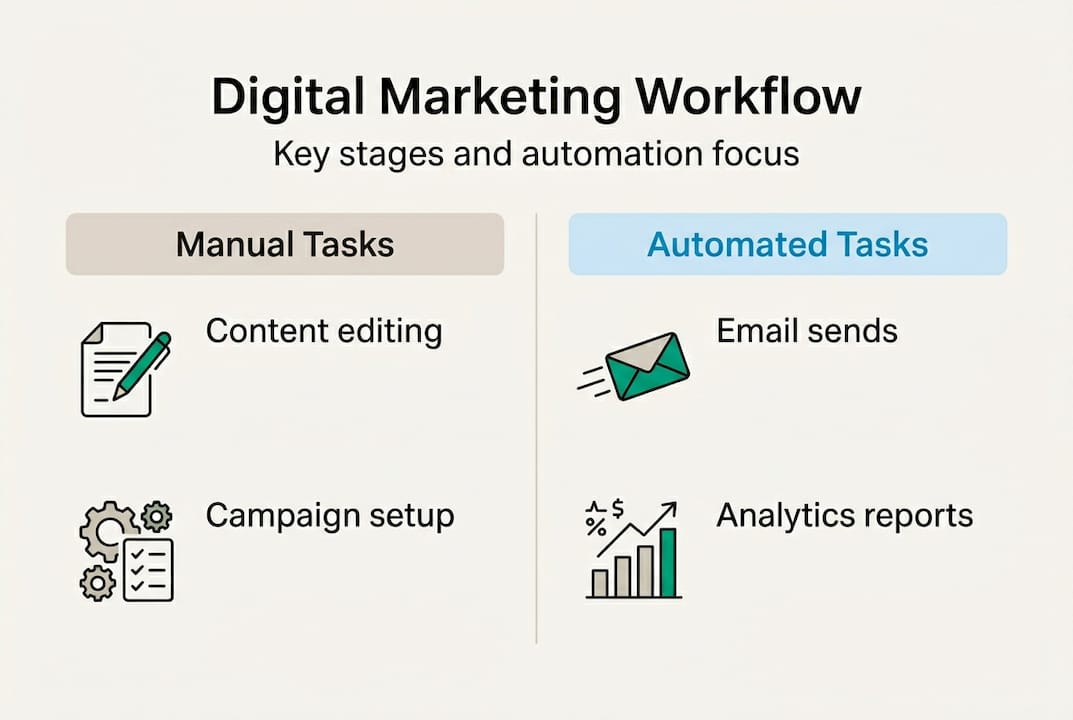
Pro Tip: Start automating your most data-heavy and repetitive tasks first. Email sends and analytics reporting are quick wins that free up time immediately, building team confidence before you tackle more complex automation layers.
How to set up and automate your workflow: A practical 60-day roadmap
Knowing the components is one thing. Actually building the system is another. The good news is you don’t need to overhaul everything at once. Starting with content and email automation while focusing on first-party data collection gives you the fastest return with the least disruption.
Here’s a phased 60-day roadmap:
- Days 1 to 10: Audit your current workflow. List every recurring marketing task, who owns it, and how long it takes. Be honest about what’s broken.
- Days 11 to 20: Prioritize automation candidates. Flag tasks that are repetitive, rule-based, or data-driven. These are your first automation targets.
- Days 21 to 30: Select and connect your tools. Choose platforms that integrate. Disconnected tools create data silos, not efficiency.
- Days 31 to 40: Build and test your first automations. Start with email sequences and reporting dashboards. Run parallel tests before going fully live.
- Days 41 to 50: Train your team. Automation only works if your team understands how to supervise it. Focus on exception handling and quality review.
- Days 51 to 60: Measure and adjust. Compare time spent and output quality before and after. Use your SMB marketing strategy goals as your benchmark.
Here’s what you can realistically expect at each stage:
| Workflow stage | Time saved per week | Cost impact | Visibility gain |
|---|---|---|---|
| Email automation | 5 hours | Reduced labor cost | Higher open and click rates |
| Content scheduling | 3 hours | Lower production cost | Consistent posting cadence |
| Analytics reporting | 4 hours | Faster decisions | Real-time performance data |
| Lead qualification | 3 hours | Fewer missed leads | Faster response times |
| Campaign management | 8 hours | Better ad spend efficiency | Improved ROAS |
Your social media checklist should also be part of this roadmap. Social scheduling and engagement monitoring are easy wins that compound over time.
Pro Tip: Never remove human review from your workflow entirely. Automation can misfire on tone, timing, or context. A quick human check before major sends or campaign launches protects your brand and catches errors before they reach your audience.
Integrating email campaigns and lead management
Email and lead management are where automation pays off fastest. When these two systems work together, you stop losing leads to slow follow-up and start converting more of the traffic you’re already generating.
The core setup involves two connected layers. First, drip automation delivers the right message to the right person based on behavior triggers like a form fill, a page visit, or a product view. Second, lead scoring and routing automatically prioritize and assign leads based on engagement signals. Email and lead automation save over 15 hours per week and boost qualified conversions for SMBs running focused campaigns.
Key benefits of integrating these systems:
- Speed: Automated follow-up happens in minutes, not days. Response time is one of the strongest predictors of conversion.
- Relevance: Segmented sequences deliver content matched to where the lead is in the buying journey.
- Consistency: No lead falls through the cracks because someone forgot to follow up.
- Scalability: You can handle 10x the lead volume without adding headcount.
Common pitfalls to avoid:
- Over-automation: Sending too many emails too fast damages deliverability and trust. Less is more.
- Skipping human review: Automated emails that sound robotic or off-brand hurt your reputation. Review templates regularly.
- Ignoring customer retention via automation: Most SMBs focus automation on acquisition. Retention sequences for existing customers often deliver better ROI.
Explore email drip campaign examples to see how real sequences are structured, and review B2B lead generation tactics to align your lead routing with your sales process.
Pro Tip: Test fewer, more targeted campaigns rather than blasting your entire list. Three well-segmented variants will consistently outperform one mass send. Precision beats volume every time for SMBs.
Using analytics to optimize your marketing workflow
Building the workflow is step one. Keeping it sharp is the ongoing job. Analytics is how you know what’s working, what’s wasting budget, and where your next optimization opportunity lives.
The metrics that matter most in 2026 go beyond basic click rates. Incrementality, not just last-click ROAS, is now the standard for measuring true marketing impact. AI-powered analytics tools increase both visibility and cost-effectiveness for small businesses running lean teams.
Here’s a step-by-step optimization cycle to run monthly:
- Pull your core metrics: ROAS, customer acquisition cost (CAC), conversion rate by channel, and email engagement rates.
- Check incrementality: Are your paid campaigns actually driving new customers, or just capturing people who would have converted anyway?
- Review GEO visibility: Are you showing up in local and regional searches relevant to your audience? This matters more than ever for SMBs.
- Analyze first-party data performance: How are your owned audiences (email lists, CRM contacts) performing compared to paid traffic?
- Identify one optimization per channel: Don’t try to fix everything at once. One focused change per cycle produces cleaner data and faster learning.
“AI-powered analytics tools can reduce reporting time and cost by up to 95%, freeing your team to act on insights rather than compile them.”
Your digital channel analytics setup should feed directly into your workflow review cycles. If you’re still pulling reports manually, that’s the first thing to automate. Use your digital marketing guide as a reference for connecting channel performance to overall business goals, and track content analytics separately to measure how your content investments are compounding over time.
Take your digital marketing workflow to the next level
You now have a clear picture of what a modern, AI-assisted digital marketing workflow looks like and how to build one in 60 days. The frameworks, tables, and roadmap above give you everything you need to start. But knowing the path and walking it efficiently are two different things.

At Ascendly Marketing, we’ve helped SMBs across industries move from scattered manual execution to streamlined, results-driven systems since 2013. Our team of SEO specialists, content creators, and strategists can audit your current workflow, identify your highest-impact automation opportunities, and build a tailored plan that fits your team and budget. Explore our digital marketing services to see how we approach workflow transformation, or start with our small business strategy resources to benchmark where you stand. If you’re just getting oriented, our digital marketing guide is a great place to build your foundation before diving into automation.
Frequently Asked Questions
What is the most time-consuming step in a digital marketing workflow for SMBs?
Manual campaign execution and content creation typically consume the most time, but AI saves up to 15 hours per week by automating routine content and campaign tasks.
How do I decide which marketing tasks to automate first?
Start with repetitive, data-heavy tasks like email sends and analytics reporting, then layer in more complex automation with human oversight to protect accuracy and brand voice.
Is a digital marketing workflow different for small businesses vs. enterprises?
Yes. SMBs typically test 3 campaign variants and prioritize precision, while enterprises scale automation across much larger data sets and team structures.
What metrics matter most for workflow optimization in 2026?
Incrementality and GEO visibility are the key metrics to track alongside ROAS and CAC, especially as first-party data becomes the primary measurement foundation.