

Most advice on email marketing for lead generation starts in the wrong place. It says to publish more lead magnets, add more popups, and send more campaigns. That advice skips the part that decides whether any of that work will matter.
A bigger list doesn’t help when your emails land in spam, your forms attract the wrong people, or your automation dumps every new contact into the same generic sequence. The result looks like a creative problem, but it usually isn’t. It’s a systems problem.
The channel is worth fixing. Email marketing returns $36 to $42 for every $1 spent, and well-optimized programs drive about 25% of overall revenue according to these email marketing statistics. That’s why teams keep investing in it. The upside is real. The waste is real too when the foundation is weak.
Rethinking Email Marketing for Modern Lead Generation
The common advice is simple. Build a bigger list and email it more often. That sounds practical, but it ignores the part that breaks first.
Email marketing for lead generation works when three layers line up. You need capture points that attract the right leads, a segmented nurture path that moves them forward, and technical setup that gets your message into the inbox. Miss one layer and the whole program underperforms.
The real bottleneck isn’t always copy
Marketers often spend the first hour debating subject lines. They should spend that hour checking whether the domain is authenticated, whether list quality is holding up, and whether the form on the site is collecting useful context. A polished campaign sent through a weak setup is still a weak campaign.
Practical rule: Before writing campaign copy, verify that your list source, sender setup, and automation logic are solid. Delivery problems erase creative wins.
This is why I treat lead generation email as part marketing, part operations. The email itself matters. The system behind it matters first.
Start with the question that actually matters
Instead of asking, “What should we send this week?” ask, “Is our system ready to turn attention into qualified conversations?” That one change fixes a lot.
A sound setup includes:
- Clean entry points that tell you where the lead came from and what they asked for
- Segment rules that split contacts by intent, offer, and behavior
- Automations that respond to actions instead of forcing everyone through one sequence
- Inbox readiness so the campaign can be seen
For teams refreshing their program, it helps to review practical email marketing strategies that connect acquisition, messaging, and retention instead of treating email like a standalone blast channel.
Lead generation is a pipeline, not a send button
B2B companies often need a slower progression. A checklist download should not trigger the same follow-up as a demo request. E-commerce brands need tighter timing. Browsing behavior, cart events, and repeat interest should shape what gets sent next. Service businesses need trust earlier, because the buyer often wants proof, clarity, and an easy path to contact before committing.
If your current approach is one list, one newsletter, one CTA, you’re not running a lead generation engine. You’re broadcasting.
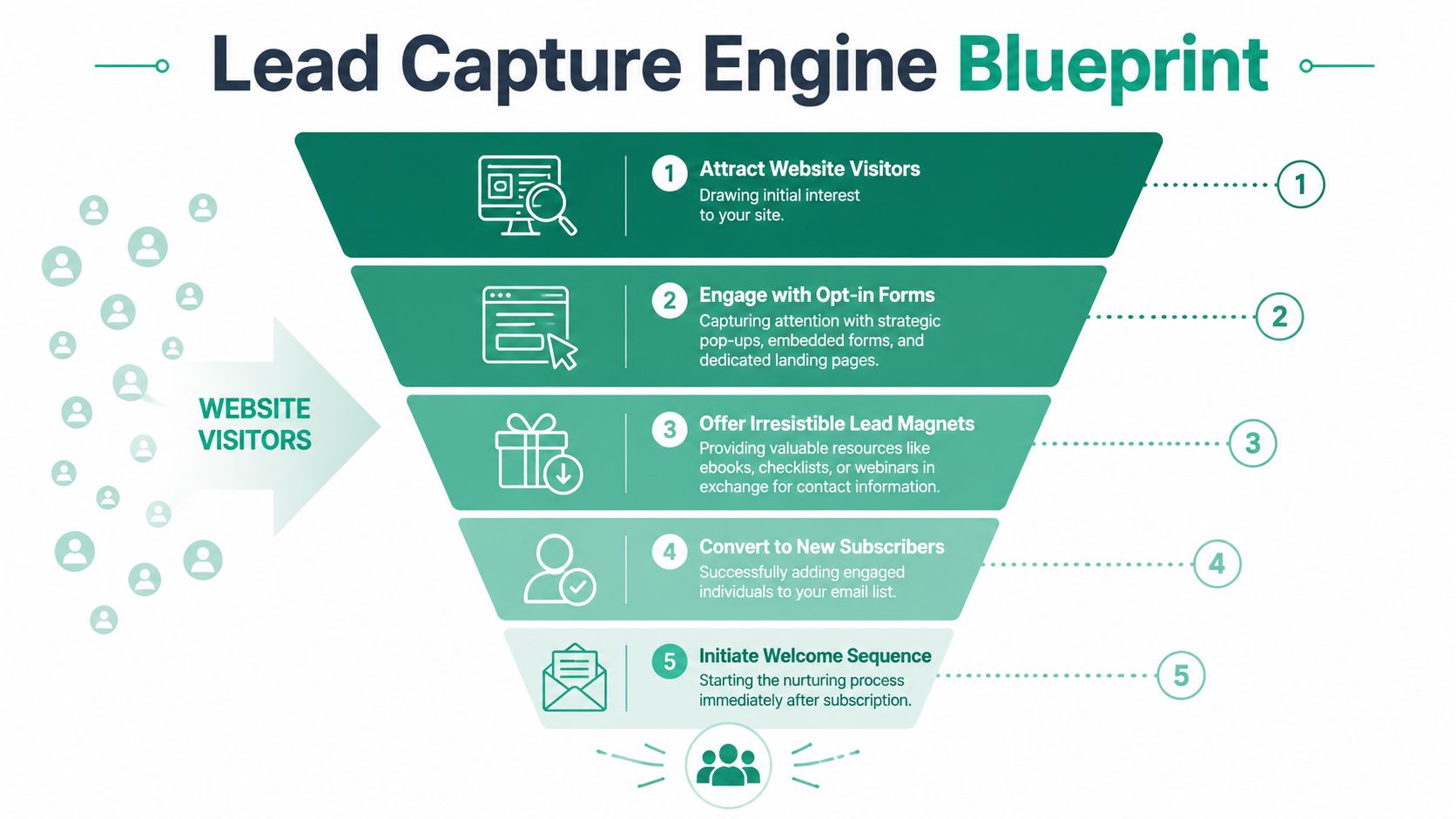
Building Your High-Conversion Lead Capture Engine
Email is widely used for lead generation. 78% of companies actively use email campaigns for that purpose, making it the most-used tactic overall in 2026 according to these lead generation statistics. The reason is simple. Email gives you a direct way to continue the conversation after the first visit.
That only works if the capture system is built with intent in mind.
Match the offer to the business model
A weak lead magnet attracts curiosity. A strong one attracts the right next step.
Here’s how that usually breaks down:
| Business type | Lead magnet that fits | Why it works |
|---|---|---|
| B2B | A buyer checklist, implementation guide, or comparison worksheet | It helps the buyer evaluate a problem and signals intent |
| E-commerce | A first-order incentive, back-in-stock alert, or product quiz result | It converts browsing interest into an owned contact |
| Service business | A service guide, estimate checklist, or consultation prep sheet | It reduces friction and answers early buying questions |
A B2B cybersecurity firm might offer a vendor evaluation checklist. An apparel store might offer a style quiz tied to category preferences. A roofing company might offer a storm damage inspection guide. Different businesses need different hooks, but the rule stays the same. The offer should solve a small problem that naturally leads to the larger service or product.
Build forms that qualify, not just collect
Most signup forms ask for too little or too much. Too little means you can’t segment. Too much means people leave.
Use forms with a job to do:
- Popup forms work when the offer is immediate, and the timing is controlled
- Embedded forms work on blog posts, service pages, and resource hubs where intent is already visible
- Dedicated landing pages work for paid traffic, webinars, and partner campaigns because they remove distractions
For list-building structure, this guide on how to build an email list covers the mechanics of turning traffic into subscribers without relying on one generic form.
A form should answer two questions fast. Why should I give you my email, and what happens next?
Use a simple capture framework
I use a five-part check before launching any lead capture asset:
Offer clarity
The headline needs to name the value plainly. No vague promise language.Context match
The form should match the page. A pricing-page visitor needs a different ask than a blog reader.Field discipline
Ask only for information that will change follow-up. If a field won’t shape segmentation or sales action, cut it.Immediate handoff
Every form should trigger a welcome or delivery email right away.Source tagging
Tag the entry point so later campaigns know whether this person came from a guide, checkout intent, a service page, or an ad.
Teams often treat forms like design elements. They’re not. They’re intake systems. Build them that way and the rest of your funnel gets easier.
Audience Segmentation and Hyper-Personalization Tactics
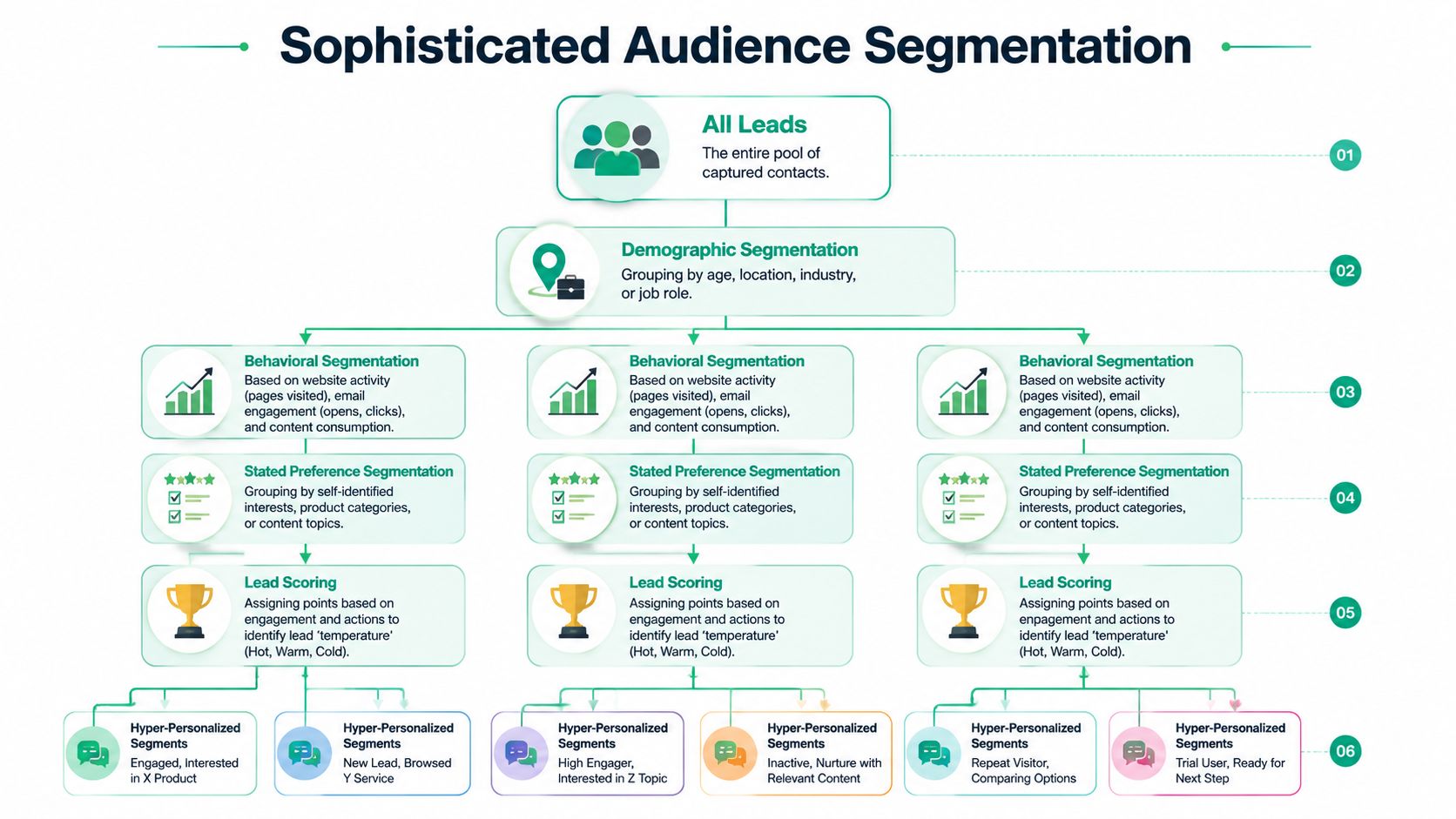
Segmentation gets treated like a creative exercise. In practice, it starts as a systems decision.
If your tags are messy, your form sources are inconsistent, or your CRM is not syncing cleanly with your email platform, personalization breaks fast. Teams end up sending the right copy to the wrong people, or the wrong cadence to high-intent leads. Good creative cannot recover from bad routing.
Analysts at Mailchimp note that segmented campaigns perform better than non-segmented sends, but the gain does not come from clever subject lines alone. It comes from having clean inputs, usable fields, and rules your team can maintain.
Build segments from usable signals
Start with signals that change either message, offer, or sales action. If a data point will not affect one of those three, it does not belong in your first segmentation layer.
I use four lenses with clients because they stay useful across B2B, e-commerce, and service funnels.
Acquisition source
Source usually predicts context better than demographics do. A lead from a webinar, a pricing page, and a blog article may fit the same ICP, but they need different follow-up because they entered with different expectations.
On-site behavior
Behavior helps separate curiosity from buying intent. Educational page views point to earlier-stage interest. Visits to pricing, comparison, shipping, financing, or service detail pages usually call for tighter CTAs and fewer introductory emails.
Business or customer fit
For B2B, that means role, company size, industry, and sometimes tech stack. For e-commerce, it can mean first-time buyer versus repeat customer, average order value, or category depth. For service businesses, location, service line, and urgency matter more than broad persona language.
Stated interest
Declared preferences are cleaner than inferred signals. Form selections, quiz answers, consultation type, product category choice, and preference center updates should carry more weight than opens or clicks by themselves.
What this looks like in the field
A B2B SaaS lead who downloads an integration guide should not get the same follow-up as a founder who requested pricing. The first lead likely needs implementation detail, internal buy-in support, and proof that rollout will not create extra work. The pricing lead usually needs timeline, ROI framing, and objection handling tied to procurement.
An e-commerce brand should split flows by category interest, purchase status, and buying pattern before it starts swapping hero images. Someone browsing running shoes and someone buying baby gifts are not two creative variants of the same audience. They are different revenue paths.
A service business has even less room for generic messaging. Emergency intent, geography, and quote status should shape the sequence immediately. A local prospect requesting same-day HVAC repair needs speed, availability, financing reassurance, and trust signals. A lead who downloaded a remodeling checklist needs education and a longer decision window.
If a segment does not change content, CTA, timing, or owner, it is just a label.
Personalization should change the email, not just the greeting
First-name insertion has limited value. Useful personalization changes what the subscriber sees and what happens next.
Use a simple operating table like this:
| Signal | Personalize this |
|---|---|
| Downloaded a guide | Next email topic, supporting resource, and CTA |
| Viewed pricing or service details | Objection-handling copy, proof, and consult CTA |
| Selected a product category | Featured products, examples, and send frequency |
| Identified role or use case | Language, case studies, and offer framing |
The trade-off is complexity. Every new branch adds maintenance load, QA risk, and more chances for bad data to create bad sends. That is why I would rather see a team run five clean segments well than build twenty segments no one can manage.
For teams mapping those branches into actual flows, these email drip campaign examples for lead nurturing and conversion show how segment logic should shape sequence structure.
Hyper-personalization works when the plumbing is clean first. Set up the fields, tags, sync rules, and suppression logic correctly, then tailor the message. Do it in the opposite order and even strong campaigns miss the inbox, the moment, or the buyer.
Designing Automated Nurture Cadences That Work
Automation fixes the mistake many teams make after capture. They either send nothing for days, or they push every lead straight to sales. That’s where momentum dies.
The numbers support a slower, smarter path. Only 27% of B2B leads convert when sent directly to sales, while marketing automation drives 77% higher conversions by supporting progressive engagement and lead scoring, according to Growth List’s lead generation statistics.
A useful reference point for sequence structure is this set of email drip campaign examples that shows how timing and message intent work together.
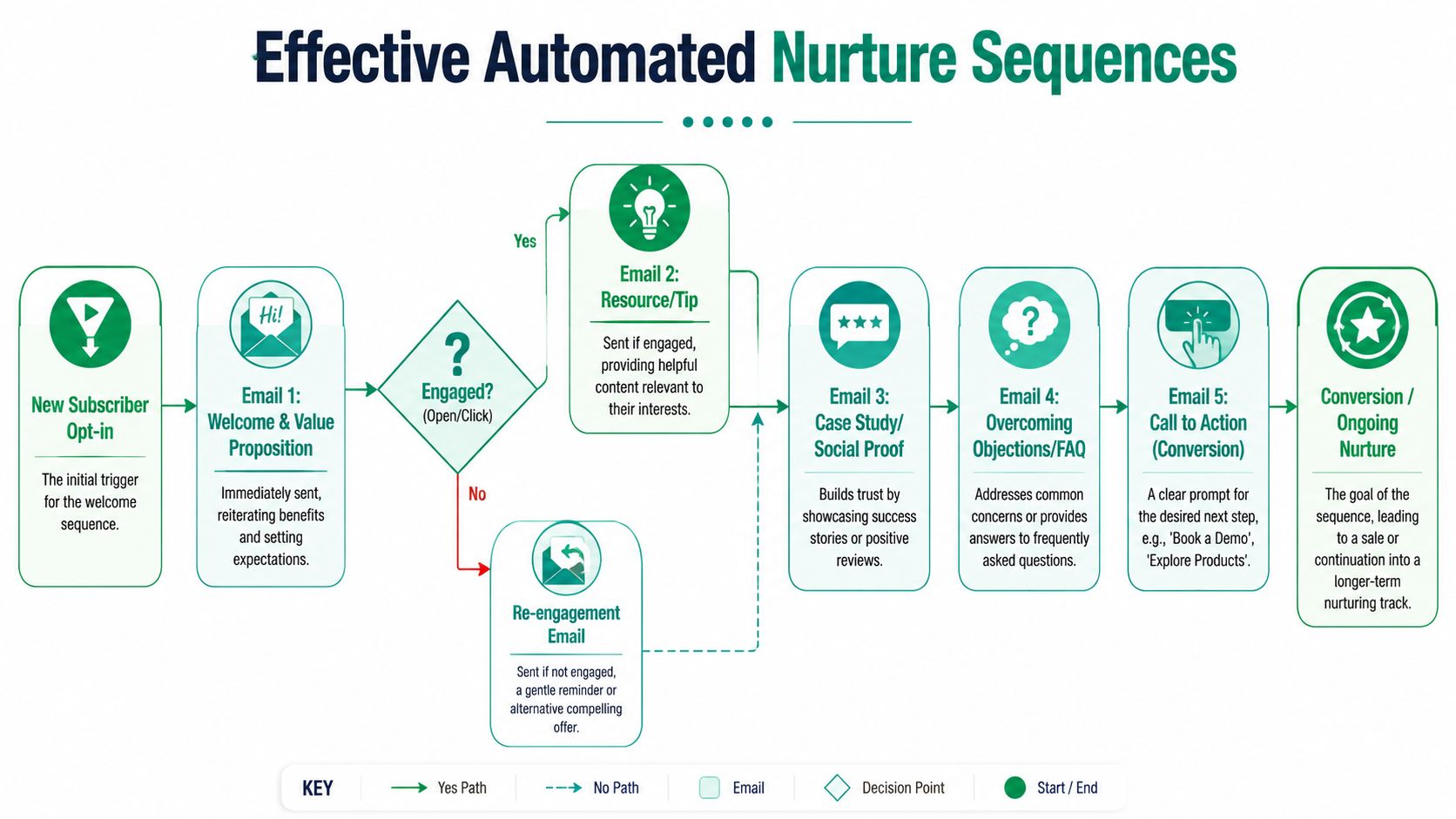
A new subscriber’s first five days
The welcome sequence does more than deliver the lead magnet. It sets the relationship.
Day 1 sends the promised asset and sets expectations. Tell the subscriber what they’ll receive and why it will help.
Day 2 teaches one useful concept tied to the original opt-in. A B2B lead gets a short operational insight. An e-commerce lead gets category guidance. A service lead gets a plain explanation of process and timing.
This walkthrough helps visualize the flow inside an automated sequence.
Day 3 introduces proof. That can mean use cases, customer review excerpts already approved for marketing, or before-and-after process framing without invented claims.
Day 4 handles objections. Address pricing concerns, effort concerns, timing concerns, or implementation concerns.
Day 5 asks for the next action. Book a call. Start a quote. Browse the recommended collection. The CTA should fit the lead temperature, not your sales team’s weekly target.
A cart abandoner’s path is shorter and sharper
For e-commerce, delay kills intent. The sequence needs to answer practical friction fast.
A workable cadence looks like this:
- First email reminds the shopper what was left behind and links back cleanly
- Second email answers likely hesitation, such as shipping questions, fit concerns, or product selection confusion
- Third email narrows the action to one clear return path
Don’t add three offers, six product blocks, and a newsletter signup into the same message. A cart sequence should recover intent, not start a brand education campaign.
The downloaded-whitepaper lead needs a bridge
This is the classic B2B gap. Someone downloaded a resource but hasn’t asked for a demo. That doesn’t mean they aren’t serious. It usually means they aren’t ready.
Send the next step that matches the buyer’s confidence level. Educational interest isn’t the same as buying intent.
That sequence should move from topic depth to practical application, then to problem-solution fit, then to a low-friction conversation. For teams that need execution support alongside platform setup, tools such as HubSpot, ActiveCampaign, and agency-run managed programs like Ascendly Marketing’s email services can handle list logic, sequence mapping, and sales handoff.
Automation works when each email has one job. Teach. Prove. Answer. Ask.
Mastering Campaign Creation and Inbox Deliverability
A lot of failed email marketing for lead generation gets blamed on weak creative. That’s often wrong. The message didn’t fail first. The delivery did.
The overlooked part is infrastructure hygiene. Data from 2025 to 2026 shows that 68% of cold email campaigns fail because sending domains lack proper SMTP authentication, which causes spam placement regardless of opt-in quality, based on Outfunnel’s lead generation analysis.
Technical setup comes before campaign design
SPF, DKIM, and DMARC are verification layers that help receiving servers trust that your email originates from you. In plain terms, they support sender identity and protect domain reputation. Without them, even solid campaigns can get filtered out.
List hygiene matters just as much. Remove bad addresses, watch engagement patterns, and avoid blasting every contact with the same cadence. A list can grow while performance drops if quality control disappears.
For teams working across fundraising and stakeholder outreach, this resource on how to optimize nonprofit communication tools is a useful example of how channel choice and message coordination affect delivery and response.
Creative rules that hold up
Once the foundation is stable, campaign structure starts doing its job. A few rules consistently improve performance.
Use one main CTA
Too many options split attention. The reader should know exactly what to do next.Write subject lines with intent, not hype
Specific beats clever. The subject should match the email content and the segment’s current problem.Design for mobile first
Short paragraphs, clear buttons, and fast visual scanning win here. Most inbox friction is layout friction.Keep copy aligned with stage
New leads need clarity. Warm leads need proof and objection handling. High-intent leads need a direct path to act.
Your campaign isn’t one thing. It’s domain trust, list quality, message relevance, layout, timing, and CTA discipline working together.
A practical pre-send checklist
Use this before every send:
| Check | What you’re confirming |
|---|---|
| Authentication | The sender setup is in place and domain trust is protected |
| Audience | The segment matches the email’s purpose |
| Offer | The value and CTA fit the lead’s stage |
| Layout | The email reads cleanly on mobile |
| Links | Every link works and points to the right next step |
| Follow-up | Opens, clicks, replies, and conversions route into the next action |
Creative gets attention. Deliverability earns the chance to compete for it.
Measuring Performance to Optimize Your Email Funnel
Open rate is an inbox signal, not a business outcome. If a campaign gets opened but never produces qualified conversations, demos, purchases, or booked calls, the funnel is underperforming no matter how healthy the subject line looks.
Measure email the same way you would diagnose a paid media funnel or sales pipeline. Track the step where performance breaks. For most programs, that means watching form conversion rate, open rate, click rate, lead-to-sale conversion rate, unsubscribe rate, and reply rate if the campaign is built to start a conversation.
Measure the step that owns the problem
Each metric should point to one owner and one likely issue.
If form conversion is weak, start with the offer, page context, and form length. B2B teams often ask for too much information too early. E-commerce brands usually have the opposite problem. They capture the email, then fail to turn that signup into first-purchase intent. Service businesses often lose leads because the email promise and booking page do not match.
If opens are strong but clicks are soft, review message match. The subject line may be earning attention that the body copy does not carry forward. If clicks are healthy but pipeline contribution stays flat, look past the email. Check landing pages, CRM routing, sales follow-up speed, and lead scoring rules. I see this issue often in SMB accounts that keep rewriting copy when the underlying problem is broken attribution or a slow handoff.
That is how email marketing for lead generation becomes a system you can improve. You stop guessing which part feels off and isolate the leak.
A practical way to keep ROI tied to revenue is to use a clear framework for calculating marketing ROI across spend, lead quality, and revenue. That keeps reporting grounded in contribution, not vanity metrics.
Test one variable at a time
Bad testing creates false confidence. If you change the subject line, CTA, offer, and landing page at once, you do not know what caused the lift or the drop.
Run controlled tests like these:
- Subject line test. Keep the audience, offer, and send window fixed.
- CTA test. Change only the action language or button treatment.
- Body copy test. Compare a short version against a longer, proof-heavy version.
- Landing page test. Keep the email constant and change only the destination experience.
- Send timing test. Hold the creative steady and test delivery by day or time block.
The right test depends on the business model. A B2B nurture sequence may get more from testing proof elements and meeting-booking CTAs. An e-commerce flow may get more from testing product blocks, urgency treatment, or discount framing. A local service brand usually sees faster gains from testing booking friction, trust signals, and speed-to-lead follow-up.
Use outcomes to change the system
Winning tests should change more than one campaign. If a segment responds better to product-led emails than educational emails, revise the nurture path. If leads from one source open but never progress, adjust the lead magnet, tighten targeting, or stop feeding that segment into sales. If unsubscribes spike after a frequency increase, pull back before domain reputation suffers and future campaigns lose inbox placement.
Measurement is there to drive decisions.
Teams with a strong email program review funnel performance weekly, not just campaign reports after the send. They know where leads are stalling, which segments convert, and whether the issue sits in the email, the landing page, or the follow-up process.
If your team wants a tighter email system, Ascendly Marketing builds and manages lead generation programs that connect capture, segmentation, automation, and reporting so email supports measurable pipeline growth instead of sitting in the background.