

TL;DR:
- A startup branding guide defines how a business positions itself, communicates its value, and visually presents its identity. It includes key elements like positioning, promise, verbal and visual identity, an activation plan, and documentation. Building a lean brand early on helps startups avoid costly rebrands and boosts marketing efficiency and market differentiation.
A branding guide for startups is a strategic framework that defines how a new business positions itself, communicates its value, and visually represents its identity to win customers and gain a competitive advantage. Brand identity goes far beyond a logo or color palette. It shapes every customer interaction, every investor pitch, and every piece of content your team produces. Founders who treat branding as a design task miss the bigger picture. The role of branding in startups is to create a foundation that drives growth, builds trust, and makes marketing more efficient from day one.
What are the core elements of a startup branding guide?
A startup branding guide covers six interconnected components. Skip any one of them and your brand will feel inconsistent, even if your logo looks great.
- Brand positioning statement. This defines who you serve, what problem you solve, and why you are different. It answers the jobs-to-be-done question: what outcome does your customer actually hire you to deliver?
- Brand promise and principles. Your promise is the single commitment you make to every customer. Your principles are the values that govern how you keep it. Together, they drive consistency across teams and channels.
- Verbal identity. This includes your brand voice, tone, and messaging architecture. Brand voice is the cheapest differentiator available to a startup. Three clear voice attributes, written down, are enough to align a team of ten.
- Visual identity. At the MVP stage, this means a strong wordmark, one or two typefaces, and a defined color palette. Complex logos are expensive to produce and hard to adapt. A wordmark scales from a business card to a billboard without losing clarity.
- Activation plan. This is how your brand shows up in practice: website copy, social profiles, pitch decks, email signatures, and ad creative. Without an activation plan, brand guidelines sit in a folder and get ignored.
- Brand documentation. A written guide that captures all of the above. It gives new hires, contractors, and agency partners a single source of truth.
A functional brand strategy document spans 15–25 slides or pages and covers positioning, audience, promise, voice, messaging, and visuals. That document becomes the upstream foundation for every downstream execution.
Pro Tip: Keep your MVP brand minimal. One wordmark, two typefaces, and three voice attributes are enough to launch. You can add complexity after you find product-market fit.

How to build a startup brand strategy by stage and budget
Startup branding strategy must match your current stage. Spending a scale-up budget on a pre-seed brand is one of the most common and costly mistakes founders make.
- Pre-seed stage. Focus on positioning clarity and verbal identity. Write your positioning statement, define your audience’s jobs to be done, and draft three voice attributes. This costs almost nothing and prevents expensive rebrands later.
- MVP launch. Add a wordmark and a basic visual system. Over-investment at this stage often leads to a full rebrand within two years as the product and audience evolve. Keep it lean and flexible.
- Post-launch iteration. Refine your messaging based on real customer language. Update your brand guide to reflect what you have learned. This is the stage where tone and voice become your sharpest competitive tools.
- Scaling. Now you invest in a full visual identity, a brand campaign, and a content system. Engaging senior contractors for branding at this stage typically costs $5,000–$50,000 depending on scope. That investment makes sense when your positioning is proven.
- Founder ownership. At every stage, the founder must own the brand strategy. Agencies and designers execute, but founder clarity drives success. Delegating strategy before you have clarity produces expensive confusion.
The types of branding approaches available to startups vary widely. Knowing which model fits your stage saves time and money.
Pro Tip: Prioritize your wordmark, tone of voice, and color contrast compliance before you spend a dollar on brand photography or illustration. Those three elements do the most work at the lowest cost.
What practical steps and tools help create a startup brand guide?
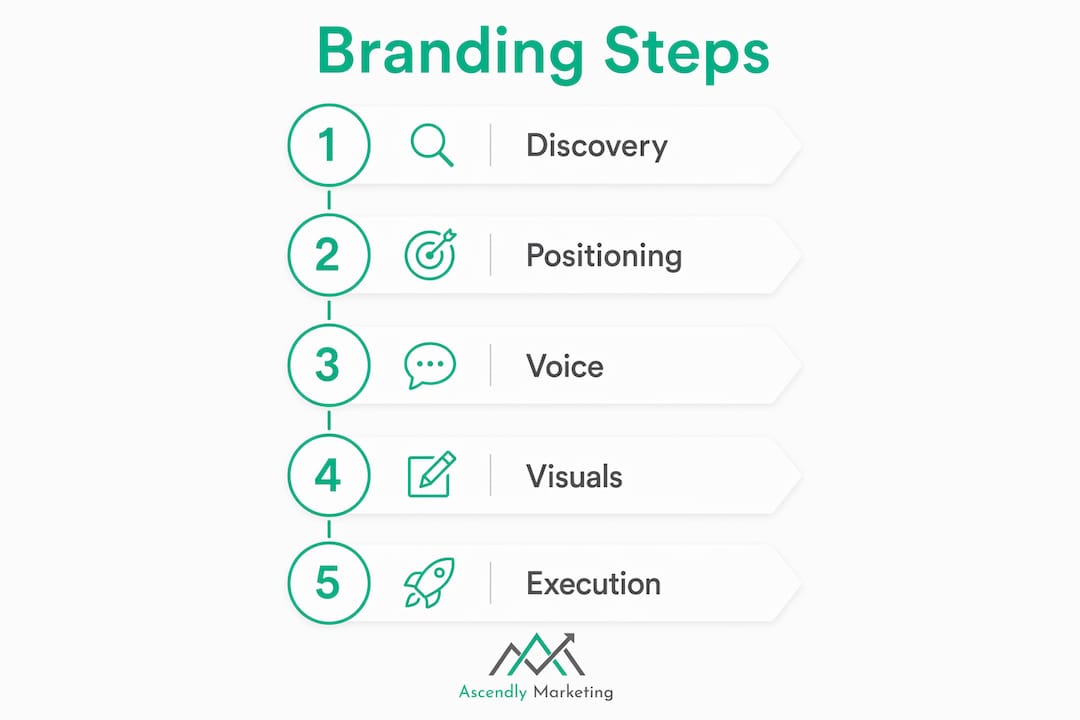
Building a brand from scratch follows a clear sequence. Rushing any phase produces work you will redo.
- Discovery. Research your market, your competitors, and your customers. Map the jobs your audience is trying to get done. Identify the gaps your competitors leave open.
- Strategy. Write your positioning statement, brand promise, and principles. This is the hardest phase and the most important. Do not outsource it.
- Verbal identity. Define three core voice attributes. Draft headlines as if explaining your product to a clear-thinking, busy friend. Avoid hype-filled language that sounds like every other startup.
- Visual identity. Choose a wordmark style, select one or two typefaces, and define a color palette. Run every color combination through a contrast checker to meet WCAG AA standards. Accessibility compliance from the start widens your audience and avoids costly retrofits later.
- Activation. Write your brand guidelines document. Build templates for your most-used formats: pitch deck, website, social posts, and email. Set usage rules for logo placement, color application, and tone.
| Phase | Key Output | Useful Tools |
|---|---|---|
| Discovery | Audience JTBD map, competitor audit | Google Forms, Typeform, SparkToro |
| Strategy | Positioning statement, brand promise | Notion, Google Docs |
| Verbal identity | Voice attributes, messaging framework | Hemingway Editor, Google Docs |
| Visual identity | Wordmark, color palette, typography | Figma, Adobe Color, WebAIM Contrast Checker |
| Activation | Brand guidelines doc, templates | Canva, Notion, Google Slides |
Pro Tip: Use WebAIM’s free contrast checker before you finalize any color palette. Fixing contrast issues after launch costs far more than checking them upfront.
How does branding impact startup growth and market differentiation?
Strong branding produces measurable business results, not just a polished appearance. 77% of consumers make purchasing decisions based on brand name alone. That statistic means your brand name carries more weight than your feature list in the moment a customer decides to buy.
Startups with data-driven brand strategies see up to 30% marketing efficiency gains and 10% revenue growth. Efficient marketing means your paid ads, content, and social posts all reinforce the same message, so each channel amplifies the others instead of competing with them. A consistent brand identity builds the trust that converts first-time visitors into repeat customers.
Differentiation is the other major payoff. Clear positioning tells customers exactly why you are the right choice over a competitor. Without it, you compete on price, and price competition destroys margins. A startup with a defined brand can charge a premium, attract better talent, and close investor conversations faster.
SEO and online presence also benefit directly from brand clarity. A consistent name, voice, and visual identity across your website, social profiles, and directory listings signals authority to search engines. That authority compounds over time and reduces your dependence on paid acquisition.
| Business Impact | Result |
|---|---|
| Consumer purchase decisions | 77% influenced by brand name alone |
| Marketing efficiency | Up to 30% improvement with data-driven brand strategy |
| Revenue growth | Up to 10% increase linked to consistent branding |
| Rebrand risk | High for startups that over-invest in brand before product-market fit |
What are common branding mistakes startups make?
Most branding errors come from misunderstanding what branding actually is. These are the mistakes that cost founders the most time and money.
- Spending scale-up budget at MVP stage. A full brand identity with custom illustration, brand photography, and a complex logo system is right for a Series A company, not a pre-seed startup. Lean branding early enables flexibility and prevents premature identity fixes after product-market fit.
- Treating branding as a design task. Design is one output of branding. Strategy, messaging, and positioning come first. Founders who hire a designer before writing a positioning statement get beautiful work that says nothing.
- Neglecting accessibility. Skipping WCAG AA compliance during visual identity development narrows your audience and creates legal exposure. Color contrast and typography choices made early are cheap to get right and expensive to fix later.
- Using generic copy. Phrases like “we help businesses grow” or “your trusted partner” appear on thousands of startup websites. Generic copy signals that you have not done the hard work of defining what makes you different.
- Skipping brand documentation. A brand guide that exists only in the founder’s head breaks down the moment you hire your first employee or brief your first agency.
- Ignoring founder ownership of messaging. Startup branding must be fast, flexible, and light to survive product pivots. That agility requires a founder who understands the strategy well enough to update it quickly.
Pro Tip: Build your brand strategy as a modular document. Keep positioning, voice, and visuals in separate sections so you can update one without rebuilding the whole thing after a pivot.
Key Takeaways
A startup brand built on clear positioning, consistent voice, and lean visual identity outperforms one built on expensive design alone.
| Point | Details |
|---|---|
| Start with strategy, not design | Write your positioning statement and voice attributes before briefing any designer. |
| Match investment to stage | Keep branding lean at MVP; scale visual identity after product-market fit is confirmed. |
| Own the brand strategy | Founders must write and maintain the strategic layer; agencies execute, not define. |
| Prioritize accessibility early | Meet WCAG AA color contrast standards from day one to avoid costly retrofits. |
| Document everything | A written brand guide is the only way to keep messaging consistent across teams and partners. |
What I have learned building brands for startups
The founders who build the strongest brands are not the ones with the biggest budgets. They are the ones who can articulate their positioning in two sentences before they ever open Figma. I have seen well-funded startups spend $40,000 on a brand identity and rebrand 18 months later because the strategy underneath it was never clear. The design was beautiful. The positioning was borrowed from a competitor.
The other pattern I keep seeing is founders who treat brand voice as an afterthought. Voice is the one brand element that shows up in every single customer touchpoint: your website, your sales emails, your investor deck, your support responses. A consistent, distinct voice builds more investor and customer confidence than any logo. It signals that someone in the building actually knows who they are talking to and why.
Modular brand elements matter more than most founders realize. When your product pivots, and it will, you need to update your messaging without rebuilding your entire identity. A brand strategy document with clearly separated sections for positioning, voice, and visuals makes that update a half-day task instead of a six-week project.
The founders who avoid expensive rebrands are the ones who resist the urge to finalize their visual identity before they have talked to 50 customers. Spend the first month on positioning and voice. Spend the second month on visuals. That sequence saves money and produces a brand that actually fits the market you are building for.
— Ascendly Marketing
How Ascendly Marketing helps startups build brands that grow
Ascendly Marketing has worked with startups and small businesses since 2013, building brand strategies and digital marketing services that match the stage and budget of each client. The team includes designers, SEO specialists, and content creators with backgrounds in major brands and tech companies.
For founders ready to move from positioning to execution, Ascendly Marketing offers brand strategy, visual identity development, website design, and content creation under one roof. The agency’s approach connects brand clarity directly to lead generation and revenue growth, so your brand investment produces measurable returns. Visit Ascendly Marketing to book a consultation and get a tailored plan for your startup’s brand development.
FAQ
What is a branding guide for startups?
A branding guide for startups is a strategic document that defines positioning, brand voice, visual identity, and usage rules. It gives every team member and external partner a single reference for consistent communication.
How much does startup branding cost?
Engaging senior contractors for startup branding typically costs $5,000–$50,000 depending on scope. Pre-seed founders can build a functional brand strategy with far less by focusing on positioning, a wordmark, and defined voice attributes.
When should a startup invest in full brand identity?
A startup should invest in a full visual identity after confirming product-market fit. Over-investing before that point often leads to a full rebrand within two years as the product and audience evolve.
Why does brand voice matter more than logo design?
Brand voice appears in every customer touchpoint, from website copy to sales emails, making it the most consistent and cost-effective differentiator a startup has. A logo is seen occasionally; your voice is read every day.
How does branding affect startup growth?
Startups with data-driven brand strategies see up to 30% marketing efficiency gains and 10% revenue growth. Consistent branding also builds the trust that converts first-time visitors into loyal customers over time.