

You’ve probably had this thought already: “We need press.”
Then the next thought lands right behind it. “Okay, but what would we even say, who would care, and how do we know if any of it turns into business?”
That’s where most small companies stall. They treat public relations like a hunt for mentions, not a system for creating demand, trust, and qualified conversations. Good public relations for small business doesn’t start with a press release. It starts with a business objective, moves through tight targeting, and ends with a result you can track.
Small companies have an advantage here. They can move faster than large brands, react to the news cycle without layers of approval, and pitch stories with a human voice instead of corporate filler. But that only works if the process is disciplined.
Set Clear Objectives Before Seeking Press
A business owner says they want coverage. Fair enough. Coverage can help. But “get our name out there” is not a usable objective.
PR is a strategic communication process that builds and maintains a positive relationship between a business and its public. That’s the working definition behind effective outreach, and it’s why the first move isn’t writing an email to a reporter. The first move is deciding what result the campaign needs to produce.

Start with the business problem
If you run an e-commerce brand, maybe the issue is low branded search and weak trust with first-time buyers. If you run a B2B firm, maybe sales needs warmer leads and more third-party validation. A local service company may need stronger visibility in a defined region.
Those are usable starting points because they connect PR to a business outcome.
The broader market is moving in that same direction. The global PR market was valued at $100.06 billion in 2024 and is projected to reach $132.52 billion by 2029, while about 60% of online businesses outsourced digital PR functions between 2024 and 2025, reflecting demand for measurable outcomes rather than vague exposure, according to Ranko Media’s PR statistics roundup.
Practical rule: If you can’t explain what press should do for pipeline, traffic, or trust, you’re not ready to pitch.
Turn broad wishes into SMART targets
A useful PR objective is specific enough to guide action and narrow enough to measure later. That means using SMART goals. Specific, measurable, achievable, relevant, and time-bound.
Here’s how that looks in practice:
- Website traffic goal: Increase referral traffic from earned media to a service page or product collection.
- Lead generation goal: Generate qualified contact form submissions from a PR-specific landing page.
- Authority goal: Secure placements in local or trade publications your buyers already read.
- Launch support goal: Use coverage to give a product release, event, or expansion a stronger opening week.
Each goal leads to different tactics. A local authority campaign needs city business journals, neighborhood publications, and community podcasts. A SaaS launch may need niche trade outlets and founder commentary on an active industry problem.
Keep the scope tight
Small businesses usually make the same planning mistake. They set too many PR goals at once.
Pick one primary objective and one secondary objective. That’s enough. If you try to build local awareness, national authority, investor visibility, retail demand, and recruitment credibility in the same campaign, the message gets diluted.
A simple planning sheet should answer five questions:
- Who needs to know about you
- What action should they take
- What proof will make them trust you
- Which media reach them
- How will you measure progress
If you need a starting point for evaluating options, directories like PeerPush public relations can help you compare service providers and support models before you commit to handling it all in-house.
Craft Your Newsworthy Story and Press Materials
Most small businesses think they “don’t have news.” Usually that’s false. What they don’t have is a clean way to turn ordinary business activity into a story angle a publication can use.
A bakery’s anniversary isn’t just an anniversary. It can become a story about neighborhood staying power, rising demand for specialty products, family ownership, hiring, local sourcing, or seasonal buying patterns. The facts may be simple. The framing does the work.

Find the angle inside the everyday
Take a small e-commerce company that adds a new product line. That isn’t automatically news. But the launch can be pitched through different lenses depending on the outlet:
- For local media: founder story, local job creation, community relevance
- For industry media: category insight, buyer behavior, market shift
- For lifestyle creators: usefulness, visual appeal, seasonal tie-in
- For podcasts: operating lessons, mistakes, customer demand patterns
That’s why “write one press release and blast it everywhere” fails. Reporters and editors don’t need your announcement. They need a story their audience will care about.
A small company rarely runs out of stories. It usually runs out of angles.
Build a press kit before you need it
When a journalist replies, speed matters. If they ask for logos, founder details, product facts, or images and you need two days to assemble them, momentum drops.
An effective public relations strategy requires core assets. Those include a concise company boilerplate, high-resolution visual assets, and a standard press kit containing founder biographies and key product facts, as outlined in Salesforce’s guide to small business PR.
Here’s the minimum viable press kit:
| Asset | What to include | Why it matters |
|---|---|---|
| Company boilerplate | Short company description, what you do, who you serve | Gives media a usable summary |
| Founder bios | Names, roles, short background, headshots | Supports interviews and profile pieces |
| Visual assets | Logos, product photos, team photos, workspace shots | Makes coverage easier to publish |
| Key product facts | Product names, categories, short descriptions | Prevents factual errors and back-and-forth |
| Media contact details | Direct email for press inquiries | Reduces friction |
A good boilerplate is short. One paragraph. Clear nouns. No slogans.
Package the story so it’s easy to use
Once you have a story angle and materials, shape them into media-ready elements. That usually means:
- One strong headline idea that reflects the angle, not your marketing language
- A summary with the core news in the first lines
- A few supporting details that make the story concrete
- A founder quote in plain English, useful enough to publish
- Links to assets in a shared folder or media page
This walkthrough is useful if you want to see how a simple story gets structured for outreach:
Don’t wait for a major milestone to create these materials. The businesses that get coverage consistently are usually prepared before the opportunity shows up.
Build a Hyper-Targeted Media List
A bad media list is huge. A useful media list is small, specific, and researched.
Small businesses lose time when they buy broad databases or scrape hundreds of contacts and assume volume will compensate for weak relevance. It won’t. Five excellent targets beat fifty random names every time because a relevant pitch has a shot. An irrelevant one gets deleted.
Build around beats, not job titles
Start with outlets your buyers already trust. That might include a local business journal, an industry trade site, a niche podcast, a regional lifestyle publication, or a newsletter operator with a focused audience.
Then find the actual person covering that topic. Not “[email protected]” unless there’s no alternative.
Use a simple workflow:
Search the outlet first
Look for recent stories related to your industry, city, or category.Identify the byline
Find the reporter, editor, columnist, or producer behind those pieces.Read their recent work
Study the last few articles or episodes. You’re checking tone, recurring topics, and what they consider news.Confirm fit
If they cover funding rounds and policy, don’t send them a product giveaway angle.Log everything
Add the details to a tracking sheet before outreach starts.
Track the details that prevent bad pitching
The strongest small-business PR systems are boring in a good way. They rely on disciplined note-taking.
A practical tracking sheet should include:
- Contact name and outlet
- Role and coverage area
- Recent article topics
- Preferred format such as email, social DM, or submission form
- Past interactions
- Potential angle match
- Status like not pitched, pitched, replied, or covered
The point isn’t paperwork. The point is relevance. If you know a journalist recently covered local hiring trends, you can frame your story around that pattern. If you know they dislike attachment-heavy emails, you can send a lightweight pitch and link out to assets instead.
A five-contact standard beats list hoarding
If you’re starting from zero, don’t build a giant sheet. Build a short list with discipline.
A good first list contains five names:
- one local outlet
- one trade outlet
- one niche newsletter
- one podcast host
- one creator or commentator with audience overlap
That mix teaches you more than a bloated spreadsheet ever will. You’ll see who responds, what angle lands, and where your story belongs.
Research removes guesswork. It also removes most of the rejection caused by sending the wrong story to the wrong person.
A hyper-targeted list also protects your reputation. Journalists remember lazy outreach. Small businesses can’t afford to burn trust with the few contacts who are a fit.
Master the Art of Personalized Media Outreach
This is the step where most campaigns fail.
Not because the business lacks a story. Not because reporters are impossible to reach. The failure usually comes from sending generic outreach that looks copied, self-centered, and poorly timed.
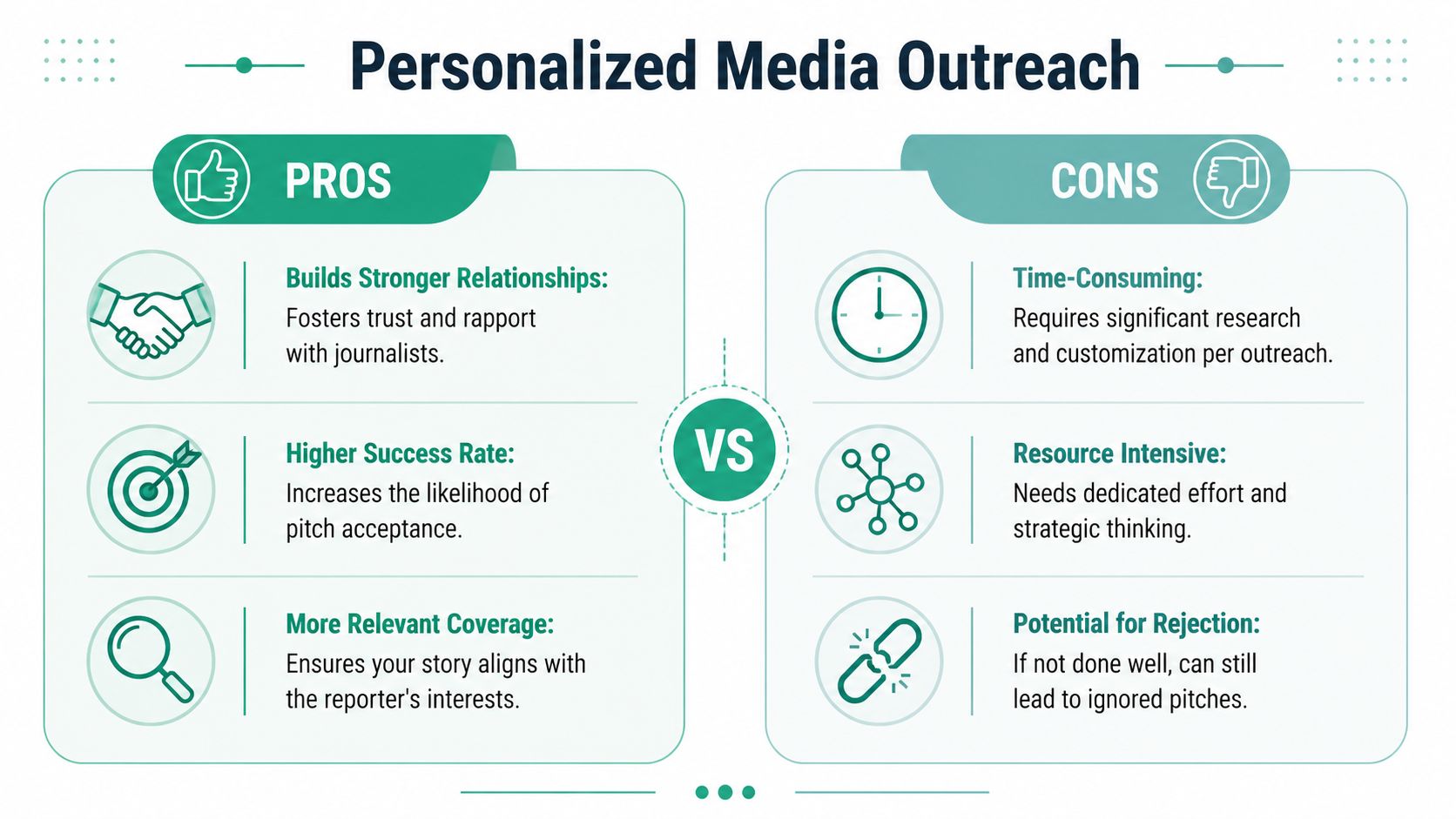
Personalization isn’t a nice extra in public relations for small businesses. It’s the core mechanic. If the pitch doesn’t prove relevance in the first few lines, the rest of the email won’t matter.
Write for the journalist, not for yourself
A weak pitch talks about the company first. A strong one starts with the audience fit.
That means the opening should show you’ve read the journalist’s work and understand what they cover. Keep it brief. One sentence is enough.
Then move into the angle. Not your full background. Not your mission statement. The angle.
A usable pitch structure looks like this:
- Subject line: clear and relevant, tied to the story
- Opening: quick reference to their beat or a recent piece
- Angle: why this story fits their audience now
- Proof: a few concrete details
- Ask: interview, product sample, source comment, or quick review
- Assets: link to press materials, no clutter
Timing changes outcomes
Even a strong pitch can die if it lands at the wrong moment. Effective publicity campaigns require calendar-driven strategies that account for holidays and news cycles so you don’t compete with major breaking stories, as noted in PRLab’s industry analysis.
That applies in simple ways. Don’t pitch a light local business feature when national news is dominating every newsroom. Don’t wait until the day before an event and expect thoughtful coverage. Don’t ignore editorial lead times for seasonal stories.
Send the right story at the wrong time and it becomes the wrong pitch.
Respect the inbox and follow up like a professional
Personalized outreach takes more time. It also saves time because you stop sending emails that were never viable.
A few rules hold up well:
Keep the email short
Most good pitches fit on one screen.Skip fake familiarity
Don’t act like you know the journalist because you read one article.Avoid attachments on first touch
Use links to a press page, image folder, or relevant background.Follow up once with purpose
Add a useful update, a new angle, or a timely reason to revisit.
If you need a benchmark for what a more integrated approach looks like, service pages like digital public relations services show how outreach, content, and measurable reporting can be tied together instead of handled as separate tasks.
Personalized outreach is slower than blasting a list. That’s exactly why it works better. The journalist sees a pitch that fits their beat, arrives at a sensible time, and gives them a usable story with minimal effort.
Amplify Every Win Across Your Owned Channels
A media placement isn’t the finish line. It’s the raw material for the next round of content.
Small businesses often put a lot of work into earning one mention, then do almost nothing with it after publication. That wastes the trust signal. One article can support sales, email, social content, website conversion elements, and follow-up outreach if you treat it like an asset.
Turn earned media into owned media
Start with your website. Add the publication logo to an “As Seen In” section if usage rights allow it. Link to the coverage from a relevant page, not just a hidden press archive. If the article validates a service, place that proof near the conversion point.
Then extend the placement across your channels.
- Email newsletters can frame the article as third-party validation.
- LinkedIn or X posts can quote a key line and link to the piece.
- Sales outreach can use the mention as a trust-building touchpoint.
- Blog content can expand on the topic raised in the article.
- Case-study style content can connect the coverage to a business problem your buyers care about.
If you’re building a broader content system around this, resources like a marketing playbook for startups can help you map social distribution and repurposing without turning every channel into duplicate noise.
Make each hit easier to reuse
A simple internal checklist keeps amplification from becoming random:
| Channel | What to publish | Business purpose |
|---|---|---|
| Website | Logo, quote, article link | Trust and conversion support |
| Social | Snippet, image, short takeaway | Reach and engagement |
| Feature in newsletter or nurture flow | Re-engagement | |
| Sales | Share with prospects in active conversations | Credibility |
| Blog | Expanded post tied to buyer questions | Search and education |
For businesses that want to package coverage into more persuasive proof assets, examples of case study marketing show how editorial validation and owned storytelling can support each other.
The point is simple. PR value compounds when a placement continues working after the first publication date.
Measure Real Impact and Use Low-Cost Tactics
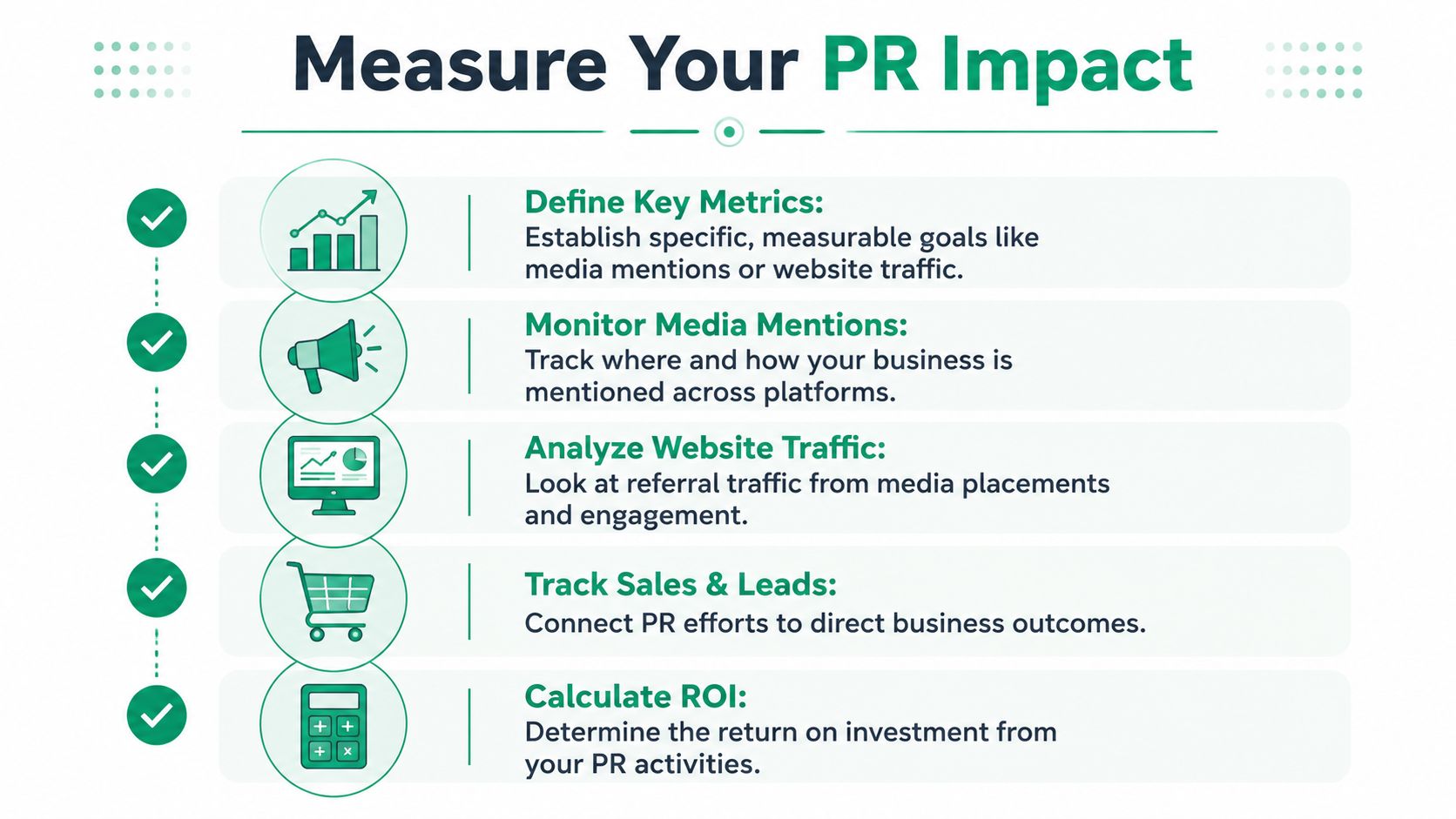
If PR can't be measured against business movement, it gets cut when budgets tighten. That's why tracking must connect earned attention to actions your company cares about.
Vanity metrics don't help much on their own. A mention, a share, or a spike in impressions might feel good, but they don't tell you whether PR influenced demand. Small businesses need a lighter system and a stricter one. Fewer metrics. Better metrics.
Track the chain from placement to outcome
Start with basic attribution. Use campaign links when possible. Create dedicated landing pages for major PR pushes. Watch referral traffic in analytics after a story goes live. Ask leads how they heard about you, and don't bury that field in your form setup.
A practical scorecard can include:
- Referral traffic from earned placements
- Branded search lift after coverage
- Contact form submissions from PR landing pages
- Demo requests or purchases during the coverage window
- Sales team feedback on lead quality
- Assisted conversions from visitors who first arrived through media
For teams that want a structured ROI model, the RPIE framework paired with SMART goals has been linked to stronger results. A 2023 PRNEWS.io analysis cited by Crowdspring's small business PR guide reports 300% ROI on average for small businesses following a structured RPIE process, compared with 120% ROI for ad-hoc strategies. The same source notes a 5 to 7 business day follow-up window captures 35% more responses than immediate follow-ups, and that disciplined tracking of journalist interests and recent articles improves response rates.
Use low-cost tactics that can still produce coverage
Cheap PR isn't the same as sloppy PR. Some of the most effective moves cost more time than money.
For small businesses, reaching out to social media influencers for joint giveaways or product reviews is a proven low-cost PR tactic. That can be paired with joining Twitter conversations and answering Quora questions to build awareness across channels, according to CIO's roundup of low-cost PR strategies.
Here's how I'd rank common low-cost tactics by effort versus likely payoff:
-
Influencer collaboration
Moderate effort. Good fit when your product is visual, demonstrable, or giftable. -
Expert commentary on social platforms
Low cost, steady return. Works well when a founder can explain trends clearly without sounding promotional. -
Quora answers and community participation
Slower payoff, but useful for credibility and long-tail visibility if answers are specific. -
Local partnerships
Strong for service businesses. Co-host an event, support a cause, or share an audience with a non-competing business. -
Owned-channel follow-up
Most impactful because it multiplies whatever attention you already earned.
Keep the system lean enough to maintain
The main problem with measurement isn't lack of tools. It's overcomplication.
Use a simple dashboard. Review it on a schedule. Tie placements to traffic, leads, and reputation signals. If your business also needs to monitor how coverage affects reviews, search perception, and trust over time, a guide to the benefits of online reputation management fits naturally into the same reporting process.
For execution support, even basic scheduling tools can reduce friction when you're promoting placements across channels. A resource like free social media tools for X creators is useful when you want consistent follow-up without adding software sprawl.
Ascendly Marketing helps small and mid-sized businesses connect PR, SEO, content, outreach, and lead generation into one measurable growth system. If you want public relations tied to traffic, qualified leads, and sales, not just mentions, you can start the conversation with Ascendly Marketing.