

A data-filled report does not typically engage an audience. A customer’s positive outcome can be transformed into a compelling story through case study marketing. This method demonstrates a product’s effectiveness with verifiable proof.
This process involves creating a narrative that builds trust and shows a potential buyer how a business solves specific problems.
What is Case Study Marketing and Why Does it Matter?
Consider yourself a director, where the protagonist is a satisfied customer. Case study marketing is the process of documenting how a client progressed from a challenge to a successful resolution using your product or service. The final product is a detailed story, supported by real data, that follows their entire journey.
The digital marketing space is projected to reach $786.2 billion by 2026, creating a competitive environment. Genuine connection is one way to gain attention. Case studies provide social proof that a business delivers on its promises. When people see others succeeding with a company, they are more likely to believe they can too.
The Impact of a Customer Success Story
An effective case study is a transformation story, not just a list of features and benefits. It follows a narrative structure that can make a solution appear necessary.
- The Relatable Hero: Your customer, who is experiencing a business problem that your target audience understands.
- The Overwhelming Challenge: The specific issues and frustrations that were part of their work before they found you.
- The Wise Guide: Your business, providing the solution that leads to success.
- The Decisive Victory: The measurable, bottom-line results the client achieved, such as increased revenue, better efficiency, or more engaged teams.
This storytelling framework presents your solution as a logical next step. When a prospect sees a similar company achieve positive results, it can create an emotional connection and a level of trust that advertising may not achieve.
Moving Beyond Simple Testimonials
A positive quote on a homepage offers initial validation, but a case study provides the detailed context and evidence that some buyers look for. It answers the “how” and “why” behind a customer’s success.
To understand its role, it is useful to compare case studies with other content types.
Case Study: Marketing vs Other Content Types
| Content Type | Primary Goal | Best For | Key Feature |
|---|---|---|---|
| Case Study | Build trust & prove value | Bottom-of-funnel decision-making | Story-driven with hard data |
| Blog Post | Educate & attract audience | Top-of-funnel awareness | Informational & SEO-focused |
| Testimonial | Provide quick social proof | Mid-funnel validation | Short, powerful customer quote |
| White Paper | Establish authority & generate leads | Mid-funnel consideration | In-depth, research-based analysis |
While other content types build awareness or offer quick validation, case studies are designed to support the final decision-making process. They provide the detailed information a prospect may need.
A testimonial states that a customer is happy. A case study shows why they are happy and demonstrates the value with concrete data, making it a tool for converting undecided buyers. This depth is what makes case study marketing effective. It directly addresses a prospect’s question: “Will this work for me?” By presenting a detailed story of a similar customer’s journey, you provide a clear answer. As you explore different ways to grow your business, consider the unique role case studies play alongside strategies outlined in these Market Edge B2B growth insights. The goal is to create a story so compelling that choosing your solution feels like a well-informed decision.
The Anatomy of a High-Converting Case Study
A case study can be more than a specification sheet. An effective one is a story that positions the prospect as the hero and shows a future where their problems are solved. This requires moving beyond a simple ‘Problem-Solution-Result’ formula and adopting a narrative approach.
Every piece of case study marketing can follow a classic five-act structure. It is a script designed to guide a reader from initial awareness to a decision point.
Think of it as producing your own “Customer Success Movie.”
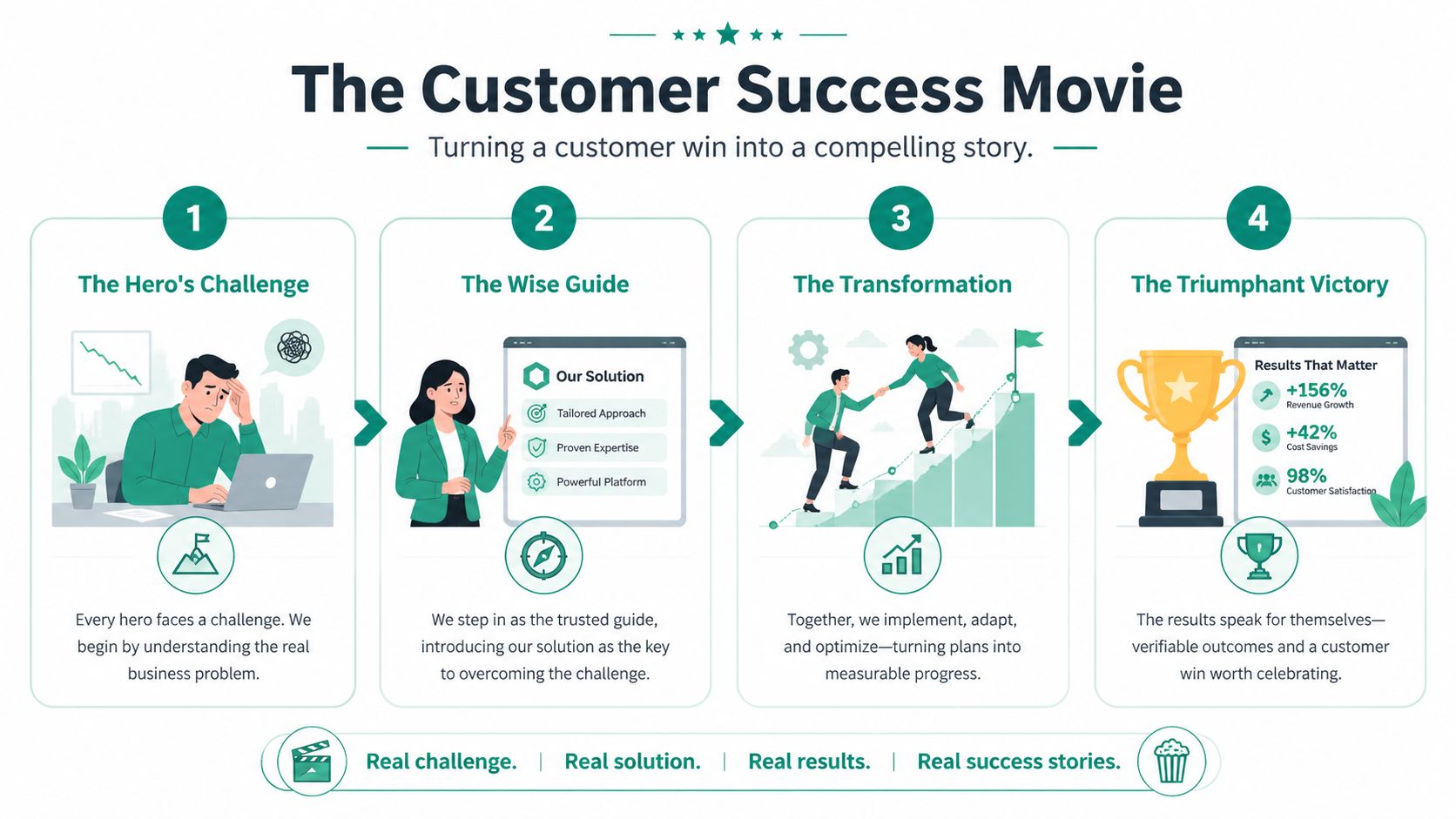
This infographic maps out the plot, from the initial conflict to the resolution. It is a straightforward blueprint for telling stories that are memorable.
The Hook
Every story needs a strong opening. Your title and first few sentences have one job: to engage the reader and make them want to know what happens next. A specific, impressive result is an effective way to achieve this.
- Vague: “A Software Company Increased Efficiency”
- Specific: “How [Client Name] Slashed Project Delays by 40% with [Your Company’s] Software”
The second example is a concise story. It provides a name, a specific number, and promises a valuable insight. It sets the stage for the rest of the narrative.
The Setup
Now, set the scene. This is where you introduce the hero of the story (your client) and the challenge they are facing (the problem). You should paint a ‘before’ picture so detailed that your ideal prospect can relate to it, perhaps thinking, “That’s us.”
Provide specific details. What were the day-to-day issues? What was the real cost of the problem? Letting the client speak for themselves is an effective way to do this.
“Before we started, our team was spending at least 10 hours a week on manual data entry. It was not only a drain on resources, but it was also leading to costly errors that affected our bottom line.”
A quote like that conveys a feeling, not just a fact. It makes the struggle tangible and sets up the introduction of the solution.
The Turning Point
This is where your brand enters the narrative. You are positioned as the guide or the tool that helps the protagonist. This part of the story explains how the client found you and what led them to realize you were the solution.
Did a colleague recommend you? Did they find one of your blog posts? Sharing their discovery moment helps prospects connect the dots in their own journey. You are transitioning the narrative from their problem to your solution.
The Journey
Now you show how the process works. The journey details the experience of working with you, from the beginning to the end. This is your opportunity to address any concerns a prospect might have about a difficult or complex implementation.
Be transparent and break down the steps:
- The Plan: Describe the initial onboarding, the kickoff meeting, and how you aligned with their goals.
- The Mission: Detail the key actions you took together. How was their team involved? Show your collaborative process.
- The Training Montage: Explain how you ensured your team was proficient with the new solution.
By providing this transparency, you build trust. You are demonstrating that you have a structured process to guide them, not just a product to sell.
The Payoff
This is the conclusion of the story. The hero is successful, and you can showcase the results. Use cold, hard numbers to prove your value. Charts, graphs, and bold statistics can make the success clear.
The metrics should directly relate to the problem introduced in the setup.
Focus on results that are meaningful to the business:
- Revenue growth.
- Cost savings.
- Productivity increases.
- New leads generated.
End with a powerful, undeniable statement. For instance, “This led to a 250% surge in qualified leads within just six months.” This is the final scene that leaves a lasting impression and encourages the audience to consider a similar journey for themselves.
Building Your Case Study Production Engine
A significant client win can be a great opportunity for a case study. However, without a system, these opportunities can be missed. Relying on sporadic efforts to create case studies is not an effective strategy. To see a real impact, you should stop treating each one as a separate project. The solution is to build a case study production engine, a system that turns the process of creating success stories into a regular, organized activity.
This approach separates professional marketers from amateurs. It involves a repeatable process that makes creating high-quality case studies a predictable and consistent part of your marketing efforts.
Securing Client Participation
Getting a client to agree to participate is often the first obstacle. Many marketers wait until a project is finished to ask. By then, the client may have moved on to other priorities, and the initial excitement has faded.
A more strategic approach is needed.
- Timing is Everything: The best time to ask is immediately after a major success, when the client is pleased with the results. This is the ideal moment. Send an email celebrating the achievement and suggest featuring their success.
- Bake It In: For new clients, you can include this in your service agreement from the start. A clause mentioning that you might request their participation in a success story after achieving certain goals sets the expectation early on. Around 40% of SaaS companies are now adding this directly into their contracts.
The effectiveness of this approach is supported by data. For three consecutive years, SaaS marketers have identified case studies as their top sales-boosting tactic, with 49% calling them ‘very effective’. This has led companies to produce an average of 14 new case studies a year, often using incentives to encourage client participation.
Assembling Your Case Study Production Kit
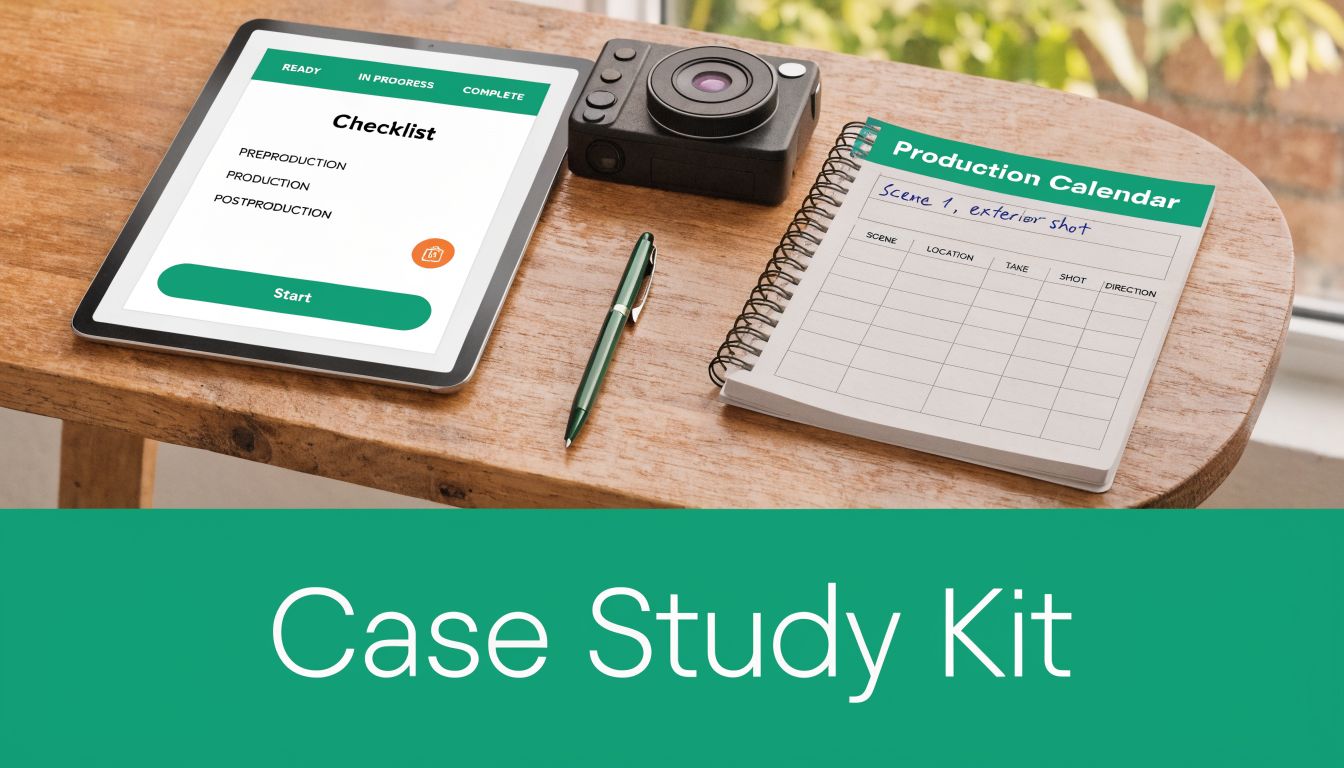
Imagine a digital toolkit filled with pre-approved quotes, logos, and data points from your most satisfied customers. This is a Case Study Kit, and it is a valuable asset for your marketing team. It eliminates the need for repeated approval requests for every social media post or sales document.
Think of it as a library of your successes. Here is what it should contain:
- Powerful Quotes: Select the best soundbites from interviews that highlight your value, from impressive results to praise for your customer service.
- Logos and Brand Assets: Obtain high-resolution logos and clear brand guidelines to ensure all materials look professional.
- Verified Data and Metrics: This is the core of your kit. Get official confirmation on the hard numbers: the percentage increase in traffic, the revenue growth, the hours saved.
- Headshots and Photos: A professional headshot of your client contact adds a human element and increases the story’s credibility.
By building a comprehensive Case Study Kit, you enable your sales and marketing teams to quickly create targeted materials like one-pagers for sales calls or social media graphics, without needing to go back to the client for permission each time.
Standardizing the Process with Templates
An efficient production engine relies on templates. When you standardize your outreach, interviews, and approval process, you reduce ambiguity and ensure every case study maintains a consistent level of quality. This is a key component when learning how to scale content marketing.
Here are the templates you need to create:
- Outreach Email Template: A polite, concise, and benefit-focused email to request participation. Frame it as an opportunity for them to gain brand exposure.
- Interview Questions Template: A structured list of questions that guides the client through the story: the initial challenge, the search for a solution, the implementation, and the results. Include prompts that encourage specific data and emotional quotes.
- Final Approval Checklist: Instead of sending a draft and asking for general feedback, provide a simple checklist. It should ask them to verify names, titles, quotes, and data, which simplifies the approval process.
You have invested time and effort into creating a compelling case study. The story is engaging, the data is solid, and the client is happy. Is the work finished?
No.
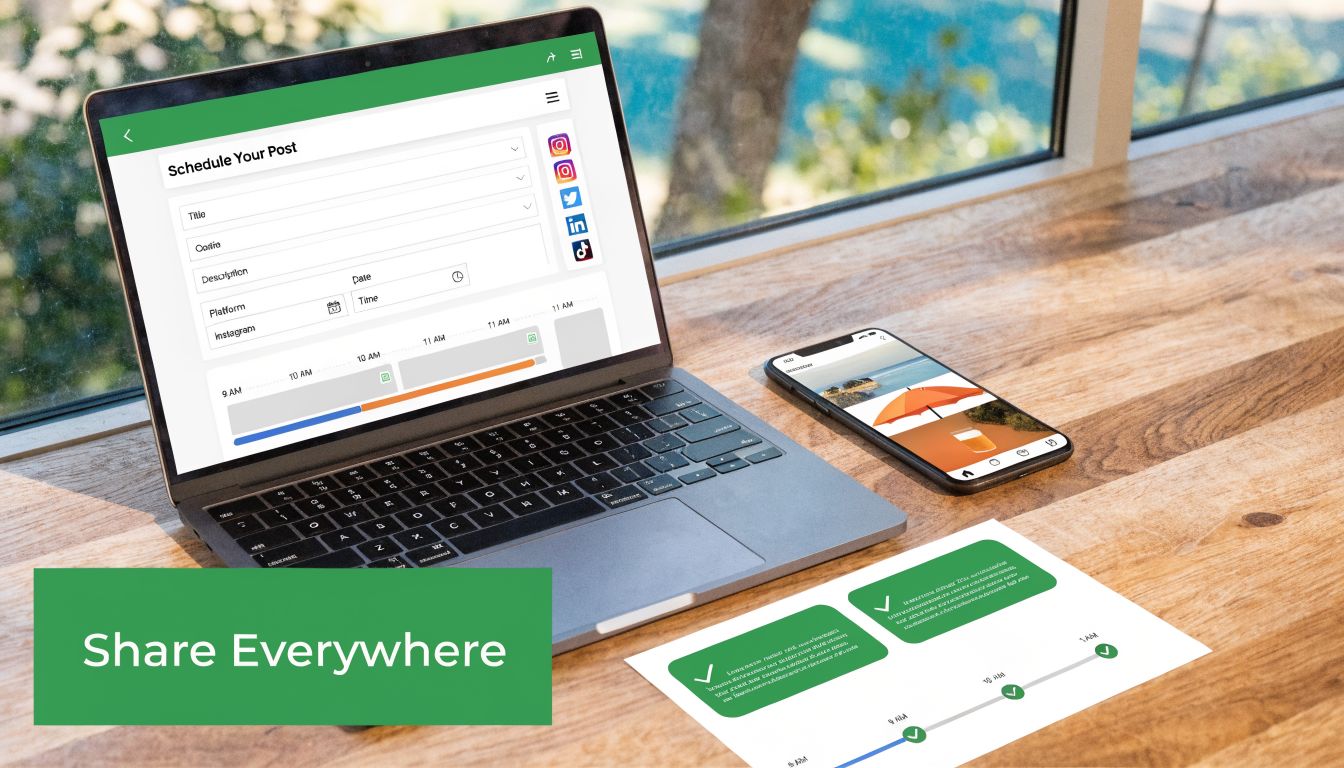
A brilliant case study that remains unseen has no value. The real impact occurs when it reaches the right audience. Think of your finished case study not as a final product, but as the fuel for a broader campaign. This is where one great story is turned into a powerful, multi-channel asset that works continuously for you.
Create a Dedicated Website Hub
Your website should serve as a library of your successes. A dedicated “Case Studies” or “Success Stories” section is a standard practice. It is the first place interested prospects will look to see if you can deliver on your claims.
Give each case study its own landing page. This is not just for organization; it is a smart SEO strategy. Optimize the page title and content with the client’s name, their industry, and the problem you solved. Think about what a potential customer would search for. Then, add schema markup to help search engines feature your story in rich results. The layout of these pages is also important. For more information, see our guide on how to design a business website that converts.
Finally, offer a well-designed PDF version for download. This benefits both parties. Your prospect gets a polished, shareable document, and you generate a lead. Simply place it behind a form to capture their contact information.
Atomize Your Story for Social Media
People do not typically read a 1,500-word document while scrolling through social media. You need to break your story into smaller, digestible pieces, a process known as “atomizing.”
LinkedIn: This is a B2B platform. Turn the case study into a carousel post. Slide 1: The problem. Slides 2-4: Your solution in action. Final slide: The results. Tag your client’s company page and any key individuals involved to increase reach.
Instagram & Facebook: Visuals are key here. Take the most powerful quote from your client and place it on a striking graphic. Or, create a short Reel or video that shows the before-and-after numbers with high-energy music. A 200% increase in leads can grab attention.
X (formerly Twitter): A well-constructed thread can tell a short, compelling story. Start with a hook about the client’s initial challenge, then reply to your own tweet with the steps you took, and finish with the results. Use relevant hashtags to join the conversation.
How much is this social media buzz worth? You can calculate your earned media value to assign a monetary value to the promotional power of shares and mentions.
Activate Your Sales and Email Channels
Your sales team will find case studies to be a valuable tool. A case study changes a sales pitch from “we can help you” to “here’s proof of how we helped someone like you.”
Equip your sales team with a slide deck version of the case study. This allows them to integrate the success story into their presentations, tailoring the narrative to a specific prospect’s pain points.
Email is a direct channel for telling this story. Do not just send a link. Create a short nurture sequence to build interest.
- Email 1: Tease the problem. “Ever feel like you’re shouting into the void? So did [Client Name]…”
- Email 2: Introduce the solution. “Here’s the ‘aha’ moment that changed everything for them.”
- Email 3: The big reveal. Share the results and link to the full story on your site.
This approach builds anticipation and makes your audience eager to see the outcome. You are not just sharing a document; you are nurturing leads and providing your sales team with the proof they need to close deals.
Real-World Examples of Winning Case Studies
Theory is useful, but seeing how professionals execute is more instructive. The best way to understand effective case study marketing is to observe brands that are succeeding with it. Let’s look at how real companies use sharp storytelling and hard data to turn customer wins into a primary sales tool.
We will analyze campaigns from major industry names, focusing on the specific techniques they use to create stories that capture attention and drive action. These examples can serve as a practical blueprint for applying the principles we have discussed to achieve measurable results.
HubSpot: The Master of Relatable Problems
HubSpot’s approach to case studies demonstrates a deep understanding of the customer. They know their audience of marketers and salespeople well, and it is evident in their content. They do not lead with product features; their stories begin with a problem so relatable that prospects often identify with it.
A typical HubSpot case study vividly describes the “before” state: the chaos of managing disconnected tools, the tediousness of manual tasks, and the uncertainty of lead generation. By using the customer’s own words, they create an immediate connection with anyone facing similar challenges.
This narrative structure positions the customer as the hero and their problem as the villain. HubSpot’s software is then presented not just as a product, but as the tool that helps the hero succeed. This makes the solution seem like a logical next step in the reader’s own career path. For a collection of well-executed client success stories, you can review these Sup Growth client results.
Slack: The Champion of Visual Proof
Slack’s case studies illustrate the principle that showing is more effective than telling. Their product is about improving team communication, a concept that can be difficult to convey with words alone. Slack addresses this by combining concise stories with a wealth of visual evidence and hard data.
You will rarely find a text-only case study from them. Instead, they provide a rich, multimedia experience that includes:
- Quote Graphics: They take the most powerful customer quotes and design them into shareable graphics suitable for social media.
- Data Visualization: Simple charts and large, bold numbers are used to highlight impressive metrics like a “25% reduction in meetings” or a “32% increase in productivity.”
- Screenshots and GIFs: They show the product in use within the customer’s story, making the benefits feel immediate and tangible.
This visual-first strategy makes their success stories easy to scan and highly persuasive. It creates a clear “before and after” picture that is quickly understood by the reader. If you are interested in how we apply similar principles for our clients, you can explore our own digital marketing agency case studies.
By focusing on the quantifiable impact, the best case studies transform vague benefits into undeniable proof. They bridge the gap between a marketing claim and a business result.
The most effective marketing case studies deliver a clear, quantifiable return on investment. SEO leaders like Zappos and HubSpot have achieved over 100% growth in organic traffic. Viral successes like Dollar Shave Club, whose $4,500 video investment reportedly generated $9 million in revenue, show how creativity can produce a significant return. These are not isolated incidents. Top performers consistently showcase measurable outcomes—higher conversion rates, revenue growth, and strong ROAS—that connect every tactic directly to the bottom line.
Frequently Asked Questions About Case Study Marketing
Let’s address some practical questions. You may be convinced of the value of case studies, but now real-world concerns arise. What if a client declines to participate? What if their data is confidential? These are common challenges. Here are straightforward answers to the questions you may be considering.
How Do I Convince a Client to Participate?
The key is to frame it as a mutual opportunity, not a favor. You are not just asking for their help; you are offering them a platform. Highlight the free publicity they will receive on your website, social media, and possibly in your newsletter. Many clients are proud of the success they have achieved with your help and are willing to share their story.
When should you ask? The best time is right after they have achieved a major milestone or seen a significant result. Their enthusiasm is at its peak. A more proactive approach is to include a clause in new client contracts about co-creating a success story in the future.
What if My Client Has Sensitive Data?
This is a normal and frequent issue, especially in B2B or regulated industries. The solution involves trust, flexibility, and creativity. You do not need to disclose all their secrets to tell a compelling story.
Here are some ways to work around it:
- Use Percentages or Ranges: This is a very effective technique. Instead of saying, “sales increased by $500,000,” you can say, “revenue grew by over 150%.” This is just as impressive but protects their private financial information.
- Focus on Operational Metrics: Not all successes are financial. Highlight other improvements, such as “slashed project onboarding time by 40%” or “boosted team productivity by 25%.”
- Anonymize the Case Study: In some cases, you can create a “blind” case study. Refer to the client by their industry and size, for example, “A Mid-Sized Logistics Firm,” and focus entirely on the challenge, your solution, and the results.
The guiding principle is to always get the client’s final approval on any number you publish. Giving them the final say builds trust and makes them feel secure.
How Can I Create Case Studies on a Small Budget?
You do not need a large production budget to create effective case studies. Some of the most powerful ones are made with limited resources. All you truly need is a satisfied client and a good story.
Here is a simple process that works well:
- Conduct a Recorded Video Interview: Use a free tool like Google Meet or Zoom to have a conversation with your client. Record the call. This gives you authentic audio for quotes and video clips for social media.
- Write the Story Yourself: You have the raw material. Now, use the narrative structure we discussed—Hook, Setup, Turning Point, Journey, Payoff—to write the story in-house. You know the journey well.
- Use Simple Design Tools: You do not need to hire a design agency. A tool like Canva provides everything you need to create a clean, professional-looking PDF, eye-catching quote graphics, and simple charts.
Remember, the authenticity of the story and the impact of the results are what make a case study effective. A genuine testimonial in a simple document is more persuasive than a slick but soulless production.
How Do I Measure the ROI of a Case Study?
Measuring the ROI of a single piece of content can seem difficult, but it is achievable with a strategic approach. How do you prove it’s working?
The most direct way to measure ROI is to use your case study as a lead-generation tool. Gate the downloadable PDF version behind a form on a dedicated landing page. Every lead captured from that form can be tracked, and if those leads convert into customers, you can attribute that revenue directly back to your case study.
You can also look at “assists.” Track how many times your sales team shares the case study with prospects in your CRM and see if deals that involve the case study have a higher close rate. On your website, check the page views and time on page for your case study landing pages. These numbers provide a clear picture of how your case study is engaging prospects and contributing to sales.
Ready to turn your client wins into your most powerful sales tool? The team at Ascendly Marketing specializes in crafting compelling success stories that build trust and drive conversions. Discover how our strategic approach can accelerate your growth.