

TL;DR:
- Proper local SEO requires consistent NAP data and complete Google Business Profile optimization.
- Ongoing engagement like reviews, local content, and citation management is essential for long-term success.
- Continuous measurement and adaptation are critical to maintaining and improving local search rankings.
Picture this: a potential customer two blocks away pulls out their phone and searches “plumber near me” or “best coffee shop in Dallas.” Your business exists. You serve that exact area. But you don’t show up. They click on a competitor instead, and you never even knew the opportunity existed. This is the quiet cost of poor local SEO (search engine optimization, the practice of improving how your business appears in online search results). This guide walks you through every practical step to fix that, from getting your information to tracking real results.
Table of Contents
- What you need before optimizing for local SEO
- Step-by-step: How to optimize for local SEO
- Troubleshooting and common pitfalls in local SEO
- How to track and measure your local SEO results
- What most small businesses miss about local SEO
- Get expert help to maximize your local SEO
- Frequently asked questions
Key Takeaways
| Point | Details |
|---|---|
| Preparation matters | Gathering accurate business data and the right tools sets you up for local SEO success. |
| Take actionable steps | Claim listings, optimize content, and request reviews to boost local visibility. |
| Avoid common mistakes | Consistent, correct information everywhere prevents ranking drops and lost customers. |
| Measure your results | Tracking calls, views, and reviews lets you adjust tactics and improve over time. |
| Continuous effort wins | Ongoing updates and reputation management keep you ahead in local search. |
What you need before optimizing for local SEO
With the importance established, let’s lay out exactly what you’ll need to get started. Jumping into local SEO without the right information is like painting a house before fixing the foundation. You need accurate data first.
The most critical piece is your NAP: Your business Name, Address, and Phone number. These three details must be identical everywhere they appear online. Even small differences, like “St.” versus “Street” or an old phone number on an outdated directory, send conflicting signals to Google and hurt your rankings. Before improving your online visibility, gather your exact business name, address, phone number, and primary business category for accuracy.
Beyond NAP, you’ll want to prepare the following:
- Your business website URL
- Official business hours (including holiday hours)
- Primary and secondary business categories
- A short business description (under 750 characters)
- High-quality photos of your location, products, or team
- A list of the services or products you offer
Once your information is ready, you’ll need the right tools to put it to work. Here’s a quick overview:
| Tool | Purpose | Cost |
|---|---|---|
| Google Business Profile | Manage your primary local listing | Free |
| Google Search Console | Monitor search performance and indexing | Free |
| Google Analytics | Track website traffic and behavior | Free |
| Moz Local or BrightLocal | Manage citations across directories | Paid |
| ReviewTrackers or Podium | Monitor and request customer reviews | Paid |
| Semrush or Ahrefs | Research local keywords and competitors | Paid |
You don’t need every paid tool on day one. Start with the free options and add paid tools as your needs grow. The free Google tools alone will give you more insight than most small businesses ever use.
Pro Tip: Before anything else, search your business name on Google and make a list of every place it appears. You’re looking for inconsistencies in your NAP data. Even one mismatched listing can suppress your rankings across the board.
Using proven SEO strategies starts with this kind of groundwork. Solid preparation makes every step that follows faster and more effective.
Step-by-step: How to optimize for local SEO
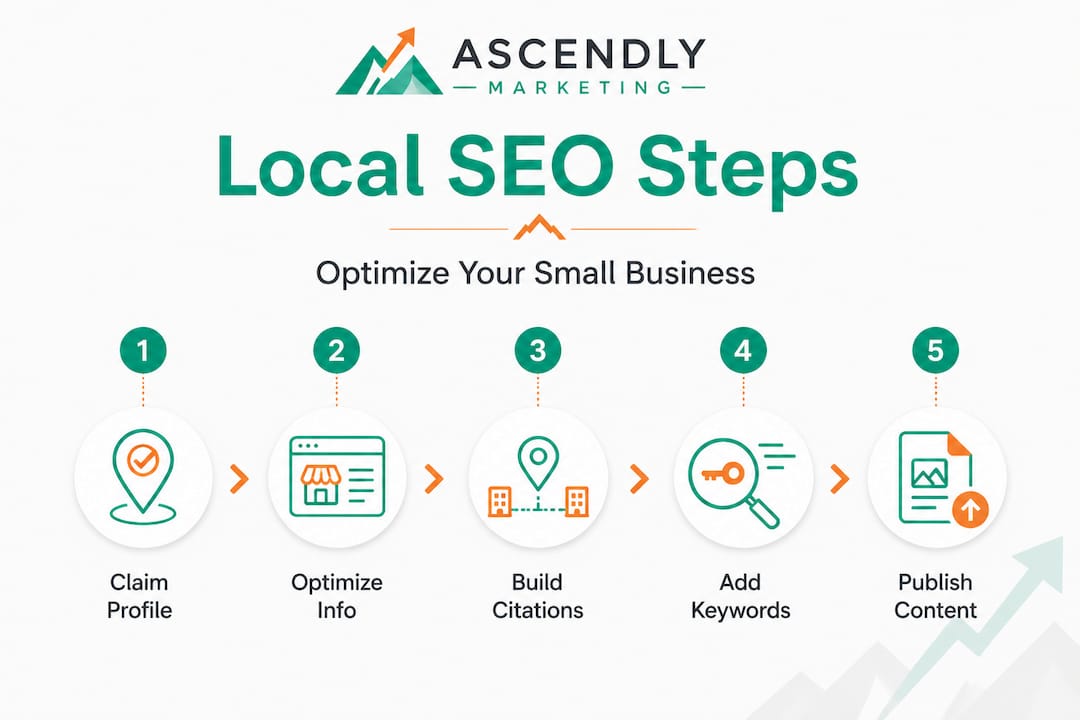
Once you’re ready, here’s how to actually execute your local SEO improvements effectively. Follow these steps in order. Each one builds on the last.
1. Claim and verify your Google Business Profile
This is step one for a reason. Your Google Business Profile (GBP) is the most visible piece of local real estate you own online. It controls what appears in Google Maps and the local “pack” (the three business listings that appear at the top of many local searches). Verify your Google Business Profile to take control of your most visible local listing. If you haven’t claimed it, go to business.google.com and follow the verification steps.
2. Fully optimize your profile
Claiming it is not enough. Fill out every single field. Upload photos (businesses with photos receive 42% more requests for directions and 35% more clicks to websites). Add your services, set your hours, write a keyword-rich description, and choose accurate primary and secondary categories. Google rewards complete profiles.
3. Build consistent citations
Citations are mentions of your business name, address, and phone number on other websites, directories, and platforms. Think Yelp, Bing Places, Apple Maps, Facebook, and industry-specific directories. Optimizing with consistent citations and structured data (markup code that helps search engines understand your business details) signals to Google that your business information is reliable.

4. Research and use local keywords
Local keywords are search phrases that include geographic signals. Instead of targeting “hair salon,” you target “hair salon in Austin, TX” or “natural hair salon near South Congress.” Use Google’s autocomplete, the “People also ask” section, and tools like Semrush to find what your customers actually type. Place these keywords naturally in your website’s title tags, page descriptions, and service pages.
5. Create locally relevant content
Write blog posts, service pages, or FAQ content that speaks directly to your community. A roofing company in Phoenix might publish “How the Arizona monsoon season damages flat roofs.” This kind of content attracts local searchers who are close to making a purchase decision. Linking to practical SEO examples from competitors or case studies in your market can sharpen your content strategy significantly.
6. Actively request and manage reviews
Reviews are a major ranking factor. After completing a job or sale, send a follow-up text or email with a direct link to your Google review page. Make it easy. Keep the request short. Most customers who had a great experience are happy to leave a review if you simply ask them.
“Businesses with a steady stream of authentic, recent reviews consistently outperform competitors in local map rankings. Volume matters, but recency and authenticity matter even more.” — Local SEO industry consensus
Here’s a comparison of free versus paid tools to help you decide where to invest:
| Task | Free tool | Paid tool |
|---|---|---|
| Google Business Profile management | Google Business Profile | BrightLocal |
| Citation building | Manually submit to directories | Moz Local, Yext |
| Review monitoring | Google alerts, GBP dashboard | ReviewTrackers, Podium |
| Keyword research | Google Search Console | Semrush, Ahrefs |
| Rank tracking | Google Search Console | BrightLocal, Semrush |
Pro Tip: When asking for reviews, make it specific. Instead of “please leave us a review,” try “if you were happy with your service today, we’d really appreciate a quick Google review. It helps other local families find us.” Specific asks get far more responses.
Managing your local search reputation through consistent review growth is one of the highest-return activities in local SEO, and it costs nothing but a few minutes of follow-up.
Troubleshooting and common pitfalls in local SEO
Even great execution can hit snags, so it’s vital to recognize and fix the most common local SEO errors. Here are the mistakes we see most often, and exactly how to fix them.
Listing mismatches across directories
If your address says “Suite 200” on your website but “Ste. 200” on Yelp and nothing on Bing, search engines lose confidence in your information. Inconsistent business information across websites can damage both trust and search rankings. Fix: Do a full citation audit using a tool like BrightLocal or Moz Local, then manually correct any discrepancies.
Weak or absent reviews
A profile with three reviews from 2021 signals neglect. Google rewards businesses that consistently collect fresh reviews. Fix: Set up a simple system to request reviews after every completed transaction. Even two or three new reviews per month add up fast over a year.
No local links
Links from other local websites, like a chamber of commerce page, a local news feature, or a neighborhood blog, tell Google your business is genuinely embedded in the community. Most small businesses skip this entirely. Fix: Sponsor a local event, partner with a complementary business, or submit your business to local business association directories.
Keyword stuffing
Some business owners, trying to rank for everything, stuff their GBP description or website content with repetitive keyword phrases. “Best plumber Dallas, Dallas plumber, plumber in Dallas” repeated four times in one paragraph is a red flag. Google’s algorithm is sophisticated enough to recognize this and may penalize you. Fix: Write naturally for your human readers, not for the algorithm.
Ignoring your own reputation management strategies
Negative reviews left unanswered tell future customers that you don’t care. Fix: Respond to every review, positive and negative, professionally and promptly. A thoughtful response to a negative review actually builds trust.
Warning: Never buy fake reviews. Google actively detects and removes them, and businesses caught doing this face profile suspension. The short-term gain is never worth the long-term damage to your visibility and credibility.
Pro Tip: Put a recurring reminder on your calendar every six months to audit your local listings. Business hours change, phone numbers change, and your information can drift out of sync without you noticing.
How to track and measure your local SEO results
After optimizing your presence, you need a way to verify that your efforts are making a real difference. Tracking results is not just about knowing your ranking. It’s about understanding what’s actually driving customers to contact you.
Here are the key metrics you should monitor:
- Profile views: How many people saw your Google Business Profile in search or maps
- Direction requests: How often someone asked Google Maps for directions to your location
- Phone calls: Direct calls initiated from your GBP listing
- Website clicks: Clicks from your GBP to your website
- Review growth: New reviews added per month, and your average star rating over time
- Keyword rankings: Where you appear in local search results for your target terms
Tracking your GBP insights, organic rankings, and call clicks reveals the real impact of your local SEO efforts. Here’s how those metrics map to tools:
| Metric | Where to track it |
|---|---|
| Profile views and interactions | Google Business Profile Insights |
| Website traffic from local search | Google Analytics (organic channel) |
| Keyword rankings | Google Search Console, Semrush |
| Review volume and rating | GBP dashboard, ReviewTrackers |
| Citation consistency score | BrightLocal, Moz Local |
| Direction requests | Google Business Profile Insights |
Looking at these numbers in isolation tells you very little. The real value is in spotting trends over time. Is your call volume growing month over month? Are profile views up after you added new photos or a fresh post? That cause-and-effect relationship is where your learning happens.
Strong SEO performance strategies always include a measurement loop. You optimize, measure, adjust, and optimize again. Skipping measurement is skipping half the work.
Pro Tip: Create a simple monthly tracking spreadsheet with columns for each metric. Fill it in on the same day each month. After three to four months, you’ll start seeing patterns that tell you exactly where to focus your energy.
What most small businesses miss about local SEO
Understanding measurement opens the door to a deeper truth about local SEO that most guides won’t tell you directly: setup is not the finish line. It’s the starting block.
We’ve worked with hundreds of small and medium-sized businesses, and the single most common mistake is treating local SEO as a one-time project. A business owner spends a weekend claiming their GBP, fixing their citations, and optimizing their website. Then they walk away, expecting the work to hold indefinitely. Six months later, they wonder why a competitor that launched a year after them is now outranking them.
Local SEO is a competitive, living system. Your competitors are not standing still. New businesses enter your market. Google updates how it ranks local results. Customer search behavior shifts. A sudden surge of reviews from a competitor can move them above you in the local pack even if your profile is technically more complete.
What separates businesses that win in the long term is ongoing engagement, not just initial setup. That means publishing new local content regularly. It means responding to every review within 24 hours. It means checking your GBP for new Q&A submissions (real customers ask questions there, and unanswered questions hurt conversions). It means building one or two new local links every month.
Our agency case studies consistently show that businesses that treat local SEO as a monthly maintenance task outperform those who treat it as a quarterly project, every single time. The compounding effect of consistent effort is real and measurable.
The mindset shift is simple but powerful: stop thinking “how do I set this up?” and start thinking “how do I stay ahead?” Local SEO rewards the businesses that stay in the game, not just the ones that start it.
Get expert help to maximize your local SEO
Knowing the steps is one thing. Executing them consistently, while running a business, is another challenge entirely. Many business owners find that partnering with an experienced team is what turns a good local SEO plan into real revenue growth.

Ascendly Marketing has been helping small and medium-sized businesses grow their local visibility since 2013. Our team of SEO specialists, content creators, and digital strategists builds tailored local SEO programs that go far beyond basic setup. From citation audits and GBP optimization to local content strategies and review management, our digital marketing services are built around results you can measure. If you’re ready to build a small business strategy that actually drives foot traffic, calls, and leads, let’s talk.
Frequently Asked Questions
How long does it take to see results from local SEO?
Most businesses start seeing noticeable improvement in local search visibility within 30 to 90 days of consistent effort, with stronger gains building over three to six months.
Is Google Business Profile really necessary for local SEO?
Yes, verifying your GBP is critical for ranking in map results and controlling how your business appears in local searches.
What should I do if my business has multiple locations?
Create and verify a separate, fully optimized Google Business Profile for each location to give each one the best chance of ranking in its specific local area.
How important are online reviews for local SEO?
Authentic reviews are a significant ranking factor, and inconsistent or weak reputation signals can suppress your rankings even when everything else is in order.
Can local SEO help service-based businesses without a storefront?
Absolutely. Service-area businesses can rank locally by accurately defining their service zones in their Google Business Profile and consistently producing location-specific content on their website.