

Lead generation for a small business is the process that turns strangers into customers and fuels growth. This is not about collecting email addresses. It is about finding the right people who are interested in what you do.
First Things First: Build a Foundation
Returning from a trade show with a stack of business cards that do not turn into business is a common scenario. Businesses can get caught up in chasing a high number of leads and forget to ask if they are the right leads.
Sustainable growth comes from quality, not just quantity. Before spending on ads or writing a blog post, you have to lay the groundwork. This means defining who you are trying to attract. It is the difference between casting a giant net and using a finely tuned rod and reel.
Who is Your Customer?
You need to know your Ideal Customer Profile (ICP). This involves more than basic demographics. You need to create a picture of the person or company that gets the most value from what you sell.
- Selling to other businesses (B2B)? Consider their industry, company size, and the job titles of the people who make buying decisions. What are their professional frustrations? What problems can you solve for them?
- Selling directly to consumers (B2C)? Examine their lifestyle. What are their hobbies, buying habits, and pain points? Where do they spend time online, and who influences their choices?
This profile guides every marketing decision, from the words on your website to the ads you run. Creating a vivid profile stops you from directing marketing dollars at people who were never going to buy.
Connect Their Problems to Your Solutions
Once you have your ideal customer defined, the next step is to map their problems to your solutions. You are not just selling features; you are selling outcomes.
A local HVAC company does not just sell an air conditioner; it sells relief during a heatwave. A financial advisor does not just sell investment plans; they sell the security of a stable retirement.
This flow, from profiling your customer to setting your goals, is the core of a lead strategy.
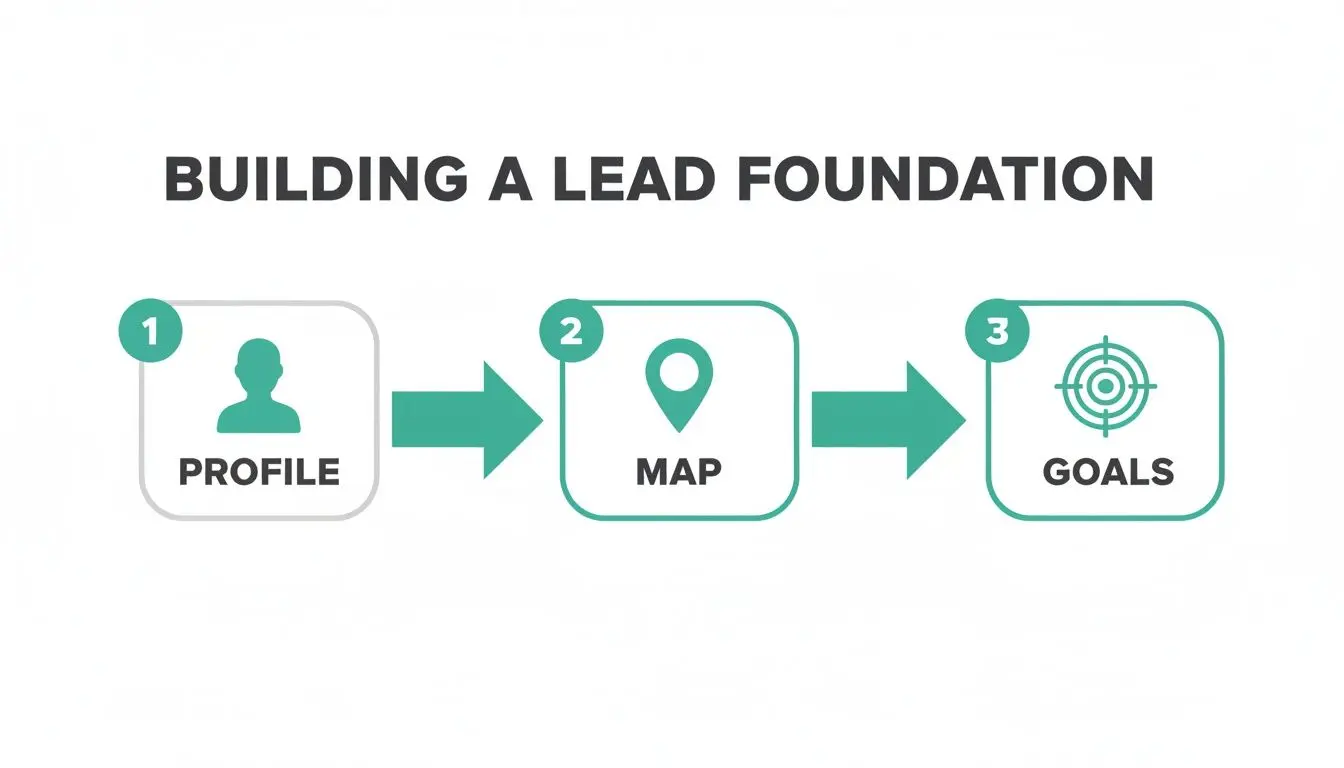
When your marketing speaks directly to a customer’s needs, it connects on a different level. A high percentage of marketers see lead generation as a primary goal. You must understand the trade-offs between pursuing every possible lead versus focusing only on the best ones.
Lead Quality vs. Lead Quantity
| Metric | High-Quality Lead Focus | High-Quantity Lead Focus |
|---|---|---|
| Sales Cycle | Shorter, more efficient | Longer, often with many dead-ends |
| Conversion Rate | Higher | Typically lower |
| Sales Team Effort | Focused on closing deals | Wasted on unqualified prospects |
| Cost Per Acquisition | Can be higher upfront, lower overall | Lower per-lead, but higher per-customer |
| Business Impact | Predictable revenue, high-value customers | Unpredictable pipeline, high customer churn |
While a flood of leads can feel productive, a focus on quality creates a more efficient and profitable sales process.
Set Measurable Goals
Connect this planning to business results. “More leads” is not a goal. A goal is something you can measure.
Start with your revenue target and work backward. For example, if your goal is 5 new customers this month and you know that 1 out of every 10 qualified leads typically buys from you, then you need to generate 50 high-quality leads.
This numbers-based goal turns marketing from a guessing game into a predictable system. A strong foundation also requires a website designed to capture and convert those leads. To ensure your site is ready for this task, you can explore this essential guide to small business website design for actionable tips.
Turn Your Website Into a Lead Generation Tool

Your website should be a tool that works 24/7 to bring in new business. Making that happen uses a combination of Search Engine Optimization (SEO) and content.
It starts with understanding your customer through keyword research. This is about using tools like Google Keyword Planner or Ahrefs to find the exact phrases your customers are typing into search engines when they are looking for a solution you provide.
When you identify your keywords, you are positioning yourself to be found at the moment a prospect is looking for help. This is the digital equivalent of being in the right place at the right time.
Creating Content That Connects and Converts
Once you know what people are searching for, you can give them the answers. Your content drives organic traffic and convinces visitors of your credibility. This is how you stop being just another website and start building a sustainable lead pipeline.
You need a mix of content. Here are a few types:
- Blog Posts: These answer specific questions. A roofer, for example, could write a post titled, “5 Signs of a Roof Leak (And What to Do Next)” to attract homeowners who are trying to diagnose a problem.
- In-Depth Guides: This is your chance to show your expertise. A software company could publish a guide on “How to Choose the Right Project Management Tool,” becoming a resource for anyone in the market.
- Targeted Landing Pages: These pages are designed for conversion. They have one job: to capture a lead. They are stripped of distractions and offer something valuable in exchange for an email address or phone number.
Do not just publish content and wait. Businesses that maintain a blog with fresh content can generate more leads than those who do not. Each piece you create is an asset that keeps working for you. The real task is to turn every piece of content into a growth opportunity.
Dominate Your Market with Local SEO
If your business serves a specific city or neighborhood, then local SEO is a useful tool. This is how you make sure your business appears when someone searches for “plumber near me” or “tacos in Austin.”
Your Google Business Profile (GBP) is the cornerstone of your local strategy. Optimizing this free listing can provide significant returns. Your Google Business Profile is a mini-website that lives directly on the search results page. It gives customers everything they need, such as your phone number, address, hours, and reviews, without them needing to click through to your site. It is a fast path from search to sale.
To optimize your GBP, check that every piece of information is accurate. Upload high-quality photos of your shop or your work. Make it a habit to ask satisfied customers to leave you a review. These reviews are trust signals for both Google and your future customers.
Getting traffic is only half the battle. You also have to make sure you improve website conversions to turn that attention into customers.
Generate Immediate Leads With Paid Advertising
While SEO and content are long-term investments, sometimes you need leads immediately. That is where Pay-Per-Click (PPC) advertising comes in. It is a fast way to get your business in front of people who are looking for a solution. You are paying for a shortcut to the top of Google or a spot in someone’s social media feed.
This is not about spending money without a plan. A PPC strategy targets keywords that indicate a user is ready to buy. Consider the difference between someone searching for “how to fix a leaky faucet” versus “emergency plumber near me.” You want to bid on the latter.
Structuring Campaigns for Impact
Getting PPC right starts with organization. On platforms like Google Ads, this means building a tightly structured campaign where everything is logically grouped. Imagine you are a home painter. You would not lump all your keywords together.
Instead, you would create separate ad groups for “interior painting services,” “exterior house painters,” and “cabinet refinishing.” This step lets you write specific ads that match what the person is searching for. The result is that your ads are more relevant, your Quality Score can go up, and Google may reward you with a lower cost per click. The point of your ad copy is to sell the click, not the entire service. Grab their attention, show them why you are the answer, and give them a clear call-to-action.
So they clicked. Where do you send them? If your answer is “my homepage,” you are probably wasting money.
Building High-Converting Landing Pages
Every paid ad needs a dedicated landing page. This page has one mission: to turn that visitor into a lead. That means removing all distractions like main navigation, footer links, or blog posts. There should be a single, focused path to conversion.
A landing page needs to address these four things:
- The Problem: Immediately connect with the visitor’s pain point.
- Your Solution: Position your service as the fix.
- The Proof: Show testimonials, case studies, or five-star reviews to build trust.
- The Action: A large button or a simple form that tells them exactly what to do next.
This focused experience separates campaigns that break even from those that become a reliable source of new business.
Smart Budgets and Re-Engaging Visitors
You do not need a massive budget to get started. Begin with a daily spend you are comfortable with and concentrate on a few of your most valuable, high-intent keywords. Once the data starts coming in, you can allocate more budget to what is working and cut what is not.
What about the people who click your ad but do not convert? Do not let them get away. That is what retargeting is for. By adding a small snippet of code to your site, you can show follow-up ads to these visitors as they browse the web or scroll through social media. It is your second chance to remind them why they were interested.
PPC is an active process, not a “set it and forget it” channel. It requires constant adjustments and testing. For a deeper dive into getting performance from your ads, check out this guide on PPC optimization tips for small business success.
Turn Your Social Feed into a Lead-Generating Tool
Social media is not just a digital billboard for your brand. It is a two-way street where conversations happen, and where you can find your next customer. The method for effective lead generation for small businesses on social media is not just broadcasting messages. It is about finding out where your ideal clients are online and creating content that stops their scroll and pulls them into your world.
Do not try to be everywhere at once. That leads to burnout. Nailing your strategy on one or two key platforms will beat a partial effort on five.
Find Your People: Picking the Right Platform
Where you operate depends on who you are trying to reach. A B2B consultant trying to connect with CEOs will not find them on TikTok. A local boutique will get more traction from a visual-first platform like Instagram than from LinkedIn.
- LinkedIn for B2B: This is your digital conference room. Do not just collect connections. Participate in industry-specific groups, join conversations, and share your perspective. A consultant, for instance, could share a short analysis of a new industry report, sparking discussions with potential clients in the comments.
- Facebook for Local Services: Facebook Groups are a resource for local businesses. If you are a home contractor, join a few community groups for the neighborhoods you serve. When someone asks a question about a leaky faucet, be the first to offer helpful advice. You will build trust and become the first person they call for a job.
- Instagram for Visual Brands: For anyone selling products or a lifestyle, Instagram is your platform. Use Reels to show your product in action, run polls in your Stories to see what customers want, and post photos that make people stop scrolling.
Once you have picked your platform, consistency is key. Showing up regularly with valuable content builds an audience that knows, likes, and trusts you. Trust is the foundation of any sale.
Don’t Just Post, Broadcast with Video
If you are going to bet on one format, make it video. Your text posts and pictures are good, but they can get lost. Video grabs attention.
A high percentage of video marketers say it is an effective tool for generating leads. Why? Because it forges a connection. Video lets you demonstrate your value, show your personality, and make a clear request in a way that plain text cannot. For a closer look at the data, you can find more insights about lead generation statistics.
The real impact of video is building trust at scale. When a potential customer sees your face and hears you explain how you can solve their problem, it feels personal. That connection is what turns a passive viewer into a lead. You do not need a professional film crew. Your smartphone and authenticity are all you need.
Real-World Video Ideas That Work
You do not need a large budget to create videos that get results. Some of the most effective content is raw, real, and filmed on a phone.
- Quick “How-To” Clips: Use TikTok or Instagram Reels and create a 30-second video that solves one specific problem for your audience. A chef could show a fast way to dice an onion. A marketing consultant could share one trick for writing an email subject line. End with a simple call to action, like “Want more? Download my free guide to 10-minute meals!”
- Live Q&A Sessions: Go live on Facebook or LinkedIn to host a Q&A on a topic your audience wants to know more about. To capture leads, promote a more in-depth webinar on the same topic and require registration. This will build an email list full of people who are interested in what you have to say.
- Demos and Success Stories: Show, do not just tell. Film a two-minute video walking through how your product or service works. Or, get a happy customer on camera to talk about their results. A software company could do a screen recording of its most useful feature, making its benefits clear.
Think of every video as a breadcrumb leading a viewer closer to becoming a customer. Make sure each one has a clear point and an obvious next step.
Nurturing Leads to the Sale
Let’s talk about what happens after you get a lead. Getting a lead is the starting gun. The race is turning that interest into a paying customer.
This is where many small businesses fail. A potential customer shows interest, and then there is no follow-up. Or, a hard-sell follow-up sends them away. The middle ground between “hello” and “here’s my credit card” is where lead nurturing happens. It is the art of staying on their radar by being helpful, so when they are ready to buy, you are the only name they consider.
Let Your Emails Do the Work
Imagine having a salesperson who works for you 24/7, sending the right message at the right time. That is an automated email sequence, or a “drip campaign.” This is not about annoying people. It is about guiding them from “Who is this?” to “I need this.”
An email sequence is your chance to educate, build trust, and guide prospects toward a sale. Let’s say someone downloads your free guide to home staging. A follow-up could look like this:
- Email 1 (Right away): Here is that guide you asked for. Thanks for your interest. I just wanted to make sure you got it.
- Email 2 (2 days later): Check out this before-and-after from a client who used the tips in the guide.
- Email 3 (4 days later): Many people ask us about paint colors. Here are 3 shades our designers are using right now.
- Email 4 (7 days later): Feeling inspired? If you are thinking about selling, I would be happy to offer a no-obligation consultation.
Every email adds value. You are being a helpful expert, not a pushy salesperson. To do this, you will want the right tools. There is marketing automation software for small businesses that makes setting this up straightforward.
Stop Shouting at a Crowd and Start Talking to a Person
What is the fastest way to get your emails deleted? Sending the same message to every single person on your list.
This is where email list segmentation is useful. It is a term for splitting your subscribers into smaller, more focused groups. When you do this, you can send messages that are so relevant, they feel personal.
You can segment your list in many ways:
- Their Origin: Did they sign up after downloading a B2B whitepaper or a B2C style guide? Their entry point is a clue about what they care about.
- Their Website Behavior: Someone who has visited your pricing page three times is more interested than someone who skimmed one blog post. Treat them differently.
- Their Demographics: For a B2B audience, this could be their industry or company size. For B2C, think location or what they have bought before.
A local landscaping business could have a “Lawn Care” segment and a “Patio” segment. The lawn care group gets tips on fertilizer schedules, while the patio group gets lookbooks for outdoor fire pits. It is a simple change that makes a difference in your open rates and conversions.
The Real Deal on Cold Email for B2B
For B2B businesses, you cannot always wait for leads to find you. Cold email is a way of proactively contacting your ideal clients. This is not about spammy, generic blasts. Modern cold email is a specific tool.
It starts with building a list of people you want to talk to. Do not buy a large, outdated list of contacts. Use a tool like LinkedIn Sales Navigator to pinpoint the decision-makers in the companies you want to work with. The secret to a cold email that gets a reply is to make it not feel cold. It needs to be so well-researched and specific that the person feels like you are talking directly to them and their problem.
A cold email has three core ingredients:
- The Personal Touch: Open with something that shows you have done your homework. “Saw your company just won an award for…” or “I liked your recent post on LinkedIn about…”
- The Pain Point: Get to the point. State a problem they likely have and how you can help solve it. Talk about their problem, not your product’s features.
- The Easy “Yes”: Do not ask for a 30-minute demo. That is a large commitment. Instead, go for a simple, low-friction question like, “Is solving this a priority for you right now?” It makes replying feel effortless.
By combining automated nurturing for the leads that come to you with personalized outreach for the ones you go after, you will have a system that keeps your pipeline full.
Measuring Your Results to Scale What Works
Let’s talk about where the results happen. Getting leads is one thing, but turning that activity into a predictable, money-making machine for your business is another. This is the part where you stop just doing marketing and start engineering growth.
Many business owners get focused on “vanity metrics.” These are social media likes, website traffic, and follower counts. They feel good, but they do not pay the bills. We are going to move past that and get down to the numbers that matter.
Moving Beyond Feel-Good Metrics
To build a system you can scale, you have to get comfortable with a few key numbers. These are the Key Performance Indicators (KPIs) that tell you the real story of what is working and what is wasting your time and money.
- Cost Per Lead (CPL): This is your marketing’s price tag. If you spend $500 on a Google Ads campaign and get 50 leads, your CPL is $10. Knowing this for every channel shows you where your dollars are working hardest.
- Conversion Rate: This number tells you how persuasive you are. If 1,000 people land on your “Request a Quote” page but only 50 fill it out, you have a 5% conversion rate. This is your most direct feedback on whether your message is effective.
- Customer Lifetime Value (CLV): This is the big-picture number. It is the total profit you can expect from a single customer over the entire time they do business with you. When you know your CLV, you might realize it is worth paying more to acquire a customer who will stick with you for years.
Knowing your numbers is a business advantage. When you can say, “For every dollar I put into Facebook Ads, I get three dollars back,” you are no longer guessing. You are running a growth engine.
Using Free Tools to Find the Answers
You do not need a large budget for analytics software to get these insights. Some of the best tools are free, and you just need to know how to use them.
Google Analytics 4 (GA4) is a useful tool. It shows you exactly how people find your website, which pages they stay on, and where they leave. Is your contact form buried at the bottom of a page that no one scrolls to? GA4 will highlight this. It helps you diagnose the weak spots in your funnel so you can fix them.
Simple Experiments Can Lead to Big Wins
So, you have used GA4 to find a leak in your sales funnel. What now? You experiment.
This is where A/B testing (or split testing) comes in. It is not as technical as it sounds. You just create two versions of something- a headline, a button, an email- and show version A to one half of your audience and version B to the other. Then you see which one gets more people to take action.
You can test almost anything to see what resonates:
- Headlines: “Affordable Roofing Services” vs. “The Last Roof You’ll Ever Need.”
- Calls-to-Action (CTAs): A “Submit” button vs. a “Get My Free Estimate!” button.
- Page Layouts: Is your phone number more effective at the top of the page or in the footer? Test it.
A simple button color change has been shown to increase leads. These small, data-backed tweaks remove guesswork and add up over time, ensuring every piece of your marketing is working to grow your business.
Answering Your Lead Gen Questions
Let’s tackle a few questions that often come up when talking with small business owners about getting more leads.
How Much Should A Small Business Spend On Lead Generation?
While there is no single answer, a general rule is to set aside 5-10% of your total revenue for marketing and lead generation.
If you are just starting and need to make an impact, you might lean toward the higher end of that range. It is important to see it as an investment, not a cost. Your goal is a positive return, so track your Cost Per Lead (CPL) to make sure every dollar you spend is coming back with more.
What Is The Difference Between A Lead And A Qualified Lead?
This is a key distinction. A lead is anyone who shows some interest; perhaps they downloaded a guide or liked a social post.
A qualified lead, on the other hand, is someone who has been vetted, either by their actions or by your team, and they match your ideal customer profile. They have the budget, the authority, and a real need for what you sell. Qualifying your leads separates the curious from the serious buyers. This lets your sales team focus their energy on conversations that turn into revenue, which makes everyone more effective.
How Long Does It Take To See Results From Lead Generation?
Patience is needed in marketing, but the timeline depends on your strategy.
Want leads now? Paid advertising, like a well-run Google Ads campaign, can have your phone ringing within hours of launch. You pay for that immediacy.
Playing the long game? SEO and content marketing are your path to sustainable, long-term growth. It often takes 3-6 months to see momentum build, but once it does, you get a steady stream of organic leads without paying for every click.
Ready to stop guessing and start growing with a predictable lead generation system? The team at Ascendly Marketing builds customized, results-driven strategies that attract more visitors and convert more customers. Discover how we can accelerate your revenue by scheduling a free consultation.