

You search your service on Google, and the same competitor keeps showing up in the map pack. Their profile looks complete. Yours exists, but calls are thin, directions requests are uneven, and one directory still shows an old number from a move you made months ago.
That’s usually where local citations building stops feeling like “SEO work” and starts looking like basic business operations. If your business details are wrong, scattered, or half-finished across the web, customers hesitate, and search platforms do too. A citation is a mention of your business information online, but the effect is bigger than the definition suggests. One listing can send trust signals. Another can create friction. A duplicate can split attention. An outdated profile can cost the lead before your website even gets a chance.
Most owners assume the competitor has some hidden tactic. Usually, they don’t. They’re just more consistent, more complete, and easier to verify across the directories and platforms that feed local search visibility.
Your Competitor isn’t Magic; They’re Just Consistent
A local searcher doesn’t see your backend effort. They see a name, a phone number, an address, business hours, photos, reviews, and whether everything lines up.
Say a customer needs a roofer, dentist, attorney, or HVAC company today. Google shows two businesses. One listing has matching contact details everywhere the customer checks. The other has a slightly different address on one site, an old tracking number on another, and a profile on a forgotten directory that still says “temporarily closed.” The customer clicks the cleaner option and moves on.
That’s the core job of local citations building. Not gaming the algorithm. Controlling your business information so search platforms and real people get the same answer every time.
What a citation actually does
A citation usually includes your business name, address, phone number, and sometimes your website. You’ll find them on Google Business Profile, Apple Maps, Yelp, Bing Places, Facebook, BBB, industry directories, local chamber sites, and news mentions.
Here’s why that matters. Local citations are a foundational ranking factor, and small businesses that keep at least 10 fully consistent citations tend to rank higher in local search than businesses with fewer or inconsistent listings, based on the reporting summarized in this local citations overview. That same source notes that data providers can push your business information into many other platforms, so one bad record can spread.
Practical rule: Your competitor often wins because their information is easier to confirm, not because their marketing is mysterious.
Why consistency beats clever tactics
The businesses that struggle with local visibility usually make ordinary mistakes.
- Old contact details stay live because nobody cleaned up older listings.
- Different formatting appears everywhere, such as “Suite” on one profile and “Ste.” on another.
- Profiles get claimed but not maintained, so they look abandoned.
- Directories are treated like busywork even though they shape map visibility.
If you want the broader picture of what influences map rankings beyond citations, Ascendly’s guide to local SEO ranking factors is a useful companion. Citations aren’t the whole system, but they’re one of the first places where trust breaks.
Most of the time, the fix isn’t dramatic. It’s disciplined.
Create Your Single Source of Truth
Before you touch a single listing, lock down your master business record. This is the file every future update will come from.

The rule is simple and strict. Your Name, Address, Phone number, and Website must be identical across every platform, and the working method is to store all core details in one master document and copy from it every time you create or correct a listing, as explained in Local Dominator’s citation best practices.
What goes in the master file
Keep this in a shared document your team can access. A spreadsheet works. A locked internal doc works too. What matters is that everyone uses the same version.
Include:
- Official business name exactly as you want it published
- Street address with one approved format, including suite or unit style
- Primary phone number that will be used everywhere
- Website URL in one canonical version
- Business hours including holiday process if you have one
- Primary category and secondary categories for directory forms
- Short business description for tight character limits
- Long business description for fuller profiles
- Email used for claiming listings
- Social profile URLs if directories request them
Small formatting choices matter more than people think. If your document says “Street,” don’t let a staff member type “St.” in half your submissions. If your site uses a call tracking number for campaigns, keep that separate from your citation record unless you have a clear local SEO setup that preserves consistency.
Build the file once and remove guesswork
Owners often skip this because it feels administrative. That’s a mistake. Without a single source of truth, every listing update becomes a memory test, and memory is where inconsistency starts.
I also recommend adding two operational fields:
- Proof assets such as a utility bill, business license, or storefront photo for verification requests
- Notes by platform so your team knows which directories have quirks, delays, or manual review steps
A clean master file saves time later because corrections become copy-and-paste work instead of detective work.
There’s also a technical side to geographic relevance that goes beyond directory accuracy. If you want a deeper read on how systems interpret place-based signals, Algomizer’s piece on strategies for geo search adds useful context.
The format must be boring
That’s the point. Don’t get creative with naming. Don’t rotate phone numbers. Don’t let different employees submit different versions.
Use one format. Save it. Protect it.
Audit Your Existing Digital Footprint
You can’t clean what you haven’t found. Start with discovery.
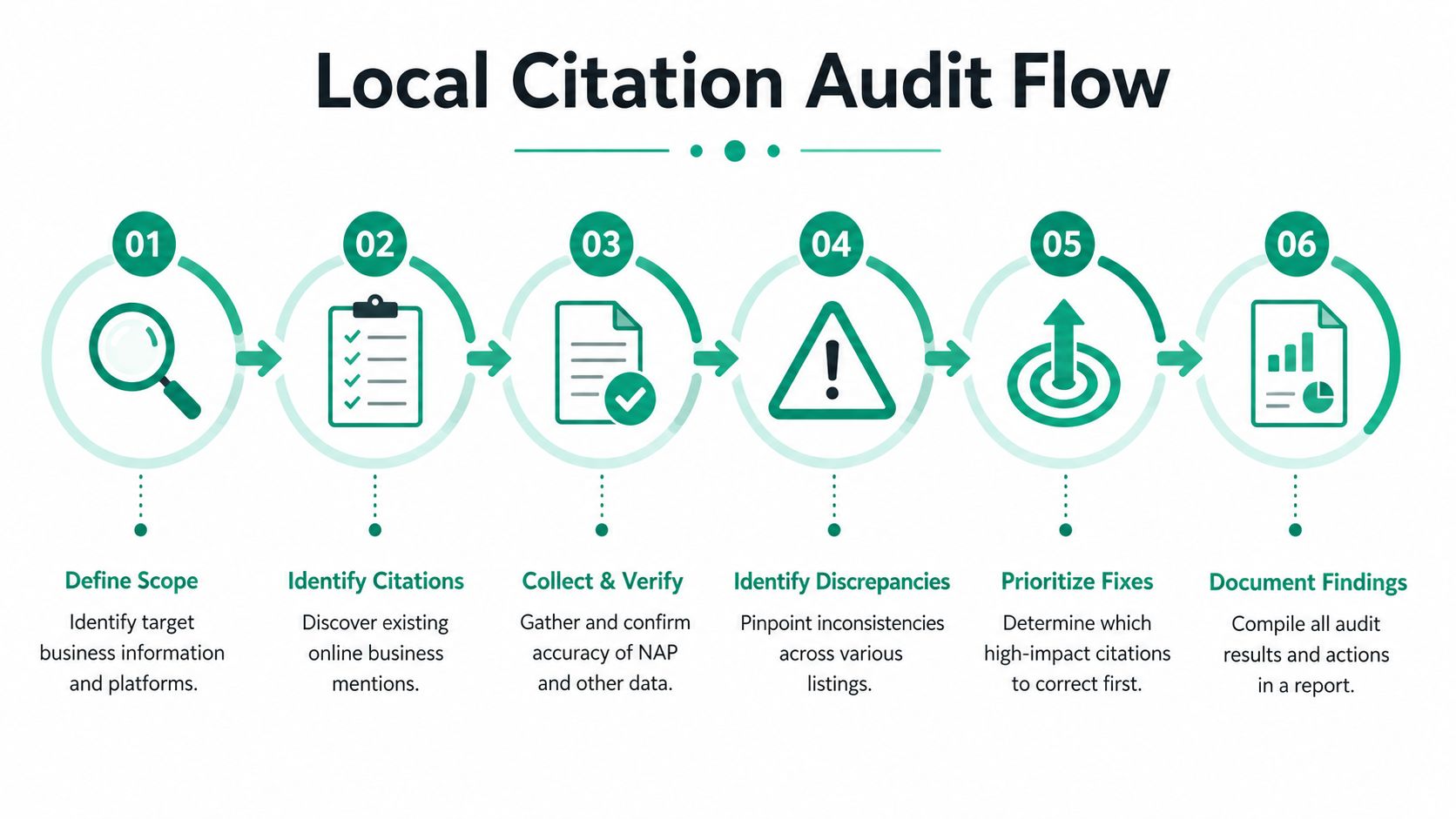
Most businesses already have more citations than they realize. Some were created by old agencies. Some were scraped by aggregators. Some came from social platforms, map apps, review sites, chamber memberships, or vendor directories you forgot about. The audit turns that sprawl into a list you can act on.
Start with the platforms that matter first
Claim the foundational listings before you chase long-tail directories. The core set usually includes Google Business Profile, Apple Maps, Bing Places, Facebook, Yelp, and BBB, then industry directories that customers in your category use. Ontoplist’s guidance also recommends a quarterly audit and notes that outreach from your business domain with proof of identity can reach 70 to 90% success rates when dealing with holdout platforms, as described in their local citation building post.
Use scanning tools to surface what exists. Moz Local, BrightLocal, and Semrush are common options for finding inconsistent listings, duplicates, and missing opportunities. You don’t need perfect software coverage. You need a working inventory.
What to look for in the audit report
Most audit reports create noise. Focus on three issue types.
Incorrect NAP or website data
This includes outdated phone numbers, old addresses, wrong URLs, or misspelled business names.Duplicate listings
These split reviews, confuse users, and create conflicting business data.Missing high-value citations
If competitors are present on major directories or niche platforms and you’re absent, that gap needs attention.
Don’t fix as you scan. Keep this stage analytical. Build a spreadsheet with columns for platform, issue type, claimed status, priority, and proof needed.
A simple sorting rule helps:
| Priority | What belongs here | Why it comes first |
|---|---|---|
| High | Google, Apple, Bing, Yelp, Facebook, BBB, major industry sites | These shape visibility and customer trust fastest |
| Medium | Strong regional directories and association listings | They reinforce relevance and fill gaps |
| Lower | Minor directories with little traffic or poor quality | Useful later, not first |
Use competitor gaps as a shortcut
Search for your top local competitors and note where they appear repeatedly. If several top-ranking businesses share the same directory sources, that pattern matters. It tells you which platforms the local ecosystem recognizes in your category.
Later, when review collection becomes part of profile quality, keep an eye on the process too. If you need a framework for handling legitimacy and trust around testimonials, this guide to 2026 best practices for verified reviews is worth reading.
After you’ve logged the problem set, add a second pass with manual searches for business name variants, old phone numbers, and former addresses. That’s often where hidden duplicates show up.
A short walkthrough helps if your team needs a visual process reference:
Field note: The audit is where most owners discover they don’t have a visibility problem. They have an accuracy problem.
Execute a Strategic Citation Building Plan
Once the audit is done, move from cleanup into structured expansion. With this, local citations building becomes a system instead of a pile of one-off tasks.
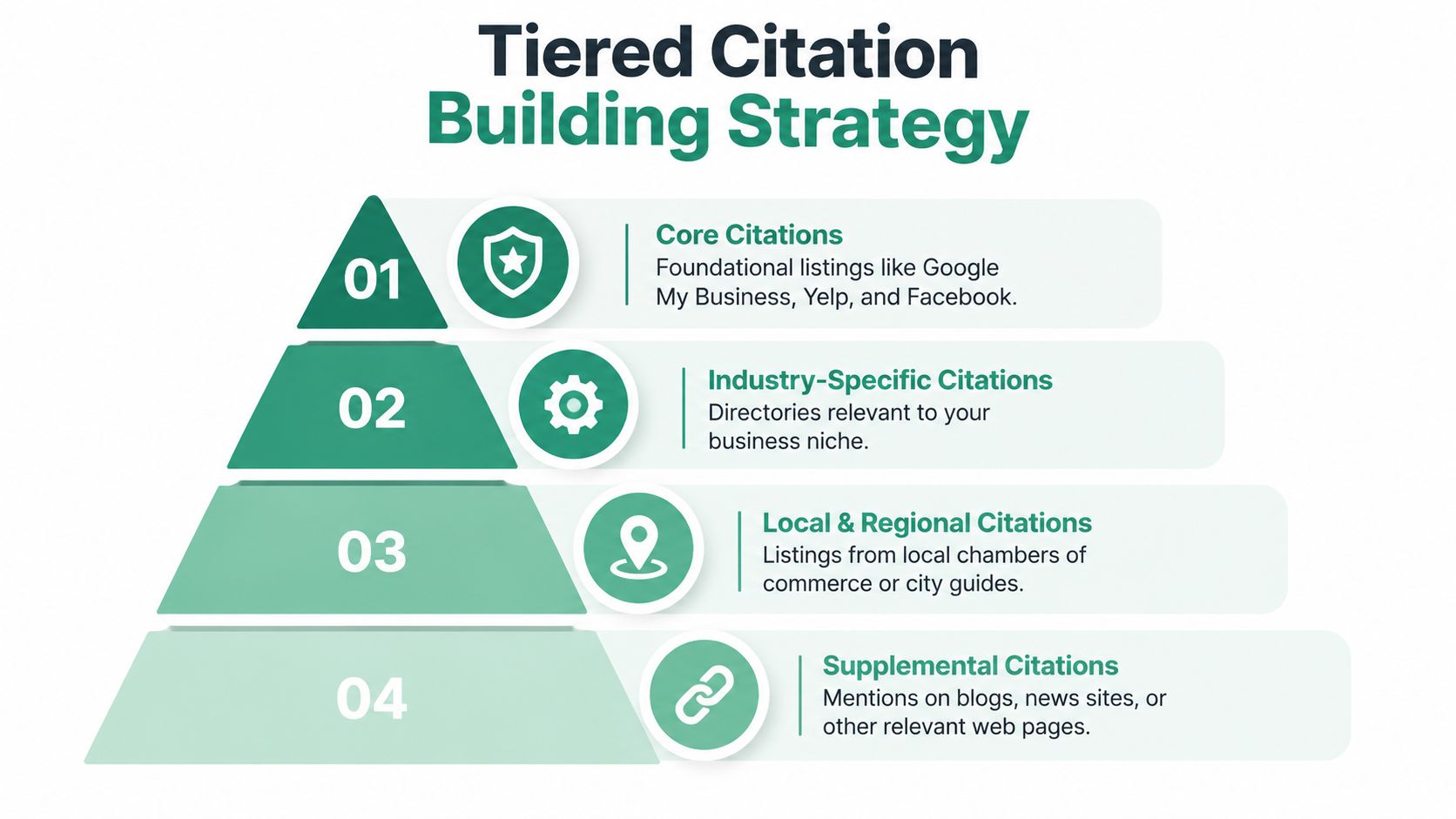
A practical plan has two parts. First, fix and claim the listings that carry the most weight. Second, add new citations in a steady rhythm that looks normal and is easy to maintain.
Build in tiers, not in random bursts
Structured citations and unstructured citations both matter, but structured listings form the base. Whitespark reports that businesses in the USA, Canada, UK, and Australia that complete listings on the top 50 citation sources by country rank 25 to 40% higher in local search than businesses with fewer than 20, according to their local citation guide.
That doesn’t mean you need every directory at once. It means you should prioritize in layers.
Tier 1 core listings
These are the platforms you manage manually because details, verification, categories, and media all need tight control.
- Google Business Profile
- Apple Maps
- Bing Places
- Yelp
- BBB
These profiles get your best data, full descriptions, business hours, photos, and direct monitoring.
Tier 2 broad directory coverage
This layer supports consistency across the web. Here, automation can help if the provider keeps data synchronized.
Examples include public directories, map ecosystems, and larger listing networks. If you’re comparing service vendors, this overview of local directory submission services gives a useful snapshot of how outsourced distribution is structured.
Tier 3 industry and local relevance
Within this domain, many businesses gain separation. Licensing boards, trade associations, local chambers, regional business indexes, and category-specific directories reinforce what your business does and where it operates.
Tier 4 unstructured mentions
These include local blogs, news stories, sponsorship pages, event listings, and partner pages. They don’t follow a rigid business-directory format, but they still strengthen local presence.
Pace matters more than volume
One common mistake is blasting dozens of listings in a week. A steadier approach works better. Jasmine Directory recommends building 5 to 10 quality listings per month rather than dumping 50 in a single week, while also recommending a hybrid model where Tier 1 directories are handled manually and lower tiers can be automated. Their guide also advises checking your top citations every 90 days and cleaning duplicates on high-traffic platforms first using tools like Moz Local, BrightLocal, or Semrush, as outlined in their citation management article.
That pacing keeps your team accurate. It also reduces sloppy submissions.
Manual versus managed tools
Use manual work where platform quality and profile completeness matter. Use software or a managed service where scale matters more than customization.
Here’s a simple comparison framework.
Comparison of Local Citation Building Tools
| Tool | Primary Function | Best For | Pricing Model |
|---|---|---|---|
| Moz Local | Listing distribution and monitoring | Businesses that want broad visibility and issue alerts | Subscription |
| BrightLocal | Citation tracking, audits, and cleanup workflows | Agencies and multi-location businesses | Subscription |
| Semrush | Listing management plus wider SEO workflows | Teams already using Semrush for search operations | Subscription |
| Whitespark | Citation discovery and local SEO support | Businesses prioritizing local SEO research and manual build support | Service and tool mix |
| Ascendly Marketing | Local citation building, cleanup, and management services | Businesses that want hands-on execution rather than software only | Service-based |
A strong build plan also has a simple order of operations.
- Claim and verify every Tier 1 profile
- Correct duplicates and wrong data on high-traffic platforms
- Expand into trusted directories that match your market
- Add niche citations your customers use
- Track completion status in the same sheet you used for the audit
If you want a directory-focused companion resource, Ascendly's article on directory listings SEO fits well alongside this process.
Don't chase every directory. Chase the right directories, in the right order, with the same data every time.
The Content-Rich Citation Advantage
Most citation advice stops too early. It tells you to get the listing live, make sure NAP matches, and move on.
That leaves a lot on the table.
A bare listing is a database entry. A content-rich listing becomes a sales asset. Photos, review responses, Q&A, services, categories, opening details, and business descriptions shape what the customer does next. They also affect how complete and useful the profile looks compared with nearby competitors.
Why basic NAP isn't enough anymore
Recent BrightLocal research for 2025 to 2026 reports that 73% of consumers decide based on listing depth such as photos and reviews, while only 12% of citation guides prioritize optimizing those elements after submission, according to the summary shared in this research discussion.
That gap is where small businesses can gain ground.
If two companies have equally consistent listings, the richer profile usually gets the click. Not because the address is more accurate, but because the profile answers questions before the prospect has to ask them.
What to add to your key citations
Start with the platforms that get real customer attention. Google Business Profile, Yelp, Facebook, Apple Maps, and the major industry directories should not look abandoned.
Add depth in layers:
- Current photos that show storefront, staff, vehicles, work samples, or office interior
- Review responses that prove someone is paying attention
- Q&A answers for recurring customer questions
- Service details so users can confirm fit quickly
- Updated hours and holiday changes so no one shows up to a locked door
A complete listing reduces hesitation. An incomplete one creates extra research work for the buyer.
Where this changes conversion, not just visibility
Think about how people use local results. They don't browse like they browse blogs. They compare quickly. They scan. They look for signs that the business is active, real, and easy to deal with.
That means your citation strategy should split into two jobs:
| Basic listing work | Content-rich listing work |
|---|---|
| Correct name, address, phone, website | Add photos, services, reviews, Q&A |
| Remove duplicates | Refresh media and business details |
| Claim ownership | Respond to customers |
| Match formatting | Improve first impression |
The trade-off is time. Richer profiles take more effort and more upkeep. But this is one of the few local SEO tasks that serves both the search platform and the buyer at the same time.
A listing that’s technically correct but visually empty doesn’t fail. It just underperforms.
Measure Impact and Maintain Momentum
Once your citation work is live, track the small set of signals that show whether it’s doing its job. Don’t drown in dashboards.
The business outcome is straightforward. If people can find accurate information fast, more of them will call, click, and visit. If they find conflicting information, many won’t bother. BrightLocal reported in 2023 that 68% of local consumers said they would not contact a business if its online information was inconsistent, and 72% of local searchers who visit a business after a local search do so within 24 hours, based on the reporting summarized in this citation analysis.
What to watch each month
Use one reporting sheet and keep it lean.
- Local keyword visibility for your core service terms in your target area
- Google Business Profile actions such as calls, website clicks, and direction requests
- Referral traffic from directories like Yelp or niche platforms
- Lead quality trends from map and directory sources
- Listing accuracy status across your top platforms
If rankings are flat but calls improve, that still matters. If visibility rises but wrong calls come in, your category or business description may need tightening.
Build a maintenance routine that survives busy weeks
Citation management fails when it depends on memory. Put it on the calendar.
A simple schedule works:
Monthly
Check your top profiles for public-facing errors, broken links, wrong hours, or missed review responses.Quarterly
Run a fuller citation scan and compare against your master record.Every 6 to 12 months
Do a deeper manual review for duplicates, stale regional listings, and platforms created by third parties. Whitespark’s guidance notes quarterly monitoring and manual reviews every 6 to 12 months, with ranking drops of up to 35% when duplicate listings and NAP issues aren’t corrected quickly, as covered earlier in their source.
One more thing. Track changes in the same file where you manage your listings. Date every correction. Note whether the platform was claimed, pending, merged, or suppressed. That log becomes your operating history.
If Google Maps visibility is the business goal, Ascendly’s guide on how to rank higher on Google Maps connects citation work to the broader map pack process.
If your listings are inconsistent, incomplete, or spread across too many platforms to manage cleanly, Ascendly Marketing can handle local citation building, cleanup, and ongoing management as part of a broader local SEO program.