

TL;DR:
- Most small businesses underestimate multi-channel marketing, missing daily lead opportunities across various platforms.
- Implementing coordinated presence on two or three key channels builds trust and resilience without needing enterprise resources.
Most small business owners assume multi-channel marketing belongs to big brands with massive budgets and large marketing teams. That assumption costs them leads every single day. Multi-channel marketing is the practice of reaching customers through multiple independent channels such as websites, social media, email, physical stores, and online marketplaces to maximize reach and visibility while allowing customers flexibility in interaction. You don’t need to be a Fortune 500 company to make it work. This guide breaks down what multi-channel marketing actually means, how it differs from similar strategies, and exactly how you can use it to grow your business.
Table of Contents
- What is multi-channel marketing?
- Multi-channel vs. omni-channel: Key differences
- Building your first multi-channel campaign: Step-by-step guide
- Common challenges and how to solve them
- Maximizing ROI with ongoing optimization
- Why do most SMBs overcomplicate multi-channel marketing
- Take your next step with expert help
- Frequently asked questions
Key Takeaways
| Point | Details |
|---|---|
| Flexible customer reach | Multi-channel marketing lets you connect with customers where they prefer, increasing your impact. |
| Start with simplicity | Begin with two or three well-chosen channels to avoid overwhelm and ensure message consistency. |
| Avoid common pitfalls | Watch out for spreading resources too thin and make sure each channel delivers a unified message. |
| Optimize for growth | Track results, tweak campaigns, and focus on channels delivering the best return for your business. |
What is multi-channel marketing?
Multi-channel marketing means showing up where your customers already are, whether that’s their email inbox, a Google search results page, your Instagram feed, or a product listing on Amazon. Instead of betting everything on one platform, you spread your presence across several touchpoints so more people discover you, and those who find you once keep seeing you again.
Think of it like fishing. One line in the water might catch something. A dozen lines, well-placed across different spots, dramatically improve your odds. The same logic applies to marketing channels.
Here’s a quick look at the most common channels businesses use:
- Website and SEO: Your home base. Drives organic search traffic and builds long-term credibility.
- Social media: Platforms like Facebook, Instagram, and LinkedIn for community building and brand awareness.
- Email marketing: Direct, personal, and extremely cost-effective for nurturing leads.
- Paid advertising (PPC): Google Ads, Meta Ads, and similar platforms for fast, targeted visibility.
- Online marketplaces: Amazon, Etsy, or industry-specific directories where buyers are already browsing.
- Physical channels: In-store promotions, direct mail, or event-based marketing for brick-and-mortar businesses.
“Multi-channel marketing is the practice of reaching customers through multiple independent channels such as websites, social media, email, physical stores, and online marketplaces to maximize reach and visibility while allowing customers flexibility in interaction.” — SPX Commerce
Why does this matter for your business? Customers rarely buy the first time they encounter a brand. Research consistently shows that buyers need multiple exposures before making a purchase decision. When you appear across multiple channels, you accelerate that familiarity and trust-building process.
For small to medium-sized businesses, a strong small business digital marketing strategy built on multiple channels creates resilience. If one channel underperforms or an algorithm changes, your business keeps generating leads through the others.
Multi-channel vs. omni-channel: Key differences
Now that we know what multi-channel marketing means, let’s see how it stacks up against omni-channel approaches. These two terms get used interchangeably, but they describe very different things.
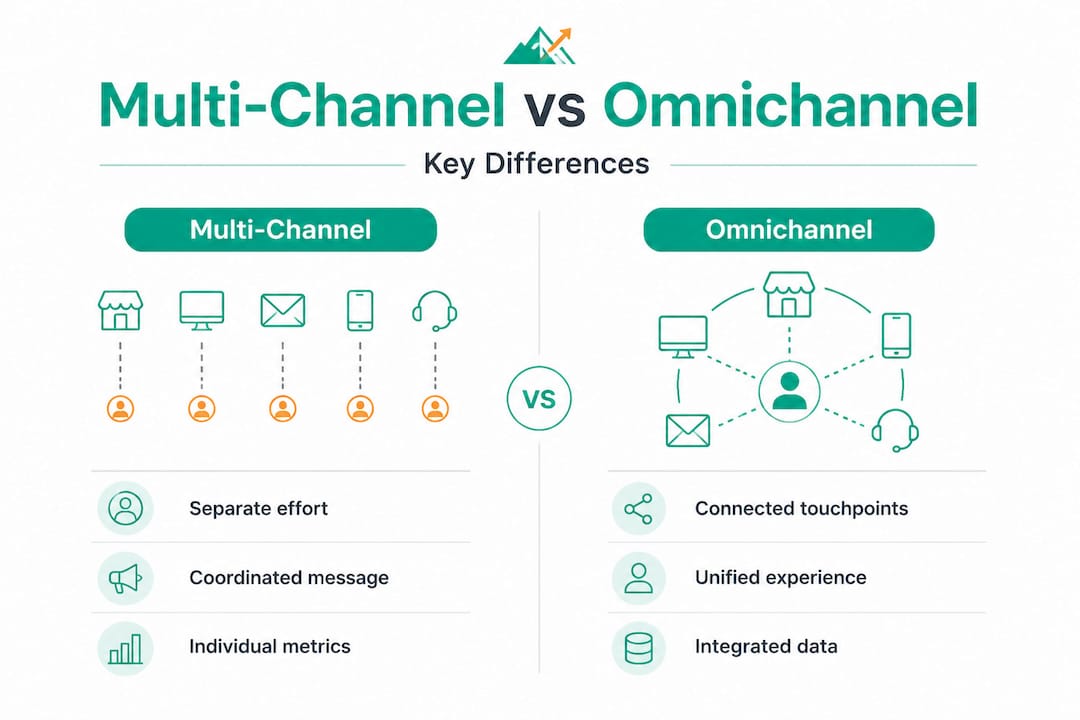
| Feature | Multi-channel | Omni-channel |
|---|---|---|
| Channel integration | Separate but coordinated | Fully connected and seamless |
| Customer experience | Consistent tone and message | Unified across every touchpoint |
| Data sharing | Often siloed per channel | Shared in real time |
| Complexity | Moderate | High |
| Best for | SMBs starting out | Larger businesses with more resources |
| Budget requirement | Low to moderate | Moderate to high |
In multi-channel marketing, each channel operates somewhat independently. Your email campaign has its own metrics. Your social ads run their own reporting. The messaging is aligned, but the data doesn’t always talk to each other automatically.
Omni-channel marketing takes it a step further. Every interaction a customer has, whether they browse your website, see a retargeted ad, walk into your store, or call your team, feeds into one unified experience. Their cart from your website follows them to your app. Their support history is visible when they call in. That level of integration requires technology and staffing that many SMBs simply don’t have yet.
For most small businesses, multi-channel is the right starting point. It gives you reach and visibility without demanding enterprise-level infrastructure. According to research, 42 to 55 percent of marketers struggle with data silos that hinder attribution, which is one of the most common pain points when scaling up.
One important thing to watch for: conflicting messages. If your Facebook ad promotes a 20% discount but your email list never hears about it, you create confusion and missed opportunity. Coordinating your messaging, even loosely, makes a huge difference.
Pro Tip: Start with multi-channel to build your presence across two or three key platforms. Once you have consistent processes and data flowing, you can layer in integration tools to move toward a more unified omni-channel experience. You can also use social media workflow strategies to keep your messaging organized across platforms without burning out your team.
Building your first multi-channel campaign: Step-by-step guide
Understanding the theory is just the start. Here’s how to begin your own multi-channel campaign without overcomplicating it.
Identify where your customers spend time. Look at your existing analytics. Which channel drives the most traffic or leads right now? Where do your best customers come from? Start there and add one adjacent channel that makes sense for your audience.
Define your campaign goal clearly. Are you trying to generate email sign-ups, drive product purchases, or increase service inquiries? Every channel in your campaign should serve that single goal. Campaigns that chase too many objectives at once tend to perform poorly everywhere.
Develop consistent but channel-appropriate messaging. Your core message stays the same. But the format changes. An Instagram post is visual and punchy. An email can be longer and more personal. A Google Ad is direct and keyword-driven. Write each piece of content for the platform it lives on, while keeping the offer and tone consistent.
Set measurable targets for each channel. Before you launch, decide what success looks like per channel. For email, maybe it’s a 25% open rate and a 3% click-through rate. For paid ads, maybe it’s a cost per lead under $15. Write these down before you start so you’re not guessing after the fact.
Track performance from day one. Use UTM parameters (tags you add to URLs that tell your analytics tool which channel a visitor came from) for every link in your campaign. This small habit saves enormous amounts of confusion later. Google Analytics 4 and most email platforms support this natively.
Review and adjust after two weeks. Multi-channel campaigns reveal insights quickly. One channel might outperform your expectations. Another might underdeliver. Shift your budget and attention toward what’s working.
Multi-channel marketing works best when execution is focused rather than scattered. For inspiration on what effective campaigns look like in practice, check out these social media campaign examples that show how coordinated storytelling drives real results.
Pro Tip: Launch with two channels you already understand. If you’ve been running email for a year and just started Instagram, use those two. Don’t add a third channel until you’ve proven results on the first two. Complexity is the enemy of execution at this stage.

Common challenges and how to solve them
Once you start, you’ll likely encounter some hurdles. Here’s how to overcome the most common ones before they derail your campaign.
The most frequent issues SMBs face:
- Data silos: Each channel reports separately, making it hard to see the full picture. You don’t know if the customer who clicked your email also saw your Facebook ad.
- Spreading too thin: Managing five channels simultaneously with a small team leads to poor-quality content everywhere. A mediocre presence on five channels performs worse than an excellent presence on two.
- Inconsistent messaging: Running a promotion on one channel but not mentioning it on others creates a disjointed customer experience. Worse, it makes your brand look disorganized.
- Attribution confusion: When a customer converts, which channel gets credit? 42 to 55 percent of marketers report that attribution issues directly impact their ability to make smart budget decisions.
| Challenge | Symptom | Fix |
|---|---|---|
| Data silos | Can’t trace leads to source | Use UTM tags and a centralized dashboard |
| Too many channels | Low-quality content | Limit to 2 to 3 channels until proven |
| Conflicting messages | Customer confusion | Create a simple messaging calendar |
| Attribution gaps | Unclear ROI per channel | Implement last-click or multi-touch attribution |
| Budget waste | High spend, low returns | Pause weakest channel, reinvest in best |
The fix for most of these challenges isn’t expensive software. It’s consistency and discipline. Create a simple content calendar that maps out what each channel says each week. Review performance monthly. Make small adjustments rather than massive overhauls.
Looking at real digital marketing case studies gives you a concrete picture of how businesses just like yours have navigated these exact problems and come out ahead. You can also look at how structured email drip campaign examples solve the consistency challenge by automating your messaging sequence so nothing falls through the cracks.
Maximizing ROI with ongoing optimization
After tackling challenges, you’re ready to make your campaigns more efficient and profitable over time.
Optimization isn’t a one-time event. It’s a habit. The businesses that get the most out of multi-channel marketing are the ones that treat every campaign as a learning opportunity, not a finished product.
Key performance indicators to track across channels:
- Leads per channel: Which channel generates the most qualified inquiries?
- Conversion rate per channel: Of the people who engage, how many take the desired action?
- Cost per lead: How much does it cost to acquire one lead from each channel?
- Customer lifetime value by channel: Do customers acquired through email spend more over time than those from paid ads?
- Engagement rate: Are people actually reading, clicking, and responding, or just scrolling past?
Start by reviewing these numbers every two weeks. Look for patterns. If your email consistently drives lower cost-per-lead than your paid ads, consider shifting budget toward list building. If social media drives volume but has poor conversion, test different calls to action or landing pages.
One of the fastest ways to improve ROI is to test creative variations. Change one element at a time, like the subject line in an email or the image in a Facebook ad, and measure the impact. This controlled testing approach, called A/B testing, gives you reliable data without guessing.
Multi-channel marketing is suitable for low-budget testing but scales poorly without integration, which is why building measurement habits early pays off later. For hands-on examples of how paid campaigns can be optimized for ROI, explore these PPC marketing examples that show the kind of iterative thinking that drives consistent improvement.
Why do most SMBs overcomplicate multi-channel marketing
Let’s step back and challenge some of the conventional wisdom that holds back so many smaller marketing teams.
Here’s what we’ve seen over and over again working with small and medium-sized businesses: they spend weeks evaluating marketing platforms, signing up for free trials, and building elaborate automation workflows before they’ve even confirmed that their core message resonates with anyone. They confuse activity with progress.
The uncomfortable truth is that most multi-channel campaigns fail not because of the wrong tool, but because of the wrong message. You can be on every platform on the internet and still generate zero leads if your offer isn’t clear or compelling. No software fixes a weak value proposition.
The most effective campaigns we’ve observed are almost boring in their simplicity. A clear offer. Two or three well-chosen channels. Consistent follow-up. Regular review. That’s it.
SMBs also tend to benchmark themselves against large enterprise brands, which is a fast way to feel inadequate and overspend. Enterprise brands run omni-channel programs with dedicated technology stacks because they have the volume and budget to justify it. You don’t need that. You need a focused digital marketing approach for SMBs that matches your actual capacity.
The businesses we’ve seen succeed fastest are the ones that pick two channels they’re genuinely good at, execute consistently for 90 days, and then layer in a third only when the first two are running smoothly. Mastery before expansion. That mindset shift alone changes outcomes.
Stop chasing the newest platform and start deepening your presence on the ones your customers already use. That’s where the real growth happens.
Take your next step with expert help
If you’ve read this far, you’re clearly serious about building a marketing strategy that actually generates leads and revenue. Multi-channel marketing gives small and medium-sized businesses a real competitive edge, but only when executed consistently and measured properly.
At Ascendly Marketing, we’ve helped SMBs build and manage multi-channel strategies since 2013. Our team of SEO specialists, content creators, and paid media experts works with your budget and your goals, not a one-size-fits-all template. Whether you need a full suite of digital marketing services or guidance on building your first SMB-friendly digital marketing strategy, we’re ready to help you make it happen. Book a consultation and let’s map out a plan that fits your business.
Frequently Asked Questions
How is multi-channel marketing different from omni-channel marketing?
Multi-channel uses separate yet coordinated channels, while omni-channel fully integrates every touchpoint for a seamless customer experience. As research shows, omni-channel demands more resources and integration, making multi-channel the smarter starting point for most SMBs.
What are the main benefits of multi-channel marketing?
It expands your audience reach, gives customers the flexibility to engage on their preferred platform, and consistently increases leads and sales. Multi-channel marketing maximizes visibility by meeting customers where they already spend their time.
What are common mistakes to avoid in multi-channel campaigns?
Avoid spreading your efforts across too many channels at once, and always maintain consistent messaging to prevent customer confusion and wasted budget. Attribution problems affect up to 55 percent of marketers who run disconnected campaigns without proper tracking.
How many marketing channels should a small business use?
Start with two or three channels you understand well, execute consistently for at least 90 days, and then expand as you see measurable results. Quality and consistency on fewer channels always outperform a scattered presence across many.
Can multi-channel marketing work on a tight budget?
Yes, it allows targeted outreach and small-scale testing before committing to larger investments. Low-budget testing across two or three channels lets you prove what works before scaling up your spend.