

TL;DR:
- Small businesses can improve search rankings quickly by focusing on on-page SEO elements they control, such as titles, URLs, and headers. Prioritizing these basics offers faster results and greater control than off-page tactics like backlinks. Proper on-page optimization is essential for long-term success and competitive advantage.
Forget the idea that search engine optimization belongs only to developers and enterprise marketing teams with six-figure budgets. A prioritized checklist covering page titles, URLs, and headers drives 80% of on-page SEO impact for small businesses, which means you already have the most powerful levers within reach. On-page SEO is about making smart, deliberate changes directly on your website- things you control completely- to earn better rankings, attract more visitors, and convert those visitors into paying customers. This guide walks you through exactly what those changes are, in what order to make them, and how to know if they are working.
Table of Contents
- Understanding on-page SEO: What it is and why it matters
- Essential on-page SEO elements to optimize
- Advanced on-page SEO: Internal links, mobile, and technical tweaks
- Measuring on-page SEO success and avoiding common mistakes
- Our take: Why on-page SEO wins for SMBs
- Ready to boost your SEO? Expert help for small businesses
- Frequently asked questions
Key Takeaways
| Point | Details |
|---|---|
| Focus on fundamentals | Prioritize page titles, URLs, and headings for quick SEO wins. |
| Optimize for users and search | Effective on-page SEO means easier navigation for visitors and clearer signals for search engines. |
| Stay mobile-ready | A responsive, mobile-friendly website is essential for ranking and user experience in 2026. |
| Track and adapt | Measure organic traffic and click-through rates to see real improvements and guide adjustments. |
| Avoid common pitfalls | Avoid thin content, missing internal links, and non-descriptive images to maximize ranking potential. |
Understanding on-page SEO: What it is and why it matters
On-page SEO refers to every action you take on your own website to improve how search engines and real visitors experience it. Think of it as your website’s foundation. Without it, even the most creative marketing campaigns can fall flat because search engines cannot properly understand or rank your pages.
On-page SEO includes optimizing page titles, content, internal links, and user experience, while off-page SEO focuses on backlinks and brand mentions across the web. Both matter, but on-page is where you start because you have direct control over it. Off-page tactics require collaboration with external sites and audiences. On-page changes? You can make those today.
For small and medium-sized businesses, this distinction is important. You likely have limited time and resources. Chasing backlinks or managing PR campaigns takes months of relationship building. Fixing a title tag takes ten minutes. On-page SEO gives you faster feedback cycles, quicker wins, and a clearer connection between effort and results.
Here is a quick comparison to clarify the two:
| Factor | On-page SEO | Off-page SEO |
|---|---|---|
| Control level | Full control | Depends on external sites |
| Speed of results | Faster (weeks) | Slower (months) |
| Examples | Titles, headers, content | Backlinks, mentions |
| Cost | Mostly time and tools | Often requires an outreach budget |
| Where it happens | Your website | Other websites |
The core on-page SEO elements every business website needs to address include:
- Page titles (title tags): The clickable headline shown in search results
- Headers (H1, H2, H3): Structural signposts for both readers and search engines
- Meta descriptions: The snippet under your title in search results
- Body content: The actual text on each page, including keyword placement
- Internal links: Links from one page on your site to another
- Images: File names, alt text, and proper formatting
- URL structure: Clean, readable web addresses that include target keywords
Understanding these elements is your entry point into the broader world of search engine marketing strategies and digital marketing strategies that grow real businesses.
Essential on-page SEO elements to optimize
Now that you know the foundational role of on-page SEO, it is time to act. Here are the building blocks that shape your results and how to optimize each one for maximum impact.
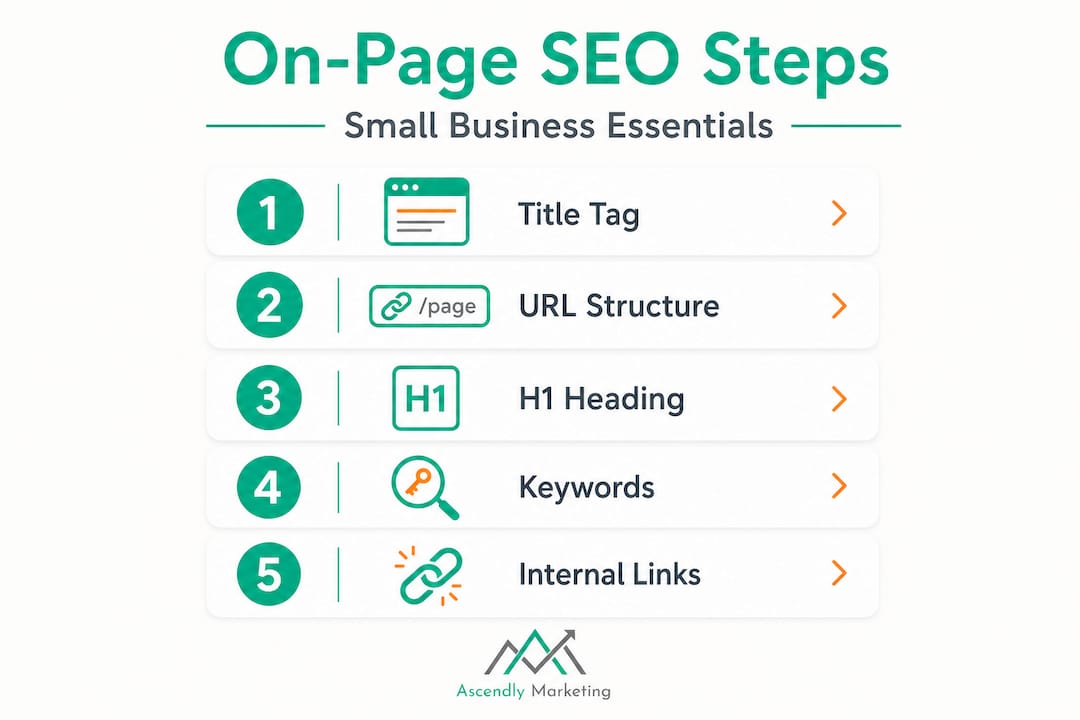
Start with prioritized optimization: page titles, URLs, H1 headings, and keyword-rich introductions drive the majority of results. This is not a guess. It is the pattern that plays out across thousands of business websites. When you fix these four elements first, you give search engines everything they need to categorize and rank your page correctly.

Here is a practical table breaking down each on-page element:
| Element | Why it matters | Quick win tip |
|---|---|---|
| Title tag | First thing search engines and users see | Include the primary keyword within the first 60 characters |
| Meta description | Drives click-through rates from search results | Write 150-160 characters with a clear benefit and call to action |
| H1 heading | Tells search engines the page topic | Use once per page with your main keyword |
| URL structure | Signals relevance and improves crawlability | Keep it short, lowercase, and keyword-focused |
| Body content | Where keywords, context, and value live | Aim for thorough coverage; no thin pages under 300 words |
| Internal links | Distribute authority across your site | Link related pages naturally within content |
| Image alt text | Accessibility and search visibility | Describe the image accurately with relevant keywords |
Follow this numbered order to tackle the highest-impact elements first:
- Audit and rewrite your page titles. Every page needs a unique, descriptive title that includes the primary keyword your audience actually searches.
- Clean up your URLs. Remove dates, random strings of numbers, and stop words. A good URL looks like yoursite.com/on-page-seo-guide, not yoursite.com/p=1234.
- Fix or write your H1 headings. Every page should have exactly one H1. It should match or closely reflect the page title.
- Strengthen your opening paragraphs. Search engines read your first 100 words carefully. Lead with your core topic and keyword naturally.
- Write compelling meta descriptions. Craft these like short ads, not just summaries. Good writing of meta descriptions can meaningfully lift your click-through rate from search results.
- Optimize every image. Images should use descriptive alt text, avoid keyword stuffing, and use proper img tags instead of CSS backgrounds for both SEO and accessibility.
- Add internal links to your most important pages. Anchor text (the clickable words in a link) should describe the destination page naturally.
For e-commerce businesses, this process has additional layers. Category pages, product titles, and filter pages all need on-page attention. Exploring e-commerce SEO best practices gives you a roadmap specific to product-based sites.
Pro Tip: After Google’s helpful content updates, thin pages (those with little to no unique information) are being pushed down or removed from search results altogether. Every page you publish should answer a real question thoroughly. If a page has fewer than 400 words and offers nothing unique, either expand it or merge it with a related page.
Avoid these common pitfalls that trip up SMBs constantly:
- Keyword stuffing: Repeating a keyword unnaturally ten times on a page signals manipulation and hurts rankings
- Duplicate title tags: Every page must have a unique title. Copying the same title across multiple pages confuses search engines
- Missing alt text: This hurts both your image search visibility and your site’s accessibility for users with screen readers
- Thin content: Pages that say very little offer very little value to search engines or users
Advanced on-page SEO: Internal links, mobile, and technical tweaks
Once the basics are handled, these more sophisticated elements can push your site’s performance even further, and they are often missed by your competitors.
Internal linking is one of the most underused tools in on-page SEO. When you link from a high-traffic page to a newer, lower-traffic page, you pass some of that authority along and help search engines discover content they might otherwise overlook. Internal linking for SEO is not complicated, but it requires intentionality. Every time you publish a new page, ask yourself: what existing pages should link to this?
Here are the technical factors that matter most as your site grows:
- Orphan pages: Pages with no internal links pointing to them are invisible to search engines. Every page on your site should be reachable through at least one internal link
- Mobile responsiveness: Orphan pages need internal links to ensure crawlability, canonical tags sort out duplicates, and mobile-first indexing means every site must be responsive. Google now uses your mobile site as the primary version for ranking purposes
- Canonical tags: When the same content appears at multiple URLs (common with e-commerce filter pages), a canonical tag tells search engines which version to index and rank
- Page speed: Slow pages frustrate users and receive lower rankings. Compress your images, reduce unnecessary plugins, and test your load time with Google’s PageSpeed Insights
- Structured data markup (Schema): Adding structured data helps search engines display rich results like star ratings, FAQ dropdowns, and product prices directly in search listings
“Google’s mobile-first indexing means your mobile experience is no longer a secondary concern. It is the primary signal used to determine rankings, which means any site that is not fully responsive is fighting with one hand tied behind its back.” — Google Search Central
Pro Tip: Run a free or low-cost audit using tools like Ahrefs or Moz at least once per quarter. These tools surface issues like broken links, missing meta tags, pages with duplicate content, and crawl errors that you would never catch by simply looking at your website. Many SMBs are surprised to discover that 20 to 30 percent of their pages have some kind of technical issue affecting their performance.
Site architecture also matters more than most small business owners realize. A flat structure (where every important page is reachable within three clicks from the homepage) improves both user experience and crawl efficiency. If your most important service pages are buried five levels deep, search engines may not prioritize them.
Measuring on-page SEO success and avoiding common mistakes
Finalizing your optimizations is just the beginning. Measuring real impact and steering clear of errors ensures your efforts turn into actual business growth.
Tracking organic traffic, click-through rates, and keyword rankings reveals success. Thin content risks de-indexing after Google’s helpful content updates. These are not hypothetical concerns. They are patterns showing up in analytics dashboards for businesses that skip the fundamentals.
Here is a numbered process for measuring your results effectively:
- Set up Google Search Console (free) and connect it to your site. This shows you which queries your pages appear for, how often they get clicked, and whether Google has any crawl issues with your site.
- Track organic traffic in Google Analytics. Look for upward trends in sessions from organic search, and note which pages are driving the most traffic.
- Monitor keyword rankings. Use a tool like Ahrefs, Moz, or Semrush to track where your target pages rank for specific keywords. Improvements of even five to ten positions can double or triple your traffic.
- Check click-through rates. A page ranking in position three with a boring title tag might underperform a page in position five with a compelling one. CTR optimization is often overlooked but can produce fast gains.
- Review page-level engagement. Bounce rate, time on page, and scroll depth tell you whether visitors actually find value in what they are reading.
Understanding content’s impact on SEO is key to interpreting these metrics correctly. Organic traffic growth is not just a vanity metric. It represents real people finding your business.
The most common mistakes that hurt SMB results include:
- Neglecting mobile optimization even after Google’s mobile-first indexing rollout
- Skipping internal links, leaving pages isolated and hard for search engines to discover
- Publishing thin content that looks like a page but offers no real answers
- Ignoring title tags and letting the CMS auto-generate them (which often produces terrible results)
- Never auditing old content to update facts, refresh keywords, or add new internal links
If you want to go deeper into creating content that ranks and converts, learning how to write SEO content gives you a structured framework to follow every time you publish.
Our take: Why on-page SEO wins for SMBs
Here is an honest observation from working with small and medium-sized businesses over many years. Most of them overcomplicate SEO. They chase the latest algorithm speculation, worry about things they cannot control, and ignore the basics that actually move the needle.
The uncomfortable truth is that most SMB websites are not losing because of backlinks. They are losing because their title tags are generic, their content is thin, their images have no alt text, and their internal links are nonexistent. That is fixable. Today. By you.
On-page SEO is the one area of digital marketing where you have complete control and fast feedback. Change a title tag and watch your impressions shift in Search Console within weeks. Add internal links and see previously buried pages start gaining clicks. These are not theoretical benefits. They are documented in real-world SEO success stories from small businesses that stopped chasing trends and started nailing fundamentals.
The businesses that outperform bigger competitors in local and niche search results are rarely doing anything exotic. They are doing the basics extremely well, consistently, across every page of their site. They have clear page titles. They write for real people and answer real questions. They link their pages together logically. That discipline is more valuable than any trending tactic.
Our perspective is this: if you have not fully optimized your on-page elements, no amount of advertising spend or social media posting will compensate for it. On-page SEO is not the starting point because it is easy. It is the starting point because it is foundational. Everything else you do in digital marketing performs better when your site is properly optimized.
Ready to boost your SEO? Expert help for small businesses
Knowing what to do and actually doing it effectively are two different things. On-page SEO has a clear process, but the details add up fast, especially when you are also running a business.

At Ascendly Marketing, we have been helping small and medium-sized businesses build stronger online presences since 2013. Our team of SEO specialists, content creators, and web designers works together to audit your existing site, fix the foundational issues, and build a strategy that drives real organic growth. Whether you need a full SEO overhaul or targeted support in specific areas, our SEO services for SMBs are built around measurable results, not empty promises. Explore our full range of digital marketing services and book a free consultation to see exactly where your website stands and what it would take to move up in the rankings.
Frequently Asked Questions
What is the difference between on-page and off-page SEO?
On-page versus off-page SEO comes down to control: on-page SEO covers everything you optimize within your own website, while off-page SEO deals with external signals like backlinks and brand mentions from other sites.
How long does on-page SEO take to show results?
Most websites see measurable changes in search rankings and organic traffic within 2 to 8 weeks after implementing on-page improvements, depending on competition and how well the site was previously optimized.
What’s the most important part of on-page SEO for SMBs?
Page titles, URLs, H1 headings, and keyword-rich opening paragraphs deliver the biggest ranking improvements for small business websites and should always be addressed first.
Can poor on-page SEO cause my content to be removed from search?
Yes. Thin content risks de-indexing after Google’s helpful content updates, meaning pages that offer little real value can be dropped from search results entirely, not just ranked lower.