
Is your pipeline short on demand, or are you using the wrong lead generation model for the way your team is built?
That distinction matters more than another channel debate. Some companies need a full-service partner that can run paid search, SEO, outreach, conversion work, and reporting as one system. Others are better off with a data platform plus an in-house SDR or demand gen manager. Some already have demand and need outside outbound support to tighten follow-up and appointment setting. If you are sorting through the best b2b lead generation options for 2026, start with the operating model before you compare vendors.
Channel choice still matters, but execution decides whether interest turns into pipeline. SEO can bring in high-intent buyers. Paid media can create volume fast. Outbound can open accounts that your inbound program will never reach on its own. None of that fixes weak ownership, poor handoffs, or bad list quality.
That is the true buying decision in this guide.
The providers below fall into three practical buckets: agencies that own execution for you, platforms your team can run internally, and hybrid firms that sit between those two. The right fit depends on stage, budget, sales capacity, and how much control you want to keep inside the company. If you need a clearer framework before comparing vendors, this B2B lead generation tactics guide for growth teams gives useful context on how these approaches work in practice.
1. Ascendly Marketing
Need one partner to run demand generation without forcing your team to coordinate five separate specialists?
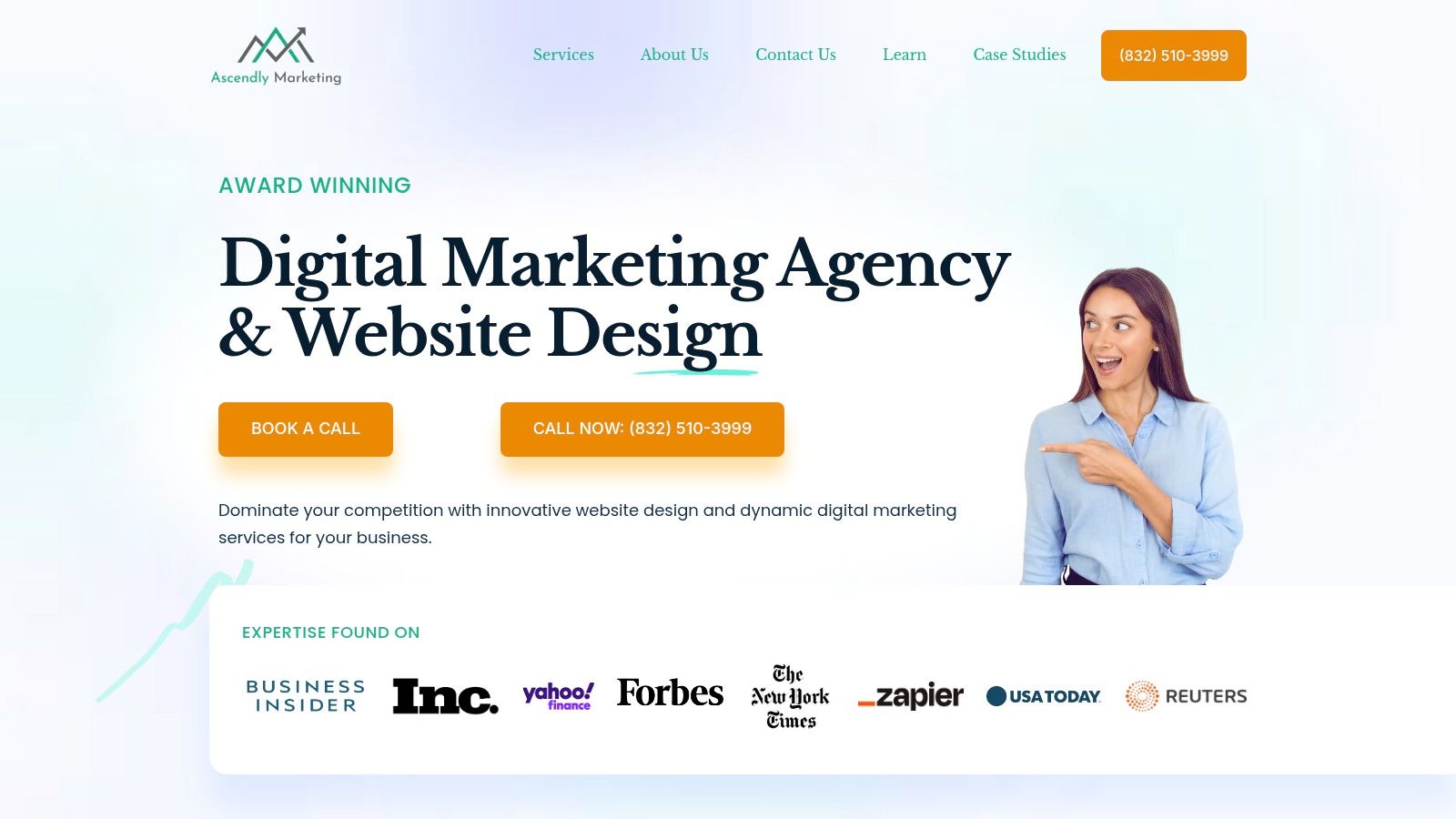
That is the case for Ascendly Marketing. The agency brings SEO, PPC, social media, content, PR, video, email, cold email outreach, CRO, and website design into one operating model. For small and midsize B2B teams, that setup fixes a common execution problem. Traffic grows in one channel, messaging lives somewhere else, the site converts poorly, and sales end up blaming lead quality.
Ascendly’s process is straightforward: discover, plan, execute, report. That sounds simple, but simple is useful when pipeline ownership gets blurry. In practice, companies lose traction when each channel owner reports on their own metrics, and no one is responsible for what happens from the first click to qualified opportunity.
Why this option stands out
Ascendly fits companies that need both strategic direction and hands-on execution. That mix matters if your funnel has more than one weak point. In my experience, B2B lead generation rarely breaks in only one place. Search visibility, offer clarity, landing page UX, forms, follow-up speed, and outbound messaging often need work at the same time.
That is why Ascendly is a better fit for some teams than a single-channel vendor. You are not just buying SEO support or paid media management. You are buying coordination across the parts of the funnel that usually fail in the handoff.
Practical rule: When website, content, paid acquisition, and outbound are owned by different teams with different incentives, lead quality usually drops before lead volume does.
If you want to see how that approach connects acquisition to conversion, their guide to building a B2B lead generation funnel that turns traffic into qualified pipeline is a useful reference. A useful starting point is Ascendly’s own page on B2B lead generation tactics, which shows how the firm frames channel mix and qualification.
Trade-offs
This option will not be the lowest-cost route, and it is not built for companies that want a quick burst of booked meetings with minimal setup. Pricing is custom, so you need a proposal. Organic acquisition also takes time, especially if your domain authority, content library, or conversion path is weak today.
The trade-off is control and consistency. One partner can keep SEO, paid media, content, outreach, and CRO pointed at the same revenue goal. That usually produces cleaner reporting and fewer gaps between traffic generation and sales readiness.
What you get is practical:
- One team across channels: SEO, paid media, content, outreach, and CRO stay aligned to the same funnel goals.
- Custom planning: The engagement is scoped around your growth targets, sales process, and internal capacity.
- Clear reporting: Performance reviews stay tied to outcomes and funnel movement, not just clicks or impressions.
Ascendly makes the most sense for companies deciding against a DIY stack and wanting an agency that can own execution across the full program.
2. Belkins
Need more meetings from named accounts, without building an outbound team from scratch? Belkins is one of the clearer outsourcing options for that job.
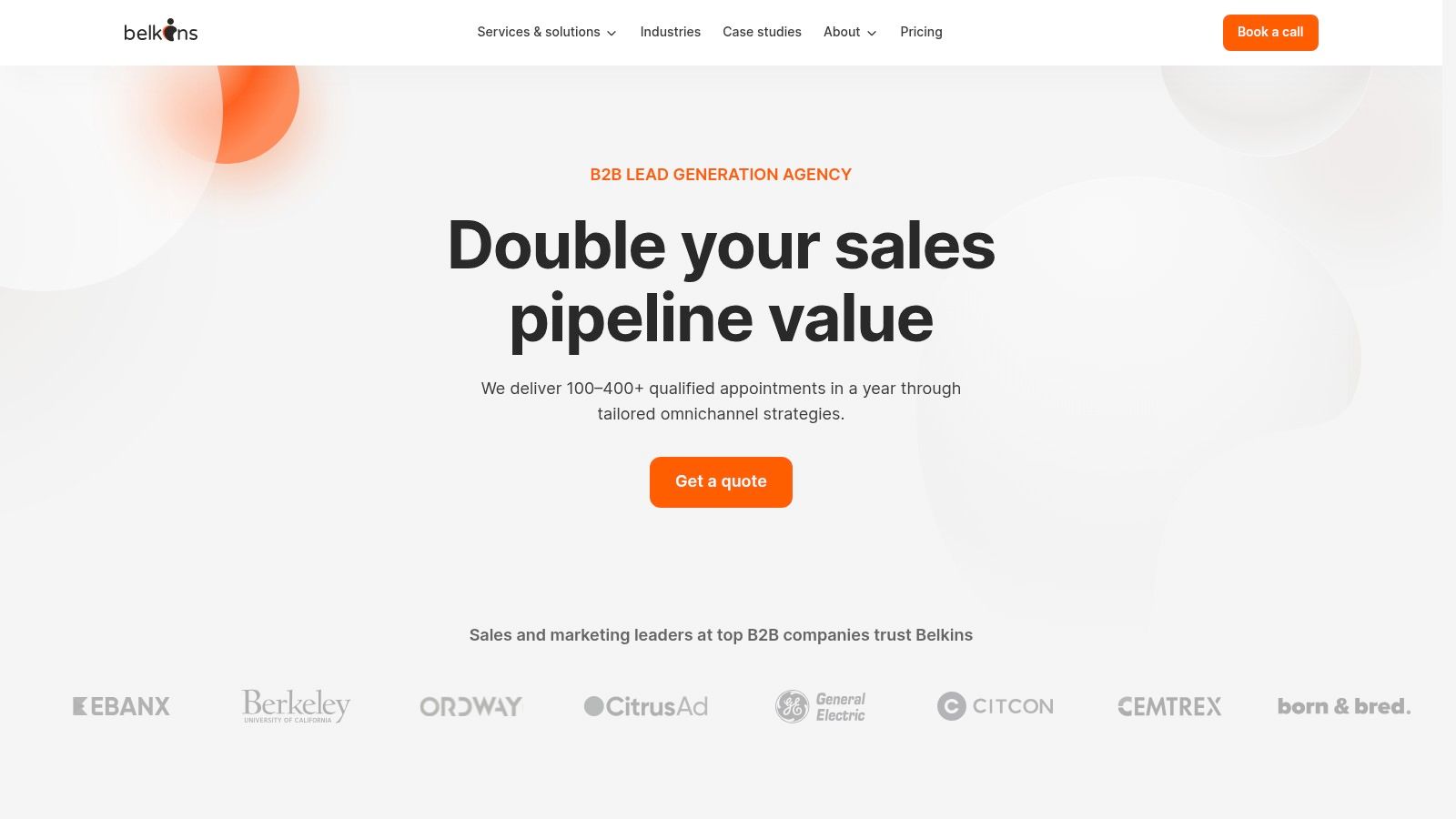
Its offer is focused. Belkins runs outbound programs built around email, LinkedIn, and calling, then supports the work with ICP refinement, list building, and message development. That makes it easier to evaluate than a broad agency engagement. You are buying pipeline creation through outbound, not a full overhaul of brand, site UX, and content operations.
That focus is the advantage and the constraint.
Belkins tends to work best for companies that already know who they want to reach and what problem they solve. If the market definition is solid and sales can run a disciplined follow-up process, an outbound specialist can produce opportunities faster than a wider demand generation rebuild. If those pieces are not in place, the agency can still execute, but the output usually looks like activity without enough sales movement behind it.
The deciding factor here is fit. Leaders choosing between DIY, a sales data platform, and a fully managed outbound partner should view Belkins as the outsource path for teams that want execution more than tooling. You give up some in-house control, but you gain speed, process, and a team that does this every day.
Qualification still decides whether the program pays off. Broad targeting creates replies that never turn into pipeline. Tight account selection, clear positioning, and a clean handoff to sales create the opposite.
If your outbound engine can book meetings but your funnel leaks after first touch, fix the handoff before adding more volume. A practical reference is Ascendly’s guide to a B2B lead generation funnel that turns early interest into qualified pipeline.
Trade-offs
Belkins is a practical choice, but only for the right brief.
- Best for outsourced outbound execution: Strong fit if your main goal is booked conversations with target accounts.
- Useful for teams without internal SDR capacity: You can stand up a program without hiring and managing a full outbound function.
- Less useful if positioning is still unclear: Agencies can test messaging, but they cannot fix weak product-market fit.
- Pricing is not transparent: Budget planning starts with a sales conversation, which slows comparison shopping.
- Performance depends on sales follow-through: If reps are slow to respond or discovery is weak, meeting volume will not translate into revenue.
Belkins makes the most sense for companies that want a done-for-you outbound program and are willing to trade some control for speed to pipeline.
3. CIENCE
Need a middle option between hiring and training an internal SDR team and handing outbound over to a fully outsourced agency? CIENCE fits that gap better than many vendors in this category.
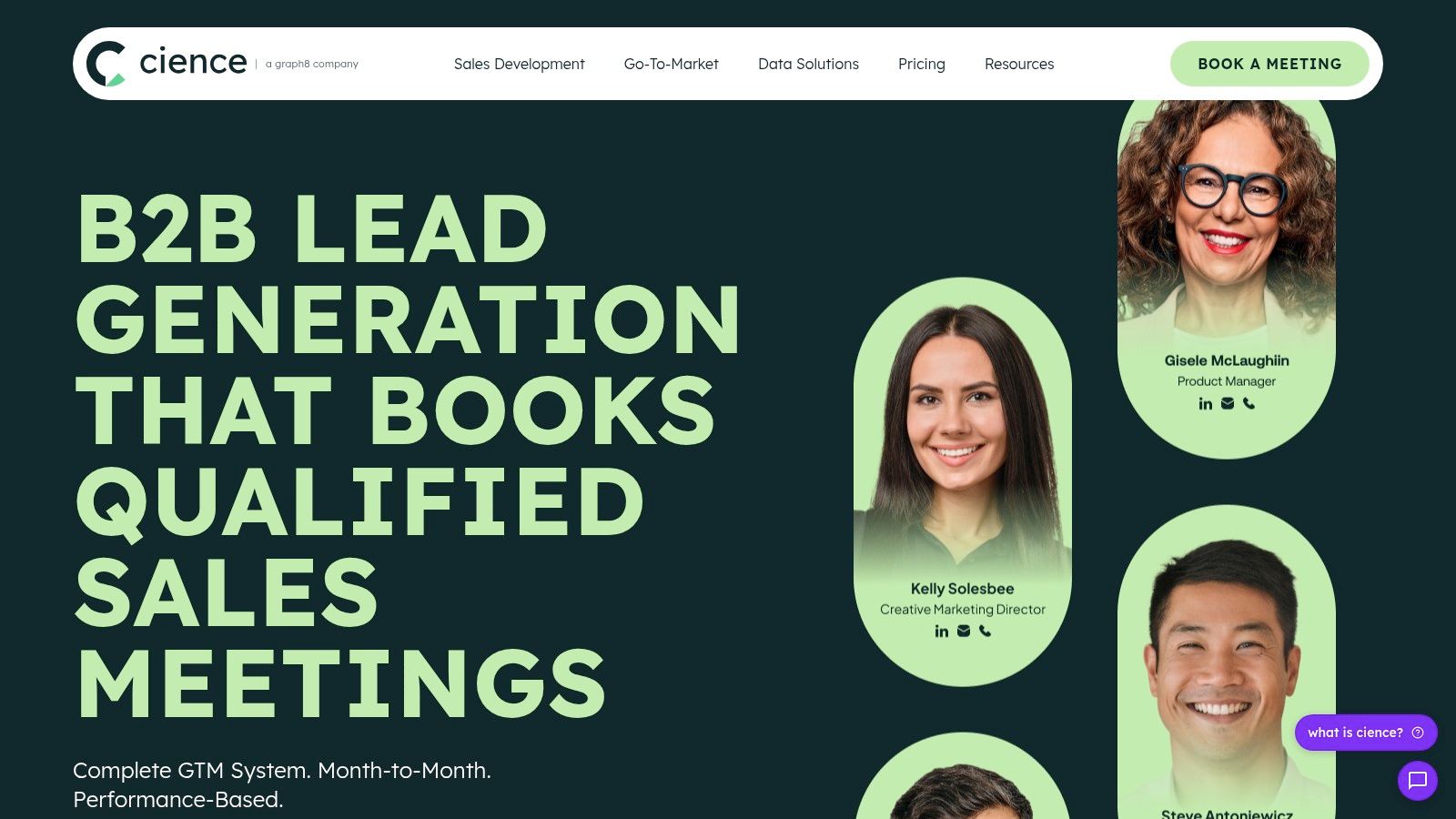
Its model combines outsourced SDR support with AI-assisted workflows for outbound, inbound qualification, and GTM setup. That makes it easier to evaluate through a practical lens. You are not only choosing a service provider. You are choosing how much of the motion stays internal, how much gets automated, and how much a partner will run for you.
That distinction matters. Some teams need a done-for-you program. Others already have sales leadership, messaging, and CRM discipline in place, but need faster response times, cleaner routing, or more consistent follow-up. CIENCE is a stronger fit for the second group, especially if the goal is to improve execution without rebuilding the whole process from scratch.
Why the hybrid model matters
AI can help with prioritization, enrichment, routing, and early qualification. It cannot fix a weak ICP, unclear messaging, or poor rep judgment. CIENCE’s appeal is that it uses automation where speed matters most, then keeps humans involved where context and nuance still decide whether a lead turns into a pipeline.
That balance tends to work best in two situations. First, inbound volume is high enough that leads need to be sorted quickly. Second, outbound teams want more activity coverage without turning every touchpoint into low-quality automation. If your team is still deciding how much of the function to build internally, these outbound lead generation strategies for B2B teams are a useful planning reference.
Trade-offs to watch
CIENCE gives buyers more flexibility than a standard SDR outsourcing package, but flexibility adds planning work.
- Strong fit for teams choosing between DIY and full outsourcing: You can use the platform and service mix to match your stage, budget, and internal capacity.
- Useful when speed and human oversight both matter: AI can reduce manual work, while reps still handle qualification and real sales conversations.
- Good option for companies that need GTM structure first: The system setup offer is more practical than jumping straight into volume with a messy process.
- Pricing still requires a sales conversation: That makes side-by-side budgeting harder if you are comparing several providers at once.
- Execution quality depends on your inputs: Bad targeting, weak domain setup, and unclear messaging will still hurt results.
Use AI for triage and workflow efficiency. Keep people responsible for judgment, objection handling, and lead quality.
For leaders comparing agencies, platforms, and hybrid providers, CIENCE stands out as a tool-assisted outsourcing option rather than a pure service play. That makes it a sensible choice for companies that want more operational control than a traditional agency relationship usually allows.
4. Martal Group
Need an outbound partner that gives you more than a promise and a monthly meeting count?
Martal Group stands out because the operating model is easier to inspect before you buy. For leadership teams comparing a full-service agency against a DIY build or a tool-assisted setup, that matters. You can usually see how they frame outreach cadence, meeting goals, and sales involvement, which makes it easier to judge whether the program fits your sales cycle or just sounds polished on a sales call.
Martal focuses on appointment setting, discovery calls, demos, and multi-channel outbound. A notable part of the offer is the involvement of senior U.S.-based sales leadership in the discovery and demo stages. In practice, that tends to matter most for companies selling higher-ticket services or more complex solutions, where a junior SDR can book meetings but struggle to qualify real buying intent.
Best use case
Martal fits companies that already understand their funnel economics and need an outsourced team that can work backward from pipeline goals. That is a different buyer than a startup still testing ICP, message, and offer.
The planning angle is one of Martal’s stronger points. Their ROI calculator and tiered packaging give operators something concrete to evaluate, even if final pricing still requires a sales conversation. If your team is still building outbound fundamentals, these outbound lead generation strategies for B2B teams will help align targeting, qualification, and handoff rules before you bring in an agency.
This is the trade-off. Martal works best when your positioning is already clear enough to support disciplined outreach.
Trade-offs
Martal offers more process visibility than many agencies, but buyers still need to pressure-test the details that affect performance.
- Good fit for outsourced execution with sales-level oversight: Senior involvement can improve qualification and reduce low-intent meetings.
- Useful for teams that plan from revenue targets backward: The packaging makes it easier to estimate activity levels against pipeline goals.
- Less ideal for companies still searching for product-market message fit: If your ICP or offer keeps changing, an agency program can become expensive experimentation.
- Pricing is not fully public: Budget comparisons will still take calls and proposal review.
- Results still depend on list quality and offer strength: Even a well-run outbound motion will struggle with weak targeting or unclear messaging.
Martal is a solid choice for teams that want a fully outsourced partner, but with enough operational visibility to manage performance like a sales function instead of treating lead gen as a black box.
5. Callbox
Need broad market coverage, not just a few booked meetings?
Callbox is built for companies that need outreach at scale across email, phone, LinkedIn, and paid channels. That mix puts it in a different category from firms that focus mainly on appointment setting. If you are entering new regions, testing several verticals at once, or feeding multiple sales teams, that wider operating model matters.
Choosing the right partner is not just about whether Callbox can generate activity. It depends on whether your team is set up to absorb it. A multi-channel program can create more conversations, more follow-up tasks, and more qualification work than a smaller outbound partner. For some teams, that is exactly the point. For others, it creates noise faster than the pipeline.
Where Callbox fits
Callbox is a practical option for mid-market and enterprise teams that want outsourced execution but still need coverage across large account lists. I would put them on the shortlist when the goal is market penetration, not just meeting volume. They also make sense for leaders deciding between building an internal SDR function and outsourcing one. Callbox sits closer to the fully managed end of that spectrum.
That makes them less attractive for early-stage teams still changing ICP, pricing, or messaging every quarter. A broad outbound machine works best when the offer is stable enough to repeat across segments.
There is also a customer experience angle. If part of your strategy includes website conversion and always-on qualification, scaling sales with 24/7 chatbots can complement a program like this by catching inbound interest while outbound creates demand.
Trade-offs
Callbox can cover a lot of ground, but scale comes with constraints and oversight requirements.
- Good fit for teams that need channel breadth: Phone, email, LinkedIn, and ads give you more ways to reach hard-to-book accounts.
- Stronger for market expansion than niche messaging tests: The model suits larger campaigns better than highly experimental outbound.
- Best when sales follow-up is already organized: More top-of-funnel output only helps if reps work leads fast and consistently.
- Pricing is custom: You will need a sales process to compare scope, channels, and support levels against other providers.
- Phone outreach needs tighter review: Call scripts, regional compliance, and brand tone should be checked closely before launch.
Callbox is a sensible choice for companies that want outsourced pipeline generation with range and volume. It is less of a DIY tool play and more of an operating partner for teams that already know their market and need execution capacity.
6. ZoomInfo Sales
Need a lead generation engine your team can run in-house without stitching together five different tools?
ZoomInfo Sales fits that brief. It combines prospecting data, intent signals, engagement tools, visitor identification, and CRM-connected workflows in one system. For the right team, that means faster targeting, tighter routing, and fewer handoffs between marketing, sales, and RevOps.
The key decision is not whether ZoomInfo has a big dataset. It does. The real question is whether your company is ready to use that data well enough to justify the cost.
What you’re really buying
ZoomInfo is strongest for companies that have already moved past basic list building. It works well when you know your ICP, have clear territory rules, and can turn buying signals into action within a day or two. If those pieces are loose, the platform often becomes an expensive contact database with a few underused features attached.
That is the trade-off leaders need to evaluate. ZoomInfo sits in the middle ground between a pure DIY stack and a fully outsourced agency model. You still need internal operators, but they get a stronger system for targeting and execution. For teams deciding between tool-assisted lead gen and hiring a partner like Belkins or Martal, this is often the fork in the road: buy software and own the motion, or pay for execution and accept less day-to-day control.
Intent data is part of that value, but only if reps and marketers act on it consistently. A surge in research activity from a target account matters when someone updates the sequence, changes the outreach angle, and follows up quickly. If no one owns that workflow, the signal goes stale fast.
I have seen ZoomInfo perform best in organizations where RevOps is active, sales managers inspect follow-up, and marketing is feeding account context into outbound. In smaller teams, the platform can still work, but the burden shifts to one or two people to keep data, sequences, and routing clean.
A related use case is response speed on inbound traffic. Teams that pair account intelligence with always-on qualification can capture more of the demand they are already paying to create. This piece on scaling sales with 24/7 chatbots connects well with the way data platforms and real-time capture tools now support the same pipeline goal.
ZoomInfo is expensive enough that weak adoption shows up in the budget fast.
Trade-offs
- Best for tool-assisted lead generation: You keep control in-house while getting data, intent, workflow automation, and integrations in one platform.
- Stronger for mature teams: Companies with stable ICPs, clear ownership, and active RevOps usually get more value than early-stage teams still figuring out their motion.
- Pricing needs scrutiny: Cost can rise quickly based on seats, add-ons, and usage limits.
- Operational discipline matters: Data quality and feature depth do not fix weak messaging, slow follow-up, or poor CRM hygiene.
- Overbuying happens often: Many teams purchase more capability than they can implement in the first six months.
ZoomInfo stays near the top of the list for companies that want a serious in-house GTM system, not a lightweight prospecting tool and not a done-for-you agency. If your budget supports it and your team can operate it, it can tighten execution across outbound and inbound in a way cheaper tools usually cannot.
7. Apollo.io
Need a lead generation setup that your team can run without buying a full sales stack or hiring an agency? Apollo.io is one of the clearest tool-assisted options for that middle ground.
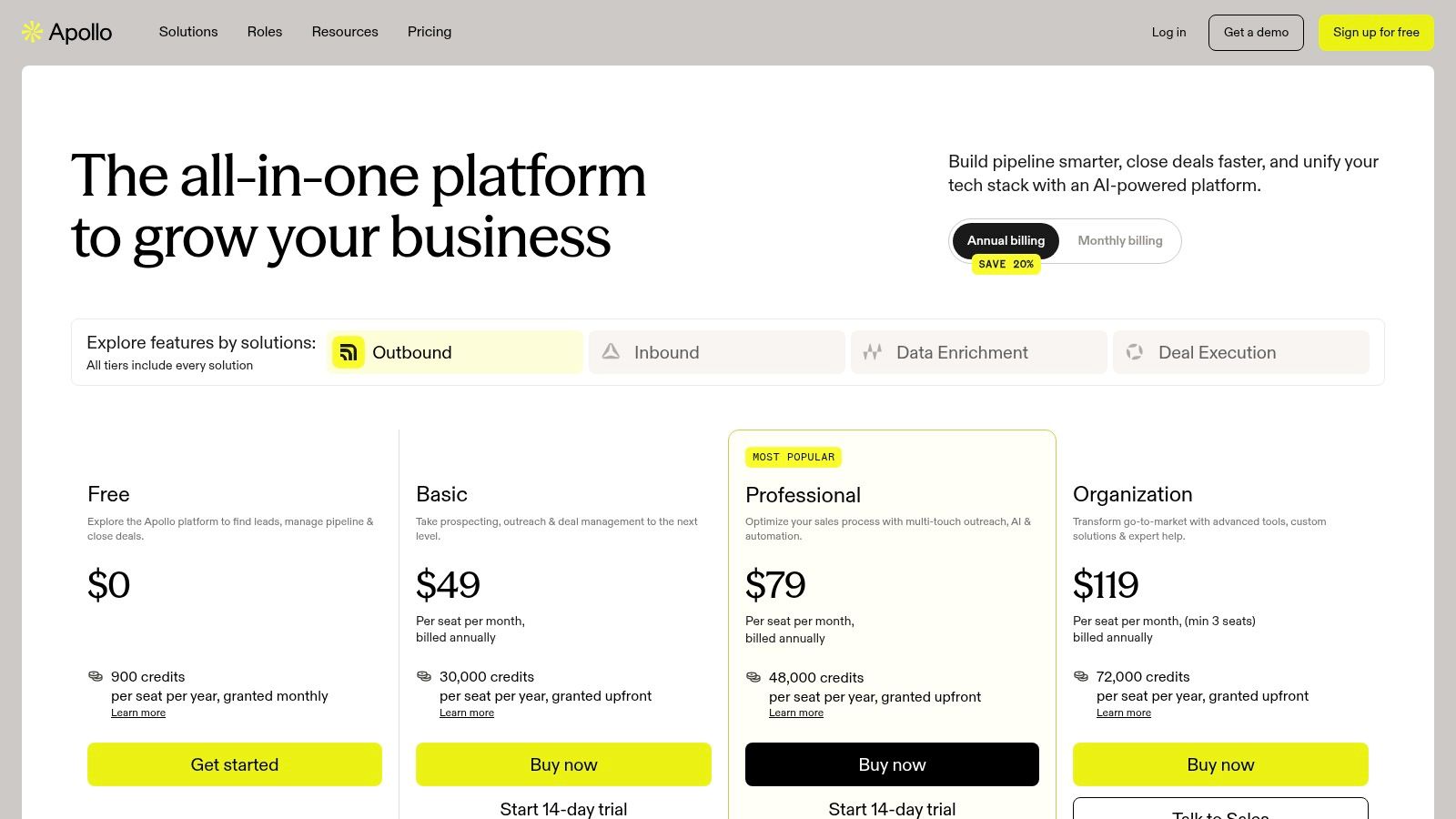
It combines prospecting data, sequencing, a dialer, enrichment, reporting, and a Chrome extension in one product. The free tier and public pricing also make evaluation simpler than with vendors that require a sales process before you can even model cost.
That matters for small teams and early mid-market companies still deciding how much of the lead generation should stay in-house. If your options are DIY, tool-assisted, or fully outsourced, Apollo sits firmly in the second category. You keep execution control, but you avoid stitching together multiple point solutions too early.
Why Apollo works for smaller teams
Apollo performs best with a team that already has basic outbound discipline.
Clean ICP rules, solid messaging, regular list maintenance, and consistent follow-up all matter here. Teams that have those habits can get a lot of value from Apollo because prospecting and execution live in the same system. Teams that do not have those habits usually blame the data or the tool when campaign management is the issue.
I have seen Apollo work well as a first serious platform after spreadsheets and disconnected tools. It gives lean teams enough functionality to test markets, build an outbound process, and see where they need more specialization later.
Trade-offs
Apollo is a strong value play for companies that want capability without enterprise software costs.
- Best for tool-assisted lead generation: It gives smaller teams a practical way to run sourcing, outreach, and basic workflow management in one place.
- Lower cost to start: The free tier and transparent plans reduce buying risk.
- Execution still stays on your team: Apollo helps you run outbound. It does not replace strategy, copy, deliverability management, or SDR oversight.
- Plan limits need a close review: Credits, feature access, and usage caps can affect ROI faster than expected.
- Data depth varies by market: Some teams in niche industries still add another data source to tighten coverage.
If your company is not ready for a full-service agency and does not need an enterprise platform, Apollo is one of the more sensible ways to build a repeatable outbound engine. It is not the best fit for every stage, but for budget-conscious teams that want to stay hands-on, it is easy to justify.
Top 7 B2B Lead Generation Providers Comparison
| Provider | Implementation complexity | Resource requirements | Expected outcomes | Ideal use cases | Key advantages |
|---|---|---|---|---|---|
| Ascendly Marketing | Medium–high (consultative onboarding, custom builds) | Agency retainer, client time for discovery; cross-discipline coordination | Measurable organic traffic, conversions and revenue growth over months | SMBs/mid-market needing integrated marketing + website builds (e-commerce, B2B) | Full-service integrated mix, process-driven reporting, experienced multidisciplinary team |
| Belkins | Low–medium (campaign setup and ICP refinement) | Budget for outbound campaigns, client input on ICP and value prop | Booked meetings and pipeline growth from multi-channel outbound | SMBs and mid-market firms seeking done-for-you appointment setting | Omnichannel outbound focus, strong case studies and third-party reviews |
| CIENCE | Medium (AI + human SDR workflows and setup) | One-time GTM setup option plus ongoing program costs; ICP and data inputs | Scalable SDR output with AI-augmented follow-up and faster program launches | Teams wanting flexible resourcing for outbound SDR programs | Blend of human and AI agents, documented setup, flexible resourcing |
| Martal Group | Low–medium (tiered programs with predefined activity ranges) | Tier-based budgets, collaboration for ICP and demos; senior involvement | Predictable outreach volumes and qualified discovery/demo calls | North America–focused tech, services and industrial B2B teams | Transparent activity metrics, senior U.S.-based sales leadership, ROI modeling |
| Callbox | Medium–high (multi-channel global coordination) | Custom packages by region/industry; compliance and program management | Long-term pipeline building and scalable sales engine across geographies | Companies needing high-volume, global lead generation and pipeline programs | Global footprint, consultative sales-engine focus, multi-channel orchestration |
| ZoomInfo Sales (SalesOS/Sales) | Medium (platform setup, integrations, credit management) | License seats, usage credits, CRM/stack integrations and training | Faster prospecting, prioritized outreach, ABM and RevOps enablement | Enterprises and RevOps teams requiring deep data and engagement tools | Massive contact database, integrated engagement stack, buyer intent data |
| Apollo.io | Low (self-serve platform with transparent plans) | Lower budget entry, optional paid tiers and credit limits, basic integrations | Cost-effective prospecting and sequences for SMBs; quick time-to-value | SMBs and lean teams building outbound without multiple tools | Budget-friendly, free tier, all-in-one prospecting + engagement workflow |
From Plan to Pipeline: Your Next Move
What stalls the pipeline after a team picks a lead generation provider? In my experience, it is usually a fit problem. The company bought an agency, platform, or hybrid setup that looked strong on paper but did not match headcount, budget, sales process, or speed to follow up.
That is the decision to make here. Choose the model before you choose the vendor.
A full-service partner like Ascendly makes sense when marketing leadership needs one team to handle strategy, channel execution, site updates, conversion work, and reporting against revenue goals. A focused outbound agency such as Belkins, Martal Group, or Callbox fits better when the offer is clear, the sales motion already works, and the main gap is booked conversations. ZoomInfo Sales and Apollo.io are better fits for teams that already have internal SDR or AE capacity and want more control over data, targeting, and outreach cadence.
Each option comes with trade-offs. Agencies can speed up execution, but they still need strong input on ICP, positioning, and follow-up rules. Platforms give teams flexibility and lower outside dependency, but they also demand process discipline, list hygiene, and someone accountable for daily execution. The hybrid route often works well for companies in transition, especially when leadership wants outside help on strategy while keeping prospecting and qualification in-house.
Do not try to fix demand generation, outbound, qualification, routing, and sales follow-up at the same time. Start with the clearest constraint. If inbound volume is weak, fix capture and conversion paths first. If leads are coming in but sales is not getting qualified conversations, tighten targeting, scoring, and handoff rules. If reps are spending time on poor-fit accounts, improve account selection and data quality before adding more volume.
As noted earlier, conversion rates usually drop hard between funnel stages. That is why diagnosis matters more than activity volume. More names at the top will not help if marketing and sales disagree on what counts as a qualified lead or if reps are responding two days too late.
The next step should be operational, not theoretical. Pick one path from this list. Assign an owner. Define the ICP, handoff point, response-time expectation, and weekly review process for lead quality. If LinkedIn is part of your outbound mix or thought-leadership plan, this article on LinkedIn posting strategy pairs well with the agencies and platforms covered above.
The best setup fits the team you have now and still holds up six months from now, after volume increases and process gaps become obvious.
If you want an integrated partner instead of another disconnected tool, Ascendly Marketing is a strong place to start. Their team handles SEO, paid media, content, outreach, CRO, and website execution in one program, with a consultative process built around discover, plan, execute, and report. Book a conversation, get a custom proposal, and see whether a full-funnel lead generation setup fits your growth goals.