

TL;DR:
- Digital transformation for SMBs is a strategic reinvention of operations, not just a tech purchase, leading to improved efficiency and responsiveness. It relies on automating processes, enhancing customer experience, and leveraging data analytics to drive growth and competitive advantage. Success requires ongoing measurement, change management, and disciplined cost control rather than one-time projects or big system overhauls.
Most SMB owners assume digital transformation means buying a new CRM or launching a company app. That assumption costs them real money. Businesses that treat transformation as a strategic shift rather than a tech purchase improve efficiency and responsiveness at a pace their competitors simply cannot match. This guide breaks down what digital transformation actually involves, which benefits matter most for small and medium-sized businesses, how to tackle real obstacles, and the practical steps you can take right now to start generating measurable results.
Table of Contents
- What digital transformation really means for SMBs
- Key drivers: Efficiency, customer experience, and data-driven growth
- How to make transformation practical: Use cases, AI, and cost discipline
- Overcoming obstacles: The people and process edge cases
- A modern SMB perspective: What most owners miss about digital transformation
- Take the next step with expert-led transformation
- Frequently asked questions
Key Takeaways
| Point | Details |
|---|---|
| Efficiency and speed | Digital transformation lets small businesses work faster, reduce manual tasks, and react swiftly to market changes. |
| Customer experience | Improved digital tools allow for more personalized, quicker customer interactions and better service overall. |
| Measurable growth | Data-driven approaches help SMBs reallocate resources for maximum marketing impact with clear ROI. |
| Cost control | Embedding financial discipline with digital projects ensures outlays do not exceed the value delivered. |
| People and process focus | Transformation succeeds when teams are prepared for change, not just when new tech is introduced. |
What digital transformation really means for SMBs
Digital transformation is not a product you install. It is a strategic reinvention of how your business operates, delivers value to customers, and measures what success looks like. That reinvention touches workflows, communication channels, how you allocate budgets, and how fast you can respond to a shift in the market.
Think about it this way: a print shop that buys a faster printer has upgraded equipment. A print shop that redesigns its entire order intake, proofing, and delivery workflow using automation and real-time tracking has transformed. The second business can handle twice the volume with the same headcount. That is the difference.
“Digital transformation for SMBs is about improving efficiency and responsiveness, not just buying technology.” The goal is to work smarter, adapt faster, and serve your customers at a higher standard.
The core drivers behind transformation are speed, agility, and customer experience. Markets move faster than they did five years ago. Customers expect real-time responses, personalized service, and frictionless transactions. SMBs that cannot keep pace lose ground to larger competitors who have already invested in these capabilities.
Here is a quick comparison of how the old approach stacks up against a transformation mindset:
| Area | Old way | Digital transformation approach |
|---|---|---|
| Lead follow-up | Manual calls, days-long delays | Automated sequences triggered in minutes |
| Performance tracking | Monthly spreadsheets | Real-time dashboards and alerts |
| Customer communication | One-size-fits-all emails | Personalized messages based on behavior |
| Budget allocation | Gut-feel decisions | Data-backed spend optimization |
| Process bottlenecks | Handled reactively | Identified and resolved proactively |
Common misconceptions include thinking transformation is only for enterprise companies, that it requires a massive budget, or that it is a one-time project with a clear finish line. None of those are true. Transformation is ongoing, scalable, and accessible to businesses of any size.
Building a foundation in data-driven marketing success is often the clearest entry point for SMBs. When you start making decisions based on what the numbers actually say rather than what you feel is working, you are already transforming.
Key drivers: Efficiency, customer experience, and data-driven growth
Now that we have defined digital transformation, the measurable benefits are what make it essential for SMB owners. Three primary levers drive results, and each one connects directly to your marketing and sales performance.
The three pillars of transformation:
Efficiency through automation. Automating repetitive tasks like lead follow-up, invoice reminders, appointment confirmations, and social media posting frees up your team to focus on high-value work. A business that automates just five hours of weekly admin tasks recovers over 250 hours per year. That translates to more time selling, serving clients, and growing.
Enhanced customer experience through speed and personalization. Customers today judge a business by how quickly and accurately it responds. A digital marketing strategy built around fast touchpoints and segmented messaging creates a noticeably better experience. Personalized follow-ups, behavior-triggered emails, and real-time chat tools all increase conversion rates significantly.
Growth through data analytics. When you track the right metrics from the start, you know which campaigns are working, which channels produce the highest-value leads, and where your budget is being wasted. That clarity allows you to scale what works and cut what does not.
Here is how traditional SMBs compare to digital-first competitors across these three levers:
| Lever | Traditional SMB | Digital-first SMB |
|---|---|---|
| Lead response time | 24 to 48 hours | Under 5 minutes (automated) |
| Campaign optimization | Monthly reviews | Weekly or real-time adjustments |
| Customer retention effort | Reactive outreach | Proactive, behavior-triggered sequences |
| Cost per acquisition | Unknown or estimated | Tracked precisely by channel |
| Revenue visibility | Quarterly reports | Live dashboard by week or day |
SMBs measure transformation as three distinct levers: cost and cycle-time reduction, better customer experience, and data-driven marketing. When you address all three simultaneously, the gains compound quickly.
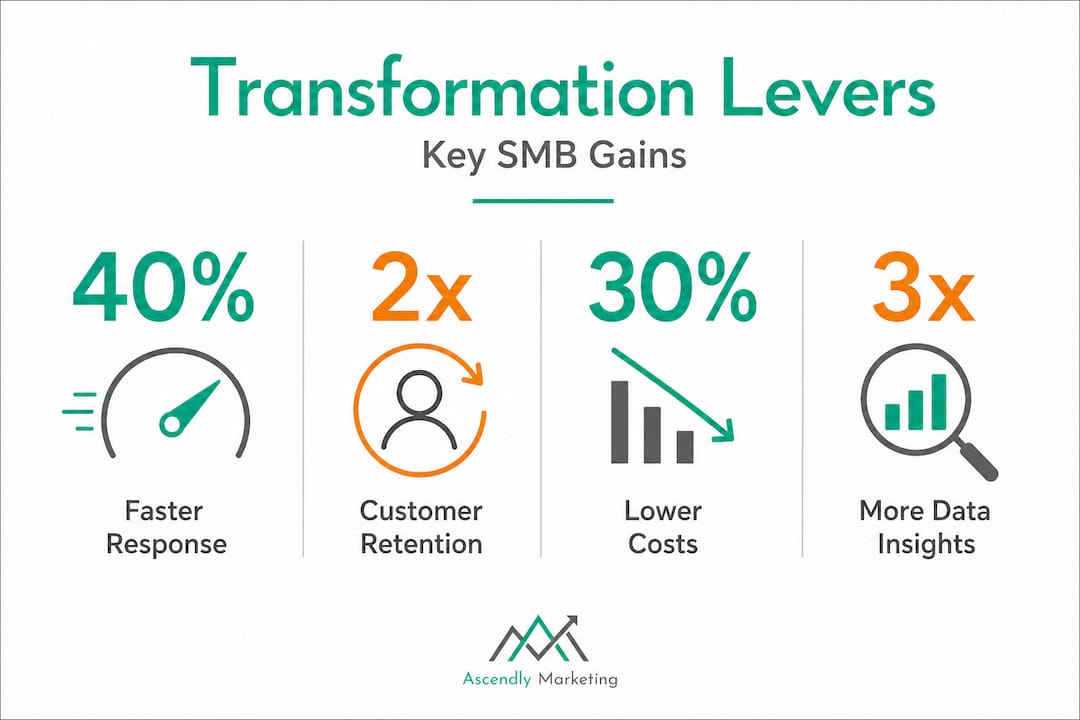
Using marketing automation as a concrete example: a business that automates its email nurture sequence can stay top of mind with 500 prospects without adding a single person to the team. The cost per touchpoint drops while engagement stays high.
Pro Tip: Pick one metric to track before you launch any transformation initiative. Whether that is cost per lead, time-to-respond, or customer retention rate, having a baseline makes it possible to prove the value of every change you make.
How to make transformation practical: Use cases, AI, and cost discipline
Understanding the benefits, the next challenge is translating vision into practical action. Here is how SMBs are making transformation work on the ground.

The biggest mistake we see is chasing transformation as a concept rather than pursuing specific, measurable outcomes. Every initiative should answer one question: what will improve, by how much, and how will we measure it? Without that clarity, budgets evaporate, and teams burn out.
Pragmatic use cases around AI and cloud are where smart SMBs are focusing, alongside strict cost and FinOps (Financial Operations) discipline. FinOps is the practice of managing cloud and AI spending in real time to ensure every dollar spent maps to a measurable business outcome. As AI tools multiply and cloud costs scale with usage, this discipline becomes critical.
Practical use cases SMBs are prioritizing right now:
- Automated lead follow-up sequences triggered by form fills, page visits, or quote requests
- AI-driven ad optimization that adjusts bidding and targeting based on live performance data
- Chatbots handling tier-one customer questions, freeing staff for complex conversations
- Predictive analytics identifying which existing customers are most likely to buy again
- Automated reporting dashboards replacing manual weekly spreadsheets
- Cloud-based project management tools give teams real-time visibility into task status
Each of these use cases delivers a measurable output. You can track response time, conversion rate, cost per acquisition, or staff hours recovered. That is the point.
Exploring AI-powered marketing use cases reveals that the businesses seeing the fastest returns are not necessarily spending the most. They are spending the smartest, starting narrow, measuring quickly, and scaling the tactics that work.
Pro Tip: Build cost controls into every AI or cloud tool you adopt from day one. Set monthly spend caps, review usage weekly, and tie every tool to a specific metric it is supposed to move. This prevents the all-too-common scenario where your software stack grows, and your margins shrink.
Using marketing analytics insights to guide spending decisions is arguably the highest-leverage shift you can make. When you know your cost per lead by channel, you can cut low-performing spend and reinvest in what actually drives revenue.
Overcoming obstacles: The people and process edge cases
Achieving true transformation means not just installing technology, but also ensuring people and processes adapt. This is often the toughest part and the one most SMBs underestimate.
Technology is actually the easy part of transformation. The hard part is changing how your team works, what they prioritize, and how they think about measuring success. Change management and skills gaps caused by time constraints are the primary failure points for small and medium businesses undertaking transformation. People who are already stretched thin do not have bandwidth to learn new systems on top of their current workload.
“Transformation stalls when teams cannot see a clear, personal benefit in the change. Leaders who tie new tools directly to reduced stress, less manual work, or better customer outcomes get far faster adoption than those who frame change as a strategic priority.”
Common edge cases that cause transformation to stall:
- Too busy to switch. Staff is at capacity. Adding training to an already full plate creates resistance, workarounds, and eventual abandonment of the new system.
- Unclear benefits. When employees do not understand how a new process makes their job easier, they default to the old way. No amount of executive enthusiasm fixes this.
- Lack of digital skills. Not every team member has the same starting point. Gaps in comfort with data tools, automation platforms, or AI assistants slow adoption across the whole organization.
- No internal champion. Transformation without a dedicated internal advocate tends to drift. Someone needs to own it.
- Poor onboarding from vendors. Many SMBs invest in good tools and then receive minimal implementation support, leaving teams to figure it out on their own.
The fix is not complicated, but it does require intentionality. Start by identifying which team members will be most affected by a change and involve them in selecting and testing the tool. Shorter training sessions focused on one specific task outperform full-day onboarding marathons. Celebrate early wins publicly to build momentum.
Tracking ROI from the start also matters here. When a team member can see that the automated follow-up they set up brought in three new clients this month, their buy-in becomes natural. Numbers create believers faster than any internal memo.
Partnering with an agency that has managed these transitions for other SMBs can compress your learning curve significantly. You avoid the trial-and-error phase and move straight to what is already proven to work.
A modern SMB perspective: What most owners miss about digital transformation
Having navigated the barriers, here is an expert perspective on what actually works and what most owners miss when it comes to digital transformation.
The most common pattern we see is SMBs treating transformation as a project with a finish line. They spend six weeks implementing a new CRM, call it a success at launch, and then six months later wonder why nothing has really changed. Transformation is not an event. It is a discipline.
The uncomfortable truth is that sustained gains come from three ongoing practices: continuous measurement, deliberate culture change, and disciplined cost management. None of these is glamorous. None of them generates excitement at a team meeting. But they are the foundation of every SMB that has actually moved the needle over time.
The businesses that succeed are not necessarily the ones with the most sophisticated tools. They are the ones that started small, measured obsessively, and scaled only what the data validated. A local service business that starts by simply tracking where every lead comes from is already ahead of competitors who are guessing. Adding one automation to nurture those leads costs almost nothing and often doubles conversion. That compounding effect is where the real ROI lives.
Contrast this with the “big bang” approach: replacing every system at once, training everyone simultaneously, and expecting results in 90 days. This approach fails regularly. The team is overwhelmed, the budget runs over, and when results are slow to materialize, leadership loses confidence in the whole effort.
The practical advice is this: begin with a single use case you can measure, something small enough to complete in four weeks and track in real time. Let that success build internal credibility. Then use that credibility to fund the next initiative. Following a step-by-step guide to growth gives you a structured path that prevents the scattered, tool-first approach that trips up so many business owners.
Digital transformation is not a destination. It is the habit of consistently asking how your business can work smarter, measure better, and serve your customers more effectively. That habit, practiced consistently, is what separates high-growth SMBs from the ones stuck in the same place year after year.
Take the next step with expert-led transformation
When you are ready to move from insight to action, tailored support can accelerate and de-risk your transformation journey. Understanding what to do is one thing. Executing it consistently, while running your actual business, is where most SMB owners need a partner.
At Ascendly Marketing, we have been helping small and medium-sized businesses build outcome-driven digital strategies since 2013. Our team of SEO specialists, content creators, paid media experts, and designers works as an extension of your team to implement, measure, and scale what works. Whether you need a single focused campaign or a full-service digital marketing services solution, we build every engagement around your specific growth goals. If you want a clear starting point, our SMB digital growth guide is a practical first resource to get oriented before your first conversation with us.
Frequently Asked Questions
What is the biggest benefit of digital transformation for SMBs?
The biggest benefit is improved efficiency and responsiveness, which directly accelerate growth and elevate customer service. As research confirms, transformation boosts efficiency and flexibility for businesses of every size.
How should SMBs prioritize digital transformation projects?
Start with practical, measurable use cases that deliver fast ROI, particularly those using AI and cloud tools, and monitor costs closely from day one. SMBs focusing on pragmatic use cases with strong FinOps discipline consistently outperform those chasing broad overhauls.
What makes digital transformation fail for small businesses?
Most failures trace back to people and process obstacles, specifically a lack of time, unclear benefits for staff, and slow adoption rates. Change management gaps are primary failure points that undermine even well-funded transformation efforts.
How does digital transformation relate to data-driven marketing?
It creates the infrastructure to track outcomes and adjust marketing spend in real time, making every dollar more effective. Transformation supports real-time analytics that give marketers the clarity to optimize constantly rather than guess quarterly.
Is digital transformation expensive for SMBs?
Costs are very controllable when you select projects carefully and implement FinOps practices early. FinOps is essential for cost discipline as digital complexity grows, ensuring spend aligns directly with measurable ROI.