

SEO for HVAC contractors isn't some abstract marketing concept. It's about making sure your business shows up when a homeowner's AC quits in the middle of a July heatwave and they grab their phone to search for help.
It boils down to optimizing your digital presence—your Google Business Profile, your website, and your local reputation—so you're the first call they make, not the tenth. This is how you attract customers who aren't just browsing; they have a serious problem and need your services right now.
The Local SEO Foundation for HVAC Dominance
The battle for HVAC leads is won street by street, not just across the internet. Think about it. When a furnace goes out on a freezing winter night, that homeowner isn't looking for the best contractor in the state. They’re frantically typing "emergency furnace repair near me" into their phone.
That single moment is where your local SEO efforts either pay off big time or fail completely.
The reality is stark: if you're not visible in those immediate, location-based searches, you don't exist to that desperate customer. Your digital footprint has to be so strong and so hyper-focused on your service area that Google has no choice but to show them your business first.
Let's break down how to build that foundation.
Master Your Google Business Profile
Treat your Google Business Profile (GBP) like your digital storefront. It's often the very first impression a potential customer gets. Leaving it incomplete is like having a messy, uninviting showroom—no one wants to walk in.
A fully fleshed-out profile tells both Google and your future customers that you're a legitimate, active, and professional operation.
Nail the essentials, but don't stop there.
- Get Specific with Categories: Don't just list "HVAC Contractor." Add secondary categories like "Air conditioning repair service," "Furnace repair service," and "Heating contractor." This helps you show up for a much wider range of specific searches.
- Write a Compelling Description: You get 750 characters—use them all. Talk about what makes you different. Mention your years in business, 24/7 emergency services, financing options, and call out the specific neighborhoods you're proud to serve.
- Upload High-Quality Photos Constantly: This is huge. Post pictures of your team on the job (with permission, of course!), your branded vans, new installations, and even your smiling office staff. It builds incredible trust and shows Google your business is active. A steady stream of new photos is a powerful ranking signal.
You also need to use Google Posts consistently. Announce a seasonal special, share a quick maintenance tip, or highlight a recent five-star review. This fresh activity keeps your profile engaging and directly impacts how often you appear in that all-important Google Map Pack.
The Power of Consistent NAP and Citations
Beyond Google itself, the algorithm cross-references your business information all over the web to make sure you are who you say you are. Your Name, Address, and Phone number (NAP) must be absolutely identical everywhere it appears online.
Even a small difference, like listing "St." on one directory and "Street" on another, can confuse search engines and slowly chip away at your digital authority.
This consistency has to be perfect across all the key online directories and citation sources that matter for home services, like:
- Yelp
- Angi (formerly Angie's List)
- HomeAdvisor
- Yellow Pages
- Apple Maps
Doing a thorough audit is the essential first step. You can start by Googling your business name and seeing what pops up, but honestly, that gets tedious fast. For a much deeper dive, you might want to get some professional help to pinpoint exactly where your information is mismatched. You can learn more by checking out our comprehensive SEO audit services.
To simplify how these pieces fit together, think of it like this:
HVAC Local SEO Pillar Breakdown
Here's a quick look at the core components of local SEO and the real-world impact they have on getting your phone to ring.
| SEO Pillar | Key Actions | Expected Outcome |
|---|---|---|
| Google Business Profile | Fully complete profile, add photos weekly, use Google Posts, select specific categories, and actively manage Q&A. | Higher visibility in the Google Map Pack, more direct calls, and increased website clicks from local search. |
| Citations & NAP | Ensure 100% consistent Name, Address, and Phone number across all major online directories and industry-specific sites. | Stronger local authority signals to Google, reduced confusion for search engines, and a more trustworthy online presence. |
| Customer Reviews | Implement a system to consistently request reviews, and respond professionally to every single one (good and bad). | Improved social proof, higher click-through rates, and a powerful ranking factor for local search algorithms. |
Ultimately, each pillar supports the others. A great GBP profile is amplified by consistent citations, and both are supercharged by a steady flow of positive reviews.
Fueling Growth with Customer Reviews
Reviews are the lifeblood of any local service business. Period. They provide the social proof that turns a curious searcher into a confident customer ready to book a call. A proactive strategy for generating a steady stream of positive reviews is completely non-negotiable.
The numbers don't lie. Research shows that 87% of consumers use Google to find local HVAC services, and an incredible 80% of those local searches convert directly into paying customers. A constant flow of new reviews is one of the most powerful signals you can send to both those consumers and Google’s algorithm.
Don't just hope for reviews to trickle in. Set up a simple, automated system that texts or emails customers a direct link to your GBP review page right after a job is completed. Making it effortless is the secret to getting more people to respond.
Responding to every single review—good and bad—is just as important. Thanking a customer for positive feedback shows you appreciate them. Professionally addressing a negative comment shows accountability and a real commitment to customer satisfaction.
To build on these foundational steps, this guide on how to do local SEO specifically for HVAC offers even more detailed, actionable advice.
Building Your High-Converting HVAC Website

Think of your website as your best salesperson—it works around the clock and never needs a coffee break. But for it to actually close deals, it has to be fast, trustworthy, and incredibly simple to use for a stressed-out homeowner staring at their phone.
This is where the technical side of SEO for HVAC contractors really flexes its muscle. It's the steel frame that turns your website from a simple digital brochure into a lead-generating machine. You can nail your local SEO and content, but without a solid technical foundation, the whole thing falls flat.
Let’s be honest, a slow, clunky mobile site doesn't just annoy people; it actively sends them straight to your competitors. When someone's AC unit dies in the middle of a heatwave, they have zero patience for a page that won’t load.
Make Your Website Mobile-First
"Mobile-first" isn't just industry jargon; it's the reality of your business. The vast majority of your customers will find you on their phone, usually in a moment of panic. Your website has to be built for that experience above all else.
What does that look like in practice? Big, easy-to-tap buttons. Simple navigation that makes sense. And a "click-to-call" phone number that's visible the second the page loads. The goal is to bulldoze every possible obstacle between their problem and your solution.
A bad mobile experience is also a direct thumbs-down to Google, signaling that your site isn’t user-friendly, and your rankings will suffer for it.
Prioritize Website Speed and Core Web Vitals
Google is obsessed with user experience, and a huge piece of that puzzle is how fast your pages load. The search engine uses a specific set of metrics called Core Web Vitals to measure your site's performance. The technical details can get a little nerdy, but the main takeaway is simple: a faster website ranks better.
Your website should load in under three seconds. I’ve seen the data—every extra second of delay sends your bounce rate through the roof. That tells Google your page wasn't the right answer for the search.
Here are a few ways to get your speed up:
- Compress Your Images: Those high-resolution photos of your clean installs are great, but they can be massive files. Use a tool to shrink them down without turning them into a pixelated mess.
- Minimize Your Code: Bloated themes and unnecessary plugins are notorious for slowing things down. A good web developer can clean this up, making your site lean and mean.
- Use Quality Hosting: You get what you pay for with web hosting. Cheap, shared hosting plans often lead to painfully slow load times. Investing in a reliable provider is non-negotiable.
Structure Your Site for Service and Location Dominance
A messy website is just as confusing for search engines as it is for users. The ideal structure for an HVAC company is clean and logical, with a dedicated page for every single service you offer and every town you serve. This lets you target specific, high-intent keywords that people are actually typing into Google.
Stop lumping all your services onto one page. You need distinct, optimized pages for things like:
- Emergency AC Repair in [Your City]
- Furnace Installation in [Your City]
- Ductless Mini-Split Services in [Your City]
- Commercial HVAC Maintenance in [Your City]
Each of these pages should be filled with content that speaks directly to that specific service. This hyper-focused approach shows Google that you're the authority on that topic, dramatically improving your odds of ranking for those valuable, long-tail searches. After all, getting traffic is only half the battle; the next step is to improve website conversion rates to turn those visitors into paying customers.
Demystify Structured Data with Schema Markup
Structured data, often called Schema markup, is a special type of code you add to your website. Think of it as giving Google a cheat sheet about your business so it doesn't have to guess.
For an HVAC contractor, this is a game-changer. You can use Schema to explicitly tell Google about your:
- Specific services offered (e.g.,
HVACBusiness,serviceType: "Air Conditioning Repair") - Hours of operation, especially your 24/7 emergency availability
- Exact service area, right down to the zip codes
- Customer reviews and star ratings
Getting this code implemented helps you earn "rich results" in search—those eye-catching star ratings or FAQs that appear right under your listing. It makes your result pop off the page, and I've seen it give clients a serious edge over competitors by boosting click-through rates.
Creating Content That Attracts Local Homeowners

A well-built website is just the foundation. If you want to really dominate the local search results, you have to fill that site with content that speaks directly to the problems, questions, and worries of homeowners in your specific service area. Let's be honest: another generic blog post about changing air filters isn't going to make the phone ring.
Your content strategy is a massive piece of any effective SEO for HVAC contractors plan. It’s how you prove you’re the expert, build trust with homeowners before they even call you, and capture leads from every stage of the buying cycle—from mild curiosity to full-blown "my AC just died" panic.
Write Service Pages That Speak to Local Needs
Think of your service pages as your digital money-makers. They need to do more than just list what you offer; they must connect your services to the specific challenges homeowners in your region actually face. This is what separates you from the faceless national franchises—it shows you get it.
Think about the unique climate and even the typical housing stock in your area.
- Working in a humid climate? Your "AC Repair" page should go beyond the basics. Talk about managing indoor humidity, preventing mold growth in the ductwork, and why a properly sized system is crucial for effective dehumidification.
- Based in a colder region? Your "Furnace Installation" page could break down the long-term savings of a high-efficiency model during brutal winters or compare the costs of different fuel types common in your state.
That level of detail screams "local expert" and builds immediate credibility.
Create a Blog That Answers Real Questions
Your blog is your secret weapon for intercepting customers before they even realize they need to hire someone. The trick is to stop guessing what they're searching for and start creating content that directly answers the questions they're already typing into Google.
Focus on topics that attract homeowners who are close to making a decision. These are the people actively researching solutions, comparing costs, and getting ready to spend money.
Your most powerful blog posts will often be your most transparent ones. An article titled "How Much Does a New AC Unit Cost in Austin, TX?" will attract far more qualified leads than a vague post about the "Benefits of a New Air Conditioner."
Here are a few high-value blog post ideas that consistently work:
- Is a Heat Pump Worth It in [Your State]? A Cost-Benefit Analysis
- [Your Brand] vs. [Competitor Brand] HVAC Systems: An Honest Comparison
- Signs You Need Emergency Furnace Repair in [Your City]
- A Homeowner's Guide to HVAC Rebates in [Your County]
Each of these topics tackles a specific, pressing question a potential customer has. By giving them a clear, helpful answer, you immediately position yourself as the authority they’ll call when it's time to act. It’s also worth exploring the key benefits of a Google Business Profile to see how your content can be amplified across Google's entire platform.
Don't Forget About Your Service Areas
This is a non-negotiable part of local SEO that so many contractors overlook. For every single town or distinct neighborhood you serve, you should have a dedicated location page on your website. These pages are powerful signals to Google that you are relevant for "[service] in [city]" searches.
And don't just copy and paste your homepage content and swap out the city name. That's a waste of time. You need to make each one unique and genuinely valuable.
What to Include on a Killer Location Page:
| Content Element | Example/Purpose |
|---|---|
| Local Landmarks | Mention providing services near well-known parks, schools, or community centers to establish local context. |
| Area-Specific Testimonials | Nothing builds trust faster. Feature a review from a customer in that specific town for powerful social proof. |
| Unique Local Challenges | Acknowledge local quirks, like dealing with lake-effect snow or the challenges of older homes with unique ductwork. |
| Embedded Local Map | Show a Google Map of your service radius that's actually centered on that specific town. |
This strategy multiplies your chances of showing up in every corner of your service area. When you combine authoritative service pages, a helpful blog, and these hyper-local location pages, you build a powerful content engine that consistently brings in ready-to-buy homeowners.
Earning Authority with Local Link Building
A great website packed with helpful content is a fantastic start, but in the world of SEO for HVAC contractors, it’s only half the battle. If Google doesn’t see your business as a credible, authoritative voice in your local community, you simply won’t rank for the keywords that bring in the big jobs.
This is where link building comes in. Don't let the term intimidate you; it's simpler than it sounds.
Think of it like a digital referral. Every high-quality link from another local website acts as a powerful vote of confidence in Google's eyes. When a respected local organization points to your site, it tells search engines you're a legitimate, trusted part of the community fabric.
Focus on Hyper-Local Opportunities
First things first: forget about chasing links from national blogs or websites that have nothing to do with your service area. Your mission is to build a backlink profile that screams "local expert." These are the links that actually move the needle for a service business like yours.
Start by looking for opportunities right in your own backyard. These are often the easiest to get and carry the most weight for your local search rankings.
Here are a few powerful, no-nonsense strategies that work:
- Sponsor a Local Event or Team: Sponsoring a little league team, a 5K charity run, or the local fall festival is a classic marketing move for a reason. It almost always comes with a link back to your website from the event’s sponsor page, giving Google a highly relevant local signal.
- Join the Chamber of Commerce: Your local Chamber of Commerce and other business associations usually have an online member directory. This is often one of the first and most authoritative local links a new business can secure. It’s a foundational piece.
- Offer a Trade School Scholarship: Partner up with a local community college or trade school that has an HVAC program. Offering a small annual scholarship is a fantastic way to give back to the industry and earn a valuable link from a trusted ".edu" domain. Google loves these.
Build Mutually Beneficial Partnerships
Some of your best link-building opportunities will come from businesses you already know. Think about the other local pros who serve the same homeowners you do but aren't your competitors. Building a real-world referral network can lead to natural, powerful backlinks.
A great way to start is by creating a "Trusted Partners" or "Recommended Professionals" page on your own website. Link out to a great local plumber, electrician, roofer, or realtor you trust. Then, just reach out and ask them to do the same for you. It's a win-win that provides genuine value to your customers and strengthens both of your SEO profiles.
When you build these relationships, focus on genuine partnership. A link from a property manager's preferred vendor list is SEO gold because it’s based on a real-world business relationship. Google understands and rewards that kind of authenticity.
Become the Local HVAC Expert
Another solid strategy is to position yourself as the go-to expert for all things heating and cooling in your area. Local journalists, bloggers, and even real estate agents are constantly looking for quotes and insights from professionals to add credibility to their own content.
Try reaching out to local home and garden bloggers or real estate writers. Offer to provide a quick quote for an upcoming article about seasonal home maintenance or energy-saving tips. A single quote can earn you a mention and a link, cementing your status as a local authority. A little proactive outreach can lead to a steady stream of these powerful media mentions.
The impact of a well-rounded strategy is undeniable. For instance, agencies like Plumbing Webmasters have shown that blending strong local SEO, GBP optimization, and strategic link building can generate 150-500 high-intent leads every single month for HVAC contractors. It’s the combination of on-site optimization and this kind of off-site authority that creates a powerful lead generation engine.
By focusing on these practical, community-oriented tactics, you'll build a backlink profile that not only boosts your search rankings but also reinforces your reputation as a trusted local leader. And remember, the authority you build through links directly supports the visibility of your customer reviews—another critical trust signal. If you need a refresher on that, check out our guide on 11 strategies to boost your Google reviews.
Measuring the Real ROI of Your HVAC SEO
Let's be honest. SEO for HVAC contractors isn't about getting a gold star for hitting the top of Google. It's about making the phone ring and filling your schedule with profitable jobs. Every dollar you put into digital marketing is an investment, not an expense, and you should demand a return on it.
If you can't draw a straight line from your SEO efforts to actual booked appointments, you're just flying blind. It's time to stop looking at fuzzy metrics and start focusing on the numbers that actually impact your bottom line.
Identifying the KPIs That Actually Matter
Forget obsessing over every minor dip and spike in website traffic. While overall growth is a good sign, a few specific metrics tell the real story of your SEO's financial impact. These are the numbers that represent real homeowners looking for your help.
You should be laser-focused on tracking these:
- Organic Traffic Growth: This is your baseline. Seeing more visitors from non-paid search is the first green flag that your strategy is working.
- Keyword Ranking Improvements: Don't just track any keyword. Monitor your position for the high-intent, "money" phrases like "emergency AC repair [your city]" or "furnace installation near me." Climbing the ranks for these is a direct path to better leads.
- Google Business Profile Calls: Your GBP is a lead-generating powerhouse. Tracking the number of "click-to-call" actions from your profile is one of the purest measures of local SEO success.
- Quote Requests and Form Fills: This is the digital equivalent of a customer walking into your office. Every form submission from an organic visitor is a tangible lead you can chalk up to your SEO investment.
By zeroing in on these data points in Google Analytics and Google Search Console, you can paint a crystal-clear picture of your return on investment.
From Digital Metrics to Dollars and Cents
This is where the magic happens—connecting those clicks and calls to your bank account. The math is simpler than you'd think. All you need are two numbers you already know from your own business: your average value per job and your lead-to-close rate.
Let's run a quick scenario. Say your SEO efforts brought in 50 qualified phone calls and form submissions last month. If your team typically closes 30% of those leads, that's 15 new booked jobs.
Now, if your average service ticket is $450, you can directly attribute $6,750 in new revenue to your SEO work that month.
It's not just theory; the returns are often staggering. Recent industry benchmarks show that the median SEO return for home services companies is an incredible 27.46x the investment. Even more impressively, data reveals that organic search is a true revenue powerhouse, driving 42% of all leads and 44% of paying customers for HVAC businesses. You can explore the full findings on HVAC marketing ROI at SearchLight Digital.
This kind of analysis transforms your marketing from a nagging cost center into your most predictable growth engine.
A Realistic 12-Month SEO Timeline
SEO is a marathon, not a sprint. Knowing what to expect and when will save you a lot of frustration. While every local market has its own quirks, a well-executed strategy almost always follows a predictable pattern of growth.
This timeline gives you a visual of how SEO efforts build on each other, starting with foundational community engagement before graduating to high-value media features that cement your authority.
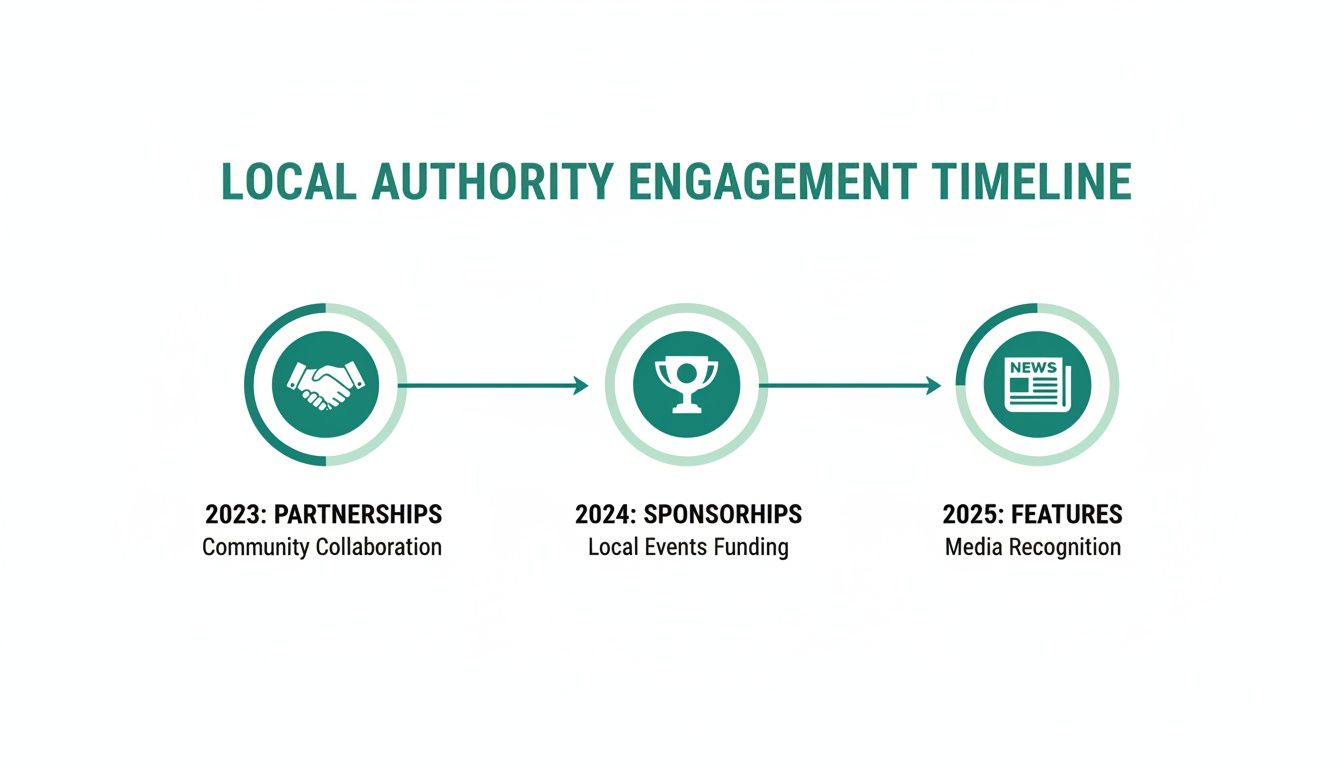
This progression highlights why a long-term mindset is so critical. Early partnerships and sponsorships are the building blocks for future authority and visibility.
Here’s a general breakdown of what the first year often looks like:
Months 1-3: Foundational Growth
The initial push is all about fixing technical issues, optimizing your on-page content, and building out local citations. You should start to see some movement for less competitive keywords and a noticeable improvement in your Google Map Pack visibility for searches of your company name.Months 4-6: Gaining Momentum
By now, your content should be hitting its stride and your local authority is growing. You can expect a steady climb in organic traffic and, more importantly, leads. You'll begin popping up on the first page for more valuable, non-branded keywords tied to your services and service area.Months 7-12: Achieving Authority
With consistent work, Google now sees your website as a legitimate authority in your market. You should be holding stable, top-3 rankings for many of your most profitable keywords. Your lead flow from organic search becomes a consistent and predictable part of your business's growth.
Patience is the name of the game. The first few months are about laying the groundwork for the massive, long-term ROI that comes from dominating the search results in your town.
Your Top HVAC SEO Questions Answered
Stepping into the world of SEO can feel a little like trying to learn a new language overnight. You start hearing terms like "backlinks" and "domain authority," and it's tough to see how they connect to actually booking more furnace installations.
Let's cut through the jargon. Here are some straightforward answers to the questions we hear most often from HVAC contractors. No fluff, just what you need to know.
How Long Does It Take for SEO to Work?
This is always the first question, and the only honest answer is: it depends. SEO isn't a light switch you can just flip on; it’s more like building a reputation. You're creating a digital asset that grows in value and authority month after month.
For a new website or one just starting with SEO in a competitive city, you should plan for at least 6 to 12 months before you see a significant, lead-generating return.
Here's a realistic timeline of what that journey looks like:
- Months 1-3: This is all about laying the groundwork. We're fixing technical glitches, optimizing your website and Google Business Profile, and building out your first local citations. You might see a few small jumps in rankings for your brand name, but don't expect the phone to start ringing off the hook just yet.
- Months 4-6: Now we're starting to build momentum. The content we've created begins to rank, and you'll see a real increase in organic traffic. This is when you should start cracking the first page for some valuable, less competitive keywords like "emergency AC repair in [your neighborhood]."
- Months 7-12: This is where the real ROI starts to show. By now, the goal is to hold stable top-3 positions for many of your most profitable keywords. Organic search transforms from a question mark into a predictable, consistent source of high-quality leads.
SEO vs. PPC: Which One Is More Important?
This isn't an either/or debate. The smartest strategy is "both, and." SEO and PPC (Pay-Per-Click) ads, like Google Ads, are two different tools that work incredibly well together. They solve different problems for your business at the same time.
Here's a simple way to think about it:
| Marketing Tactic | Primary Goal | Speed to Results | Long-Term Value |
|---|---|---|---|
| SEO | Builds long-term trust and a sustainable flow of "free" organic leads. | Slower (6-12 months) | An asset that grows over time |
| PPC | Generates immediate phone calls by placing you at the very top of Google. | Immediate (within days) | Stops the second you stop paying |
My advice? Start with a combined approach. Use PPC ads to get the phone ringing right away while your long-term SEO strategy builds traction in the background. Once SEO is consistently bringing in jobs, you can start to strategically dial back your ad spend.
How Much Should an HVAC Contractor Budget for SEO?
There’s no magic number for SEO pricing. The right budget depends on the competition in your market, where your business stands online today, and how fast you want to grow. A contractor in a small town will have a very different budget than one battling it out in a major metro area with dozens of competitors.
As a general benchmark, most small to mid-sized HVAC businesses should expect to invest between $1,500 and $5,000 per month for a comprehensive SEO campaign from a reputable agency. That investment typically covers everything: technical SEO, content creation, link building, local optimization, and detailed reporting.
Be very wary of anyone promising page-one rankings for a few hundred bucks a month. Real SEO requires serious expertise, time, and resources. Those rock-bottom offers almost always lead to poor results or, even worse, spammy tactics that can get your website penalized by Google. Investing in a quality strategy from the start is always the more profitable move.
Ready to stop wondering and start ranking? The expert team at Ascendly Marketing builds customized SEO strategies that deliver measurable results for HVAC contractors. Let's create a plan to fill your schedule with high-quality leads. Schedule your free consultation today!