
How do you choose a web design partner when every agency looks polished on a review site, and every homepage says roughly the same thing? That gap trips up a lot of buying teams. Portfolios are easy to compare. Operational reliability is harder.
That matters because buyers judge digital credibility fast. Industry summaries citing Stanford-linked research report that 75% of people judge a business’s credibility by its website design, 94% of first impressions are design-related, and visitors form an opinion in 0.05 seconds according to Clique Studios’ web design statistics roundup. Reviews for design firms often reflect that reality. Clients don’t just react to colors and layouts. They react to trust, clarity, speed, and whether the site works on mobile.
The market is also large enough that comparison shopping is normal, not optional. The U.S. web design service market is valued at USD 45.1 billion in 2024, with a projected 7.5% CAGR from 2025 to 2032 to USD 79.5 billion by 2032, according to P&S Market Research on the U.S. web design service market. In a category this crowded, review quality matters more than review volume.
So this list doesn’t treat website design company reviews as popularity scores. It compares seven firms the way practitioners vet them: specialties, process, platform fit, post-launch support, and whether the agency can still help once the redesign is live.
1. Ascendly Marketing
Ascendly Marketing stands out when the website isn’t a standalone project. It’s part of a broader growth program. If you need a new site plus SEO, PPC, content, email, CRO, social, and lead generation support under one roof, this is the type of agency that makes sense.
The firm is based in The Woodlands, Texas, and works across small and mid-sized businesses, e-commerce, B2B, local service brands, startups, and franchisors. The main advantage isn’t just range. It’s coordination. A redesign tends to break when design decisions, content, conversion paths, and acquisition channels are handled by separate vendors.
Why reviews tend to be favorable
Ascendly uses a consultative process built around discover, plan, execute, and report. That sounds simple, but in practice it answers one of the biggest weaknesses in website design company reviews. Many review platforms tell you whether clients liked the agency. They don’t tell you whether the agency documented decisions, managed revisions cleanly, and stayed useful after launch.
Practical rule: If a design firm can’t explain its workflow, reporting cadence, and ownership after launch, the portfolio doesn’t matter much.
Ascendly also benefits from being built like a multidisciplinary shop rather than a narrow design studio. Designers, writers, analysts, video and PR specialists, and team members with Google experience give it a broader operating range than a firm that only handles mockups and development.
A useful starting point is Ascendly’s own guide on how to choose a digital marketing agency. It reflects the same buyer-side questions you should ask in a review process.
Best fit and trade-offs
This is a strong fit when you want one partner to own both the build and the growth model around it.
- Best for ongoing growth programs: Businesses that need a site tied to lead generation, content, paid acquisition, and reporting usually get more value here than from a design-only studio.
- Best for B2B and service brands: Ascendly also offers cold email outreach and broader lead-gen support, which is unusual among agencies that market web design.
- Less ideal for one-off small tasks: If you only need a small page refresh or a very low-budget brochure site, a freelancer or narrow boutique may be easier to hire.
Pricing isn’t listed publicly, so buyers need a consultation to get a scoped proposal. That can frustrate teams that want instant cost comparison, but custom quoting is also normal when the work includes strategy, analytics, content, and post-launch optimization.
2. WebFX
WebFX is one of the easier agencies to evaluate from the outside because it publishes more pricing guidance than most competitors. That doesn’t mean you’ll get a final number without discovery, but it does mean buyers can estimate scope earlier.
Its appeal is process rigor. WebFX isn’t a boutique creative studio built around one founder’s taste. It’s a large full-service agency built for repeatable delivery across design, development, SEO, PPC, CRO, and analytics.
Where it works well
If your team wants a single vendor and prefers a clearly documented process over a highly bespoke studio feel, WebFX usually lands on the shortlist. It offers custom builds and quicker-turn options, which can help teams that need to launch without a long custom engagement.
The practical upside is alignment between design and performance. That matters because broader web design demand remains strong, and one industry analysis projects the global market will grow at a 5.7% CAGR from 2025 to 2035 while also repeating a common UX benchmark that $1 spent on UX can return $100, as noted in TENET’s web design statistics article. Buyers don’t need to accept every industry benchmark at face value to take the main lesson seriously. Sites are judged on business performance, not visual polish alone.
A related reference point is Ascendly’s summary of website design practices that affect usability and conversion, which is useful when reviewing proposals from larger agencies.
A polished review profile is useful. A scoped workflow with reporting is more useful.
Trade-offs to watch
- Good fit for broader programs: WebFX makes the most sense when design is tied to SEO, CRO, or paid media.
- Less attractive for lean budgets: Larger teams and more structured delivery often push pricing upward.
- Account continuity matters: In large agencies, the process can stay stable even if contacts change. Ask who owns strategy versus day-to-day communication.
If you’re reviewing WebFX against smaller firms, don’t just compare homepage aesthetics. Compare how each agency handles scoping, revisions, analytics access, and handoff after launch.
3. SmartSites
SmartSites is a practical choice for companies that want website design tightly connected to traffic acquisition. Its positioning is clear. The site isn’t the end product. It’s the thing SEO and PPC campaigns point at.
That’s a meaningful distinction in website design company reviews. Some agencies produce strong visual work but leave the growth team to retrofit tracking, landing page logic, and content structure later. SmartSites is more likely to build with those downstream needs already in mind.
Why buyers shortlist it
SmartSites offers custom website and web app development, integrations, maintenance, and ongoing marketing support. That makes it especially workable for mid-market SMBs that don’t want a beautiful redesign followed by a separate scramble to rebuild campaign infrastructure.
It also has a strong review presence on Clutch, which matters less as a trust badge than as a way to inspect patterns. Repeated comments about communication, revision handling, and launch support tell you more than star averages do.
For teams trying to decide whether a redesign should be tied directly to trust and revenue goals, Ascendly’s article on why investing in website design affects traffic, trust, and sales is a useful framing tool.
Best fit and limits
SmartSites tends to work well when you need speed, solid process, and a handoff into ongoing SEO or PPC.
- Strong fit for SMB timelines: Buyers that need a capable agency without a long enterprise-style procurement cycle often find the process manageable.
- Useful for acquisition-led sites: If search and paid media are central to the project, the service mix is a plus.
- Less transparent on upfront pricing: Public line-item pricing isn’t the focus. You typically get numbers after discovery.
What doesn’t work as well? Buyers who want a public menu of exact costs and a highly art-directed boutique experience may prefer a different type of agency.
4. Coalition Technologies
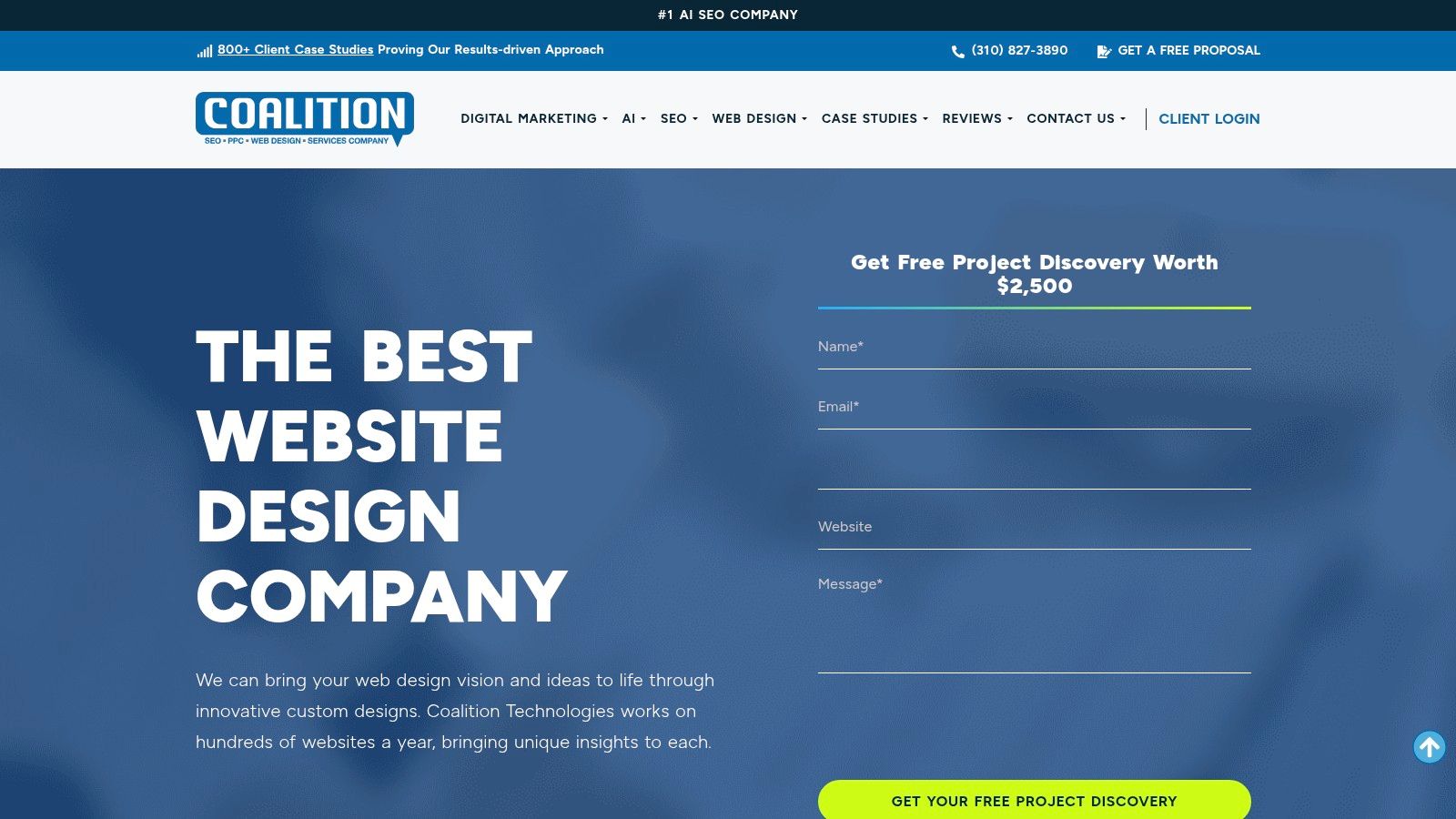
Coalition Technologies is easiest to evaluate through the platform lens. If you’re on Shopify, BigCommerce, Magento, or WordPress, that matters immediately. Platform familiarity reduces avoidable mistakes in architecture, content handling, and launch planning.
This is one of the stronger options in the list for e-commerce-heavy work. The agency combines design and development with SEO and PPC, which tends to matter more for stores and lead-gen sites than abstract brand positioning alone.
What reviews should focus on here?
A lot of review content around agencies overweights portfolio appearance. Coalition is a reminder to inspect implementation depth instead. E-commerce projects fail in ordinary places. Theme constraints, app conflicts, collection logic, migration gaps, redirect handling, and category-page structure.
Ask platform-specific questions, not generic agency questions. “Have you designed e-commerce sites?” is weak. “How do you handle Shopify app conflicts and collection-page SEO during redesigns?” is useful.
Coalition also offers headless options, which can be attractive for brands with more complex front-end requirements. That said, headless builds aren’t automatically better. They add complexity, and some teams buy them because the architecture sounds advanced, not because the business needs it.
Best fit and trade-offs
- Best for e-commerce brands: Especially when the redesign needs to support SEO and conversion work after launch.
- Strong for CMS-specific builds: Buyers who want a team already fluent in their stack can save time during scoping.
- Less ideal for tiny brochure projects: Specialized e-commerce work tends to bring larger minimums and longer timelines.
The trade-off is straightforward. If your business runs on product catalogs, category structure, and post-launch growth work, Coalition’s specialization helps. If you just need a simple small-business site, the overhead may feel heavier than necessary.
5. OuterBox
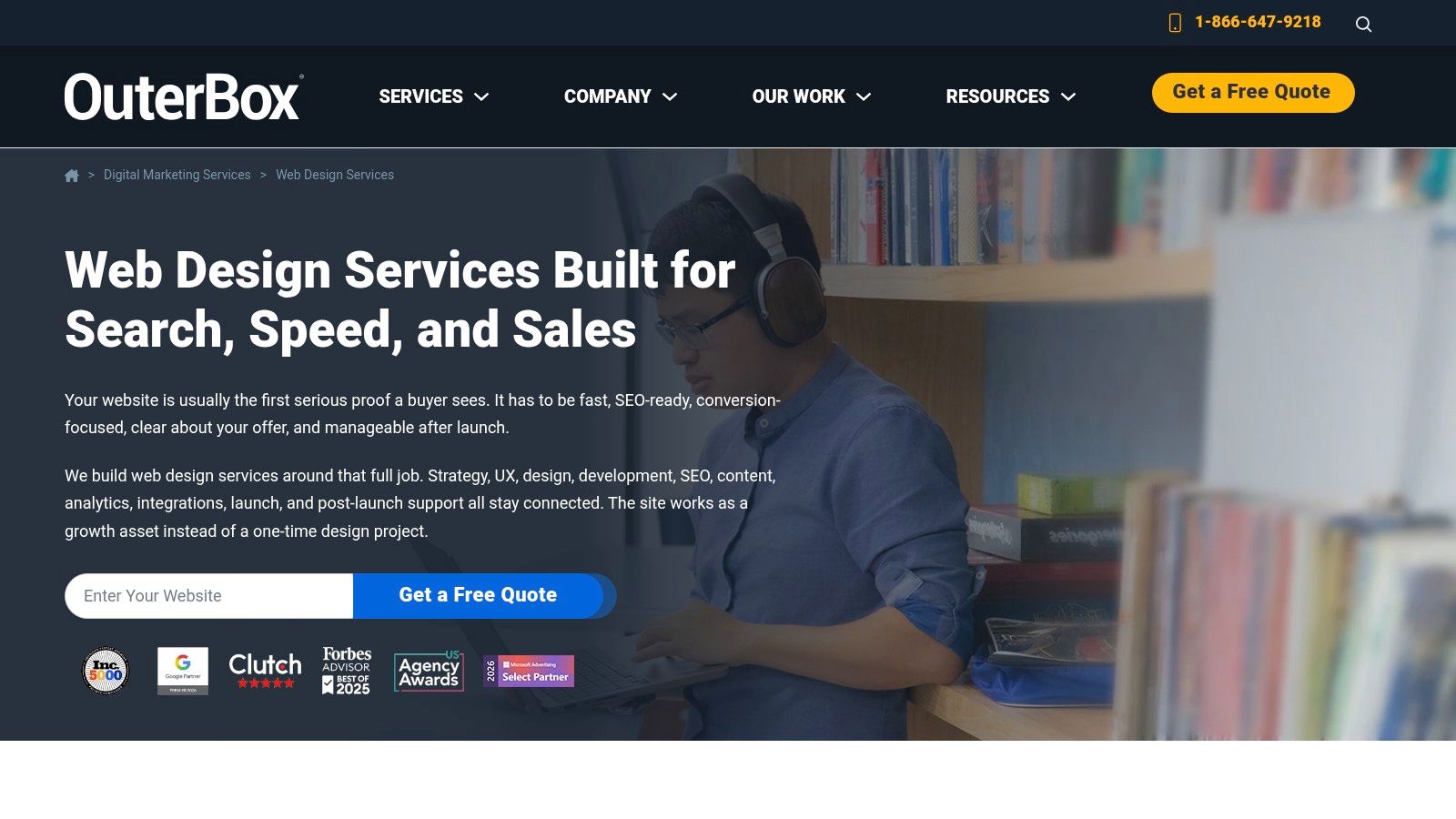
OuterBox came up through e-commerce and performance marketing, and that background still shows in how it approaches web design. It tends to think in terms of ranking, conversion paths, and platform execution, not just page aesthetics.
For review readers, that’s useful because many agencies talk about strategy while really selling a redesign package. OuterBox is more credible when the website has to carry ongoing acquisition goals after launch.
Where it has an edge
The agency supports custom sites for e-commerce and B2B lead generation, and it pairs that with in-house SEO, PPC, and CRO. If your team doesn’t want to relaunch and then search for a second vendor to fix conversion issues, that’s a real advantage.
Platform experience also matters here. OuterBox works across Shopify, BigCommerce, and Magento, so buyers can ask stack-specific questions instead of abstract ones. That’s usually where website design company reviews become more predictive. The best review isn’t “great team.” It’s “they understood the platform constraints and planned around them.”
What to press on in sales calls
- Post-launch ownership: Who handles optimization after the build is live?
- SEO migration process: How are redirects, metadata, and category structures handled during redesign?
- Growth integration: Will the same team support PPC, SEO, or CRO if results lag after launch?
Many review ecosystems exhibit a lack of depth. Orbit Media has argued that buyers should inspect process management, support, note-taking, project tools, and whether a vendor acts like a long-term partner, while major review environments such as Clutch, G2, Yelp, and Trustpilot make comparison easy but don’t standardize those operational signals, as discussed on Clutch’s Los Angeles web designers page.
OuterBox is usually a stronger option for companies that want that longer arc, especially in e-commerce. Small companies with simple needs may find a more compact studio easier to work with.
6. HUEMOR
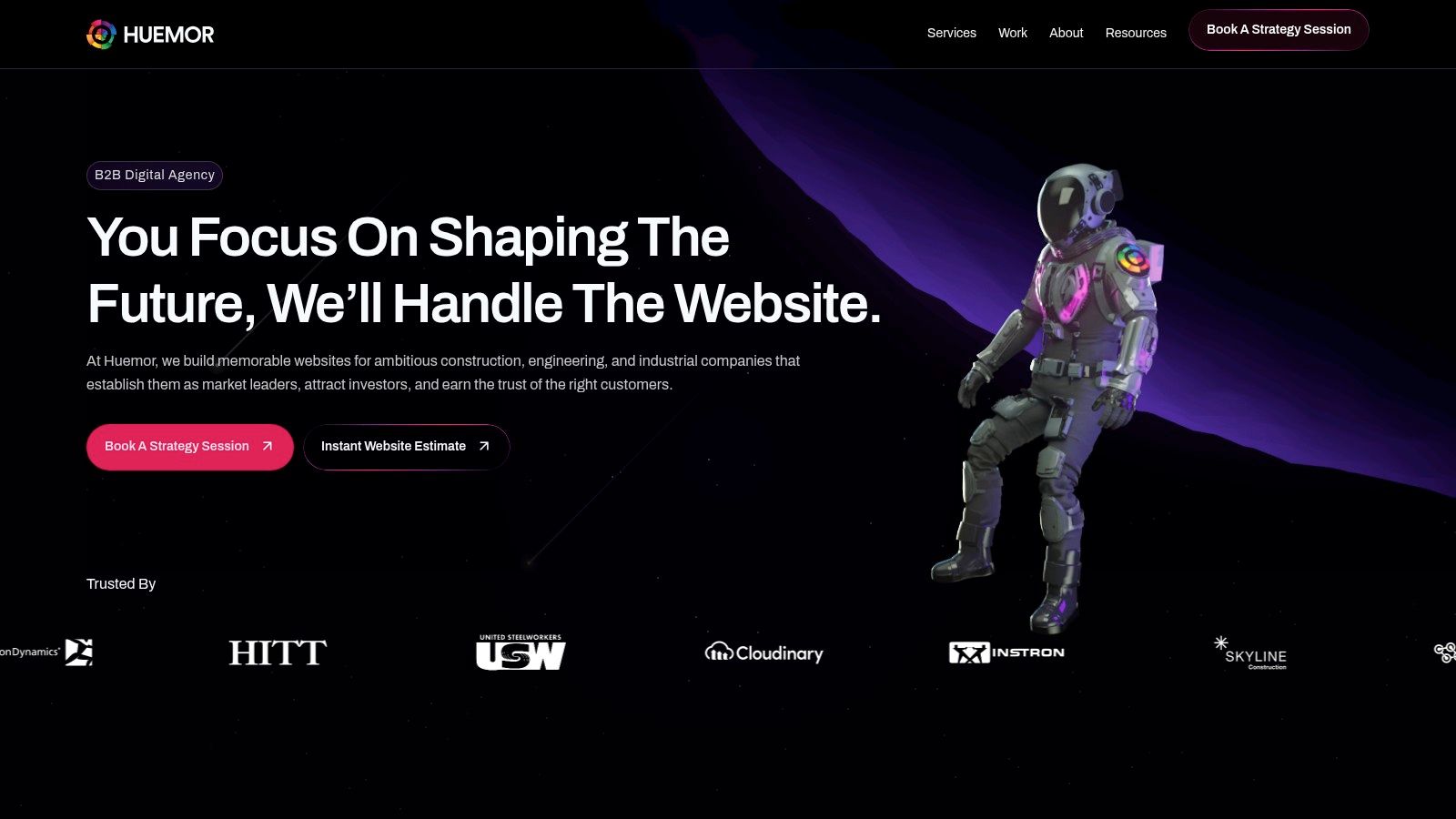
HUEMOR tends to enter the conversation when a company wants a redesign that changes brand perception, not just page layout. That’s a different buying motion from “we need a site refresh before next quarter.”
Its work is usually positioned around strategy-led redesigns, UI/UX research, design systems, and larger rebuilds. That makes it more relevant for B2B firms and e-commerce brands that already have traction and now need a more mature digital presence.
Why some teams prefer it
HUEMOR feels closer to a design-forward partner than a marketing machine. For the right buyer, that’s the point. Internal stakeholders often need an agency that can enhance messaging hierarchy, navigation, brand clarity, and interface consistency across a more complex site.
That doesn’t mean performance gets ignored. It means creative differentiation gets more attention than it would at a process-heavy generalist.
The wrong way to hire a firm like HUEMOR is to ask only about launch date and page count. Ask how they test assumptions, handle stakeholder alignment, and make design decisions under disagreement.
Limits to be realistic about
- Works best on larger redesigns: The service model fits companies making a substantial change, not minor tune-ups.
- Discovery matters more here: If your team wants an instant quote before discussing goals, the process may feel slow.
- Budget fit can narrow the field: Design-led rebuilds often come with higher investment than practical SMB site projects.
Website design company reviews can overrate agencies that feel easy to buy and underrate agencies that ask harder questions upfront. HUEMOR is one of the firms where that tension shows. If your project is complex, extra strategic friction early can save real pain later.
7. Thrive Internet Marketing Agency
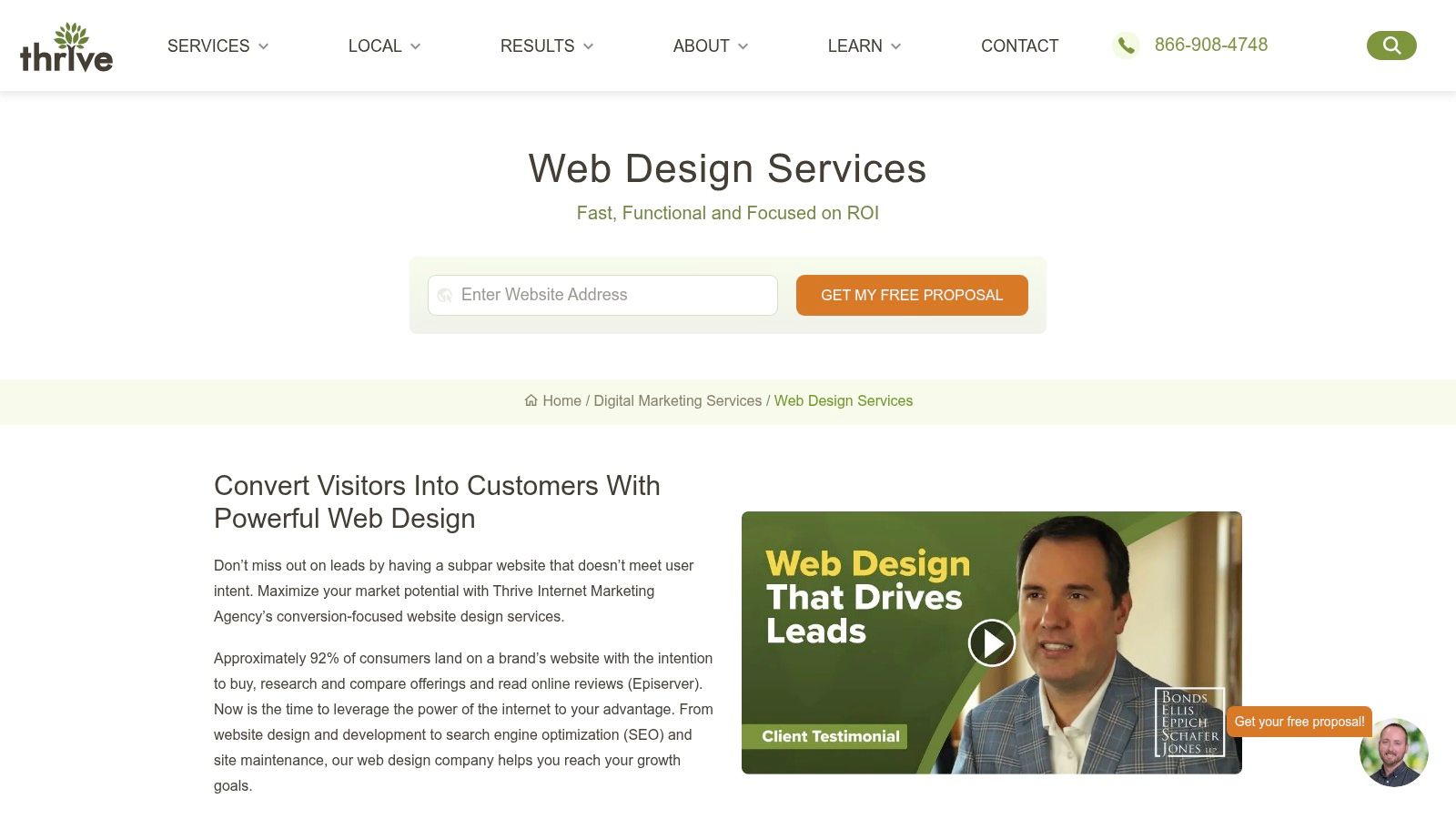
Need a site that your team can manage after launch without hiring a developer for every update? That is the practical case for Thrive.
Thrive fits businesses that want a marketing-ready website, often on WordPress, with design, development, SEO, PPC, social, and content available under one roof. For SMBs, that operating model matters as much as the visual work. It reduces handoff problems after launch and gives the same vendor a clear role in traffic and lead generation.
The appeal is straightforward. Many companies do not need an experimental rebuild or a custom stack. They need a site that is easy to edit, organized for search, and structured to support campaigns, location pages, service pages, and conversion tracking.
Why it makes sense for certain buyers
Thrive is easiest to justify when WordPress is already the right platform choice. That usually means service businesses, local brands, multi-location companies, and teams that want a familiar CMS with a large plugin ecosystem and broad hiring market. The upside is lower operational friction. The trade-off is that WordPress projects still depend on disciplined plugin management, hosting, and performance oversight.
Another reason Thrive appears in website design company reviews is breadth. A buyer can compare one agency across three practical criteria: specialty, process, and stack. Thrive’s specialty is growth-oriented SMB marketing. Its process tends to center on launch readiness and ongoing promotion, not brand-led reinvention. Its stack often points back to WordPress and standard marketing integrations rather than highly custom engineering.
Trade-offs
- Strong fit for practical growth projects: Thrive aligns well with local service businesses, franchise groups, and SMBs that need a site tied closely to SEO and paid acquisition.
- Less suited to unusual technical requirements: If your roadmap includes headless architecture, advanced application logic, or heavy platform customization, a more technical specialist is usually a better comparison.
- Review quality matters more than review volume: Look for comments about communication, revision handling, CMS usability, and post-launch support. Those details tell you more than a star rating.
Mobile UX should be part of that review filter. Google’s documentation on mobile-first indexing makes the standard clear: Google primarily uses the mobile version of a site for indexing and ranking, so weak mobile structure can affect both usability and search visibility (Google Search Central on mobile-first indexing). When you vet Thrive, ask to see recent mobile examples and ask how the team handles page speed, template bloat, forms, and location-page usability on smaller screens.
A simple set of questions will usually expose fit fast: What parts of the build are customized versus theme-based? Who owns QA on mobile devices? How are SEO requirements handled before design approval? What happens after launch if rankings or conversion rates slip? That framework works better than judging an agency on aesthetics alone.
Top 7 Website Design Agencies Comparison
| Agency | Implementation complexity | Resource requirements | Expected outcomes | Ideal use cases | Key advantages |
|---|---|---|---|---|---|
| Ascendly Marketing | Moderate–High, consultative, ongoing optimization | Custom engagements; multidisciplinary team involvement; budget scoped after discovery | Measurable increases in organic traffic, leads and online sales | SMBs, e-commerce, B2B lead-gen, local service providers, franchisors | End-to-end services, ex‑Google talent, strong reporting and lead-gen focus |
| WebFX | Moderate–High, process-driven, scalable for large projects | Large in-house team; premium pricing for multi-channel programs; configurator helps scope | Consistent traffic, leads and revenue growth with ROI tracking | SMBs to enterprise seeking a single full‑service partner | Rigorous processes, transparent scoping tools and strong project management |
| SmartSites | Moderate, repeatable web + acquisition alignment | Fixed-cost project models available; consult-based quotes; review-backed capacity | Tight integration of design with SEO/PPC; predictable launch timelines | Mid-market SMBs needing acquisition-focused design | Smooth handoffs between design and paid/organic channels; large portfolio |
| Coalition Technologies | High, e-commerce and platform-specific builds, headless options | Mid-to-upper market budgets; platform expertise (Shopify, Magento, BigCommerce, WP) | Strong e-commerce growth, improved site performance and SEO | E-commerce brands and B2B teams needing platform-optimized redesigns | Deep e-commerce/CMS expertise, CRO and performance emphasis |
| OuterBox | Moderate–High, e-commerce-first with growth pairing | Discovery-based custom scopes; higher budgets for full e-commerce builds | Measurable e-commerce and lead-gen improvements post-launch | E-commerce retailers and B2B lead‑gen sites | Extensive e-commerce experience, integrated SEO/PPC/CRO capabilities |
| HUEMOR | High, strategy-led redesigns and complex migrations | Higher budget thresholds (commonly $50k+); stakeholder collaboration required | Brand elevation, improved conversions and UX for enterprise redesigns | Organizations seeking brand differentiation and complex rebuilds | Strong creative/UX depth, clear budget guidance and collaboration |
| Thrive Internet Marketing Agency | Moderate, practical, WordPress-focused builds | Accessible engagement model for SMBs; higher tiers for complex/headless work | SEO-ready sites with clearer growth paths, improved traffic and leads | SMBs and multi-location service brands needing WordPress expertise | WordPress specialization, integrated SEO/content and national footprint |
Your Framework for Choosing a Web Design Partner
A shortlist helps, but the final decision usually turns on a few questions that review platforms don’t answer well. Start with discovery. Ask each agency what happens before design starts, who participates, what inputs they need from your team, and what they produce at the end of that phase. Vague answers usually predict vague execution.
Then move to measurement. Ask how they define success for a redesign. Push past generic terms like engagement or performance. You want to hear what they track, how often they report, who owns analytics setup, and how the agency responds if the site launches cleanly but doesn’t perform the way everyone hoped.
Next, test process discipline. Ask what project management tool they use, how they document decisions, how revisions are handled, and who your primary contact will be. If an agency can’t explain communication structure clearly, you should expect confusion once content, approvals, and technical changes pile up.
Use a challenge-based question instead of a softball. Ask for an example of a project where timelines slipped, stakeholders disagreed, or a migration got messy. The answer will tell you more than a curated success story. Good agencies don’t pretend problems never happen. They explain how they work through them.
A few interview questions usually separate strong candidates from polished sellers:
- Discovery depth: What do you need from us before sitemap, wireframes, or design concepts start?
- Success metrics: What will you measure after launch, and how will we see that data?
- Platform reasoning: Why are you recommending WordPress, Shopify, Magento, headless, or something else?
- Support model: Who handles post-launch fixes, updates, and optimization?
- Content and SEO workflow: Who owns copy, redirects, metadata, and migration checks?
- Team access: Will we work with strategists and developers directly, or only through an account manager?
The final screen is simple. Pick the firm whose answers reduce uncertainty. A good portfolio shows taste. A good process shows control. For most businesses, control is what turns a redesign into a working asset instead of an expensive reset.
If you want a partner that can handle the website build and the growth work around it, Ascendly Marketing is worth a serious look. The team combines website design with SEO, PPC, content, CRO, email, and lead generation, which makes it a strong fit for businesses that don’t want separate vendors for every stage of digital growth.