

You’re probably looking at two very different marketing proposals right now.
One says to run Google Ads, LinkedIn ads, cold email, maybe even event outreach so leads start coming in fast. The other says to invest in SEO, publish content, improve your website, and build an email nurture system that compounds over time. Both sound reasonable. Both want budget. And both claim they’ll grow the business.
That’s where most owners get stuck.
The core question isn’t which side sounds smarter in theory. It’s which approach fits your cash flow, sales cycle, team capacity, and growth target right now. If you’re asking what is inbound vs outbound marketing, you don’t need another vague explanation. You need a clear operating difference, a realistic timeline, and a practical way to decide where your next dollar goes.
The Marketing Crossroads Every Business Faces
A business owner gets two proposals.
The first proposal promises immediate visibility. Launch paid search. Send cold outreach. Retarget visitors. Sponsor an industry event. The message is simple: pay now, get attention now.
The second proposal asks for patience. Build landing pages. Publish useful articles. tighten up SEO. Create email sequences that educate leads instead of chasing them. The message is different: invest now, build momentum later.
Both proposals are talking about a real growth path. They’re just built on different philosophies.
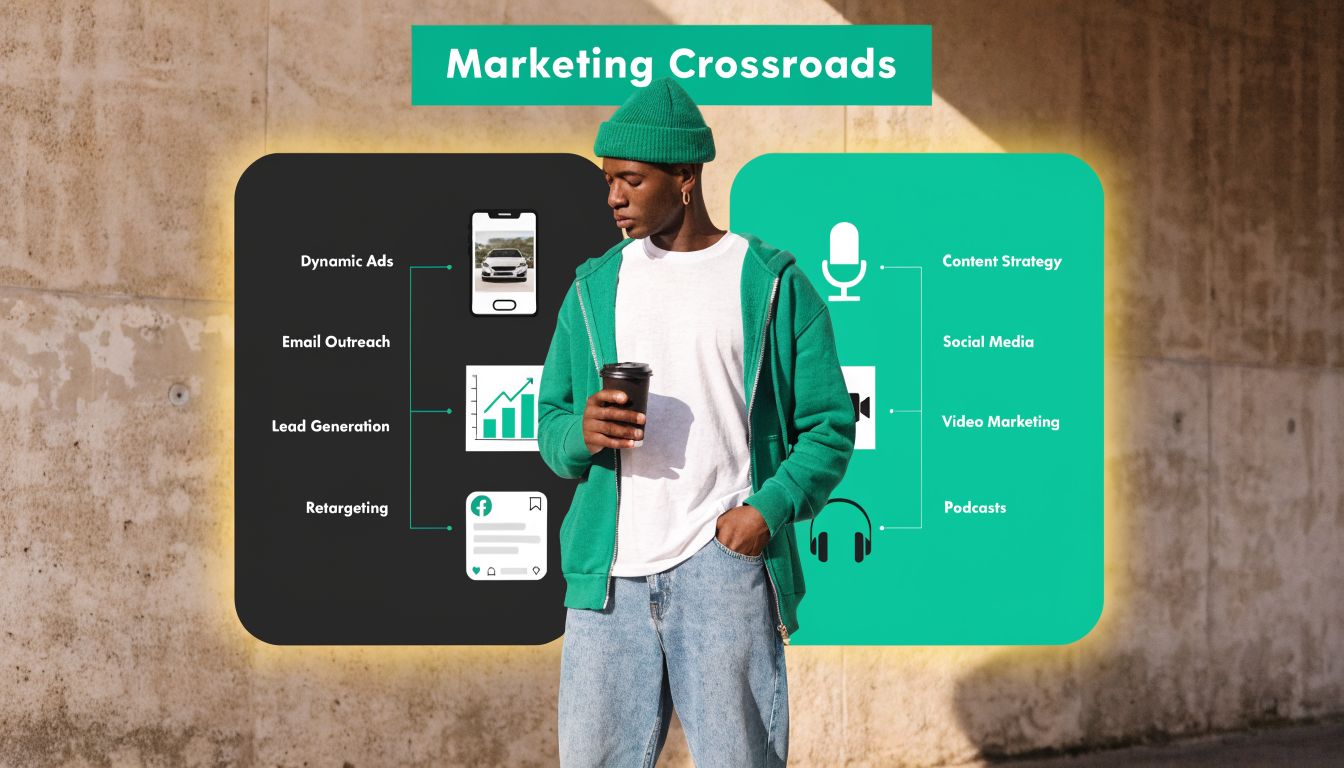
That choice shows up everywhere. A local service company wants more booked jobs this month. A B2B software company needs a stronger pipeline for next quarter. An ecommerce brand wants sales today but also wants to stop depending entirely on ad spend. They’re all dealing with the same decision.
The real issue isn’t preference
This isn’t a branding debate. It’s a resource allocation decision.
If you put too much money into outbound when your economics only work with long-term lead efficiency, you’ll burn budget fast. If you put everything into inbound when you need leads next month, you’ll sit on a nice content calendar while sales waits.
Practical rule: Choose marketing based on business timing first, channel preference second.
Here’s the blunt version. Inbound builds demand capture and trust over time. Outbound buys reach and speed. Most businesses need both, but not in equal amounts and not at the same stage.
Defining the Two Marketing Philosophies
Inbound marketing attracts people who are already looking for help, answers, or options. Outbound marketing pushes your message in front of people whether they were looking for you or not.
That’s the cleanest way to understand what is inbound vs outbound marketing.

Inbound works like a magnet
Inbound is the pull strategy.
You create useful assets that match buyer intent. That can be SEO pages, blog articles, comparison pages, email newsletters, lead magnets, webinars, videos, or helpful social content. A prospect searches, clicks, reads, compares, and reaches out because your business showed up at the right moment with something relevant.
The key point is intent. The buyer is moving toward the solution.
A few common inbound examples:
- SEO content: Service pages, blog posts, location pages, buying guides
- Email nurture: Sequences that educate leads after they download or inquire
- Organic social: Posts that answer questions and build familiarity
- Website conversion paths: Forms, landing pages, case-study pages, demo requests
Inbound usually feels less aggressive because it’s permission-based. The prospect chose to engage.
Outbound works like a megaphone
Outbound is the push strategy.
You go find the audience, pay for placement, or initiate contact directly. That includes Google Ads, paid social, display ads, direct mail, cold email, cold calling, trade shows, sponsorships, and list-based outreach. Instead of waiting for buyers to discover you, you put your offer in front of them.
The key point here is proactive reach. You move toward the buyer.
Common outbound examples include:
- Paid search and paid social: You buy visibility for targeted queries or audiences
- Cold outreach: Your team sends messages to prospects who haven’t asked for them
- Event marketing: Booths, sponsorships, and in-person lead capture
- Retargeting: Ads shown to previous site visitors or engaged users
A business launching a new offer often uses outbound because waiting for SEO and content to mature won’t help this quarter.
For a quick visual walkthrough, this video covers the core difference well:
The mindset difference matters more than the channel list
The mistake is thinking inbound and outbound are just two buckets of tactics. They’re not. They reflect two different ways of acquiring demand.
| Factor | Inbound | Outbound |
|---|---|---|
| Core move | Attract interest | Initiate contact |
| Buyer state | Already researching | May not be actively looking |
| Message style | Helpful and educational | Direct and promotional |
| Speed | Slower start | Faster launch |
| Durability | Builds assets | Stops when campaigns stop |
When owners say, “We need marketing,” they usually mean one of two things: “we need leads now” or “we need a system that lowers acquisition costs over time.”
That distinction decides whether inbound, outbound, or a hybrid makes sense.
A Detailed Comparison of Inbound and Outbound Tactics
Most articles stop at definitions. That’s not useful when you’re deciding where to spend actual money. You need to compare the methods the way an operator would compare them.
Here’s the early snapshot.

| Criteria | Inbound marketing | Outbound marketing |
|---|---|---|
| Primary goal | Earn attention and convert demand already forming | Create attention and generate immediate reach |
| Typical channels | SEO, blogs, organic social, email nurture, webinars, content hubs | PPC, paid social, cold email, cold calling, display, events, direct mail |
| Audience dynamic | Permission-based engagement | Interruption-based engagement |
| Budget pattern | Front-loaded in content, site work, SEO, systems | Ongoing spend tied to media or outreach volume |
| Result pattern | Slower start, longer tail | Faster start, shorter tail |

Channels and where they fit
Inbound channels work best when buyers ask questions before they buy. If your customers compare options, research vendors, or need education, inbound should carry real weight in your mix.
That usually includes:
- Search-driven content: Buyers search, your page ranks, and your site captures the visit.
- Educational assets: Guides, FAQs, videos, and product explainers help hesitant prospects move forward.
- Email nurture: Once a lead opts in, you continue the conversation without paying for every touch.
Outbound channels fit better when you need to create awareness quickly or when your ideal buyer isn’t actively searching in large enough volume.
That usually includes:
- Google Ads: Strong for high-intent terms and fast testing.
- LinkedIn or Meta ads: Useful when job title, interest, or audience segmentation matters.
- Cold email and outbound prospecting: Strong when your target account list is clear.
- Trade shows and exhibitions: Still useful in industries where in-person trust matters. If your growth strategy includes events, reviewing examples from specialist Exhibition Stand Builders can help you think through the outbound mechanics of booth design, traffic flow, and lead capture.
Audience engagement feels completely different
Inbound starts with relevance. The buyer encounters a page, article, video, or email because it lines up with a need they already have. That changes the tone from the start. You’re not trying to force attention. You’re trying to deserve it.
Outbound starts with interruption. That doesn’t make it bad. It just means your targeting and message have to work much harder. If the offer is weak, or the audience is wrong, outbound gets expensive quickly.
A lot of businesses don’t have a lead problem. They have a message-to-market fit problem that outbound exposes faster than inbound.
Cost structure and conversion behavior
At this point, the gap becomes hard to ignore.
According to GrowLeads' inbound vs outbound conversion data, inbound marketing demonstrates a 10x higher effectiveness rate for lead conversion compared to outbound approaches. The same source states that well-executed inbound strategies can double average website conversion rates from 6% to 12%, while generating 54% more leads and reducing cost-per-lead by 62%.
Those numbers don’t mean outbound is broken. They mean inbound usually produces better economics once the system is working.
Outbound spend is easier to activate. Turn on campaigns, buy placements, start outreach. But when you stop paying or stop sending, volume usually falls with it. Inbound takes longer because content, SEO, site structure, and conversion assets need time to build traction. Once they do, they keep working.
If you’re running outbound today and you need a cleaner framework for prospecting channels, offer structure, and campaign design, this breakdown of outbound lead generation strategies is worth reviewing.
Timelines and what owners usually get wrong
Owners often compare inbound and outbound as if they should produce results on the same timeline. That’s the wrong comparison.
Outbound is built for speed. Inbound is built for durability.
Here’s the practical difference:
- Need leads now: outbound solves the timing problem faster.
- Need lower acquisition costs over time: inbound solves the efficiency problem better.
- Need both: run outbound to create short-term flow while inbound infrastructure matures.
The businesses that get stuck usually do one of two things. They expect inbound to work like paid media in the first few weeks, or they stay addicted to paid campaigns and never build assets that reduce reliance on them.
The Financial Reality Cost Versus Investment
A lot of owners hear “inbound is cheaper” and assume it’s automatically the better choice. That’s too simplistic.
The smarter question is this: cheaper when, and cheaper for whom?

Inbound usually wins on efficiency
For small and mid-sized businesses, Salesforce’s overview of inbound vs outbound marketing says inbound marketing yields 3x more leads per dollar than outbound, but it can require a 62% higher upfront investment in content and SEO tools. The same source notes that inbound ROI often takes 6-12 months to show up.
That’s the part many agencies gloss over.
Inbound isn’t cheap at the start if you do it properly. You need strategy, content production, SEO work, landing pages, analytics, and someone to keep the machine moving. You’re building assets, not just buying traffic.
Outbound is easier to forecast in the short term
Outbound is often more comfortable for owners who need immediate movement. You can assign budget, launch campaigns, monitor response, and make changes quickly. That makes outbound easier to justify when sales pressure is high.
The tradeoff is that outbound rarely gives you the same long-run economics. It’s more like renting attention. Useful, sometimes necessary, but still rented.
A simple way to think about the money:
| Question | Inbound answer | Outbound answer |
|---|---|---|
| What are you buying? | Assets that can keep producing | Exposure and immediate reach |
| When do results show? | Later | Earlier |
| What happens if spending slows? | Existing assets can keep generating demand | Results usually drop fast |
| Who struggles with it? | Businesses with tight cash flow and no runway | Businesses with weak targeting or weak conversion economics |
Match the plan to your runway
If your business needs pipeline this month to cover payroll, a pure inbound plan is a bad management decision. If your business has stable cash flow and a long sales cycle, leaning too hard on outbound can trap you in constant spend.
Use this quick filter:
- Choose inbound first if your buyers research before they buy, your margins support a slower ramp, and you want stronger long-term efficiency.
- Choose outbound first if you need immediate traffic, fast testing, or rapid awareness for a new offer.
- Choose a blend if you need near-term leads but also want to stop rebuilding the pipeline from scratch every month.
Owner test: If you turn off your current marketing for a month, what still works? If the answer is “almost nothing,” you have an asset problem, not just a lead problem.
If you want to pressure-test your own numbers, this guide to how to calculate marketing ROI is a useful place to start. It helps separate channel vanity from actual business return.
Choosing Your Strategy Industry-Specific Playbooks
There isn’t one correct split between inbound and outbound. The right mix depends on how buyers buy in your category.
According to IMD’s analysis of inbound vs outbound strategy, the choice is context-dependent. Inbound performs better when trust-building and education matter, such as in B2B SaaS, while outbound is stronger for rapid market penetration and broad awareness campaigns, including the kind used by brands like Nike and Coca-Cola.
That’s a useful principle. Now make it practical.
B2B companies should lean inbound first
If you sell a service or product with a longer sales cycle, buyers need proof before they need a pitch. They want to know whether you understand the problem, whether your process is credible, and whether your team can reduce risk.
That makes inbound the foundation.
Use:
- SEO pages around high-intent problems
- Comparison content and decision-stage articles
- LinkedIn thought leadership from leadership or sales
- Email nurture for leads that aren’t ready yet
Outbound still matters, especially for account-based targeting and list-based outreach. But if your website can’t educate and convert, outbound just drives more people to a weak follow-up experience.
For B2B firms building authority, a strong B2B content marketing strategy is usually the first serious upgrade.
Ecommerce brands need a balanced model
Ecommerce is different. Speed matters. Visibility matters. Product discovery matters. You often can’t wait for organic content alone to carry revenue, especially with new collections, seasonal demand, or competitive categories.
That’s why a hybrid model usually makes more sense.
Run outbound for immediate product exposure through paid search, paid social, retargeting, and promotional campaigns. Build inbound around category pages, product education, email flows, buying guides, and content that supports repeat purchase and branded search growth.
The split works because each side does a different job:
- Paid channels create demand and capture short-term buying intent
- Inbound content improves trust, search coverage, and retention over time
If an ecommerce brand relies only on outbound, customer acquisition stays expensive. If it relies only on inbound, growth can stall while competitors buy attention.
Local service businesses should keep it simple
Local operators often overcomplicate this decision.
If you’re a law firm, home service company, clinic, contractor, or regional provider, you need two things. Show up when people search locally, and stay visible when they’re comparing options. That means local SEO and paid local campaigns usually work best together.
Your inbound base should include:
- Service pages built around actual customer searches
- Location pages where geographic intent matters
- Reviews, trust signals, and clear conversion paths
- Helpful FAQ content that answers the questions customers ask before calling
Your outbound side should focus on targeted paid search, retargeting, and selective local promotions. Broad awareness buys are usually wasteful unless your category depends on scale.
Local service businesses don’t need more channels. They need tighter targeting, better landing pages, and faster follow-up.
Startups and new offers should use outbound to force learning
A startup doesn’t just need leads. It needs feedback.
Outbound helps you test message, audience, and offer faster because you can get in front of buyers quickly. You learn which objections show up, which positioning resonates, and which segments respond. Then you use that intelligence to build stronger inbound assets.
That sequence matters. Don’t spend months writing polished content before you know which message converts.
Measuring What Matters Key Performance Indicators for Each
A bad dashboard can wreck a good strategy.
If you judge inbound with the same lens you use for outbound, you’ll cut it too early. If you judge outbound with vague brand metrics, you’ll overspend without knowing why.
What to watch for inbound
Inbound needs metrics tied to asset performance and conversion quality.
Look at:
- Organic traffic quality: not just visits, but whether the right pages attract the right prospects
- Keyword visibility for commercial topics: service, comparison, and solution-based terms
- Landing page conversion rate: what percent of visitors become leads
- Lead quality over time: are sales conversations improving as content matures
- Assisted conversions: which pages influence leads before they convert
The economics matter here. According to BrandExtract’s review of inbound and outbound performance, inbound marketing leads cost 61% less on average than outbound leads. The same source says content marketing generates over three times as many leads as traditional outbound methods while costing 62% less per lead.
That means the right inbound dashboard should show whether your content engine is lowering acquisition cost and improving lead quality over time.
What to watch for outbound
Outbound needs tighter short-cycle controls.
Track:
- Click-through rate and response rate: are people reacting at all
- Cost per lead or cost per acquisition: what does each result cost
- Lead-to-meeting rate: are the leads worth sales time
- Audience and offer performance by channel: which message works with which segment
- Speed to response: especially for paid leads and form submissions
Outbound gives faster feedback. That’s its strength. But it also punishes weak execution faster.
Don’t ask paid campaigns to prove long-term brand trust, and don’t ask SEO to justify itself like a week-one ad test. Different systems need different scorecards.
Build one view, not one metric
You want one reporting view across both approaches, but not one success metric. Inbound should be judged on momentum, conversion quality, and cost efficiency as assets mature. Outbound should be judged on speed, controllability, and immediate pipeline contribution.
If those are mixed together carelessly, you’ll end up funding the loudest channel instead of the one doing the right job.
Your First 90 Days A Quick Implementation Roadmap
Most businesses don’t need a full rebuild. They need a disciplined first quarter.
A strong opening move is to combine a modest outbound push with a focused inbound build. That creates early data, early traffic, and the foundation for better economics later.
Days 1 to 30 set the foundation
Start with clarity.
Define your best buyer segments, your highest-value services or products, and the core questions buyers ask before they convert. Tighten up your website pages so each one has one clear job. Then set up analytics, CRM attribution, form tracking, and campaign tagging so future decisions aren’t based on guesswork.
In the same month, choose one outbound test lane and one inbound asset lane.
For example:
- Outbound lane: Google Ads for high-intent searches, LinkedIn ads for narrow B2B targeting, or cold email to a tightly defined list
- Inbound lane: one service page refresh, one landing page, and a short content cluster around a real buyer problem
If your internal team is stretched thin, operational support matters. For execution-heavy tasks like inbox management, list cleanup, scheduling, and campaign admin, this guide on hiring a virtual assistant for internet marketing gives a practical view of what can be delegated without slowing strategy.
Days 31 to 60 launch and gather signal
Now you need live feedback.
Launch the outbound test with a constrained budget and a tight offer. Don’t spread money across too many channels. One clean campaign with solid landing pages beats five weak experiments.
At the same time, publish your first inbound assets and connect them to conversion paths. Add forms, demo requests, quote requests, downloads, or consultation CTAs based on how your buyers move.
Use this period to answer basic questions:
- Which message gets clicks or replies?
- Which audience converts, not just engages?
- Which pages hold attention and move people forward?
- Which objections appear repeatedly in sales conversations?
Days 61 to 90 optimize and add AI carefully
By this stage, you should have signal. Not perfect certainty, but enough to stop guessing.
According to Default’s discussion of inbound vs outbound sales trends, emerging AI-driven trends are shaping both strategies for 2026. The source says AI-powered outbound tools can boost conversion by 40%, and it also points to AI’s growing role in inbound content creation and personalization as Google’s AI Overviews prioritize E-E-A-T signals.
The practical move isn’t to automate everything. It’s to use AI where it improves speed and relevance.
Use it for:
- Outbound personalization: adapt cold outreach by segment, industry, or pain point
- Content support: accelerate briefs, topic clustering, and page updates
- Lead routing and follow-up prompts: reduce lag between inquiry and response
- Testing: generate message variants faster, then let real performance decide
Don’t use AI to replace strategy. Use it to remove slow manual work so your team can spend more time on message, offer, and conversion.
By the end of the first 90 days, you should know which outbound motion can produce short-term pipeline and which inbound assets deserve more investment. That’s enough to build a serious quarter-two plan instead of running random tactics.
If you want a team that can build the strategy, execute the channels, and show you what’s working, talk to Ascendly Marketing. They help businesses turn inbound and outbound into one measurable growth system instead of two disconnected experiments.