

You publish a blog post. A few people on the team share it on LinkedIn. Traffic comes in, but sales asks a familiar question: “Did this bring in anything useful?” No one has a clean answer.
That’s where most B2B content programs stall. The issue usually isn’t effort. It’s the lack of a system that connects buyer research, content planning, production, distribution, and measurement to the pipeline.
A workable B2B content marketing strategy looks less like an editorial calendar and more like an operating model. It starts with buyer evidence, not assumptions. It turns a small number of core ideas into repeatable assets. It gives sales something usable. And it measures content by movement through the funnel, not by page views alone.
Only 41% of B2B marketers have a documented content strategy, according to Lovewell’s roundup of B2B content marketing data. That gap shows up quickly in the field: scattered topics, inconsistent messaging, weak attribution, and reporting that never gets past engagement metrics.
Laying the Foundation with Buyer-Centric Research
Most weak content strategies start with a persona slide. It has a job title, a list of pain points, maybe a stock photo, and almost nothing your team can use to make decisions. That’s not enough for messaging, topic selection, or distribution.
A stronger starting point is a live ICP, built from current signals. That means sales calls, support conversations, CRM notes, lost deal reasons, and the language buyers already use when they compare options. For small teams, this is more practical than commissioning a large research project, and it produces sharper messaging faster.

Build an ICP from evidence, not preference
Start with accounts you’d want more of. Not just companies that bought, but companies that bought quickly, stayed engaged, and matched your margins or service model.
Then document five things:
Company fit
Industry, business model, team structure, buying complexity, and whether your offer fits their actual operating reality.Trigger events
What causes them to look for help? That could be a stalled growth target, a site migration, a lead quality problem, or pressure from leadership to prove marketing contribution.Decision criteria
What they care about when they compare vendors or solutions. Some buyers want speed. Others want reporting clarity, channel integration, or stronger sales alignment.Internal blockers
Procurement, legal review, unclear ownership, executive skepticism, or lack of internal bandwidth. These shape the content buyers need before they’re ready to talk.Language patterns
Exact phrases from calls, tickets, demos, and email threads. These phrases often outperform polished internal messaging because they match how the buyer thinks.
Practical rule: If your ICP can’t help you reject a topic, choose a format, or brief a writer, it’s still too vague.
Use lightweight research methods your team already has
You don’t need a dedicated research department to get useful buyer insight. Your organization likely possesses enough raw material to improve its strategy.
A practical discovery sprint usually includes:
Sales interviews
Ask account executives what questions come up before a deal moves forward, what objections repeat, and which deals looked good but went nowhere.Support and success review
Look at onboarding friction, feature confusion, and recurring requests. Post-sale questions often reveal what pre-sale content failed to explain.CRM and call recording review
Pull notes from wins, losses, and stalled opportunities. The goal isn’t volume. The goal is recurring patterns.Social listening and community scans
Check LinkedIn comments, Reddit threads, Slack groups, event chats, and niche forums where your buyers ask blunt questions they won’t ask in a sales call.Site search and search console data
Internal site search shows what people expected to find but didn’t. Search queries show where your language may not match market language.
For teams refining their framework, this guide on how to create buyer personas that drive B2B growth is useful because it pushes beyond demographic descriptions and toward buying behavior.
Find the gap between what buyers ask and what the business needs
Buyer-centric doesn’t mean publishing every basic question your audience could type into Google. Content needs to sit at the intersection of buyer demand and business value.
That’s where many teams drift. They publish broad educational content that attracts interest from people who will never buy. Traffic grows, but the wrong traffic grows.
A better filter is simple:
| Question | If yes | If no |
|---|---|---|
| Does this topic map to a real buying trigger? | Keep evaluating | Drop it |
| Can sales use this in an active conversation? | Prioritize it | Rework it |
| Does it support a service, offer, or category you want to grow? | Build around it | Park it |
| Can your team add a distinct point of view? | Publish it | It will blend in |
Forrester notes that 82% of buyers want vendors with unique perspectives, yet many teams lack the buy-in or research budget to operationalize that buyer-centric messaging, as discussed in Forrester’s content strategy guidance. That’s why generic content underperforms. It sounds acceptable to everyone and useful to no one.
A digital buyer journey also changes how early this research work matters. If your prospects do most of their evaluation before speaking with you, your published content has to carry more of the sales process. That’s why this breakdown of how much of the buyer’s journey is digital is worth reviewing when you set expectations for content’s role.
Turn research into a working messaging document
Don’t leave your findings in a slide deck. Convert them into a document your team can use every week.
Include:
- ICP summary with fit criteria and buying triggers
- Message map with core problems, common objections, and proof points
- Topic exclusions so the team avoids low-value traffic traps
- Channel notes showing where this buyer engages
- Sales questions list that content should answer before a meeting
That document becomes the base for everything that follows. Without it, pillar planning turns into guesswork.
Building Your Content Engine with Pillars and Formats
Once the ICP is clear, content planning gets easier. Not because you’ll have fewer ideas, but because you’ll stop chasing the wrong ones.
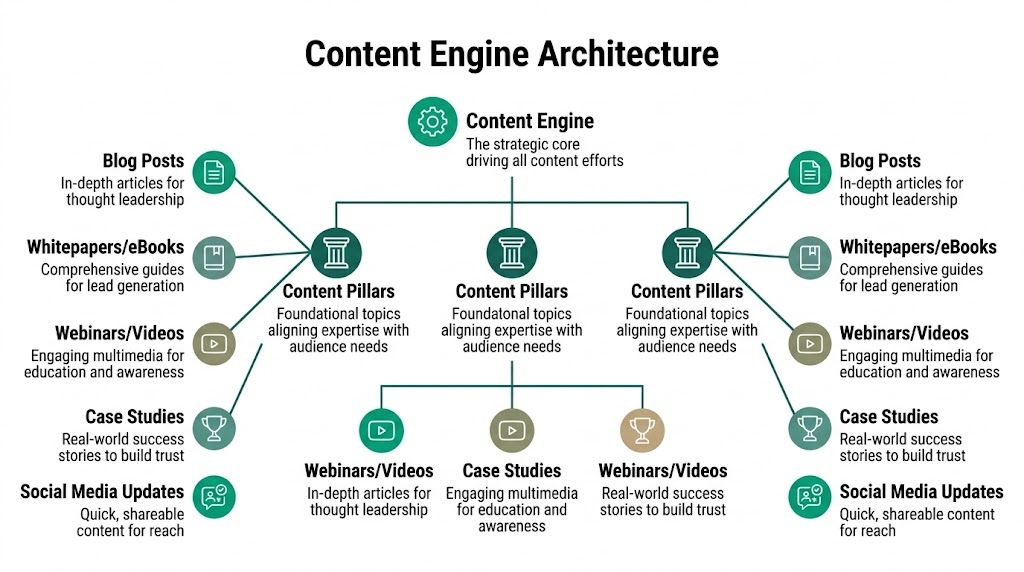
Teams often don’t need more topics. They need structure. A content engine works when it groups ideas into a small number of pillars and then breaks those pillars into related clusters and formats.
Choose pillars that support revenue, not just relevance
A pillar is a topic area where three things overlap: buyer need, business offer, and internal expertise. If one of those is missing, the pillar won’t hold.
For a B2B agency or service business, a clean pillar set might look like this:
-
Demand generation
Topics around lead quality, pipeline creation, offer positioning, and channel mix. -
Website and conversion performance
Messaging, UX friction, conversion paths, landing pages, and sales handoff points. -
Measurement and attribution
Content ROI, CRM tracking, reporting frameworks, and sales-marketing alignment.
Those pillars are broad enough to support many assets, but narrow enough to keep the brand focused. They also create a direct path from educational content to commercial relevance.
Build topic clusters under each pillar
Clusters turn a pillar into an editorial system. One pillar can support early-stage search content, mid-funnel consideration content, and bottom-funnel enablement content.
Here’s a simple example for the measurement and attribution pillar:
| Cluster | Buyer question | Useful formats |
|---|---|---|
| Content ROI basics | What should we measure besides traffic? | Blog post, checklist, webinar |
| Attribution setup | How do we connect content to opportunities? | Guide, template, video walkthrough |
| Sales alignment | Why does marketing report one thing and sales another? | Executive brief, workshop deck, article |
| Reporting model | What should a content dashboard include? | Spreadsheet template, blog post, email series |
Strategy starts to save time. Instead of brainstorming from scratch every month, you’re selecting from a mapped system.
Strong content planning reduces waste. Teams stop asking “What should we publish next?” and start asking “Which part of the journey needs support?”
Match formats to buyer stage
Format choice shouldn’t come down to team preference. It should reflect the level of commitment you’re asking from the buyer and the decision they’re trying to make.
A simple way to choose:
-
For early-stage discovery
Use search-focused blog posts, short videos, visual explainers, and concise LinkedIn posts. These help buyers frame the problem. -
For mid-funnel evaluation
Move into webinars, guides, comparison pages, and email sequences. These help buyers assess approaches and shortlist options. -
For late-stage confidence
Use case studies, implementation pages, sales one-pagers, proposal support assets, and objection-handling content. These help buyers justify the decision internally.
Not every company needs every format. Most small teams do better with fewer formats used consistently than with a long list produced irregularly.
If you need a practical planning framework, this content marketing plan template is a useful reference because it forces a connection between topic, format, audience, and business objective.
Keep the engine narrow at first
A common mistake is launching too wide. Five pillars become ten. One webinar idea becomes a dozen loosely related blog drafts. The calendar fills up, and none of it compounds.
Keep your first version tight:
- Pick a small number of pillars
- Define cluster topics before assigning titles
- Choose formats your team can sustain
- Make each asset serve a clear stage in the journey
That discipline matters more than volume. A B2B content marketing strategy works when it builds familiarity and trust around a focused set of problems your team can solve.
Orchestrating a Repeatable Production Flywheel
A strategy can be sound and still fail in execution. That usually happens when production depends on memory, heroics, or a few overextended people chasing approvals.
The fix isn’t more meetings. It’s a repeatable workflow with clear ownership, clear deadlines, and a repurposing model that gets more value from each core asset.
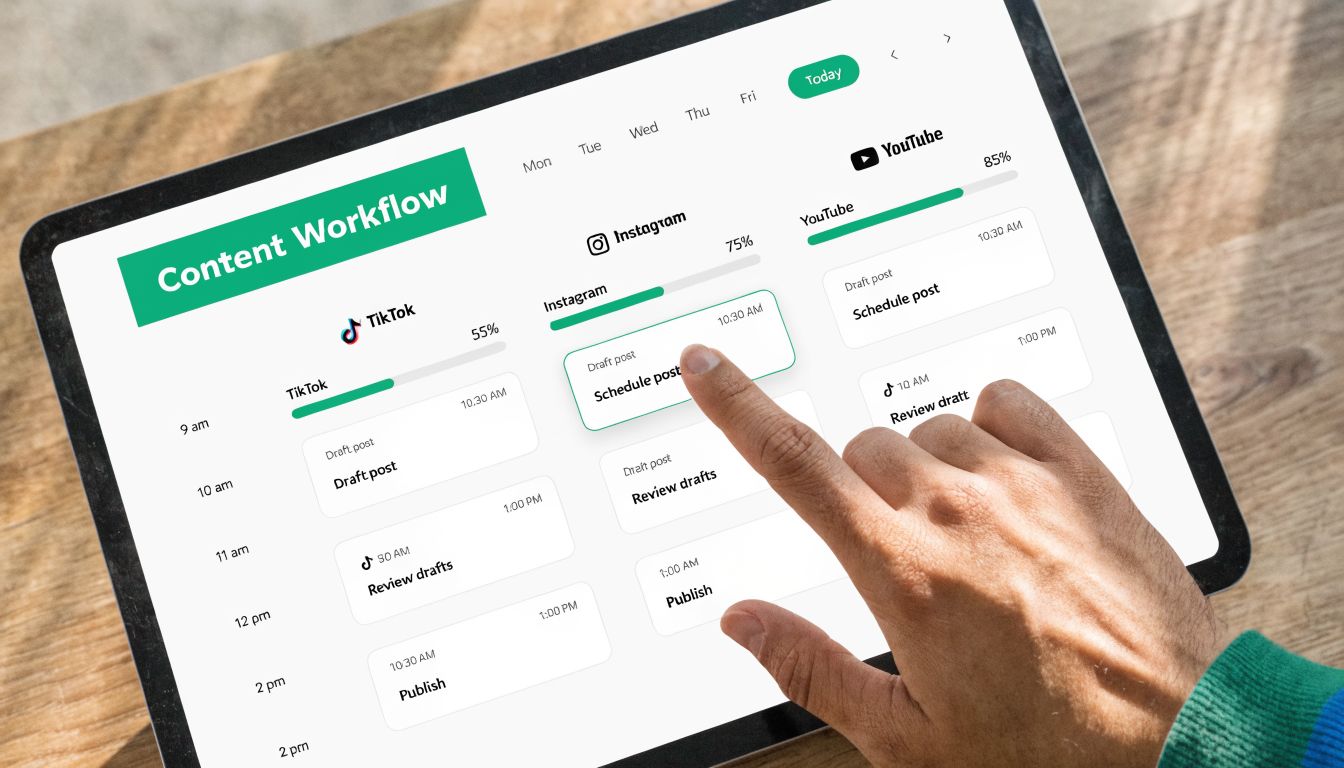
Build a calendar your team will actually maintain
Skip the complicated editorial software if no one will keep it updated. A spreadsheet, Airtable base, or ClickUp board is enough if the fields are useful and the team respects the process.
At minimum, track:
| Field | Why it matters |
|---|---|
| Topic or asset name | Keeps naming consistent across teams |
| Pillar and cluster | Prevents random publishing |
| Target audience | Avoids one-size-fits-all briefs |
| Funnel stage | Clarifies the job of the asset |
| Format | Controls production scope |
| Owner | Removes confusion fast |
| Draft date and publish date | Creates accountability |
| Distribution plan | Stops “publish and forget” behavior |
| CTA | Connects content to next action |
That calendar should live where content, design, SEO, paid, and sales can all see it. Hidden calendars create hidden delays.
Use a five-stage workflow
Most production problems come from skipping steps, not from the writing itself. A simple workflow keeps quality stable even when multiple people touch the asset.
Stage one: Ideation and prioritization
Pull ideas from your pillar map, sales requests, SEO research, and campaign needs. Score each idea on buyer relevance, business relevance, and execution effort. If a topic scores high on attention but low on buyer fit, drop it.
Stage two: Brief creation
A brief should answer the writer’s real questions before they ask them. Include the audience, search intent, CTA, internal links, proof points, objections to address, examples to include, and phrases from customer research.
Stage three: Drafting and subject review
Writers draft. Subject matter experts review for accuracy and nuance. Keep reviews focused. SMEs shouldn’t rewrite the article in their own voice line by line unless they’re the author.
Stage four: Design, SEO, and publication prep
Add visuals, check metadata, confirm internal links, verify CTA placement, and make sure the page supports scanning. This is also where teams often forget to plan distribution copy.
Stage five: Post-publication checks
Confirm indexing, validate forms, test CTA clicks, and monitor early engagement signals. Then collect feedback from sales. If reps don’t use the piece, find out why.
Operational note: A content workflow should remove decision fatigue. Each person needs to know what they own, what “done” means, and what happens next.
Repurpose from a premium asset outward
At this point, the flywheel starts to work. Instead of creating every asset from zero, build from one substantial piece of source material.
Hinge Marketing notes that high-performing teams repurpose one research study into over 150 related assets, creating a multi-touch experience across the funnel, in their analysis of why B2B content strategies fail. The point isn’t to hit that exact number. The point is that one strong source asset can support many downstream uses if the system is designed for it.
A practical repurposing chain might look like this:
Start with a whitepaper or research report
Use original insight, internal data, or a structured point of view.Split it into focused articles
Each article answers one question from the larger asset.Extract short social posts
Pull findings, counterpoints, or practical rules.Turn sections into email nurture content
Sequence content by buyer stage, not publish date.Equip sales with derivative assets
One-pagers, follow-up emails, objection responses, and slides.
Later in the workflow, a short explainer can help teams visualize how automation supports repeatable execution.
Protect quality without slowing everything down
Small teams often swing between two bad extremes. Either nothing gets reviewed, and quality drops, or every stakeholder edits every draft and output stalls.
A better review model is narrower:
- One strategic owner decides whether the asset fits the plan
- One subject reviewer checks accuracy
- One editor protects clarity, consistency, and structure
- One final approver signs off if needed
If you want production support inside a broader execution system, marketing automation for B2B is one useful area to connect with content operations. Workflow automation won’t fix a weak strategy, but it will reduce manual follow-up, missed handoffs, and publishing delays when the strategy is already solid.
Activating Smart Content Distribution Channels
Publishing is the midpoint, not the finish line. A strong article with weak distribution usually looks like a content problem when it’s really an exposure problem.
Good distribution is coordinated. Search, LinkedIn, email, and paid promotion should reinforce the same asset from different angles. When these channels work in isolation, performance is uneven and hard to explain. When they work together, each one supports the next touch.
Treat SEO, social, and email as one system
Search brings in buyers who are actively looking for answers. LinkedIn creates repeated exposure in the places B2B buyers already spend professional attention. Email keeps the conversation moving after someone raises a hand.
That means one content asset should rarely have one route to market.
A simple integrated rollout looks like this:
- Organic search captures problem-aware buyers with a page built around a clear query and internal links to related content.
- LinkedIn distribution reframes the same asset into short posts, executive commentary, carousels, and team shares that create familiarity.
- Email nurture delivers the asset to segmented contacts based on role, interest, or stage rather than blasting the full list.
- Paid amplification extends reach after you know the message is resonating organically.
This approach also improves learning. If a topic gains traction in search but gets ignored in email, that tells you something different than a broad “this piece underperformed” label.
Improve discoverability before adding promotion
Teams often jump to paid distribution when the asset itself is hard to find, hard to scan, or unclear in its next step. Fix the page first.
Check these basics:
| Distribution area | What to verify |
|---|---|
| Search visibility | Clear title, useful headers, internal links, and a page that matches search intent |
| Readability | Short paragraphs, strong subheads, obvious CTA, and no wall-of-text sections |
| Social sharing | Distinct point of view, short pull quotes, and a post angle tailored to the platform |
| Email readiness | Segment-specific intro copy and one clear reason to click |
| Sales usage | A version reps can send without rewriting it |
A page can rank and still fail commercially if it attracts curiosity instead of qualified intent. Distribution quality depends on message-market fit, not just channel effort.
Use LinkedIn with more discipline
For many B2B teams, LinkedIn is the default social channel. That doesn’t mean dropping a link with “new blog post” and hoping for traction.
A better method is to create multiple entry points:
- A founder or executive take that frames the issue and links to the deeper piece
- A practitioner post from someone closer to delivery that adds a tactical observation
- A carousel or visual summary for buyers who won’t click into long-form content right away
- Employee advocacy prompts that give internal teams a short, usable share angle
The goal isn’t to repeat the same caption. It’s to adapt the message for different voices while keeping the underlying argument consistent.
A distribution plan should answer one question for each channel: why would someone engage with this here?
Use email for movement, not announcements
Email still works well in B2B when it does a job beyond promotion. Instead of announcing each asset, use email to move contacts from one question to the next.
For example:
- A lead downloaded a measurement guide. Send a follow-up email that addresses reporting friction.
- A prospect viewed a service page after reading an educational article. Send a related asset that handles a likely objection.
- A dormant opportunity re-engaged. Route a practical case-relevant resource to sales for one-to-one follow-up.
That’s a very different use of email than “here’s our latest post.” It treats content as part of progression.
Add paid support after organic proof
Paid distribution is useful when you’ve already seen signs of relevance. If a piece performs well in search, email clicks, or LinkedIn discussion, it may be worth putting budget behind it for a defined audience.
Use paid support selectively:
- Promote mid-funnel assets tied to known buying problems
- Retarget visitors who engaged with related topics
- Test creative based on the strongest organic hooks
- Coordinate with sales outreach so high-intent accounts see the same argument in multiple places
That creates a cleaner distribution system. Organic validates the message. Paid extends it. Email nurtures it. Sales applies it.
Proving ROI with Revenue-Centric Measurement
A common reporting scene goes like this: marketing brings page views, engagement, and download numbers to the quarterly review. The leadership team asks a different question. Which content created pipeline, helped sales progress deals, or showed up in closed-won revenue?
Content programs often lose executive support when reporting stays stuck on attention metrics while budget decisions are made on revenue impact. If the section of the dashboard everyone remembers is traffic, content gets treated like a publishing function instead of a growth system.
Stop using attention metrics as business proof
Traffic has a role. It shows a topic earned interest. It does not show whether the right accounts engaged, whether sales used the asset, or whether that touch influenced an opportunity.
The same applies to likes, shares, and time on page. These are useful operating signals for the content team. They are weak evidence in an executive conversation unless they connect to pipeline movement.
A better set of questions looks like this:
- Did this asset generate a known lead?
- Did that lead become sales accepted or qualified?
- Did this content appear in active opportunities?
- Did opportunities touched by this asset move faster or advance further?
- Did closed-won deals include this asset anywhere in the buying journey?
That shift changes the job of measurement. The goal is no longer to prove that content was consumed. The goal is to show where content contributed to commercial progress.
Content ROI gets clearer when each asset has a defined job in the pipeline.
Use stage-based measurement before content goes live
Attribution problems usually start before publishing. Teams create assets first, then try to decide how to measure them later. That approach produces messy naming, missing source data, and reporting no one trusts.
Set the lifecycle stages first. Then assign metrics to each stage.
| Stage | What to track |
|---|---|
| Visitor | Entry source, landing page, content path |
| Lead | Form fills, subscriptions, demo requests, contact creation |
| Qualified lead | Fit, intent signals, sales acceptance |
| Opportunity | Associated content touches, campaign influence, stage progression |
| Closed-won revenue | Content used before or during the deal cycle |
This does not require a large enterprise stack. It requires consistent setup. Use UTMs the same way every time, keep campaign naming clean, and pass source data into the CRM wherever possible. If marketing and sales define stages differently, fix that before building another dashboard.
Measure content by role
A search article and a case study should not be judged by the same standard.
Some assets are built to create demand. Others help buyers compare options, handle objections, or reduce risk late in the process. If every asset is scored on direct conversions alone, the reporting will undervalue the content sales needs.
A practical model is to group assets by role:
- Discovery assets: qualified entry, new contacts, assisted progression
- Consideration assets: meeting conversion, repeat engagement, solution interest
- Decision assets: opportunity influence, sales usage, closed-won involvement
This is one of the biggest mistakes I see in B2B programs. Teams publish a top-of-funnel article, then call it underperforming because it did not generate demos on its own. That asset may still be doing its job if it consistently brings in the right accounts and starts journeys that convert later.
If you want another perspective on linking content to pipeline, this Executive Guide on how companies can improve pipeline through content is useful because it frames content around sales progression rather than simple reach.
Build a dashboard leadership can read in two minutes
A good content dashboard answers business questions quickly. It does not require the CFO, CRO, or CEO to translate marketing terms.
Keep the reporting focused on a short set of commercial indicators:
- Content-sourced leads
- Content-influenced opportunities
- Pipeline tied to content touches
- Closed-won revenue with content involvement
- Top assets by stage contribution
- Sales-used assets and the outcomes tied to them
Add commentary beside the numbers. Context matters. If an article drove strong traffic but weak-fit leads, say so directly. If a low-traffic case study was repeatedly used by sales in late-stage deals, that deserves more attention than another spike in impressions.
What usually breaks attribution
The failure points are predictable, and they are usually operational rather than strategic:
- No documented strategy, so assets are published without a stage or revenue job
- Inconsistent tracking, because campaign names and UTMs change between teams
- Weak CRM hygiene, which leaves source data incomplete
- No shared definitions, so marketing and sales report different versions of reality
- No feedback loop from sales, so the content team never learns which assets help move deals
There is a trade-off here. You can build a lighter reporting model and move faster, or build a stricter one that takes more setup but gives leadership more confidence. For most B2B teams, the right answer is not perfect attribution. It is a measurement system that is accurate enough to guide investment decisions and simple enough to maintain every month.
Ascendly Marketing works across content, SEO, paid media, websites, and reporting. That matters because revenue measurement depends on connected systems, disciplined tagging, and a shared view of pipeline, not just a content calendar.