

You search your business name. The homepage is there. Your Google Business Profile is there. Then you see the problem sitting on page one: a bad review thread, an old article, a complaint on a forum, maybe a page that is technically true but badly framed.
That moment scrambles judgment. Owners often jump straight to the wrong move. They fire off an angry email, threaten legal action too early, or pay for a quick-fix service that promises deletion and delivers noise.
A better response is simple. Slow down, document what is ranking, try removal where removal is realistic, and build replacement visibility where it is not. That is how professionals remove negative search results when possible and suppress them when removal won’t happen.
That Sinking Feeling: Discovering a Negative Search Result
You search your company name before a sales call or after a customer complaint. Your homepage shows up. Your Google Business Profile shows up. Then a bad article, forum thread, or review page appears near the top of page one.
That reaction is normal. Owners usually want the result gone by the end of the day. In practice, that is rarely how this works.
Full removal is possible in a narrow set of cases. If the page violates platform rules, exposes private information, copies content without permission, or creates a clear legal issue, there may be a direct path to deletion or deindexing. If the content is lawful, published on a site with authority, and tied to a real complaint or news event, removal odds drop fast. Google itself explains that it removes limited categories of content from search, not ordinary criticism or unfavorable coverage, in its guidance on removing content from Google.
That is the first business decision. Treat this as a two-part problem. What can be removed, and what will need to be pushed down?
Three paths show up in almost every case
Most small and midsize businesses end up dealing with one of these situations:
-
Removal path
The page breaks a platform rule, includes doxxing, impersonation, non-consensual personal content, copyright misuse, or another issue the host will act on. This path can be fast, but only when the facts are strong and the request is documented well. -
Suppression path
The page stays up. Then the job becomes SEO, content, PR, review generation, and profile management. The goal is to replace weak branded results with stronger assets you control. -
Hybrid path
This is the common case. Start removal outreach where there is a valid basis. At the same time, build the assets that can take over the page if the takedown fails.
For SMBs, the hybrid path is usually the right one because time matters. Waiting three weeks for a publisher response while doing nothing else gives the negative result more room to sit in front of prospects.
A few reactions waste money early.
- Threatening legal action before checking site policies often hardens the other side and slows down a result that could have been handled by a standard abuse or privacy process
- Publishing a stack of low-value blog posts rarely moves a page-one result because thin content on a weak domain does not outrank established review sites, news domains, or active forum threads
- Paying for guaranteed deletion services usually leads to inflated promises, vague reporting, and no durable change in rankings
- Arguing in public with the poster or publisher can attract more clicks, more replies, and more branded searches around the problem
The practical mindset is different. Handle the negative result like an operating issue with revenue impact. Assign ownership, document what ranks, decide whether removal is realistic, and fund the suppression work if it is not.
That approach is less satisfying than demanding an instant takedown. It is also the approach that produces results.
Your First 48 Hours: A SERP Damage Assessment
Before you contact anyone, build a working map of the search results.
Most owners underestimate the situation because they only look at one query on one device. That gives you a partial view. Search behavior changes by location, device, and wording. A proper assessment shows what ranking is, who controls it, and how hard it will be to move.
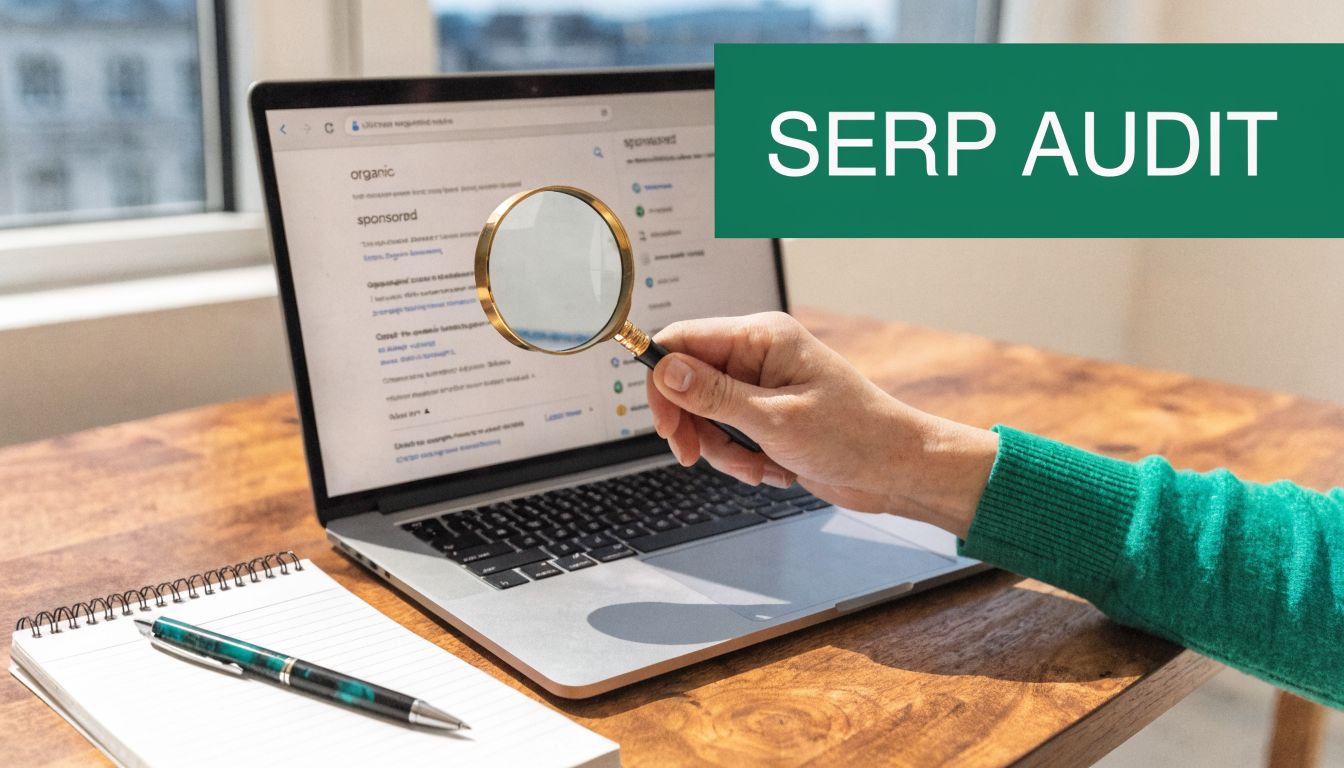
Build a simple tracking sheet
Use a spreadsheet. Google Sheets is fine. Airtable works too if your team likes database-style views.
Create one row for every negative or borderline result you find. Track:
-
Search query
Brand name, owner name, branded review searches, branded complaint searches, and product-specific branded searches. -
Ranking position
Note where it appears on the page when you first record it. -
Exact URL
Copy the live URL, not a shortened share link. -
Page title
This helps you spot later title changes and identify whether the ranking is page-specific or domain-level. -
Content type
News story, review profile, forum thread, complaint site, blog post, PDF, social post, video, image result. -
Sentiment
Negative, mixed, misleading, outdated, or neutral-but-unhelpful. -
Publisher or site owner
Identify who controls the page. A local blogger, a review platform, a newspaper, a trade site, or an anonymous forum all require different tactics. -
Removal path
Policy complaint, direct outreach, DMCA, noindex request, legal review, or suppression only. -
Notes on evidence
Screenshot the page. Save the cache if available. Record publication date, author name, and anything incorrect or policy-sensitive.
Audit more than one search variation
A single result often ranks for more than one branded query. Check:
- Your company name
- Your company name plus reviews
- Your company name plus complaints
- Owner or founder names
- Key product or service names tied to the brand
- Brand plus location if location matters to lead flow
This isn’t overkill. A page that sits lower for one query may sit higher for another.
A good audit answers two separate questions. What is visible now, and what is vulnerable to becoming visible next?
Sort the threats before you respond
Not every negative page deserves the same effort. Prioritize by business risk.
A practical sorting method looks like this:
| Priority | What belongs here | Typical response |
|---|---|---|
| High | Page-one branded result with clear commercial harm | Immediate removal review plus suppression plan |
| Medium | Mixed or lower-ranking result on an authoritative site | Monitor and prepare supporting assets |
| Low | Weak result with little relevance or unstable rankings | Track only, no major action yet |
What to look for during review
Some patterns tell you a lot about likely outcomes:
- High-authority publisher means outreach may be harder, but suppression can still work if the page gets no ongoing support.
- Forum thread often needs a different tactic than a formal article. Sometimes the title or your branded mentions create the ranking, not the thread itself.
- Review site profile may not be removable, but individual reviews can sometimes be challenged through platform rules.
- An old page with your name in the title may be a candidate for an edit request or noindex discussion.
By the end of this first pass, you should know what you are trying to remove, what you are trying to outrank, and what can safely wait. Without that list, every next step turns into guesswork.
The Removal Toolkit: Direct Action and Legal Routes
Once you know which URLs are causing real business harm, move quickly on removal paths with the highest chance of success. For SMBs, at this point, discipline matters. Owners often jump straight to a lawyer or fire off angry emails to publishers, then burn budget before they have tested the simpler routes that successfully get pages edited, noindexed, or taken down.
Removal work is a process, not a single tactic. In practice, the best outcomes usually come from matching the problem to the right channel. Platform-policy complaints can work well for impersonation, privacy leaks, fake reviews, and terms-of-service violations. Publisher outreach works better for outdated articles, old directories, and pages that are technically accurate but unnecessarily damaging. DMCA fits a narrower set of cases. Legal action belongs in the stack, but near the end, not at the start. Reputation X’s push-down strategy overview outlines that broader framework.
Start with direct publisher outreach
Publisher outreach is often the cheapest serious option, and sometimes the fastest. A short, factual request from the business owner or an agency representative will often get more traction than a threatening letter full of legal jargon.
The goal is to make one practical request the editor can say yes to.
A usable structure:
- Identify the exact page and URL
- State what is wrong, outdated, unauthorized, or unnecessarily identifying
- Ask for one specific action
- Attach documents only if they help prove the point
- Give a reasonable deadline for a reply
The specific action matters. “Please remove this defamatory page” is usually weaker than a targeted request such as:
- Remove the page
- Correct factual errors
- Remove your business name from the title tag or headline
- Add a noindex tag
- Remove names, addresses, or other identifying details
- Update the article to reflect the current status of the issue
That level of precision cuts friction and improves response rates.
When noindex is the better ask
Deletion is not always the best outcome to pursue. Some publishers will refuse to remove content because they believe it is accurate, archived, or newsworthy. The same publisher may still agree to add a noindex tag, which keeps the page live for their records while removing it from normal search visibility.
For many businesses, that is enough.
I recommend treating noindex as a practical middle ground, especially with local publishers, niche blogs, and trade sites that do not want a censorship argument but will consider a search visibility change. It often costs less time and less goodwill than pushing for full deletion.
DMCA works in narrow, high-confidence cases
DMCA is useful when the harmful page contains material you own, and the use is unauthorized. That can include copied product photos, service-page text, brochures, lead magnets, videos, and other original assets.
It is not a general-purpose reputation tool.
If the problem is criticism, a complaint, or a bad review written in the other party’s own words, DMCA is usually the wrong route. If the page scraped your website copy or reused your images, it can be one of the cleanest takedown paths. Gather the original files, dates of publication, and proof of ownership before you file.
A stretched DMCA claim usually fails and can make later outreach harder.
Here is a useful explainer if you are also weighing visibility recovery after removal efforts: paid search engine optimization.
Google policy removals and privacy-based requests
Some pages do not need to be removed from the web to disappear from branded search results. In the right cases, they can be removed from Google through policy or privacy requests. This route is strongest when the page exposes sensitive personal information, doxxing details, explicit content shared without consent, or other material that violates Google’s rules.
The legal side is more limited than business owners often expect. The Court of Justice of the European Union established the right to request certain search-result removals under data protection law in 2014. Google explains the scope and process in its European privacy removals guidance. That right does not erase every unfavorable page. It applies to specific circumstances, and factual reporting is still difficult to remove.
A few distinctions matter in practice:
- Sensitive personal information usually has the strongest basis for removal
- Platform-rule violations should go through the platform and Google reporting forms
- Factually correct criticism or coverage is rarely removed just because it harms reputation
- Outdated personal information may qualify in some jurisdictions, but the review is case-specific
This is also where business owners need realistic expectations. A valid privacy request can work well. A weak one usually goes nowhere, and repeated low-quality filings waste time you could spend on stronger removal or suppression work.
For a broader view of how agencies combine removal, search strategy, and brand protection, see Brand Reputation Marketing Online.
Video walkthrough
If you want a quick visual overview of the removal mindset before you draft requests, this walkthrough is a useful companion:
When legal escalation helps and when it backfires
Lawyers matter in the right cases. They are rarely the first move I recommend for an SMB unless the content includes clear defamation, blackmail, privacy violations, trademark abuse, or repeated misuse of your intellectual property.
A legal letter can help when a publisher has ignored reasonable requests, and the claim is strong. It can also fail badly when the page is opinion-based, newsworthy, or legally defensible. Some publishers dig in. Others update the article to mention the dispute. In the worst cases, a small issue turns into a much more visible one.
That is the trade-off. Legal pressure can produce results, but it raises costs fast and reduces flexibility.
Use a removal ladder
The cleanest way to control cost is to move from low-friction actions to high-friction ones.
-
Self-controlled removals
Old social posts, duplicate pages, stale PDFs, forgotten subdomains, abandoned microsites. -
Platform and search-engine policy reports
Review platforms, social networks, privacy forms, impersonation reports, Google removal requests. -
Direct publisher outreach
Editors, moderators, webmasters, authors, and site owners. -
DMCA or IP complaints
Cases with real ownership and clear documentation. -
Legal escalation
Cases with an actual legal basis and a business reason to spend the money.
That order keeps the work grounded. It also gives you a realistic operating model. Some URLs can be removed in days. Others will stay alive and need suppression instead. The businesses that handle this well do both. They push every legitimate removal route first, then stop forcing low-probability fights and shift resources where they can effectively change the search results.
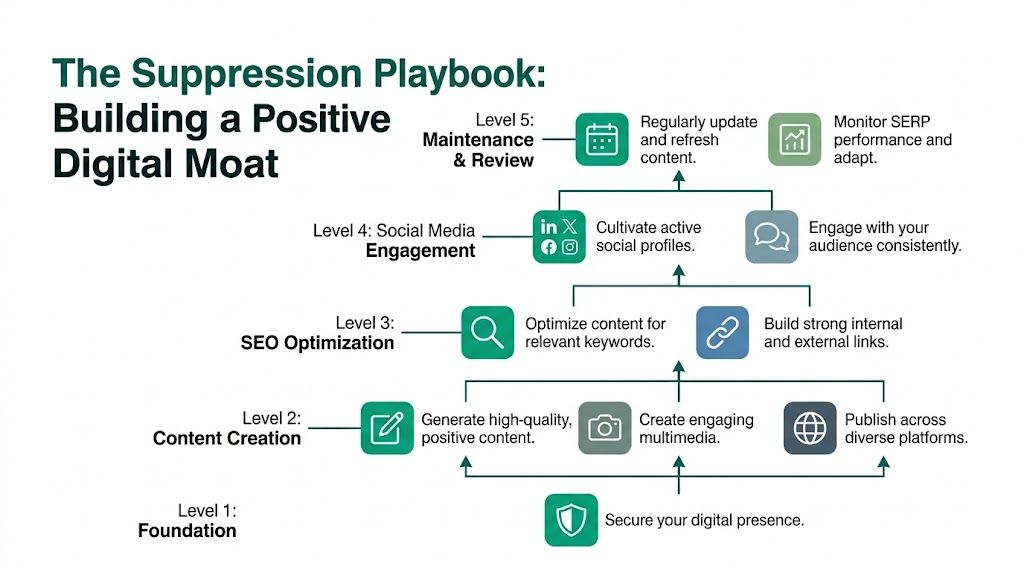
The Suppression Playbook: Building a Positive Digital Moat
You search for your company name after a bad review, complaint thread, or news item goes live. The result is still sitting on page one a week later. Removal efforts have stalled. At that point, the job changes. You are no longer trying to win an argument with the publisher. You are building enough relevant, credible assets to take control of more branded search real estate.
That work is slower than business owners expect, and it is more operational than creative. A real suppression plan usually means choosing a small set of assets that can rank, improving them properly, and promoting them consistently until Google treats them as the better answer for your branded searches.
Start with assets that already have authority
Small and mid-sized businesses waste money when they publish ten weak pages instead of fixing the five properties that already have a chance to rank.
In practice, the strongest suppression candidates usually include:
- Your main website, especially the homepage, about page, leadership bios, location pages, and a press or media section
- LinkedIn company and executive profiles with complete descriptions, current visuals, and regular activity
- Google Business Profile and other major directory listings that rank for branded searches
- YouTube or other video profiles that can appear in universal search
- Third-party profiles on industry associations, marketplaces, chamber sites, and established business databases
- Earned media and contributed articles on sites with actual authority
One useful outside perspective is Brand Reputation Marketing Online, which treats reputation work as a marketing system, not a one-off cleanup job. That is the right frame for SMBs, because suppression only works when content, SEO, PR, and profile management are coordinated.
Match the asset to the query
At this stage, good campaigns save time and bad campaigns burn budget.
If the damaging result ranks for the founder’s name, build and improve founder-focused assets. If it ranks for brand plus reviews, strengthen review-related pages, customer service content, and high-trust business profiles. If it ranks for a product or service phrase, publish a page that directly addresses that phrase with useful details, proof, and internal support.
Generic content usually stalls. Search results are query-specific, so the replacement assets need to be query-specific too.
Publish fewer pages, but make them worth ranking
Thin branded articles rarely move a strong negative result. Complaint pages, forum threads, and news stories often rank because they have age, links, engagement, or exact-match relevance. Beating them takes better execution, not more filler.
The replacement assets need clear signals:
- named authors or executives
- original company information
- updated brand descriptions across every profile
- useful media such as photos, videos, or case examples
- internal links from strong pages on your site
- metadata and headings aligned to branded searches
- consistent contact details and business facts
I usually tell clients to treat every suppression asset like a sales page, bio page, or profile that has to earn its spot. If a page would not help a prospect trust you, it probably will not help you suppress a negative result either.
Fix the trust layer before you scale content
A lot of SMBs have the same problem. Old bios. Three versions of the company description. Dead social links. Different logos on different platforms. Missing authors. Broken schema. Those issues do not create a crisis on their own, but they weaken every asset you are trying to rank.
Google rewards consistency because consistency makes entity recognition easier. The practical fix is boring and effective. Standardize your company description, leadership bios, images, contact information, and links across the properties you control. Then add schema markup to your site so the organization, people, articles, videos, and local details are easier for search engines to connect.
Use PR as a ranking input, not just a publicity tactic
Owned assets matter, but third-party mentions often make the difference between a page that sits on page three and one that reaches page one.
That is why digital public relations services fit naturally into suppression work. Good PR creates articles, interviews, expert quotes, and profile mentions on sites you do not own. Some of those assets rank directly. Others pass authority and branded relevance back to the properties you are trying to move up.
There is a cost trade-off here. PR-led suppression tends to be more expensive than refreshing your site and profiles, but it gives you stronger external signals and more durable results.
Promotion is part of suppression
Publishing alone is not enough. New pages need support.
Use internal linking from your strongest branded pages. Share new assets through active social channels. Send executives and sales teams to the profile pages you want used and cited. Earn links and mentions where you have a legitimate reason to be included. Refresh pages that start to age out.
For SMBs, that usually means building a practical stack of 5 to 10 priority assets and working them in sequence, instead of trying to launch everything at once. Some campaigns get traction from profile cleanup and on-site improvements alone. Others need content production, PR outreach, and review work before page-one results start to shift.
The main point is simple. Suppression is not a trick. It is a business process. When removal options are limited, the companies that make progress are the ones that build credible assets, support them consistently, and stop spending time on content that never had ranking potential.
Timelines, Costs, and When to Call for Help
A business owner usually reaches this point after the initial shock has worn off. The bad result is still ranking. Sales has started hearing about it. Now the questions get practical. How long will this take, what will it cost, and should your team handle it or bring in outside help?
The answer depends on the route. Removal can be fast if the page clearly violates a platform rule, exposes private information, or uses your copyrighted material without permission. Suppression takes longer because you are building and strengthening enough positive assets to change what Google sees as the best branded results. For a useful benchmark across those different paths, this overview of professional timelines for search result removal breaks out source deletion, deindexing, and suppression work.
For SMBs, the planning mistake is usually underestimating labor. Owners often focus on the takedown request and ignore everything around it. Someone still has to document evidence, follow up with publishers, update weak branded properties, coordinate new content, and keep leadership aligned while rankings shift slowly.
Reputation Management Method Comparison
| Method | Typical Timeline | Estimated Cost (DIY) | Estimated Cost (Agency) | Success Probability | Best For |
|---|---|---|---|---|---|
| Direct outreach to publisher | Days to weeks, depending on publisher response | Staff time only | Varies by scope | Moderate when the content is outdated, inaccurate, or low-value to the publisher | Smaller issues on independent sites |
| Google or platform policy removal | Often faster than other routes when the issue clearly fits a policy | Staff time only | Varies by case | Higher when the content clearly violates rules or reveals sensitive personal information | Policy-based removals |
| DMCA takedown | Days to weeks, depending on evidence quality and platform process | Staff time plus legal review if needed | Varies by case and counsel involvement | Strong when copyright ownership is clear | Unauthorized use of your content |
| Noindex or source edit request | Depends on publisher cooperation | Staff time only | Varies | Moderate when the publisher will compromise but not delete | Cases where deletion is unlikely |
| Suppression campaign | Often measured in months, not days, as noted earlier | Internal labor, content production, and promotion costs | Ongoing monthly retainer in many agency engagements | Stronger over time when assets are credible and properly supported | Persistent first-page problems |
When DIY works
DIY can work if the problem is contained and your team already has some marketing infrastructure.
That usually means one or two URLs, a cooperative platform, and someone inside the business who can write clear outreach, track follow-up, and improve branded search assets without letting the project stall. If your website is current, your profiles are claimed, and your team can support review generation and basic SEO, a small case is often manageable.
DIY becomes less practical when the negative result touches several channels at once. A bad article may also trigger review issues, Reddit threads, and social posts. At that point, the work starts to overlap with your broader social media reputation management process, customer response workflows, and branded search strategy.
When expert help is worth the spend
Outside help makes sense when the result is sitting on page one for core branded searches and affecting revenue. That includes deals slowing down, candidates asking about the issue, referral partners hesitating, or customer success teams spending time on objections that should never have reached them.
Bring in specialists sooner if any of these are true:
- the publisher is authoritative, hostile, or difficult to reach
- the case involves privacy, legal review, or copyright claims
- the negative result has been stable for months
- your internal team cannot produce content and promotion consistently
- leadership wants a forecast, reporting, and a single owner for the process
I usually tell SMB clients to price the delay realistically. If an owner spends three weeks chasing a takedown, but no one is fixing the branded search gap that allowed the result to rank so well, the business is still losing ground. Agency fees can look expensive on paper. Lost conversions, slower hiring, and distracted leadership usually cost more.
Sustaining Your Clean SERP Monitoring and Prevention
A cleaned-up search page won’t stay clean by itself.
That is the part many businesses miss. They remove one result or push it down, then stop publishing, stop updating, and stop checking. Rankings shift back. Old pages regain ground. New complaints appear and sit unnoticed until they climb.
Research focused on long-term suppression points to the maintenance problem directly. Suppression can show movement in 2-4 months, but rankings can slip without ongoing optimization and content refreshes. The same analysis also notes that recent Google updates place more weight on authentic, expert-driven content under E-E-A-T-style expectations, as discussed in Reputation Resolutions’ guide to burying negative Google results.

Set up basic monitoring first
You do not need an enterprise software stack to start.
A practical minimum includes:
- Google Alerts for your business name, leadership names, and key branded phrases
- Manual monthly branded searches in incognito mode
- A quarterly SERP audit using the same spreadsheet from your first assessment
- Review monitoring across major platforms where customers post feedback
If social discussion around your brand tends to spill into search visibility, a dedicated process for reputation management in social media helps catch issues before they become search problems.
Refresh the assets that won the rankings
Businesses often focus only on creating new assets. Old winners need maintenance too.
Refresh:
- leadership bios
- service pages
- location pages
- newsroom or press pages
- video descriptions and channel details
- high-value third-party profiles you control
A page that ranked well during a suppression campaign can lose relevance if it sits untouched while the negative page stays live.
Use a repeating maintenance rhythm
This works well for most SMBs:
| Frequency | Task |
|---|---|
| Weekly | Scan alerts and review mentions |
| Monthly | Check branded search results and note movement |
| Quarterly | Audit top branded queries and update key assets |
| Ongoing | Publish or refresh expert-led branded content |
Search reputation is a maintenance function, not a one-time project.
Prevention beats emergency cleanup
The best long-term defense is a branded search page already filled with strong, current assets. Then a single negative page has fewer openings.
That means continuing to publish useful content, keeping executive and company profiles current, and earning legitimate mentions from places that already carry authority. Prevention is less dramatic than cleanup. It is also more stable.
Frequently Asked Questions About Reputation Repair
Can I remove an anonymous negative review?
Sometimes, but the outcome depends on the platform and the facts you can document.
Anonymous reviews come down when they clearly violate platform rules. The stronger cases usually involve impersonation, a reviewer who was never a customer, threats, hate speech, or a post that is really about a different business. A review that feels unfair or one-sided usually stays up.
For an SMB, the practical process is simple. Save screenshots, collect order records or client logs, file the platform report with specific policy violations, and set a follow-up date. If the review is not removed after that cycle, stop spending time on repeat complaints and switch to damage control. A public response, fresh legitimate reviews, and better visibility for stronger brand assets usually produce a better return than arguing with a platform for weeks.
What if the negative article is true but still hurts the business
If the article is accurate, full removal is uncommon.
The workable options are narrower. Ask for a correction if facts are outdated, request a headline adjustment if it overstates the issue, or ask whether the publisher will add an update that reflects what changed after the original event. Some publishers will consider a noindex request, but that is rare and usually tied to a clear editorial reason, not commercial harm.
In these cases, suppression usually carries more of the workload. That means building pages and profiles that deserve to rank for your brand name, then maintaining them long enough to hold position. It is slower than a takedown, but it is often the only realistic path when the content is true.
Does the right to be forgotten help businesses
Usually, no. That process is designed mainly for individuals, not companies trying to remove unfavorable but lawful business information from search results.
The core rule came from a Court of Justice of the European Union decision on May 13, 2014, which recognized that people can request delisting of certain results tied to their names. Even then, the standard is limited. Public interest still matters, and search engines do not have to remove accurate information merely because it is inconvenient.
For business owners, this matters because it changes budgeting and expectations. If a founder is dealing with a personal result tied to their own name, legal review may be worth the cost. If the issue is a company-related article, complaint, or review, removal odds are lower, and the plan usually shifts toward publisher outreach, search suppression, and reputation rebuilding.
Is reputation management software enough on its own
Software is useful for alerts, review monitoring, and reporting across locations or platforms. It does not make the hard calls.
A tool can show that a negative result moved from position nine to position four. It cannot tell you whether to file a copyright complaint, ask counsel to review a defamation claim, negotiate with a publisher, or invest the next quarter in new branded assets. That judgment comes from understanding platform rules, search behavior, and what your business can afford to sustain.
For most SMBs, software works best as part of a process. Use it to catch changes early, then have a person decide which issues deserve legal action, which need customer service follow-up, and which should be handled through long-term suppression.
If your business needs a clear plan instead of guesswork, Ascendly Marketing can help you assess the SERP, prioritize removal options, and build the search visibility needed to reduce the impact of negative results.