

TL;DR:
- Keywords are essential for search visibility and attracting targeted organic traffic.
- Effective SEO requires ongoing keyword research, strategic placement, and regular performance tracking.
- Most businesses neglect keyword evolution, missing opportunities to improve rankings and conversions.
SEO delivers an average 748% ROI for businesses that use it strategically, yet most small business owners treat keywords as an afterthought. You pick a few obvious phrases, drop them into your homepage, and wonder why the phone isn’t ringing. The problem isn’t SEO itself. It’s that keywords are more nuanced than they appear. This article breaks down why keywords are the engine behind search visibility, how different keyword types serve different goals, how to research and apply them effectively, and what trends are reshaping keyword strategy in 2026.
Table of Contents
- Why keywords matter in modern SEO
- Types of keywords and how they influence search results
- Keyword research: Finding phrases your customers actually use
- Integrating keywords into your content strategy
- Measuring the impact: Tracking keyword ROI and making improvements
- Our take: Why most businesses miss the real power of keywords
- Ready to amplify your SEO with smarter keywords?
- Frequently asked questions
Key Takeaways
| Point | Details |
|---|---|
| Keywords boost visibility | Using the right keywords connects your business with more customers through better search rankings. |
| Long-tail wins conversions | Specific, targeted keywords attract visitors who are ready to take action. |
| Research drives results | Ongoing keyword research is essential for adapting to new trends and maintaining SEO growth. |
| Track and optimize | Regularly monitor your keyword performance to maximize traffic and return on investment. |
Why keywords matter in modern SEO
Search engines like Google work by scanning and indexing billions of web pages. When someone types a query, the algorithm matches that query to the most relevant pages it has indexed. Keywords are the bridge between what your potential customer types and what your website says. Without the right keywords, your content is essentially invisible, no matter how good it is.
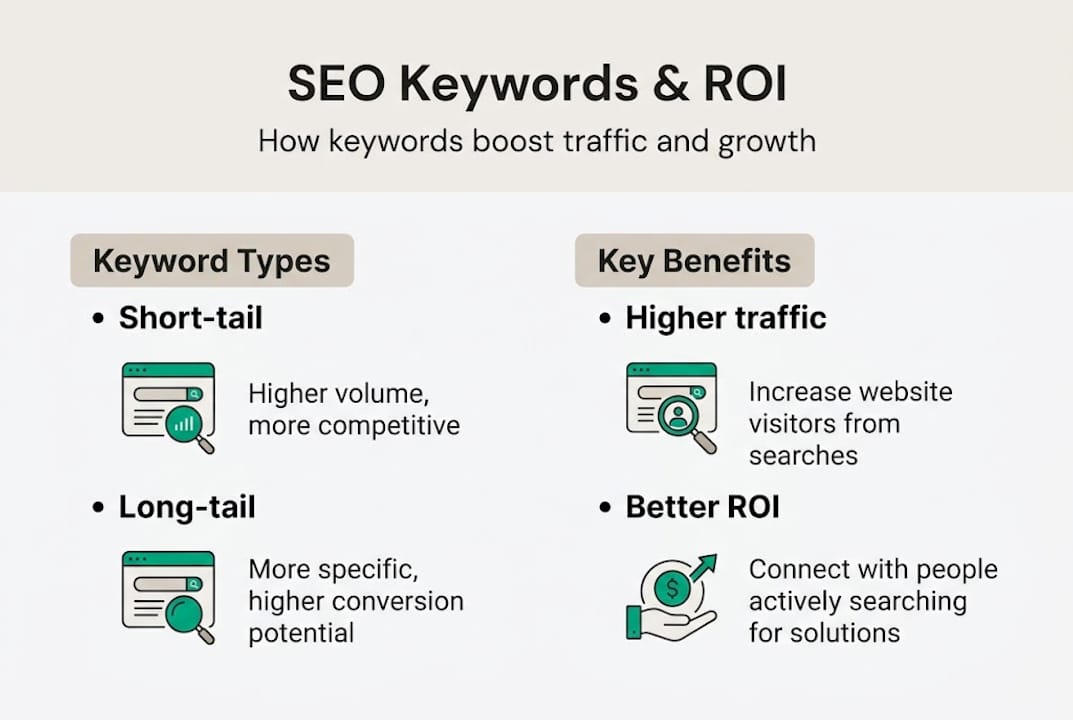
This is not a small issue. Organic search drives 53% of all website traffic across industries. That means more than half of the clicks happening on the internet come from people typing something into a search bar. If your pages aren’t optimized with the right language, you’re handing that traffic to a competitor.
Keywords also signal intent. A person searching “emergency plumber near me” has completely different needs than someone searching “how plumbing pipes work.” When you use targeted keywords that reflect genuine buyer intent, you attract visitors who are already partway through their decision. That’s what makes keyword-driven SEO so powerful for increasing organic traffic without spending a fortune on ads.
Here’s what happens when keyword strategy is done right:
- Your pages appear in front of people actively searching for your service
- Your site traffic grows with visitors who actually want what you offer
- Your content answers real questions, building trust and authority
- Your conversion rates improve because you’re attracting the right audience
And here’s what happens when it goes wrong:
“Keyword stuffing, or forcing unnatural keyword repetition into your content, signals low quality to search engines and triggers ranking penalties. More keywords is not better. Better keywords are better.”
That distinction matters enormously. Writing content for SEO means creating pages that genuinely answer the questions your customers are already asking, using language that mirrors their searches. Google’s algorithms have become sophisticated enough to reward relevance and punish manipulation. Strategy beats volume every time.
Types of keywords and how they influence search results
Not all keywords work the same way. Each type serves a different purpose in your SEO strategy, and knowing when to use each one gives you a real edge.
Short-tail keywords are broad, high-volume terms like “marketing agency” or “coffee shop.” They drive massive search volume but are intensely competitive. For most SMBs, ranking on page one for a short-tail keyword takes years and significant investment.
Long-tail keywords are longer, more specific phrases like “affordable digital marketing agency for restaurants in Austin.” Long-tail keywords deliver higher conversion rates because they reach people with very specific needs. Less competition means you can rank faster too.

Branded keywords include your business name or product names. These are essential for protecting your brand in search results and capturing high-intent searchers who already know you.
Geo-targeted keywords combine a service or product with a location, like “SEO company in Denver.” These are critical for local businesses that serve specific geographic areas.
| Keyword type | Search volume | Competition | Conversion rate | Best use case |
|---|---|---|---|---|
| Short-tail | Very high | Very high | Lower | Brand awareness |
| Long-tail | Lower | Low to medium | Higher | Lead generation |
| Branded | Moderate | Low | Very high | Retention, loyalty |
| Geo-targeted | Moderate | Medium | High | Local service businesses |
Choosing the right mix depends on where your business is in its growth journey. New sites benefit most from long-tail and geo-targeted keywords because the barriers to ranking are lower. Established sites can begin competing for shorter, broader terms once they’ve built domain authority.
To get started with keyword type selection:
- List your core services or products
- Add location modifiers for each if you serve local markets
- Expand each into question-based long-tail phrases your customers ask
- Identify branded terms competitors might be bidding on
Explore content marketing for SMBs to see how keyword types connect with content planning for sustained growth.
Pro Tip: Don’t try to rank for everything. Pick two or three long-tail keywords per page, target them well, and build from there. See how content marketing examples can inspire a focused, keyword-driven content plan.
Keyword research: Finding phrases your customers actually use
Armed with the knowledge of keyword types, the next step is to identify which specific phrases your potential customers are searching for. This is where most business owners skip a critical step: they guess instead of researching.
Effective keyword research starts with listening to your customers. What words do they use when they call you? What questions appear in your reviews or emails? What language shows up in your competitors’ pages? These are your raw keyword seeds.
From there, you can use free tools to expand and validate:
- Google Search itself: Type a seed keyword and study the autocomplete suggestions and “People also ask” boxes. These reflect real search behavior.
- Google Keyword Planner: Shows search volume and competition level for any keyword.
- Google Search Console: If your site is already live, this reveals which queries are already driving impressions and clicks.
- Competitor analysis: Look at the pages ranking in the top 5 for your target keywords and analyze the language they use.
Targeted keyword research can increase traffic by up to 460% for SMBs when done systematically. That’s not a small margin. That’s the difference between a website that generates leads and one that collects digital dust.
When evaluating keywords, focus on three things:
| Factor | What to look for | Why it matters |
|---|---|---|
| Search volume | At least 100 searches/month | Ensures there’s real demand |
| Competition | Low to medium for new sites | Improves your chances of ranking |
| Search intent | Matches what your page offers | Drives relevant, converting traffic |
Understanding the benefits of content marketing will show you why pairing keyword research with strong content creation multiplies your results. And if you’re considering backing organic efforts with investment, paid SEO strategies can accelerate results while you build long-term rankings.
Pro Tip: Avoid chasing terms with enormous search volumes if they don’t match your buyer’s intent. A keyword with 200 monthly searches and high purchase intent will outperform a keyword with 20,000 searches and casual browsing behavior every single time.
Integrating keywords into your content strategy
Once you’ve identified your target keywords, the real power comes from putting them into action across your website and marketing content. Knowing which keywords to use is only half the equation. Placement and context determine whether those keywords actually move your rankings.
Here’s where your keywords should appear:
- Page title and H1 heading: This is the most weighted placement on any page
- Meta description: Though not a direct ranking factor, it improves click-through rates from search results
- First 100 words of your content: Signals early relevance to search engines
- Subheadings (H2 and H3 tags): Reinforce the topic structure for both users and algorithms
- Image alt text: Captures visual search and supports overall page relevance
- URL slug: A clean, keyword-rich URL helps both rankings and readability
Natural usage is everything. When keywords are forced into sentences where they don’t belong, readers notice, and so do search engines. Write for your reader first. Then check that your keywords appear where they make sense.
“Strategic keyword integration is not about frequency. It’s about relevance. One perfectly placed keyword in a heading outperforms ten awkward insertions scattered through body text.”
Over-optimization is a real risk. Google’s algorithms penalize pages that appear to be gaming rankings through unnatural keyword repetition. Review your content for readability. If a sentence sounds mechanical or repetitive, rewrite it before hitting publish.
When done right, using keywords in content can return up to 748% on investment when your SEO strategy is tightly aligned with what your customers are searching for. For proof, look at keyword success stories from businesses that turned organic search into a reliable revenue channel.
Measuring the impact: Tracking keyword ROI and making improvements
Integrating keywords is not a one-time effort. Tracking and optimizing your strategy ensures your SEO continues to drive growth long after you’ve published your content.
Start by monitoring these three core metrics:
- Search rankings: Track where your target keywords rank week over week. Movements up or down reveal whether your optimizations are working.
- Organic traffic: Use Google Analytics to measure how many visitors land on your pages through unpaid search. A growing trend confirms your keyword strategy is gaining traction.
- Conversions: Traffic without action is noise. Track form fills, calls, purchases, or any other goal completion tied to your organic visitors.
Google Search Console and Google Analytics are free and powerful starting points. Paid tools like Ahrefs or Semrush provide deeper competitive data if you want to scale your analysis.
Businesses that measure and refine keyword strategies average 748% ROI because iteration compounds results. Each round of refinement builds on what’s working and cuts what isn’t.
A simple review process looks like this:
- Pull ranking and traffic data every 30 days
- Identify pages with high impressions but low clicks (rewrite meta descriptions)
- Identify pages with good rankings but low conversions (improve calls to action)
- Spot new keyword opportunities from Search Console’s “queries” report
- Update and expand content based on what searchers are actually responding to
Learning how to calculate marketing ROI will help you connect keyword performance to business outcomes in language your stakeholders understand. For inspiration on what consistent optimization looks like in practice, explore real-world ROI examples from businesses similar to yours.
Pro Tip: Set a recurring calendar reminder for a quarterly keyword review. Search behavior shifts with seasons, trends, and industry changes. Staying proactive means you catch opportunities before competitors do.
Our take: Why most businesses miss the real power of keywords
Here’s something we’ve observed after years of working with SMBs on SEO: most business owners treat keyword strategy like a box to check. They do the research once, stuff the terms into a few pages, and assume the work is done. It isn’t.
Keywords are a living signal of what your customers want. Their language changes. Their questions evolve. New competitors enter your space. Chasing volume or trending terms without understanding the intent behind them almost always leads to traffic that doesn’t convert.
The businesses that win at SEO treat keywords as an ongoing conversation with their market. They update their content when customer questions shift. They build new pages when new needs emerge. They integrate keyword thinking into every piece of content they create, not just their homepage.
Our advice is simple: make keywords part of your digital marketing guide for SMBs from day one, not a tactic you bolt on later. The businesses that do this consistently are the ones that show up when it matters most.
Ready to amplify your SEO with smarter keywords?
If you’ve made it this far, you already understand something most businesses don’t: keywords aren’t just words. They’re the connective tissue between your business and the customers searching for exactly what you offer.

At Ascendly Marketing, we help SMBs move from guessing to growing. Our top-rated SEO services are built around the kind of targeted keyword strategy you’ve read about in this article. If you’re new to organic search, our organic SEO guide is a great starting point. And when you’re ready for a full-picture strategy, explore our comprehensive digital marketing services. Let’s build something that actually ranks.
Frequently asked questions
How do keywords actually impact my Google rankings?
Keywords signal to search engines what your page is about, boosting your chances of appearing for relevant search queries. The more closely your content matches what someone searches, the more likely Google is to show your page.
What is the difference between short-tail and long-tail keywords?
Short-tail keywords are broad and competitive, while long-tail keywords provide more targeted audiences with better conversion rates. For most SMBs, long-tail keywords offer faster wins and more qualified traffic.
How do I know if my keyword strategy is working?
Check if your organic traffic, search rankings, and conversions are rising over time. SEO ROI comes from tracking these three indicators consistently and making adjustments when they plateau.
How often should I update and optimize my keywords?
Review and refresh your keyword strategy at least quarterly to keep up with changing search trends and customer needs. Search behavior shifts faster than most business owners realize, so staying ahead of it protects your rankings.