

Many small businesses shy away from paid search, thinking it’s too costly, but precise strategies can deliver positive returns even on modest budgets. Paid search offers immediate traffic and measurable results when executed correctly. This guide will clarify what paid search is and show you how to use it effectively to enhance your online visibility and drive customer acquisition quickly.
Table of Contents
- What is Paid Search? Definition and How It Works
- Paid Search Vs SEO: Key Differences and Use Cases
- How Paid Search Works: Bidding, Optimizing, and Improving ROI
- Paid Search Compared to Other Digital Advertising Channels
- Common Misconceptions and Budget Considerations
- Practical Steps to Launch and Manage Paid Search Campaigns
- Summary: Maximizing Paid Search Impact for Small Businesses
- Boost Your Paid Search Success with Expert Help
- Frequently Asked Questions About Paid Search
Key takeaways
| Point | Details |
|---|---|
| Immediate visibility | Paid search is a keyword-based auction model that delivers instant traffic to your website. |
| Complements SEO | It drives immediate results while SEO builds long-term organic presence. |
| ROI through optimization | Continuous refinement of bids and keywords maximizes return on investment. |
| Quality matters | Ad relevance and landing page experience directly impact your costs and placement. |
What is paid search? Definition and how it works
Paid search advertising lets you bid on keywords to display ads when users search for those terms. Unlike organic SEO, which requires months to build rankings, paid search basics deliver instant visibility once your campaign launches.
The system operates through real-time auctions. Every time someone searches for your target keyword, an auction determines which ads appear and in what order. Your bid amount is just one factor. Google and other platforms also evaluate Quality Score, which measures ad relevance, expected click-through rate, and landing page experience.
Quality Score acts as a multiplier in the auction. A high score can lower your cost per click while improving your ad position. This means you can outrank competitors who bid higher but have less relevant ads. The bidding auction framework combined with quality score determines both cost and placement.
Key components of paid search include:
- Keyword targeting: Choose terms your potential customers search for
- Bid management: Set maximum amounts you’ll pay per click
- Ad creation: Write compelling copy that matches search intent
- Landing pages: Design pages that convert visitors into customers
- Performance tracking: Monitor metrics to optimize campaigns
The beauty of paid search is control. You decide daily budgets, target specific locations, schedule ads for certain times, and pause campaigns instantly. This flexibility makes it ideal for testing market demand or promoting time-sensitive offers.
Paid search vs SEO: Key differences and use cases
Paid search and organic SEO basics serve different but complementary roles in your marketing strategy. Understanding when to use each maximizes your overall digital presence.
| Factor | Paid Search | SEO |
|---|---|---|
| Speed to results | Immediate traffic once the campaign launches | 3-6 months to see significant rankings |
| Cost structure | Pay per click or impression | Upfront investment in content and optimization |
| Longevity | Stops when budget ends | Continues generating traffic over time |
| Targeting precision | Exact keywords, demographics, locations | Broader topic and intent matching |
| Click-through rates | Marked as ads, lower trust for some users | Higher trust, better CTR for top rankings |
Paid search delivers instant traffic through paid ads at the top and bottom of search results. You’re essentially buying visibility. This works perfectly for new product launches, seasonal promotions, or when you need leads immediately.

SEO builds long-term organic visibility but requires patience and consistent content investment. You earn rankings through quality content, technical optimization, and authoritative backlinks. Once established, SEO vs paid search shows that organic traffic continues flowing without ongoing ad spend.
Smart businesses combine both strategies. Use paid search to generate immediate revenue while your SEO efforts mature. As organic rankings improve, you can reduce paid spend or focus ads on high-converting keywords where you lack organic presence. This balanced approach provides steady traffic growth and sustainable customer acquisition.
How paid search works: Bidding, optimizing, and improving ROI
Paid search runs real-time auctions every time someone searches your target keywords. The auction considers your maximum bid and Quality Score to determine ad rank. Higher rank means better placement and more visibility.
Quality Score multiplies the effectiveness of your bids. Google evaluates three main factors: expected click-through rate based on historical performance, ad relevance to the search query, and landing page experience. Improving these elements can cut your costs by 50% or more while boosting your position.
Refining keywords continuously is essential to reduce waste and boost conversions. Start with a core set of high-intent terms. Monitor which keywords drive actual leads or sales, not just clicks. Eliminate underperformers and invest more in winners.
Small businesses often target overly broad keywords, resulting in wasted spend and low-quality traffic. Instead, use long-tail phrases that match specific customer needs. “Affordable plumbing repair in Austin” converts better than “plumber” because it filters for ready buyers in your service area.
Bidding strategies impact your ROI significantly:
- Manual CPC: You control each keyword bid for maximum precision
- Enhanced CPC: Automated adjustments based on conversion likelihood
- Maximize conversions: Algorithm optimizes bids within your budget
- Target CPA: System aims for a specific cost per acquisition
- Target ROAS: Focuses on return on ad spend goals
Start with manual bidding to understand your keyword economics. Once you have conversion data, test automated strategies that align with your business goals. Track conversion rate improvement tactics closely to identify which approach delivers best results.
Pro Tip: Add negative keywords to prevent your ads from showing for irrelevant searches. If you sell premium services, add “cheap” and “free” as negatives to avoid clicks from budget shoppers who won’t convert.
Regular paid search optimization requires weekly reviews of performance data. Adjust bids based on day of week and time of day patterns. Pause keywords with high costs but no conversions. Test new ad copy variations to improve click-through rates. Small incremental improvements compound into major ROI gains over time.
Paid search compared to other digital advertising channels
Paid search generally produces higher conversion rates than display or social media ads because users show active purchase intent. Someone searching “buy standing desk” is ready to purchase. Someone scrolling Facebook is browsing passively.
| Channel | Average CTR | Intent Level | Cost Efficiency |
|---|---|---|---|
| Paid Search | 3.17% industry average | High – active searchers | Best for bottom-funnel conversions |
| Display Ads | 0.46% average | Low – passive viewers | Good for awareness and retargeting |
| Social Media Ads | 0.90% average | Medium – interest-based | Strong for audience building |
The average CTR for paid search ads is approximately 3.17%, with top ads achieving significantly higher rates. Display ads average just 0.46% CTR, while social media falls around 0.90%. This difference reflects user mindset at the moment they see your ad.
Users on search platforms demonstrate stronger purchase intent, increasing ad effectiveness. They’re solving a problem right now. Display and social ads interrupt other activities, requiring more touches to convert.
Costs vary across ad types, requiring planned bidding budgets to maximize ROI. Paid search typically costs more per click but converts better, lowering your actual cost per customer. Display ads cost less per impression but need larger volume to generate comparable results.
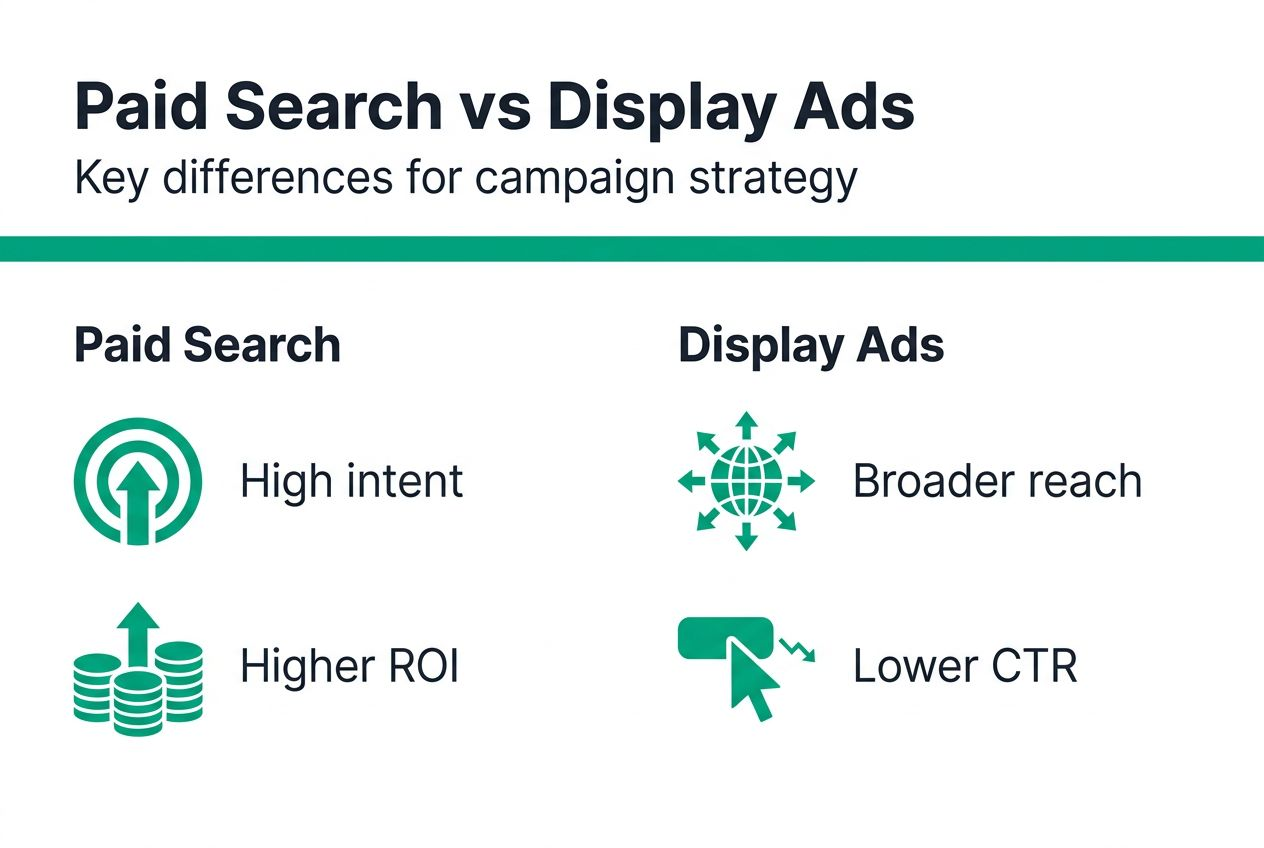
Choose paid search vs display ads based on your campaign goals. Use paid search for direct response and lead generation. Deploy display for brand awareness and retargeting visitors who didn’t convert. Combine social ads to build audiences and nurture prospects before they’re ready to search.
The key advantage of paid search is measurement. You can track exact ROI by keyword, ad, and landing page. This transparency lets you optimize aggressively and scale what works.
Common misconceptions and budget considerations
Paid search is not inherently too expensive. With precise targeting, small budgets can yield strong returns. A local service business might spend $1,500 monthly on 10 highly specific keywords and generate 15 qualified leads worth $10,000 in revenue.
The cost myth persists because businesses make preventable mistakes. Broad keyword targeting wastes spend and decreases ad relevance. If you bid on “marketing,” you’ll attract students researching papers, job seekers, and competitors, not potential clients.
Use negative keywords and long-tail phrases to filter traffic. Instead of “accounting services,” target “small business tax preparation in Denver.” The longer phrase costs less per click and attracts ready buyers in your market.
Key budget considerations include:
- Start small and scale based on performance data
- Allocate more to keywords that actually convert, not just generate clicks
- Factor in landing page optimization, which multiplies campaign effectiveness
- Reserve budget for testing new keywords and ad variations
- Plan for seasonal fluctuations in competition and costs
Paid search results stop immediately if campaigns are paused, unlike SEO’s lasting effects. This temporary nature requires ongoing investment but also provides control. You can pause during slow periods and ramp up when demand peaks.
Another misconception is that you need thousands monthly to compete. Reality depends on your market and goals. Highly competitive industries like legal services require larger budgets. Niche B2B services might succeed with $500-$1,000 monthly by targeting ultra-specific terms.
Pro Tip: Calculate your customer lifetime value before setting budgets. If one customer is worth $5,000, you can afford to pay $500 per acquisition and still profit. This math guides how aggressively you should bid on high-intent keywords.
Setting realistic budgets requires understanding your industry benchmarks, customer value, and conversion rates. Start conservatively, gather data, then invest more in proven winners.
Practical steps to launch and manage paid search campaigns
Research relevant keywords using tools like Google Keyword Planner, SEMrush, or Ahrefs. Focus on commercial intent terms where searchers want to buy, not just learn. Group similar keywords into tightly themed ad groups for better relevance.
Choose appropriate match types to control who sees your ads:
- Exact match: [keyword] shows ads only for that specific term
- Phrase match: “keyword” includes close variations and word order
- Broad match modifier: +keyword requires the term but allows other words
- Broad match: keyword triggers ads for related searches (use cautiously)
Set realistic daily and monthly budgets based on your goals and available capital. Start with enough volume to gather meaningful data, typically at least 100 clicks per keyword. If clicks cost $3, budget $300 per keyword to test effectively.
Write compelling ad copy that matches user intent and includes your target keyword. Your headline should promise a clear benefit. Description lines should reinforce value and include a strong call to action. Test multiple variations to discover what resonates.
Optimize landing pages for user experience and conversions. The page should deliver exactly what your ad promises. Use clear headlines, concise copy, trust signals like testimonials, and prominent contact forms or purchase buttons. Fast load times and mobile responsiveness are mandatory.
Monitor these key metrics weekly:
- Click-through rate (CTR): Percentage of impressions that generate clicks
- Cost per click (CPC): Average amount paid for each click
- Conversion rate: Percentage of clicks that complete your goal action
- Cost per conversion: Total spend divided by conversions
- Quality Score: Google’s rating of ad and landing page relevance
Continuously refine based on performance data. Pause keywords with high costs but zero conversions after 50-100 clicks. Increase bids on terms that convert profitably. Test new ad copy monthly to improve CTR. Add negative keywords as you discover irrelevant searches triggering your ads.
Pro Tip: Use conversion tracking pixels on your thank you or confirmation pages. This data feeds Google’s algorithm and enables automated bidding strategies that optimize for actual business results, not just clicks.
Follow this paid search campaign setup checklist to avoid common launch mistakes. Implement Google Ads optimization tips throughout your campaign lifecycle to maximize performance.
Summary: Maximizing paid search impact for small businesses
Understanding auction mechanics helps you place smarter bids and control costs effectively. Quality Score rewards relevance, letting you compete against bigger budgets through better targeting and ad copy.
Combining paid search with SEO maximizes both immediate and long-term visibility. Use paid ads to generate revenue now while building organic presence for sustainable growth. The two strategies amplify each other when executed together.
Commit to ongoing analysis and optimization to improve conversion rates and ROI over time. Paid search success requires weekly attention, not set-and-forget management. Small refinements compound into significant performance improvements.
Avoid common pitfalls that drain budgets:
- Targeting overly broad keywords that attract unqualified traffic
- Setting unrealistic budgets without understanding customer acquisition costs
- Ignoring Quality Score and landing page optimization
- Failing to use negative keywords to filter irrelevant searches
- Not tracking conversions to measure actual business impact
Use data to make informed decisions and adapt your strategy continuously. Let performance metrics guide your keyword selection, bid adjustments, and budget allocation. Test new approaches systematically and scale what proves profitable.
Explore paid search expertise to accelerate your results. Leverage SEO and paid search synergy for comprehensive market coverage.
Boost your paid search success with expert help
Managing effective paid search campaigns requires specialized knowledge and ongoing attention. Professional management helps optimize your campaigns for better ROI through expert keyword research, bid management, and conversion optimization.
Experts can tailor keyword strategies and bidding to your specific business goals and market conditions. They bring experience from managing hundreds of campaigns across industries, knowing what works and what wastes money.

Partnering with a trusted agency like Ascendly Marketing brings proven experience and measurable results. Since 2013, we’ve helped small and medium businesses maximize their paid search performance through data-driven strategies and continuous optimization.
Explore professional PPC advertising services to get started today. Our comprehensive digital marketing services integrate paid search with SEO, content marketing, and conversion optimization for maximum impact. Visit Ascendly Marketing to discover how we can accelerate your business growth.
Frequently Asked Questions About Paid Search
What exactly is paid search advertising?
Paid search is a digital advertising model where businesses bid on keywords to display ads in search engine results. Advertisers pay only when users click their ads, making it a performance-based channel. The auction system considers both bid amount and ad quality to determine placement.
How does paid search differ from organic SEO?
Paid search delivers immediate, paid traffic that appears at the top of search results marked as ads. SEO builds free but slower, long-term visibility through content and optimization. Paid search stops when your budget ends, while SEO continues generating traffic over time without ongoing ad costs.
What budget should small businesses allocate for paid search?
Start with modest budgets like $1,000 to $2,500 monthly and scale based on ROI and conversion data. Precise keyword targeting helps prevent wasted ad spend by focusing on high-intent searches. Your ideal budget depends on customer lifetime value, industry competition, and business goals.
What key metrics indicate paid search success?
CTR shows how engaging your ads are to searchers. CPC reveals cost efficiency and bidding effectiveness. Conversion rate tracks the percentage of clicks that complete desired actions like purchases or form submissions. Monitoring these metrics together helps optimize campaigns for maximum ROI.
How soon can I expect results from paid search?
Paid search campaigns can produce traffic and leads within minutes or hours after launch once approved. This immediate impact contrasts sharply with SEO’s longer ramp-up times of three to six months. The speed makes paid search ideal for time-sensitive promotions or rapid market testing.