A customer sends you an email that says, “I told a colleague to call you.” That message is small, but the lead usually is not. The prospect arrives warmer, asks better questions, and spends less time doubting whether you can do the job.
This clarifies how do referrals work. A referral takes trust that already exists between two people and transfers part of it to your business. A referral program turns that from a lucky accident into a repeatable system.
Most articles stop at “offer a discount and ask customers to share.” That leaves out the hard parts. Who should receive the ask. What makes someone share. How tracking works once links, codes, cookies, and CRM records get involved. What breaks the program. And what happens when a referred customer has a bad experience.
The Untapped Power of Word-of-Mouth
A lot of businesses already get referrals, but they get them in a messy way. A customer texts a friend. A prospect mentions your name on a call. Someone forgets to ask who sent them. The sale closes, but nobody logs the source, nobody thanks the advocate, and the business learns nothing from it.
A referral program fixes that. It does not replace word-of-mouth. It gives it structure.
Trust changes the starting line
A cold lead starts from skepticism. A referred lead starts from borrowed confidence.
That difference shows up clearly in hiring. In referral hiring, referred candidates are 15 times more likely to get hired, and although referrals make up only 1% of applications across 38 million analyzed, they account for 37% of hires according to Boterview’s referral statistics summary. The context is hiring, not customer acquisition, but the mechanism is the same. A trusted person says, “This one is worth your time,” and the receiver treats the recommendation differently.
For customer referrals, that means fewer trust-building steps at the start. The prospect often arrives already believing three things:
You are legitimate because someone they trust used you
You fit the problem because the advocate made a relevant introduction
You are safer to try because the referrer has already tested you
Word-of-mouth becomes a channel when you can track it
Plenty of owners say, “Most of our business comes from referrals.” Then they cannot tell you which customers refer most often, which offers drive sharing, or where the handoff breaks.
That is not a referral channel. That is anecdotal growth.
A working referral engine has four traits. It is visible, easy to share, easy to attribute, and easy to reward.
Once those pieces exist, referrals stop being random praise and start becoming an acquisition system you can improve.
The Anatomy of a Modern Referral Program
A referral program looks simple from the outside because the customer should not have to think much. Under the hood, five parts have to work together.
The advocate
The advocate is your current customer, client, user, or member. They are the person making the recommendation.
Not every customer should get the same referral prompt. A buyer who just had a strong result, left positive feedback, renewed a contract, or completed a successful project is a better candidate than someone still waiting on onboarding or support. Timing shapes participation more than many teams anticipate.
An advocate needs three things:
A clear reason to share
A simple sharing method
Confidence that you will not embarrass them
That last part matters most in services and B2B. When someone refers you, they are putting their own judgment on the line.
The friend
The friend is the referred prospect. In B2B, this might be a peer, another owner, a department head, or a procurement contact. In ecommerce, it is often a personal contact who trusts the buyer’s taste.
The friend’s experience should feel direct. They should land on a page that explains the offer plainly, confirms that the recommendation came from someone they know, and removes extra steps. If they have to hunt for the discount or re-explain why they are there, conversion suffers.
The offer
The offer answers the practical question in the advocate’s head: “Why should I do this now?”
The reward can be money, account credit, product credit, a gift, access, or something reputation-based. The strongest offers fit your margin structure and your customer psychology. A generic reward often underperforms a well-matched one.
The tracking mechanism
Many homegrown programs fail at this stage. If you cannot tie the referral action to the eventual conversion, your program turns into a guessing game.
Common tracking methods include:
Unique referral links with an advocate-specific ID
Referral codes that the friend enters at signup or checkout
UTM parameters passed into analytics and CRM workflows
Platform integrations with systems such as HubSpot or Klaviyo
Each method has trade-offs. Links are easy to share. Codes work when people prefer to mention the offer verbally. CRM integrations reduce manual work, but they need clean setup.
The redemption process
A reward should not depend on someone checking a spreadsheet every Friday.
Define the event that triggers the reward. That might be a purchase, a signed agreement, a completed first invoice, or another verified milestone. Then decide how the reward gets delivered and how the participant sees its status.
A solid redemption flow answers these questions up front:
Program Part
What it does
Failure point if missing
Advocate setup
Gives the customer a shareable identity in the program
Nobody knows who referred whom
Friend offer
Gives the prospect a reason to act
The referral feels vague or unconvincing
Tracking
Connects the share to the conversion
Rewards become disputed
Validation
Confirms a qualifying action happened
Fraud and accidental payouts increase
Reward delivery
Closes the loop with the advocate and friend
Trust drops fast
If one of these pieces is weak, the whole program feels unreliable even when demand is strong.
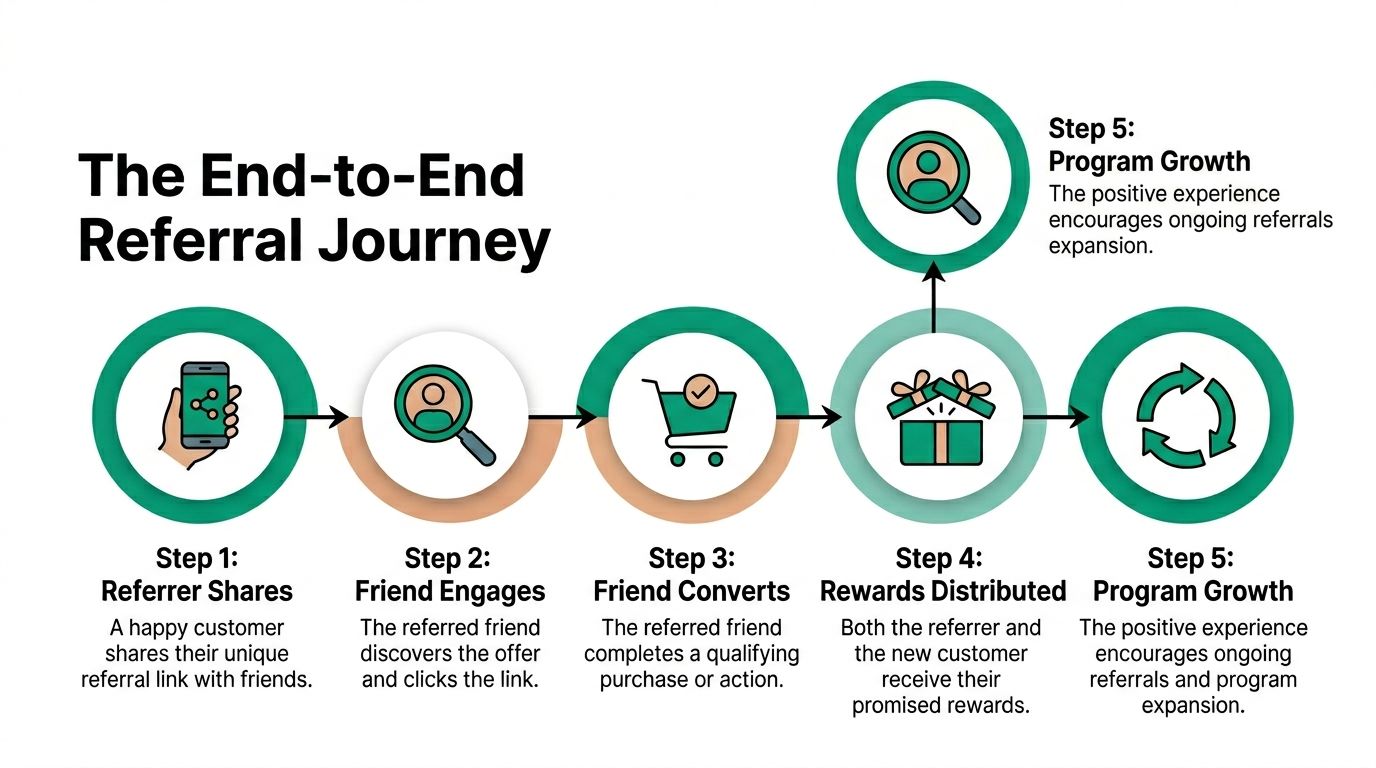
The End-to-End Referral Journey
A referral is not one action. It is a sequence. A customer shares. A prospect clicks. Your systems identify the source. Your team validates the conversion. Then the reward gets released.
What the advocate experiences
The advocate usually enters the referral flow right after a positive moment. For ecommerce, that can be after delivery or after a strong review. For services, it is often after a successful milestone, a visible result, or a renewal conversation.
The system generates a unique referral link or code for that person. In many setups, software handles this automatically and presents a small dashboard with copy options for email, text, and social sharing. The advocate sends the link with a short personal note. That note matters more than the reward copy because it carries the original trust.
A good prompt sounds like a favor to a friend, not a commission pitch.
What the friend experiences
The friend clicks the referral link and lands on a page built for context. The page should confirm the value quickly. If the business uses email and CRM automation, the click can pass UTM parameters and referral IDs into systems such as HubSpot or Klaviyo, which makes later attribution easier.
The referred prospect often moves faster because the first trust hurdle has already been cleared. In customer referral programs, referred customers show 18% greater loyalty and 16% higher lifetime value, while the trust transfer can cut customer acquisition cost by 50-70% versus paid ads according to Rivo’s overview of how referral programs work.
That does not mean every referred lead closes. It means the lead enters the funnel with less friction than a stranger from an ad click.
For businesses that already run outbound and inbound together, referrals can feed other acquisition systems instead of replacing them. A practical example is using referred contacts to strengthen a broader lead generation process for small business, where warm introductions and direct outreach support each other rather than compete.
What the business has to track
The business side is less glamorous. It is also where the program either scales or becomes a mess.
At minimum, your workflow needs to answer four questions:
Who shared the referral
Who clicked or submitted
What counts as a qualifying conversion
When the reward should be released
The qualifying event varies by model. In ecommerce, it is usually a completed purchase. In B2B, it may be a booked demo, a signed contract, or a paid first invoice. For local services, it might be a completed job.
Teams often encounter issues at this point. They launch the front-end experience first, then try to patch together attribution later. That creates disputes. A customer says they referred someone. Sales says the lead came from organic search. The CRM record lacks a source field. Finance does not know whether to approve the reward.
Clean referral operations solve that before launch.
A practical backend flow often looks like this:
Share recorded: the software assigns the advocate’s unique identifier
Visit captured: the click passes a referral ID or code into analytics
Lead created: form submission writes the source into the CRM
Conversion validated: the system checks whether the event meets program rules
Reward triggered: credit, discount, or gift is released automatically or approved through review
A short visual helps if you need to explain the process to a team member or stakeholder: