

TL;DR:
- Small businesses now account for 27% of the US digital ad market, with a 22% increase in digital ad spend in 2025. Online advertising provides SMBs with precise targeting, immediate visibility, and scalable, measurable results. AI and automation tools are democratizing ad management, enabling SMBs to compete effectively without large budgets or expertise.
Small businesses increased their digital ad spend by 22% in 2025, now accounting for roughly 27% of the entire US digital advertising market. That number surprises a lot of business owners who still think online advertising is reserved for companies with massive marketing departments and unlimited budgets. It is not. The tools, platforms, and automation available today make it possible for a local service business or regional retailer to run campaigns that rival what large brands do, at a fraction of the cost. This guide breaks down exactly why online advertising works for SMBs, which platforms deserve your attention, and how to make every dollar count.
Table of Contents
- How online advertising unlocks growth for SMBs
- Choosing the right platforms: Where your audience spends time
- The role of AI and automation in modern online advertising
- Making your ad budget work: Maximizing ROI and common pitfalls
- What most SMBs get wrong (and right) about online advertising
- Ready to accelerate your growth with online ads?
- Frequently asked questions
Key Takeaways
| Point | Details |
|---|---|
| Precise targeting | Online ads let SMBs reach ideal customers based on demographics and behavior. |
| Scalable results | Ad campaigns can start small, with budgets scaling as you see returns and growth. |
| Automation advantage | AI tools automate campaign optimization, making success more accessible for SMBs. |
| Measurable impact | Every ad dollar can be tracked, helping you focus spending on what delivers results. |
How online advertising unlocks growth for SMBs
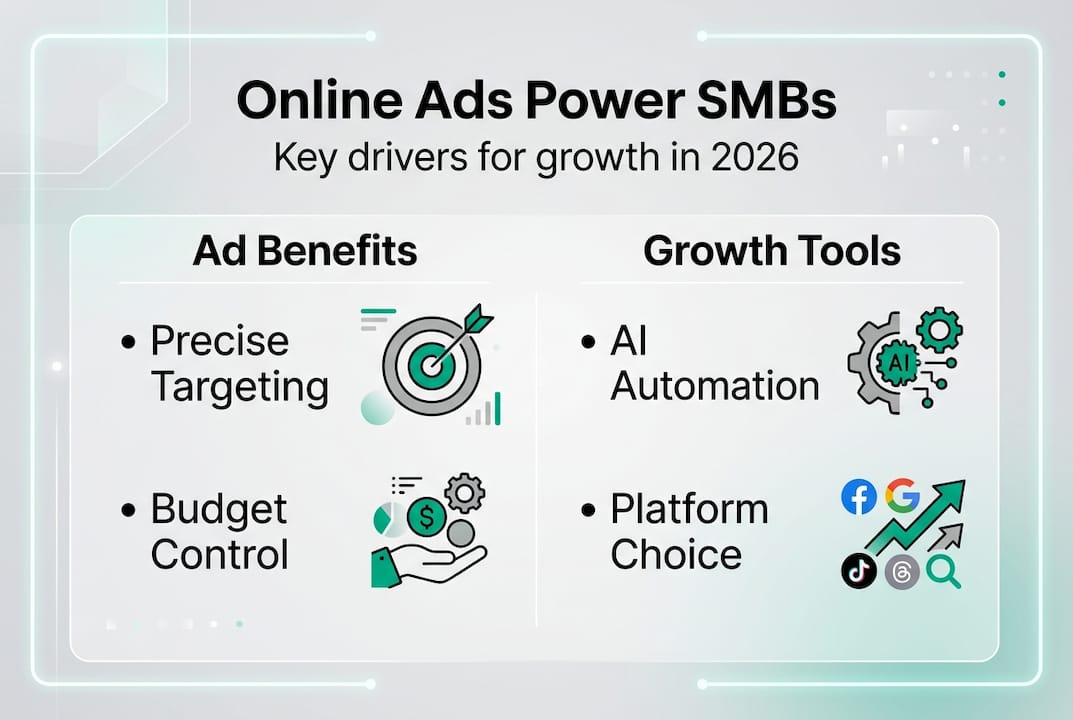
Online advertising gives small and medium-sized businesses something traditional media never could: precision. You are not buying a billboard and hoping the right person drives by. You are placing your message directly in front of people who match your ideal customer profile, based on their location, age, income, interests, and even their recent online behavior.
This kind of precise targeting by demographics and behaviors means your budget works harder. A plumber in Austin does not need to advertise to people in Seattle. A boutique clothing store can target women aged 25 to 45 within a 10-mile radius who have shown interest in fashion. That level of control is a genuine competitive advantage, and it is available to any business willing to learn the basics.
Here is a quick look at the core benefits online advertising delivers for SMBs:
- Immediate visibility: Your ads can appear within hours of launching a campaign, not weeks.
- Trackable results: Every click, lead, and sale can be traced back to a specific ad or keyword.
- Flexible budgets: You set the daily or monthly limit. There is no minimum spend requirement on most platforms.
- Scalability: Start small, prove what works, then increase spend with confidence.
- Competitive reach: You can appear alongside or above large brands in search results.
The types of digital marketing available today range from paid search to display ads to video, and each serves a different purpose in your growth strategy.
| Advertising type | Best for | Typical cost model |
|---|---|---|
| Paid search (Google Ads) | High-intent buyers ready to act | Cost per click (CPC) |
| Social media ads (Meta) | Brand awareness and retargeting | Cost per impression (CPM) |
| Display advertising | Keeping your brand visible | CPM or CPC |
| Video ads (YouTube) | Storytelling and product demos | Cost per view (CPV) |
The digital marketing guide for SMBs offers a practical roadmap if you are just starting to build your strategy. The key takeaway here is that online advertising is not a single tactic. It is a toolkit, and using the right tools together is what drives real growth.
Choosing the right platforms: Where your audience spends time
Not every platform will be right for your business. The best choice depends on where your customers are, what they are doing when they see your ad, and what action you want them to take.
Google Ads offers high-intent search options, meaning your ad appears when someone is actively searching for what you sell. Meta (Facebook and Instagram) excels at demographic and interest-based targeting, reaching people who fit your customer profile even if they are not actively searching. Both platforms now use AI automation to optimize your campaigns in real time.
Here is how to think about the platform decision:
- Google Ads: Best when customers are already looking for your product or service. High purchase intent means higher conversion rates.
- Meta Ads: Best for building awareness, retargeting website visitors, or reaching a specific demographic with visual content.
- Instagram: Strong for product-based businesses, restaurants, and lifestyle brands where visuals drive decisions.
- LinkedIn Ads: Effective for B2B businesses targeting professionals by job title, industry, or company size.
| Platform | Primary strength | Ideal business type |
|---|---|---|
| Google Ads | Search intent | Service businesses, local businesses |
| Meta (Facebook/Instagram) | Demographic targeting | Retail, e-commerce, local brands |
| Professional targeting | B2B, consulting, professional services | |
| YouTube | Video storytelling | Product demos, brand building |
Pro Tip: If your budget is limited, start with Google Ads for bottom-of-funnel traffic (people ready to buy) and add Meta Ads later for awareness and retargeting once you have data to work with.
You can learn more about how Google Ads works in detail on our platform page. Staying current with digital marketing trends also helps you spot new platform opportunities before your competitors do.
The role of AI and automation in modern online advertising
A few years ago, running effective paid ad campaigns required significant expertise. You needed to manually research keywords, write multiple ad variations, set bids, and constantly monitor performance. That is no longer the case for most SMBs.
AI tools are democratizing access, letting smaller businesses compete more efficiently by automating the most complex parts of campaign management. This shift is significant because it removes the skill barrier that once kept many SMB owners away from paid advertising.
Here is how AI and automation are changing the game right now:
- Smart bidding: Google’s automated bidding adjusts your bids in real time based on the likelihood of a conversion, so you are not overpaying for clicks that will not convert.
- Dynamic creative optimization: Platforms test different combinations of headlines, images, and descriptions automatically, then serve the best-performing version to each user.
- Meta Advantage+: This suite of tools automates audience targeting, budget allocation, and creative testing across Facebook and Instagram with minimal manual input.
- Google Smart Campaigns: Designed specifically for small businesses, these campaigns handle keyword selection, ad creation, and bidding automatically.
- Lookalike audiences: AI analyzes your existing customer list and finds new people who share similar characteristics, expanding your reach intelligently.
“The biggest shift AI brings to SMB advertising is not just efficiency. It is the ability to learn faster than any human campaign manager could manually.”
Pro Tip: When starting with AI-powered campaigns, give the algorithm at least two to four weeks of data before making major changes. Cutting campaigns too early is one of the most common mistakes SMB owners make.
Exploring AI in digital marketing further reveals how these tools extend well beyond advertising into web design, content, and customer experience.
Making your ad budget work: Maximizing ROI and common pitfalls
Having the right platform and the right tools means nothing if your budget is not managed carefully. The good news is that you do not need a large budget to see results. You need a disciplined approach.

Starting small and tracking ROAS (Return on Ad Spend) and CPL (Cost per Lead) gives you the data to make smart decisions before scaling. ROAS tells you how much revenue you earn for every dollar spent on ads. CPL tells you what you are paying to acquire each new lead. Both numbers should guide every budget decision you make.
Here are the most important budget practices for SMBs:
- Set a clear goal first: Are you trying to generate phone calls, form submissions, online purchases, or store visits? Your goal shapes everything else.
- Start with a test budget: Run campaigns at a modest spend for 30 days before committing larger amounts. Treat it as paid research.
- Review performance weekly: Do not let campaigns run unattended. Check your metrics every week and pause what is not working.
- Test your creativity: Run at least two or three ad variations at a time to identify which message, image, or offer resonates most.
- Track conversions properly: Install conversion tracking before you spend a single dollar. Without it, you are flying blind.
Pro Tip: A common mistake is judging a campaign too quickly based on clicks alone. Focus on conversion actions (calls, form fills, purchases) rather than traffic volume. Clicks that do not convert are just expenses.
Our paid advertising strategies guide covers budget frameworks in more depth, and our PPC optimization tips article gives you specific tactics to improve campaign performance without increasing spend.
What most SMBs get wrong (and right) about online advertising
After working with hundreds of small and medium-sized businesses, we have seen the same patterns repeat. The businesses that struggle with online advertising almost always fall into the “set and forget” trap. They launch a campaign, walk away, and check back months later, wondering why results are poor. Online advertising is not a vending machine. It rewards consistent attention and willingness to adjust.
The other common mistake is trying to copy what big brands do. Large companies run brand awareness campaigns because they have already saturated high-intent search. Most SMBs have not. Your priority should be capturing demand that already exists, not creating it from scratch with expensive awareness campaigns.
What the winning SMBs get right is agility. They test fast, learn fast, and double down on what works. They treat every campaign as an experiment with a hypothesis. That mindset, combined with the discipline to track real metrics, is what separates businesses that grow from those that stall. Our SMB strategy insights dig deeper into the strategic frameworks that consistently produce results.
Ready to accelerate your growth with online ads?
Understanding online advertising is one thing. Executing it consistently while running a business is another challenge entirely. That is where having the right partner makes a measurable difference.
At Ascendly Marketing, our digital marketing experts have been helping SMBs build and manage profitable ad campaigns since 2013. Whether you need a full-service team to handle your PPC advertising from strategy to execution, or you want to explore the full range of our marketing services to find the right fit, we are ready to help. Book a consultation and let us show you exactly what a well-run campaign can do for your business.
Frequently Asked Questions
What is the biggest advantage of online advertising for small businesses?
The biggest advantage is precise targeting by demographics, interests, and behaviors, which allows SMBs to reach the right audience efficiently and generate measurable results without wasting budget on broad, untargeted exposure.
How much should a small business spend on online ads to see results?
Even a modest budget can deliver results when you start small and track performance metrics like ROAS and CPL, then adjust your spending based on what the data tells you.
Which online advertising platform delivers the best ROI for SMBs?
Google Ads for high-intent search works well when customers are actively looking for your service, while Meta excels at demographic targeting; the best platform depends on your specific business goals and where your customers spend their time.
How do AI tools help SMBs with online advertising?
AI tools democratize access by automating targeting, budget optimization, and creative testing, making effective advertising easier and more accessible for small businesses without requiring deep technical expertise.