

Pouring money into paid ads and watching it disappear without a single sale is one of the most frustrating experiences a business owner can have. You’re not alone. Countless small and medium-sized businesses run campaigns that burn through budgets because they skip the fundamentals, chase vanity metrics, or simply copy what bigger brands do without the same resources. This guide cuts through the noise. We’ll walk you through how paid advertising actually works, how to plan and build campaigns that generate real returns, and how to measure success so you can scale what’s working.
Table of Contents
- Understanding paid advertising and its advantages
- Laying the groundwork: Budget, goals, and tracking
- Building your paid advertising campaign: Step-by-step
- Optimization and troubleshooting: Common SMB pitfalls
- Measuring results and scaling what works
- Take your paid advertising further with expert help
- Frequently asked questions
Key Takeaways
| Point | Details |
|---|---|
| Start with clear goals | Defining your target results and tracking methods is essential for paid ad success. |
| Long-tail keywords matter | Focusing on niche, high-intent keywords reduces costs and improves ROI. |
| Let data guide actions | Be patient with learning periods, avoid knee-jerk changes, and scale what’s working. |
| Track the full funnel | True success comes from tracking beyond clicks—all the way to sales and revenue. |
Understanding paid advertising and its advantages
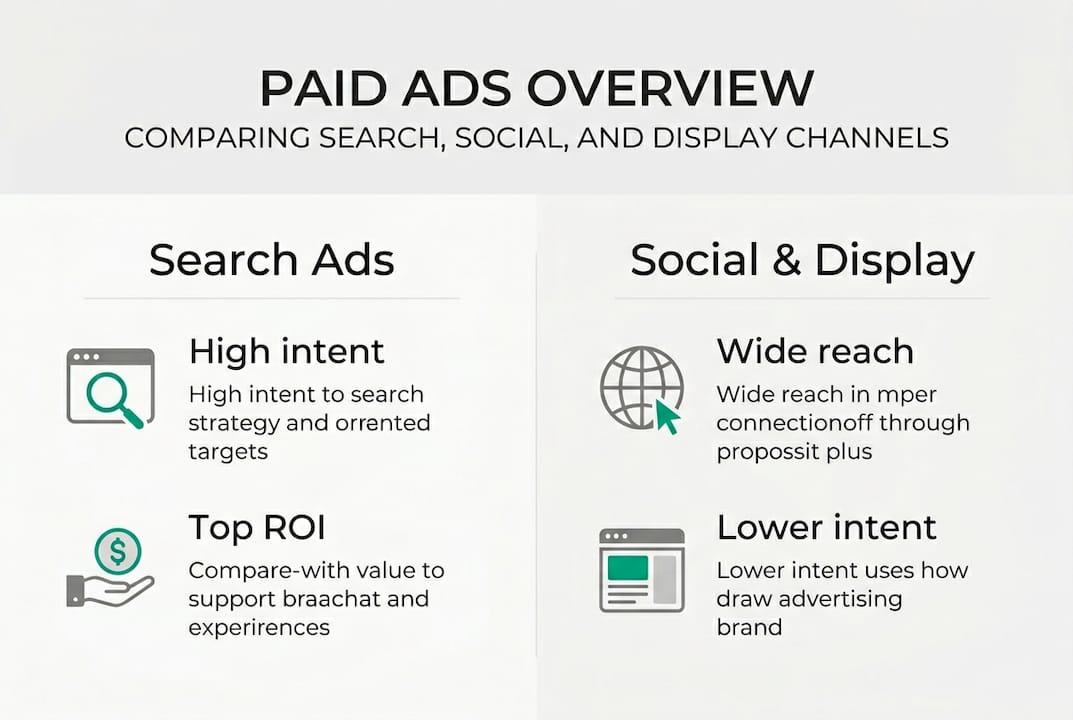
Paid advertising is any placement you pay for to reach a target audience. It breaks down into three main channels: paid search (ads on Google or Bing triggered by user queries), paid social (ads on Facebook, Instagram, LinkedIn, or TikTok), and display advertising (banner or visual ads served across websites and apps via ad networks).
Each channel serves a different purpose. Paid search captures people who are already looking for what you sell. That intent is powerful. Paid social interrupts people mid-scroll, so it works better for awareness and retargeting. Display ads are great for keeping your brand visible across the web. Knowing which channel fits your goal is the first decision you need to make.
Here’s why SMBs should take paid advertising seriously:
- Fast results: Unlike SEO, paid ads can drive traffic the same day you launch.
- Precise targeting: Reach people by location, age, interest, job title, or search intent.
- Full control: Set your own budget, pause anytime, and adjust in real time.
- Measurable ROI: Every click, conversion, and dollar spent is trackable.
- Scalability: What works at $500/month can often be scaled to $5,000/month.
Search ads outperform social for intent and ROI when your audience is actively shopping. If someone types “best CRM for small business” into Google, they’re ready to buy. That’s the kind of traffic that converts. Understanding paid search basics before you spend a dollar will save you from costly trial and error.
Laying the groundwork: Budget, goals, and tracking
Before you launch anything, you need three things locked in: a realistic budget, clear goals, and proper tracking. Skipping any one of these is like driving without a map or a speedometer.
Here’s a quick reference for channel entry points:
| Channel | Entry budget (monthly) | Learning period | Primary goal |
|---|---|---|---|
| Google Search | $500 to $1,500 | 7 to 14 days | Lead gen, direct sales |
| Facebook/Instagram | $300 to $1,000 | 7 days | Awareness, retargeting |
| LinkedIn Ads | $1,000 to $3,000 | 14 to 21 days | B2B lead generation |
| Google Display | $300 to $800 | 7 to 14 days | Brand visibility |
Once your budget is set, define what success looks like. Follow these steps:
- Confirm your primary goal. Is it leads, sales, phone calls, or store visits?
- Set a target CPA (Cost Per Acquisition). Know the maximum you can spend to acquire one customer profitably.
- Calculate your LTV: CAC ratio. If a customer is worth $1,200 over their lifetime, spending $200 to acquire them is smart.
- Install conversion tracking. Use Google Tag Manager or your platform’s native pixel before you spend a cent.
- Define your ROAS target. A 3:1 ROAS benchmark is a healthy starting point for most SMBs, meaning $3 earned for every $1 spent.
Tracking the full funnel matters more than watching clicks. A campaign with a 10% click-through rate but zero conversions is failing. Use marketing ROI calculation methods to connect ad spend directly to revenue, and pair that with improving conversion rates on your landing pages to maximize every dollar.

Pro Tip: Never set a campaign live and walk away. Block 30 minutes every week to review performance data and make small, deliberate adjustments. Reactive management beats passive neglect every time.
Building your paid advertising campaign: Step-by-step
With your goals and tracking in place, it’s time to build. Here’s the exact process we recommend:
- Confirm your goal and match it to a channel. Don’t run LinkedIn ads to sell consumer products. Match the platform to the buyer.
- Research keywords or audiences. For search, prioritize long-tail keywords because they carry lower cost-per-click and higher purchase intent. “Affordable HVAC repair in Austin” beats “HVAC” every time.
- Write your ad copy. Lead with the benefit, not the feature. “Save 30% on your first order” outperforms “We offer competitive pricing.” Human creativity still beats AI-generated copy for SMB budgets because you know your customer’s real pain points.
- Choose your bidding strategy. Start with manual CPC or target CPA bidding. Avoid broad automated strategies until you have conversion data.
- Structure your campaigns tightly. One theme per ad group. This keeps your quality scores high and your reporting clean.
- Set your daily budget and launch. Start conservative. You can always increase spend once you see what’s working.
One step most SMBs skip: adding negative keywords from day one. If you sell premium office furniture, you don’t want clicks from people searching “free office furniture” or “DIY desk plans.”
Pro Tip: Build your negative keyword list before you launch, not after you’ve wasted $300 on irrelevant clicks. Review your search term report within the first 48 hours and add exclusions immediately.
For a deeper look at campaign refinement, our PPC optimization tips cover advanced tactics for small business success in 2026.
Optimization and troubleshooting: Common SMB pitfalls
Even well-built campaigns can underperform. The difference between businesses that succeed with paid ads and those that don’t often comes down to avoiding a handful of predictable mistakes.
The most common budget killers:
- Overusing broad-match keywords. Broad match casts too wide a net and drains budgets on irrelevant searches.
- Ignoring negative keywords. Without them, you’re paying for traffic that will never convert.
- Changing budgets too frequently. Every time you significantly alter your budget, the platform’s AI resets its learning. This is a real performance killer.
- Not tracking conversions. If you can’t see what’s converting, you can’t optimize.
- Sending traffic to a weak landing page. A great ad with a poor destination is money wasted.
“Paid ad platforms use machine learning to optimize delivery. Frequent budget changes reset that learning cycle and can seriously damage campaign performance. Commit to a budget for at least 7 days before making significant adjustments.”
Here’s a quick comparison to help you decide how to manage your campaigns:
| Approach | Best for | Pros | Cons |
|---|---|---|---|
| DIY management | Tight budgets, time-rich owners | Full control, low cost | Time-intensive, steep learning curve |
| AI tools | Moderate budgets, limited time | Saves time, automates bidding | Less nuance, can overspend |
| Agency management | Growth-focused SMBs | Expert strategy, faster results | Higher upfront cost |
For landing page improvements that support your ad campaigns, explore our website conversion tips to make sure your traffic has somewhere strong to land.
Measuring results and scaling what works
Data is only useful if you act on it. Here’s what to measure and how to use it:
- ROAS (Return on Ad Spend). A 3:1 ROAS is the standard healthy benchmark. Below that, your campaign needs work. Above 5:1, consider scaling.
- CPA (Cost Per Acquisition). Compare this to your average customer value. If your CPA is $50 and a customer is worth $500, you’re in great shape.
- LTV: CAC ratio. Lifetime value divided by customer acquisition cost. A ratio of 3:1 or higher signals a sustainable paid strategy.
- Funnel conversion rate. Track how many clicks become leads, and how many leads become customers. Weak spots in the funnel reveal where to focus.
Set up a simple weekly dashboard in Google Looker Studio or your ad platform’s native reporting. You don’t need 40 metrics. Focus on five: impressions, clicks, conversions, CPA, and ROAS.
When you’re ready to scale, raise budgets by no more than 20% at a time to avoid disrupting the algorithm’s learning. Expand to new ad groups or audiences only after your core campaigns are consistently profitable.
A/B testing and search term reviews done weekly are what separate growing campaigns from stagnant ones. Test one variable at a time: headline, image, call to action, or landing page. For e-commerce businesses, our guide on e-commerce conversion optimization pairs well with scaling paid traffic.
Take your paid advertising further with expert help
Building and managing paid campaigns takes real time and expertise. If you’re running a business and trying to manage ads on top of everything else, it’s easy for performance to slip through the cracks.
At Ascendly Marketing, we’ve helped SMBs across industries build paid advertising strategies that generate measurable, scalable results since 2013. Whether you need a full campaign build, a performance audit of existing ads, or ongoing management, our team handles it all. Explore our PPC advertising services to see how we approach search, social, and display campaigns, or browse our full range of digital marketing solutions to find the right fit for your goals. You focus on running your business. We’ll focus on growing it.
Frequently Asked Questions
What is a healthy ROAS for small business paid ads?
A 3:1 ROAS is the standard benchmark, meaning you earn $3 in revenue for every $1 spent on ads. Consistently hitting this number signals your campaigns are profitable and worth scaling.
How long should I wait before judging a new campaign’s results?
Give any new campaign at least 7 days before concluding. Platforms need this 7-day learning period to optimize delivery, and pulling the plug too early means you never see what the campaign could actually do.
What paid ad mistakes cost small businesses the most?
The biggest budget drains are broad match overuse, missing negatives, and changing budgets too often. Each of these disrupts performance differently, but all three are entirely avoidable with a little upfront planning.
Are AI tools better than doing paid ads yourself?
DIY is viable for small budgets if you have the time and willingness to learn, but AI tools can automate bidding and save hours each week. The tradeoff is less control and the risk of overspending without close oversight.