

TL;DR:
- AI is transforming SEO by automating data analysis, keyword research, and content optimization.
- Small businesses can leverage affordable AI tools for targeted, efficient SEO strategies.
- Ethical use of AI includes avoiding duplicate content, maintaining brand voice, and following search engine guidelines.
Most small business owners still picture SEO as a grind of manual keyword lists, endless spreadsheets, and guesswork. That picture is outdated. AI is reshaping how businesses get found online, and the shift is happening faster than most marketers realize. Whether you’re managing SEO in-house or working with an agency, understanding how artificial intelligence fits into your strategy is no longer optional. This guide breaks down exactly what AI in SEO means, where it creates real advantages, and how your business can start using it without blowing your budget or violating Google’s rules.
Table of Contents
- Understanding the basics: What is AI in SEO?
- Core ways AI is changing SEO
- How small businesses can leverage AI for better SEO results
- Potential pitfalls and ethical considerations with AI in SEO
- Our perspective: The future of AI in SEO for small businesses
- Ready to take your SEO to the next level?
- Frequently asked questions
Key Takeaways
| Point | Details |
|---|---|
| AI drives SEO efficiency | Leveraging AI tools streamlines research, optimization, and monitoring, saving time for teams. |
| Quality beats automation | AI is powerful, but human oversight ensures content meets user and search engine expectations. |
| Start small for results | Testing AI in one or two SEO areas first allows small businesses to see benefits without high risk. |
| Balance risk and reward | Recognizing ethical pitfalls and compliance needs is essential with any AI adoption. |
Understanding the basics: What is AI in SEO?
Artificial intelligence (AI) refers to computer systems that can perform tasks that normally require human thinking, like recognizing patterns, making decisions, and learning from data. Machine learning (ML) is a branch of AI where systems improve automatically through experience rather than being explicitly programmed for every task. In SEO, these technologies work together to process massive amounts of data, spot ranking patterns, and surface actionable insights faster than any human team could.
AI uses machine learning and data analysis to automate and enhance SEO tasks that once took hours of manual work. That includes everything from identifying which keywords are gaining traction to analyzing why a competitor’s page outranks yours. For small businesses, this means access to capabilities that were once reserved for enterprise-level marketing teams with big budgets.
Here are some key terms you’ll encounter when exploring AI in SEO:
- Automation: Using software to complete repetitive tasks like meta tag generation or broken link detection without manual input
- Algorithm: A set of rules a search engine or AI tool uses to evaluate and rank content
- Predictive analysis: Using historical data to forecast future outcomes, such as which keywords are likely to grow in search volume
- Natural language processing (NLP): AI’s ability to understand and generate human language is critical for content and search intent analysis
- Content optimization: AI-driven suggestions for improving existing content to rank higher for target queries
Understanding SEO for small businessES starts with recognizing that AI tools are not magic buttons. They amplify what you already know and speed up what you already do. The more context you give them, the better the output.
Pro Tip: Before buying any AI SEO tool, ask the vendor specifically how the system learns and updates. Many tools label themselves as “AI-powered” but simply run rule-based scripts with no actual learning capability. True AI tools improve their recommendations over time based on real performance data.
Core ways AI is changing SEO
AI is not just tweaking how SEO works. It’s rewriting the process from the ground up. Here are the five core areas where the impact is most significant:
- Keyword research: AI tools analyze billions of search queries to surface long-tail keywords, seasonal trends, and intent clusters that manual research would miss entirely
- Content generation and optimization: AI assists in drafting outlines, suggesting headings, and optimizing existing content for relevance and readability
- Technical site audits: Automated crawlers powered by AI can identify crawl errors, page speed issues, and schema gaps across hundreds of pages in minutes
- Predictive rankings: AI models analyze current ranking signals to predict how a page will perform before you publish it
- User intent analysis: AI categorizes search queries by intent (informational, navigational, transactional) so you can match content to what users actually want
AI-powered tools increase SEO efficiency by automating keyword research, content optimization, and site audits, freeing your team to focus on strategy rather than data collection.
“The businesses winning at SEO in 2026 are not the ones doing more manual work. They’re the ones using AI to work smarter, then applying human judgment to what the data surfaces.” — Ascendly Marketing
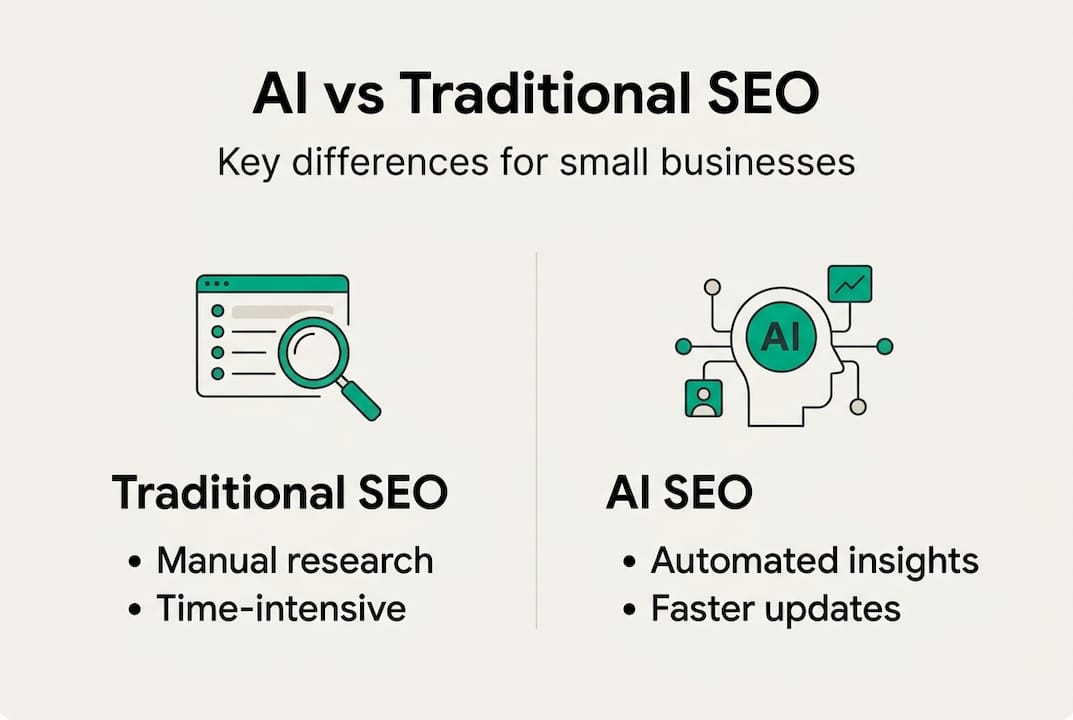
| Task | Traditional SEO | AI-enhanced SEO |
|---|---|---|
| Keyword research | Manual tools, hours of filtering | Automated clustering, intent mapping |
| Content creation | Fully human-written drafts | AI-assisted outlines and optimization |
| Technical audits | Scheduled manual crawls | Real-time automated monitoring |
| Competitor analysis | Periodic manual review | Continuous AI-driven tracking |
| Ranking predictions | Educated guesses | Data-backed forecasting models |
Humans remain essential for strategic judgment, creative direction, and brand voice. Self-optimizing websites powered by AI still need human oversight to ensure they reflect the right business goals. You can explore real outcomes in AI SEO case studies that show how this balance plays out in practice. AI handles the volume. You handle the vision. That combination is what produces consistent results according to AI for SEO research.

How small businesses can leverage AI for better SEO results
AI-driven platforms can help small businesses prioritize limited resources for high-impact SEO actions, which is exactly what resource-constrained teams need. The key is starting with the right tools and the right expectations.
Here are the most practical use cases for AI in your SEO workflow:
- Blog content planning: AI tools generate topic clusters and outline structures based on what’s already ranking in your niche
- Metadata optimization: Automatically generate and test title tags and meta descriptions at scale
- Local listing management: AI platforms monitor and update your Google Business Profile and directory listings for consistency
- Technical fixes: Automated alerts for broken links, slow pages, and missing alt text so issues get caught before they hurt rankings
- Competitor gap analysis: AI tools identify keywords your competitors rank for that you don’t, revealing quick-win opportunities
When it comes to tools, not every option fits every budget. Here’s a practical comparison:
| Tool tier | Example tools | Monthly cost | Best for | Learning curve |
|---|---|---|---|---|
| Entry-level | Ubersuggest, RankMath | $0 to $30 | Keyword ideas, on-page optimization | Low |
| Mid-range | Semrush, Surfer SEO | $50 to $150 | Content optimization, audits | Medium |
| Advanced | Clearscope, MarketMuse | $150 to $400+ | Deep content strategy, competitive analysis | Medium to high |
For a deeper look at what’s available, AI SEO tool reviews can help you compare features before committing. You can also align your tool choices with broader AI marketing strategies to make sure everything works together.
Pro Tip: Don’t try to automate your entire SEO workflow at once. Pick one area, like metadata generation or keyword research, run it for 60 days, and measure the impact before expanding. This approach prevents overwhelm and gives you clean data on what’s actually working.
Potential pitfalls and ethical considerations with AI in SEO
As you consider leveraging AI for SEO, it’s essential to be aware of potential pitfalls and ethical boundaries. AI can accelerate results, but it can also accelerate mistakes if you’re not careful.
Watch out for these common pitfalls:
- Duplicate content: AI tools that generate content at scale can produce near-identical pages, which search engines penalize
- Loss of brand voice: Over-relying on AI writing tools strips the personality and authenticity that make your content memorable
- Black-hat tactics: Some AI tools automate link schemes or keyword stuffing, which violate search engine guidelines and can result in manual penalties
- Outdated training data: AI models trained on older data may recommend strategies that no longer align with current ranking factors
- Algorithm misunderstandings: Assuming AI tools understand Google’s algorithm completely leads to over-optimized, robotic content
Excessive automation can compromise content originality and violate search engine quality guidelines, which is a risk that affects both rankings and brand reputation. Understanding SEO lead generation risks can help you spot where automation creates vulnerability in your pipeline.
On the ethical side, misleading automation practices, fake AI-generated reviews, and undisclosed AI content all carry real consequences, both from search engines and from your audience’s trust.
“Google’s guidance is clear: content created primarily to manipulate search rankings, whether by humans or AI, violates our spam policies. The focus must be on people-first content.” — Google Search guidance on AI content
The fix is straightforward. Use AI to assist your content team, not replace it. Have a human review every piece of AI-generated content before it goes live. Keep your SEO compliance practices grounded in quality-first principles, and you’ll avoid the traps that catch businesses off guard.
Our perspective: The future of AI in SEO for small businesses
Here’s something most AI SEO articles won’t tell you: the businesses that struggle most with AI adoption are not the ones with the smallest budgets. They’re the ones who treat AI as a shortcut instead of a system. We’ve seen it repeatedly. A business automates its entire content calendar, skips the human review step, and ends up with pages that rank for nothing because they read like they were written by a robot for a robot.
The uncomfortable truth is that AI makes good SEO teams better and bad SEO habits worse. If your strategy lacks focus before you add AI, the tools will just help you produce unfocused content faster. The real advantage comes from pairing AI’s data processing power with human creativity and strategic judgment.
Don’t believe the myth that full SEO automation is around the corner. It isn’t. Search engines are getting better at detecting low-effort, machine-generated content. The businesses that will win long-term are the ones that use AI to handle volume and analysis while keeping humans in charge of meaning and direction. Our SEO case studies show that this hybrid model consistently outperforms full automation. Treat AI as your most capable assistant, not your replacement strategist.
Ready to take your SEO to the next level?
Understanding AI in SEO is one thing. Implementing it correctly, without wasting budget or risking penalties, is another challenge entirely.

At Ascendly Marketing, we help small and medium-sized businesses apply AI-powered SEO strategies that are both effective and sustainable. Our team combines proven SEO services for small businesses with the latest AI tools to deliver measurable results. Whether you’re just getting started or looking to scale what’s already working, our AI SEO services Dallas team is ready to build a strategy tailored to your goals. Let’s turn your SEO from a guessing game into a growth engine.
Frequently Asked Questions
What are the top benefits of using AI in SEO for small businesses?
AI saves time, improves accuracy in keyword research, and optimizes content quickly. AI-powered tools automate keyword research, content optimization, and trend analysis so small teams can compete with larger ones.
Is AI-generated content accepted by Google for SEO?
Google allows AI-generated content when it prioritizes quality, originality, and genuine user value. Google’s official stance is that AI content must meet the same quality standards as human-written content.
How can I start using AI for SEO without a big budget?
Begin with free or low-cost tools for keyword ideas, basic audits, and content suggestions, then expand as your needs grow. AI-driven platforms enable small businesses to prioritize the most effective and budget-friendly SEO actions first.
What mistakes should businesses avoid when adopting AI for SEO?
Avoid fully automating content production, skipping quality reviews, or using AI tactics that violate search engine guidelines. Over-automation and poor content quality can breach search engine policies and damage your rankings.