

Many small business owners believe SEO is either too expensive or too technical to be worth the investment. This misconception costs businesses thousands in missed opportunities every year. The truth is that organic search drives 53% of all website traffic, and SEO typically delivers a cost per lead 60-70% lower than paid advertising after consistent execution. This guide clarifies what SEO actually is, how it works in 2026’s AI-driven landscape, and why mastering these fundamentals can transform your business visibility and revenue. You’ll learn the core strategies that drive real results and how to measure success effectively.
Table of Contents
- What Is SEO? Understanding the Basics and Why It Matters
- SEO Fundamentals Every Small Business Must Master in 2026
- How SEO Is Evolving With AI in 2026 and What It Means for Your Business
- Measuring and Applying SEO Success: Turning Visibility into Sales
- Unlock Your Business Growth With Expert SEO and Digital Marketing
- Frequently Asked Questions
Key takeaways
| Point | Details |
|---|---|
| SEO cuts lead costs significantly | Cost per lead is 60-70% lower with SEO versus paid ads after consistent execution |
| Organic search dominates traffic | Organic search drives 53% of all website traffic and converts at 5-8x higher rates than outbound leads |
| AI changes search dynamics | Pages cited in AI Overviews earn 35% more organic clicks and 91% more paid clicks than competitors |
| Core fundamentals still matter | Technical SEO, Core Web Vitals, topical authority, and E-E-A-T serve both traditional rankings and AI answers |
| Results require patience | Initial improvements appear within 3-6 months, but significant impact typically requires 12 months of consistent effort |
What is SEO? Understanding the basics and why it matters
SEO, or search engine optimization, is the practice of optimizing your website and content to appear prominently in free search engine results when potential customers search for products or services you offer. Unlike paid advertising where you buy placement, SEO earns visibility through strategic improvements to your site’s technical structure, content quality, and authority signals.
The main components of effective SEO include technical optimization ensuring search engines can properly crawl and index your site, creating valuable content that matches user intent, and building linking strategies that demonstrate your site’s authority and relevance. These elements work together to help search engines understand what your business offers and why it deserves to rank for specific searches.
Why does this matter for your bottom line? Organic search drives 53% of all website traffic, making it the single largest source of visitors for most businesses. More importantly, these visitors actively searched for solutions you provide, meaning they arrive with clear intent and higher conversion potential than passive audiences reached through other channels. SEO enhances your visibility precisely when prospects need your services most.
For small businesses competing against larger brands, SEO levels the playing field by rewarding relevance and expertise over budget size. A well-optimized local business can outrank national competitors for location-specific searches. The key is focusing on increasing organic traffic through content that addresses specific customer needs at different decision stages.
Pro Tip: Map your content to buyer intent stages. Create awareness content answering broad questions, consideration content comparing solutions, and decision content addressing specific product or service details. This strategic approach captures prospects throughout their entire journey.
SEO fundamentals every small business must master in 2026
Building a strong SEO foundation requires mastering several interconnected elements that work together to improve your search visibility and user experience. The core foundations of SEO include technical SEO, Core Web Vitals, topical authority, and E-E-A-T, serving both traditional rankings and AI answers.
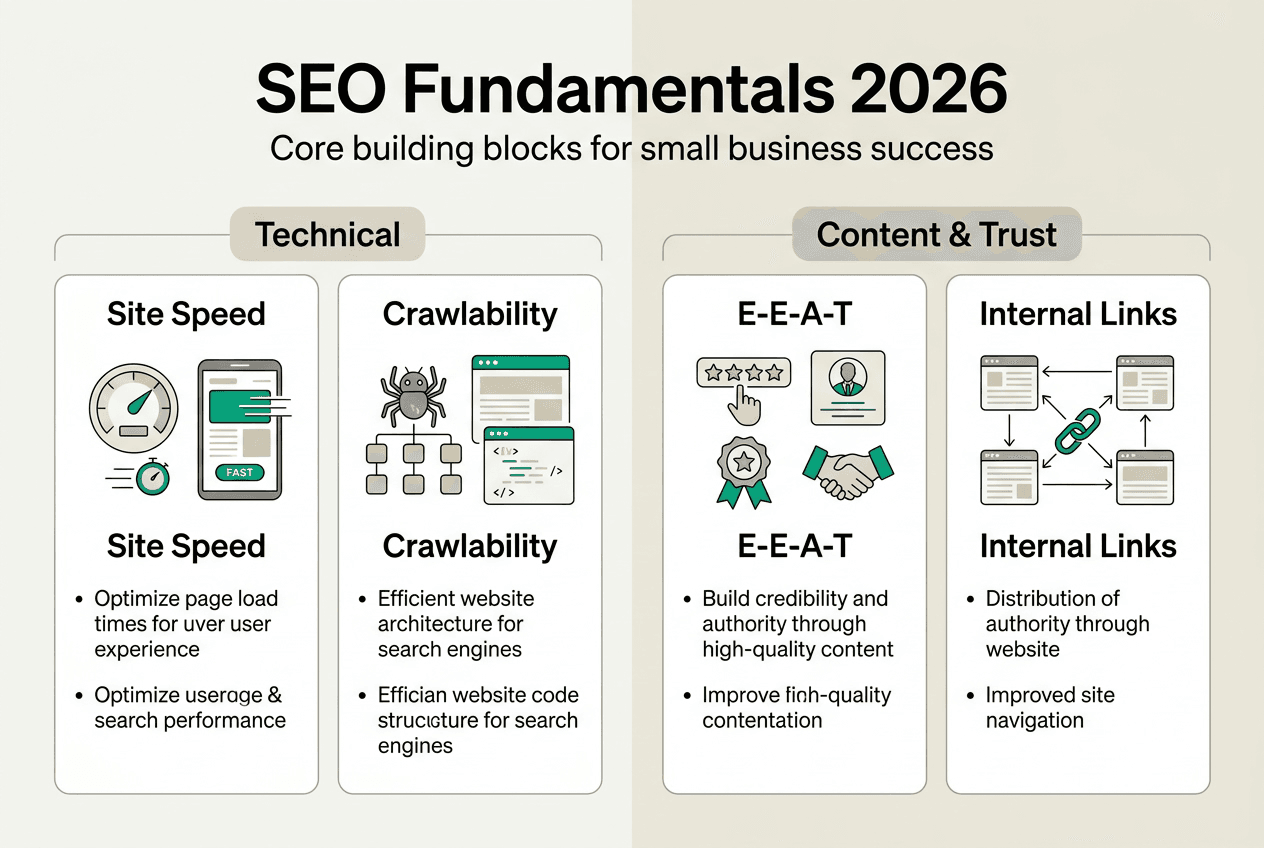
Technical SEO ensures search engines can efficiently crawl, understand, and index your website. This includes creating XML sitemaps, optimizing site architecture for logical navigation, implementing proper metadata like title tags and descriptions, and ensuring mobile responsiveness. Core Web Vitals, Google’s specific technical metrics, measure page loading speed, interactivity, and visual stability. Sites that load slowly or shift content unexpectedly frustrate users and face ranking penalties.
Content quality now centers on E-E-A-T: Experience, Expertise, Authoritativeness, and Trustworthiness. Your content must demonstrate real knowledge of your industry, show practical experience solving customer problems, establish your business as a credible authority, and build trust through transparency and accuracy. Generic, shallow content no longer ranks well regardless of keyword optimization.

Internal linking creates pathways between related pages on your site, helping search engines understand your content hierarchy and topic relationships. Strategic internal links distribute authority throughout your site and guide visitors to relevant information. Understanding organic SEO fundamentals helps you implement these connections effectively.
Local SEO remains vital for businesses serving specific geographic areas. Claiming and optimizing your Google Business Profile, maintaining consistent NAP information across directories, and earning local reviews significantly impact visibility for location-based searches. Conversion tracking completes the picture by connecting SEO efforts to actual business outcomes like form submissions, calls, and purchases.
| SEO Fundamental | Primary Role | Impact on Rankings |
|---|---|---|
| Technical SEO | Ensures crawlability and indexing | Foundation for all other efforts |
| Core Web Vitals | Measures user experience quality | Direct ranking factor since 2021 |
| E-E-A-T Content | Demonstrates expertise and trust | Primary content quality signal |
| Internal Linking | Distributes authority and context | Supports topical authority building |
| Local Optimization | Targets geographic searches | Critical for location-based businesses |
Pro Tip: Audit your site quarterly for technical issues using free tools like Google Search Console. Addressing crawl errors, broken links, and slow pages prevents ranking losses before they impact your traffic.
How SEO is evolving with AI in 2026 and what it means for your business
Artificial intelligence has fundamentally changed how search engines deliver results and how users find information. Google’s AI Overviews and similar features from other search engines now generate direct answers at the top of search results, synthesizing information from multiple sources. This shift means some searches no longer result in clicks to traditional organic listings.
The impact on click-through rates varies by query type. Informational searches increasingly get answered directly in AI-generated summaries, reducing clicks to source websites. However, pages cited in AI Overviews earn 35% more organic clicks and 91% more paid clicks than competitors not featured. Being selected as a source for AI answers provides a significant competitive advantage.
More remarkably, AI citation delivers 4.4× better conversion rates for visitors referred from language models compared to traditional search traffic. These users arrive with higher intent and trust, having already received preliminary answers that positioned your business as an authority. AI citation is now the highest-ROI SEO investment with a 35% organic CTR boost.
Optimizing for AI-driven search requires adapting your content strategy. Structure content to directly answer specific questions using clear, concise language. Use descriptive headings that mirror common search queries. Provide comprehensive coverage of topics rather than superficial keyword stuffing. AI systems favor content demonstrating genuine expertise and thorough treatment of subjects.
AI citation is now the highest-ROI SEO investment with 35% organic CTR boost and 4.4× better conversion rates for LLM-referred visitors.
Implementing AI SEO strategies means creating content that serves both human readers and AI systems parsing information for answers. This dual optimization approach ensures visibility regardless of how users search. The good news is that quality content meeting user needs naturally performs well in both contexts.
Pro Tip: Create FAQ sections addressing specific customer questions with direct, complete answers. This format helps AI systems extract relevant information while providing immediate value to human visitors scanning your content.
Measuring and applying SEO success: Turning visibility into sales
Tracking the right metrics separates effective SEO programs from wasted effort. Focus on measurements directly tied to business outcomes rather than vanity metrics like total traffic or keyword rankings alone. Qualified lead generation, conversion rates, and customer acquisition costs reveal SEO’s true impact on your bottom line.
Comparing SEO performance to paid advertising provides valuable context. Cost per lead is typically 60-70% lower with SEO versus paid ads after consistent execution. Additionally, SEO leads convert at 5-8x higher rates than outbound leads because they actively sought solutions rather than passively receiving interruption-based marketing. These economics make SEO compelling for budget-conscious small businesses.
To track and optimize SEO performance effectively, follow these steps:
- Set up conversion tracking in Google Analytics 4, connecting website actions to business goals like form submissions, phone calls, and purchases.
- Establish baseline metrics for organic traffic, conversion rates, and lead quality before implementing new SEO strategies.
- Monitor keyword rankings for terms directly related to your products and services, focusing on commercial intent keywords.
- Track page-level performance, identifying which content drives the most qualified leads and revenue.
- Calculate customer lifetime value for SEO-acquired customers compared to other channels to understand true ROI.
- Review competitor visibility for your target keywords quarterly to identify gaps and opportunities.
- Adjust content and technical optimization based on performance data, doubling down on what works.
Connecting SEO efforts to sales outcomes requires integrating your analytics with CRM systems. Tag leads by source channel so you can track which SEO content ultimately converts to customers. This closed-loop reporting demonstrates SEO’s contribution to revenue, not just traffic.
| Lead Source | Average Conversion Rate | Typical Cost Per Lead | Lead Quality Score |
|---|---|---|---|
| Organic SEO | 14-20% | $50-$150 | High intent, actively searching |
| Paid Search | 3-5% | $150-$300 | Moderate intent, responsive to ads |
| Outbound | 2-3% | $200-$400 | Low intent, interrupted activity |
| Social Media | 1-2% | $100-$250 | Variable intent, passive discovery |
Understanding conversion rate improvement techniques helps you maximize the value of traffic SEO delivers. Small changes to landing page design, messaging clarity, and calls to action can significantly boost the percentage of visitors who become customers.
Pro Tip: Use attribution modeling to credit SEO appropriately when customers interact with multiple touchpoints before converting. First-click attribution shows SEO’s role in initial discovery, while multi-touch models reveal its influence throughout the buyer journey.
Unlock your business growth with expert SEO and digital marketing
Understanding SEO fundamentals is the first step. Implementing them consistently while adapting to evolving search algorithms requires expertise and dedicated resources many small businesses lack. That’s where professional guidance makes the difference between sporadic results and sustained growth.
Ascendly Marketing specializes in helping small and medium-sized businesses build comprehensive digital marketing strategies that drive measurable results. Our team combines technical SEO expertise with content creation, conversion optimization, and performance tracking to maximize your online visibility and lead generation.

As a best SEO service agency, we’ve helped businesses across industries achieve first-page rankings, increase organic traffic, and significantly reduce customer acquisition costs. Our approach integrates SEO with broader marketing initiatives, ensuring every element of your small business marketing strategy works together cohesively. Schedule a consultation to discover how we can accelerate your growth through proven digital marketing strategies.
Frequently Asked Questions
What are the most common SEO misconceptions?
Many business owners believe SEO is simply about stuffing keywords into content, but modern SEO prioritizes user intent and experience above keyword density. Search engines now evaluate content quality, relevance, and helpfulness rather than rewarding repetitive keyword usage. Another misconception is that SEO delivers instant results like paid advertising, when reality shows meaningful improvements typically require months of consistent effort building authority and trust signals.
How long does it take to see results from SEO?
Initial improvements in search visibility usually appear within 3 to 6 months of implementing proper SEO strategies, with some quick wins like fixing technical errors showing faster impact. However, significant traffic increases and competitive rankings typically require 12 months of consistent optimization, content creation, and authority building. SEO is a long-term investment that compounds over time, with established sites maintaining rankings more easily than new entrants constantly fighting for position.
Can SEO replace paid advertising completely?
SEO significantly lowers lead acquisition costs and provides sustainable long-term traffic, but paid advertising offers immediate visibility that SEO cannot match during launch periods or promotional campaigns. The most effective approach combines both channels strategically, using paid ads for quick wins and testing while building SEO for cost-efficient long-term growth. Understanding paid search guide principles helps you allocate budget optimally between channels based on your specific business goals and timeline.
What role does content play in SEO?
Content serves as the primary vehicle for demonstrating expertise, answering user questions, and targeting relevant search queries that bring qualified traffic to your site. High-quality content that thoroughly covers topics, addresses user intent, and provides genuine value drives both traditional search rankings and inclusion in AI-generated answers. Thin, generic content no longer ranks well regardless of technical optimization, making substantive content creation essential for SEO success. Implementing SEO content best practices ensures your content meets both user needs and search engine quality standards.