

TL;DR:
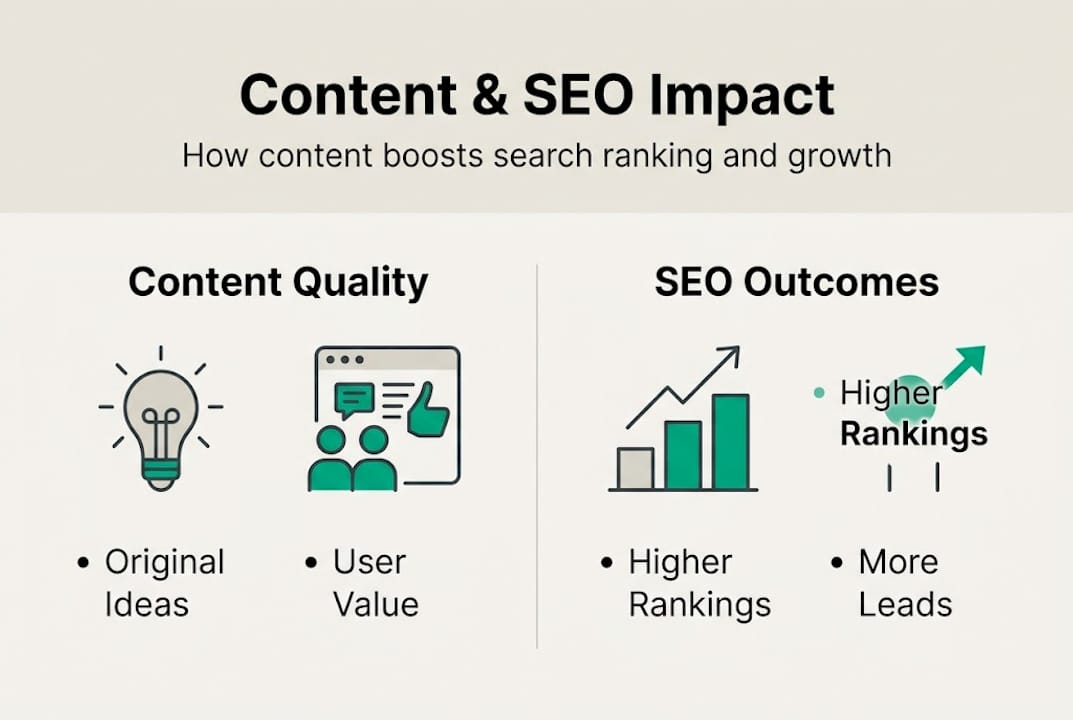
- Content quality, relevance, depth, and originality are crucial for improving SEO rankings and visibility.
- High-quality content earns backlinks, engages users, and builds authority, unlike thin or repetitive pages.
- Combining human expertise with automation produces sustainable, trust-building content that drives leads and revenue.
Most business owners assume that publishing more pages or running content through an AI tool is enough to climb Google’s rankings. It isn’t. Content quality is the single biggest lever you control for SEO performance, and getting it wrong doesn’t just stall your growth, it actively pushes you down the results page. The content marketing benefits for businesses that get this right are significant: stronger rankings, more qualified traffic, and a steady pipeline of leads. This guide breaks down exactly how content affects your search visibility and what you should do about it.
Table of Contents
- The foundation: How content influences SEO performance
- Quality vs. quantity: What actually moves the SEO needle?
- E-A-T, authority, and backlinks: Building trust with search engines
- From rankings to revenue: Content’s role in converting traffic to leads
- What most content/SEO guides get wrong—and what really works
- A smarter approach: Partner with proven SEO content experts
- Frequently asked questions
Key Takeaways
| Point | Details |
|---|---|
| Quality drives ranking | Original, insightful content improves SEO more effectively than simply publishing often. |
| Balance speed and substance | AI tools can help, but human oversight ensures content earns trust and backlinks. |
| E-A-T boosts authority | Showcasing expertise and trust builds credibility and supports better search visibility. |
| Content fuels conversions | Great SEO content not only attracts visitors but also generates leads and business growth. |
The foundation: How content influences SEO performance
Search engines are not impressed by word count alone. Google’s algorithms evaluate content based on three core qualities: relevance, depth, and originality. Relevance means your content directly answers what your audience is searching for. Depth means you cover the topic thoroughly enough to satisfy that search. Originality means you’re adding something new to the conversation, not just restating what everyone else has already said.
When your content hits all three marks, it sends powerful signals to search engines. Here are the key SEO signals that content directly influences:
- Keywords and search intent: Naturally placed keywords help Google understand what your page covers and match it to relevant queries.
- User engagement: Time on page, scroll depth, and low bounce rates signal that visitors find your content genuinely useful.
- Backlinks: Other websites link to content they trust and find valuable, which builds your domain authority.
- Topical authority: Publishing consistently on related subjects tells search engines you’re a reliable source in your niche.
- Originality: Unique and original content is crucial for SEO performance, separating high-ranking pages from the rest.
Content is also the bridge between what your audience needs and what your business offers. A well-written blog post about a customer’s pain point does double duty: it ranks for a search term and positions your product or service as the solution.
“High-quality, original content remains the most reliable path to sustainable search visibility. Search engines are built to reward pages that genuinely serve users, not pages built to game algorithms.”
Pro Tip: Always write for your users first and optimize for search second. Google’s systems are sophisticated enough to reward content that real people love, so user satisfaction and SEO alignment are not competing goals.
Following a solid content strategy best practices framework helps you build content that satisfies both users and algorithms simultaneously. It also prevents the common trap of producing content that looks busy but delivers no real value.
Quality vs. quantity: What actually moves the SEO needle?
Understanding the foundation, let’s get specific about what kind of content truly drives outcomes. Many businesses flood their websites with thin, repetitive posts hoping sheer volume will boost rankings. Google’s helpful content updates have made this strategy not just ineffective but actively harmful.
Here’s a direct comparison of the two approaches:
| Criteria | High-quality content | High-quantity content |
|---|---|---|
| Search rankings | Climbs and holds position | Volatile or penalized |
| Backlinks earned | Attracts natural links | Rarely linked to |
| User engagement | High time-on-page, low bounce | Poor engagement metrics |
| Long-term value | Compounds over time | Decays quickly |
| Lead generation | Converts visitors to leads | Minimal conversion impact |
Thin content, meaning pages with little original insight, duplicate information, or generic filler, signals low value to Google. The algorithm actively devalues these pages, and in some cases removes them from indexable results entirely. Research into the impact of AI content shows that while AI-generated text isn’t automatically penalized, pure AI output without human editing consistently fails to earn backlinks and struggles to hold rankings.

The risks around AI and SEO are real, and understanding them protects your investment. Similarly, building organic SEO importance through genuine content quality gives you a compounding advantage that paid ads simply can’t replicate.
Pro Tip: Instead of publishing ten mediocre posts this month, update your three best-performing pages with fresh data, stronger examples, and clearer calls to action. One improved page almost always outperforms ten new thin ones.
The businesses winning at SEO in 2026 are not the ones publishing the most. They’re the ones publishing content that earns trust, links, and repeat visits.
E-A-T, authority, and backlinks: Building trust with search engines
With quality in focus, the next question is: what makes your content stand out and earn trust over competitors? The answer lives in a framework Google uses called E-A-T, which stands for Expertise, Authority, and Trustworthiness. It’s not a direct ranking factor with a single score, but it shapes how Google’s quality raters evaluate your pages and influences long-term rankings significantly.
Content that supports strong E-A-T signals includes:
- Author bylines with credentials: Named authors with verifiable expertise signal accountability and depth.
- Cited data and research: Linking to credible sources shows you’ve done the work.
- Expert quotes and interviews: First-hand insights from industry professionals add substance that generic content can’t replicate.
- Case studies and real examples: Proof of outcomes builds trust faster than any claim.
- Consistent publishing on a focused topic: Topical authority compounds over time.
Backlinks remain one of the strongest ranking signals, and authoritative content earns them naturally. This is the difference between link earning and link building. Link building means manually reaching out to get links placed. Link earning means creating something so useful that other sites reference it without being asked.
Here’s a breakdown of the types of backlinks quality content can generate:
| Content type | Backlink source |
|---|---|
| Original research or data | News outlets, industry blogs |
| Ultimate guides | Niche directories, educational sites |
| Expert roundups | Contributors and their networks |
| Case studies | Industry publications |
| Infographics | Visual content aggregators |
“Human oversight is essential for top search rankings, even with AI tools. Automation speeds up production, but it’s human judgment that makes content credible enough to earn links and trust.”
AI tools are genuinely useful for research, drafting, and scaling output. But the businesses seeing the strongest SEO lead generation results are those pairing AI efficiency with AI SEO and human expertise to produce content that no algorithm could generate on its own.
From rankings to revenue: Content’s role in converting traffic to leads
Now that we’ve covered authority and trust, let’s see how content investments actually drive business results. Rankings are great. Traffic is better. But leads and revenue are the goal, and content is what connects search visibility to your bottom line.
Here’s how quality content supports every stage of the buyer’s journey:
- Awareness: A blog post answers a question your ideal customer is actively searching for, introducing them to your brand for the first time.
- Consideration: A detailed guide or comparison page helps them evaluate their options, with your expertise front and center.
- Decision: A case study or testimonial-backed service page removes doubt and builds the confidence needed to reach out.
- Conversion: A clear, relevant call to action on a high-traffic page captures the lead before they leave.
Beyond the journey, SEO content creates leads through several direct mechanisms:
- Answering specific questions that signal purchase intent
- Building trust through consistent, accurate information
- Capturing email addresses via gated content like checklists or guides
- Driving calls and form submissions through strategically placed CTAs
- Retargeting visitors who engaged with your content but didn’t convert
Consider a real scenario: a local accounting firm publishes a detailed blog post targeting the phrase “small business tax deductions 2026.” That post ranks on page one, attracts 800 monthly visitors, and includes a lead magnet offering a free tax checklist. Within 90 days, it generates 40 new email subscribers and 12 consultation requests. That’s the compounding power of content marketing examples done right.
Human-edited, strategic content delivers stronger user and financial outcomes than automation alone, and the data consistently backs this up. Pairing great content with smart SEO marketing strategies turns your website from a digital brochure into a lead-generating asset.
Pro Tip: Add a conversion-focused CTA to every high-traffic page on your site. Even a simple “Download our free guide” or “Book a free consultation” can dramatically increase the percentage of visitors who take action.
What most content/SEO guides get wrong—and what really works
Here’s the uncomfortable truth most SEO content guides skip: the businesses that consistently win in search aren’t the ones with the biggest content budgets or the fastest publishing schedules. They’re the ones with something real to say.
Most guides reduce SEO content to a checklist: target a keyword, hit a word count, add some headers, publish. That approach produces forgettable pages that rank briefly and fade. What actually separates high-performing content from noise is proof. Original research, genuine expert input, and documented outcomes are things no competitor can easily copy.
“Real results come from combining human creativity with the best automation—never one or the other.”
AI tools have a place in every modern content workflow. But the future of AI SEO belongs to teams that use automation for efficiency and human expertise for credibility. The content assets that compound value over years are case studies, data roundups, and original research, not blog posts written to a keyword brief with no unique perspective.
Here’s a quick checklist for sustainable SEO content success:
- [ ] Does this content answer a real question your audience has?
- [ ] Does it include original data, examples, or expert insight?
- [ ] Is there a clear next step for the reader?
- [ ] Has a knowledgeable human reviewed and refined it?
- [ ] Will it still be relevant and valuable in 12 months?
If you can check every box, you’re building content that compounds. If you can’t, you’re filling space.
A smarter approach: Partner with proven SEO content experts
If you’ve made it this far, you already understand that content is not a checkbox. It’s a strategic investment that, done right, builds rankings, earns trust, and generates leads month after month.

At Ascendly Marketing, we help small and medium-sized businesses turn content into measurable growth. From strategy and creation to technical organic SEO services and full small business digital strategy planning, our team brings the expertise to make your content work harder. Whether you need a full content audit, a targeted SEO strategy, or hands-on execution, we’re ready to help you build something that lasts. Book a free consultation and let’s map out your path to stronger rankings and real results.
Frequently asked questions
How does content help my website rank higher on Google?
Google prioritizes websites with relevant, unique content that matches user intent and demonstrates authority, pushing those pages above competitors who publish generic or thin material.
Are AI-generated articles safe for SEO?
AI content isn’t penalized when it’s high quality and human-edited, but unreviewed AI output consistently struggles to earn backlinks and risks being removed from search results entirely.
What is E-A-T and why does it matter for SEO?
E-A-T stands for Expertise, Authority, and Trustworthiness, and it represents the signals search engines use to determine whether your content is credible enough to rank prominently for competitive queries.
How often should I update my website content for SEO?
Focus on refreshing your top-performing pages with new data and stronger examples on a regular basis rather than publishing new pages just to increase volume.
Does content really affect lead generation?
Absolutely. Well-crafted SEO content attracts visitors who are actively searching for what you offer, builds trust through valuable information, and creates natural opportunities for them to contact you or make a purchase.