

TL;DR:
- Effective SEO content begins with understanding and fulfilling genuine user search intent to improve rankings and engagement.
- Preparation, including competitor analysis, keyword research, and proper site optimization, is crucial before content creation to ensure success.
You spend hours crafting a well-researched article, hit publish, and then… nothing. No traffic, no shares, no leads. It’s one of the most common frustrations we hear from small and medium-sized business owners. The problem almost never comes down to writing quality alone. It comes down to strategy. Effective SEO content starts with fulfilling real user needs, not just chasing rankings. This guide walks you through every practical step: researching intent, building the right structure, writing for both people and search engines, and measuring what actually works.
Table of Contents
- Understand your audience and search intent
- Prepare: Tools, research, and prerequisites for SEO writing
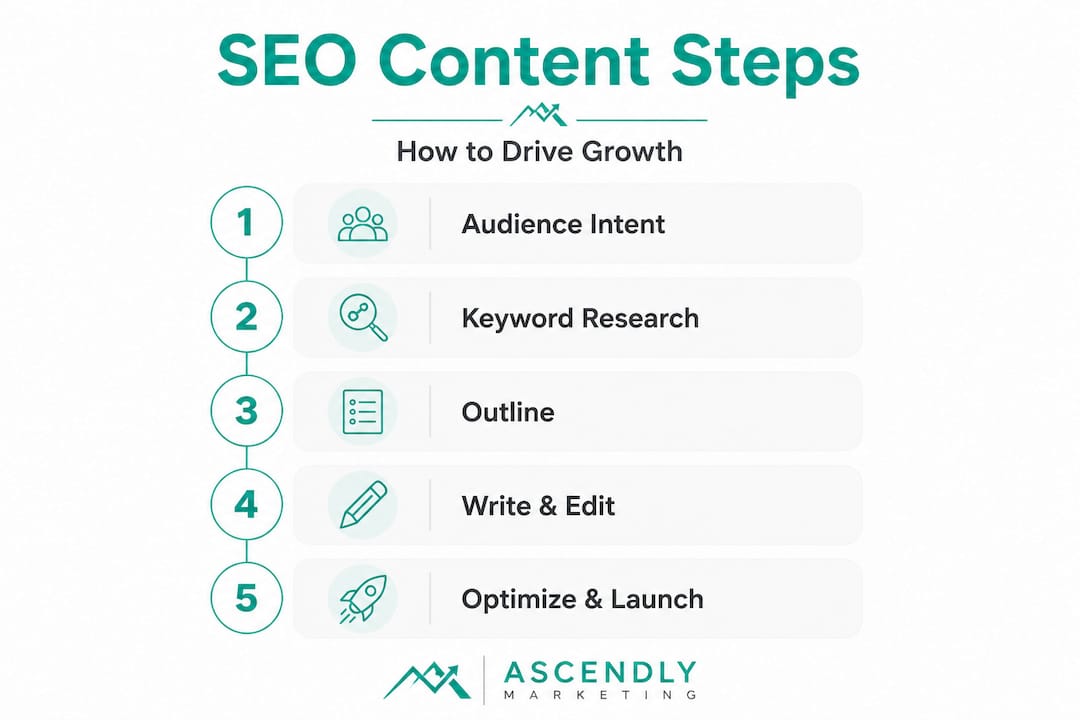
- Step-by-step: How to write SEO content for results
- Common mistakes, troubleshooting, and how to measure impact
- What most SEO guides miss: the “non-commodity” content advantage
- Need expert help? Accelerate your SEO growth with Ascendly
- Frequently asked questions
Key Takeaways
| Point | Details |
|---|---|
| Always start with search intent | Align every piece of content to what your target audience actually wants and needs. |
| Use clear, readable structure | Headings, short paragraphs, and bullets improve both rankings and user experience. |
| Originality matters most | Stand out by providing unique value and insights, not just rehashing others’ articles. |
| Plan and measure everything | Success comes from good preparation, smart execution, and tracking results. |
Understand your audience and search intent
Before you write a single word, you need to know why someone is searching for your topic. This is called search intent, and it’s the single biggest factor that separates content that ranks from content that gets buried on page five. Understanding why content matters for SEO starts here.
There are four core types of search intent you should recognize immediately:
- Informational: The user wants to learn something. (“How does content marketing work?”)
- Navigational: The user wants to find a specific website or page. (“Ascendly Marketing blog”)
- Commercial investigation: The user is comparing options before buying. (“Best SEO tools for small business”)
- Transactional: The user is ready to take action. (“Hire an SEO agency near me”)
Matching your content to the right intent is non-negotiable. If someone types in a question, they want an answer, not a product page. If someone is ready to buy, they don’t want a 2,000-word explainer. Getting this wrong means your content will almost never perform, even if it’s beautifully written.
So how do you research intent effectively? Start with free tools. Google’s own search results tell you a huge amount. Type your keyword and look at what’s ranking. Are the results mostly blog posts? Landing pages? Videos? That’s Google telling you what it believes the intent is. Then look at the “People also ask” box and the related searches at the bottom of the page. These give you a direct window into the exact questions your audience is asking.
“Create content that fulfills people’s needs, not just rankings.” This is Google’s own guidance, and it reflects how AI-powered search now evaluates whether content truly satisfies a user’s purpose.
For paid tools, SEMrush, Ahrefs, and Moz all let you filter keywords by intent type and show you search volume, competition levels, and related keyword clusters. If budget is tight, Google Keyword Planner is free and surprisingly powerful for identifying realistic keyword targets.
Pro Tip: Don’t just look at what keywords you want to rank for. Study your competitors’ top-performing pages and ask yourself: what question did they answer better than everyone else? That’s the real bar you need to clear. A solid content marketing strategy for SMBs always begins with this kind of competitive awareness.
Google rewards content that quickly meets user needs and offers something genuinely different. If your page sounds like every other page on the topic, it won’t earn the visibility you’re hoping for.
Prepare: Tools, research, and prerequisites for SEO writing
Now that you understand user intent, it’s time to gather everything you need before you start drafting. Skipping this step is how businesses end up publishing content that technically covers a topic but fails to rank or convert.
Here’s a quick-reference table to help you pick the right tools for each stage of preparation:
| Task | Free tools | Paid tools |
|---|---|---|
| Keyword research | Google Keyword Planner | SEMrush, Ahrefs, Moz |
| Competitor content analysis | Google search, SERPs | SEMrush, Buzzsumo |
| Site analytics | Google Analytics, Search Console | Semrush, Hotjar |
| Page speed testing | Google PageSpeed Insights | GTmetrix Pro |
| Content brief creation | Google Docs templates | Clearscope, Surfer SEO |
Beyond tools, you need a clear content structure before you write. This means building a topic cluster plan. A topic cluster groups your main “pillar” page (a broad overview of a subject) with several related “cluster” pages that go deeper on specific subtopics. This structure signals authority to Google and naturally creates opportunities for internal linking, which is one of the most underused proven SEO strategies for small business sites.
Here’s a pre-writing checklist to run through before you draft anything:
- Confirm your primary keyword and two to three secondary keywords
- Identify the correct search intent for your topic
- Map out your H1, H2, and H3 headings in an outline
- Plan your internal links to existing pages on your site
- Check that your site loads in under three seconds on mobile
- Verify that your page template is mobile-friendly
On-page fundamentals like readability, structured headings, internal links, and good page experience still drive results, especially for small business pages that need to earn trust fast. If your page is slow, cluttered, or hard to read on a phone, even great content won’t perform. Make sure these technical basics are in place before you invest time in writing.

Working with SEO services for small business can help you audit these technical factors quickly if you’re not sure where to start.
Step-by-step: How to write SEO content for results
With your research complete and your outline ready, you’re set to write. Follow this process consistently and your content will serve both readers and search engines at the same time.
-
Open with the answer. The inverted pyramid approach means leading with your most important point, not building up to it slowly. If your article is “how to write SEO content,” your introduction should immediately signal what the reader will get and deliver a key takeaway right away. This is also how you optimize for featured snippets: answer early, then elaborate with clearly labeled sections and concise paragraphs.
-
Write semantic, descriptive headings. Your H2s and H3s should describe exactly what each section covers. Search engines use headings to understand page structure. Readers use them to skim and find what they need. Both matter. Avoid vague headings like “More tips” or “Next steps.” Use specific ones like “How to choose the right keyword tool.”
-
Keep paragraphs short and focused. Three to four sentences per paragraph is the target. Long walls of text drive readers away and make it harder for AI search tools to extract clean answers from your content. White space is your friend.
-
Embed keywords naturally. Use your primary keyword in the title, the first paragraph, at least one H2, and the meta description. Use secondary keywords and related terms throughout, but only where they fit naturally. Keyword stuffing hurts readability and can trigger ranking penalties.
-
Add internal links strategically. Every piece of content should link to at least two or three other relevant pages on your site. This keeps users engaged and distributes what SEO professionals call “link equity” across your domain. Understanding the full benefits of content marketing becomes clearer when you see how well-linked content compounds its value over time.
-
Include a FAQ section. Frequently asked questions are one of the most efficient ways to capture additional long-tail keyword traffic and increase your chances of appearing in “People also ask” results. Write answers in two to three concise sentences.
-
Close with a clear call to action. Tell readers exactly what to do next. Subscribe, download, contact, or read another page. Don’t leave them guessing. This is especially important for ecommerce SEO best practices where the next step is often a product page or cart.
Pro Tip: Write like you’re explaining something to a smart colleague, not writing a research paper. Simple, direct language consistently outperforms complex, formal copy in both readability scores and user engagement metrics.
Consistency in tone matters as much as structure. If your brand voice is conversational and practical, maintain that across every article. Readers and algorithms both reward predictability.
Common mistakes, troubleshooting, and how to measure impact
Once your content goes live, knowing what to watch for and how to measure success will determine whether you improve over time or repeat the same mistakes.
| Do this | Not this |
|---|---|
| Cover one focused topic per page | Try to rank for everything in one article |
| Write original, experience-based content | Rewrite what’s already ranking without adding value |
| Use clear, logical heading structure | Dump keywords into headings without context |
| Optimize for mobile and page speed | Assume desktop performance is enough |
| Update content regularly as topics evolve | Publish once and ignore it |
| Track rankings and engagement together | Obsess only over page views |
Thin content is the most widespread problem we see. A 300-word page that barely touches a topic will almost never rank for competitive terms, and it signals low quality to both users and search engines. The fix is simple but requires effort: go deeper, add real examples, include original data or perspective, and structure the page properly.
If your content is live but not performing, run through this diagnostic checklist:
- Is the search intent actually matched? Re-check the top five results for your target keyword.
- Is the page indexed? Use Google Search Console to confirm.
- Does the page have any technical errors affecting crawlability?
- Are there enough internal and external links pointing to this page?
- Is the content noticeably better than what’s currently ranking?
Content must be “unique and non-commodity” to perform well as AI search formats expand. Generic text that could have been written by anyone about anything is increasingly invisible in modern search results.
For measuring results, focus on these key performance indicators (KPIs):
- Organic traffic: Tracked in Google Analytics under the “Organic Search” channel
- Keyword rankings: Monitored through Google Search Console or a tool like SEMrush
- Engagement rate or time on page: Shows whether users are actually reading your content
- Bounce rate: A high bounce rate on informational content may signal an intent mismatch
- Conversions: Form fills, calls, purchases, or any defined goal tied to that page
Understanding the AI impact on SEO is increasingly important here too. AI-powered search tools now summarize and synthesize results, which means generic content gets filtered out faster than ever. Content that earns clicks from AI-generated summaries tends to be specific, authoritative, and directly useful.
What most SEO guides miss: the “non-commodity” content advantage
Here’s something we’ve seen consistently across the businesses we work with: following every SEO checklist to the letter still isn’t enough if your content feels interchangeable with the other ten articles on the same topic.
Most SEO guides tell you to optimize your title tags, use your keyword three times per 500 words, and get some backlinks. That advice isn’t wrong. It’s just incomplete. The businesses that actually win in organic search over the long term are the ones producing content that couldn’t have been written by someone else.
Small and medium-sized businesses have a real structural advantage here that they almost never use. You have direct customer relationships, firsthand industry experience, and local market knowledge that no national brand or content farm can replicate. A plumber in Denver who writes about the specific freeze-thaw problems affecting older pipe systems in Colorado winters isn’t just producing relevant content. They’re producing content that nobody else can copy because it comes from lived experience.
The same principle applies to any industry. Adding original data from your own customer base, sharing what actually worked (and what didn’t) in a recent campaign, or explaining a process in a way that reflects how your team actually does it, that’s what turns a forgettable article into a bookmarked resource.
This matters even more now that AI tools can generate passable SEO content at scale. If your articles sound like they were written by a language model following generic instructions, they’ll compete directly against content that was written by a language model following generic instructions. That’s a race to the bottom. The long-term SEO content value comes from originality and genuine expertise, not from optimizing your way to mediocrity.
Our honest advice: go back to your five most important content pages right now and ask a single question. “Did we actually solve the user’s problem better than everyone else?” If the honest answer is no, that’s your highest-priority content project.
Need expert help? Accelerate your SEO growth with Ascendly
Creating SEO content that consistently ranks and converts takes time, strategy, and ongoing refinement. Many business owners have the knowledge but not the bandwidth to execute it week after week. That’s exactly where a focused agency partnership makes the biggest difference.

At Ascendly Marketing, we’ve helped small and medium-sized businesses build content programs that generate real, measurable organic growth since 2013. Whether you’re starting from scratch or optimizing an existing content library, our team of SEO specialists and content creators builds strategies tailored to your market and your goals. Explore our digital marketing services to see what’s possible, learn the principles behind organic SEO best practices, or get a custom plan built around your small business marketing strategy. Ready to grow? Book a consultation and let’s map out your next move together.
Frequently asked questions
What is the most important part of writing SEO content?
Understanding search intent is the single most important element, because content that doesn’t match what a user actually wants will rarely rank or convert regardless of how well it’s written.
How long should SEO content be?
SEO content should be long enough to fully address the topic, which typically means 800 to 2,000 words for most business articles, but always prioritize depth and usefulness over hitting a specific word count.
How do you optimize SEO content for featured snippets?
Write in an inverted pyramid style, answering the main question in the first two sentences, then use clear labeled headings and short, direct paragraphs that search engines can easily extract.
What are common mistakes to avoid with SEO content?
Avoid thin, duplicated, or generic content and ensure your pages are structured for readability, fast loading, and mobile use, since on-page fundamentals directly affect how quickly your site earns trust with both users and search engines.
How do you know if your SEO content is successful?
Track organic traffic, keyword rankings, and engagement metrics like time on page and conversion rate together, because no single metric tells the full story of content performance.