

Most advice on how to choose keywords for search engine optimization pushes you toward the biggest search numbers you can find. That sounds logical. It also causes a lot of small and mid-sized businesses to waste months chasing terms they were never likely to rank for and never needed in the first place.
A better approach starts with business value. A keyword isn't good because many people search for it. A keyword is good when it brings the right person to the right page at the right moment.
That distinction matters more for SMBs, B2B firms, and local service businesses than it does for large publishers. If you sell a specialized service, manage a longer sales cycle, or depend on qualified leads instead of casual traffic, broad volume-first keyword selection will usually point you in the wrong direction. You need terms that match buying intent, fit your offer, and give your site a realistic path to visibility.
Aligning Keywords with Business Goals and Buyer Intent
Before opening Ahrefs, SEMrush, Moz, or Google Keyword Planner, define what a win looks like.
For an ecommerce brand, a useful keyword may support direct product sales. For a B2B company, it may attract someone comparing vendors, researching a specific problem, or looking for implementation support. For a local service business, the most valuable keyword may be the one that signals immediate need in a defined area.
That means the first filter isn't volume. It's intent.
The three intent types that shape keyword value
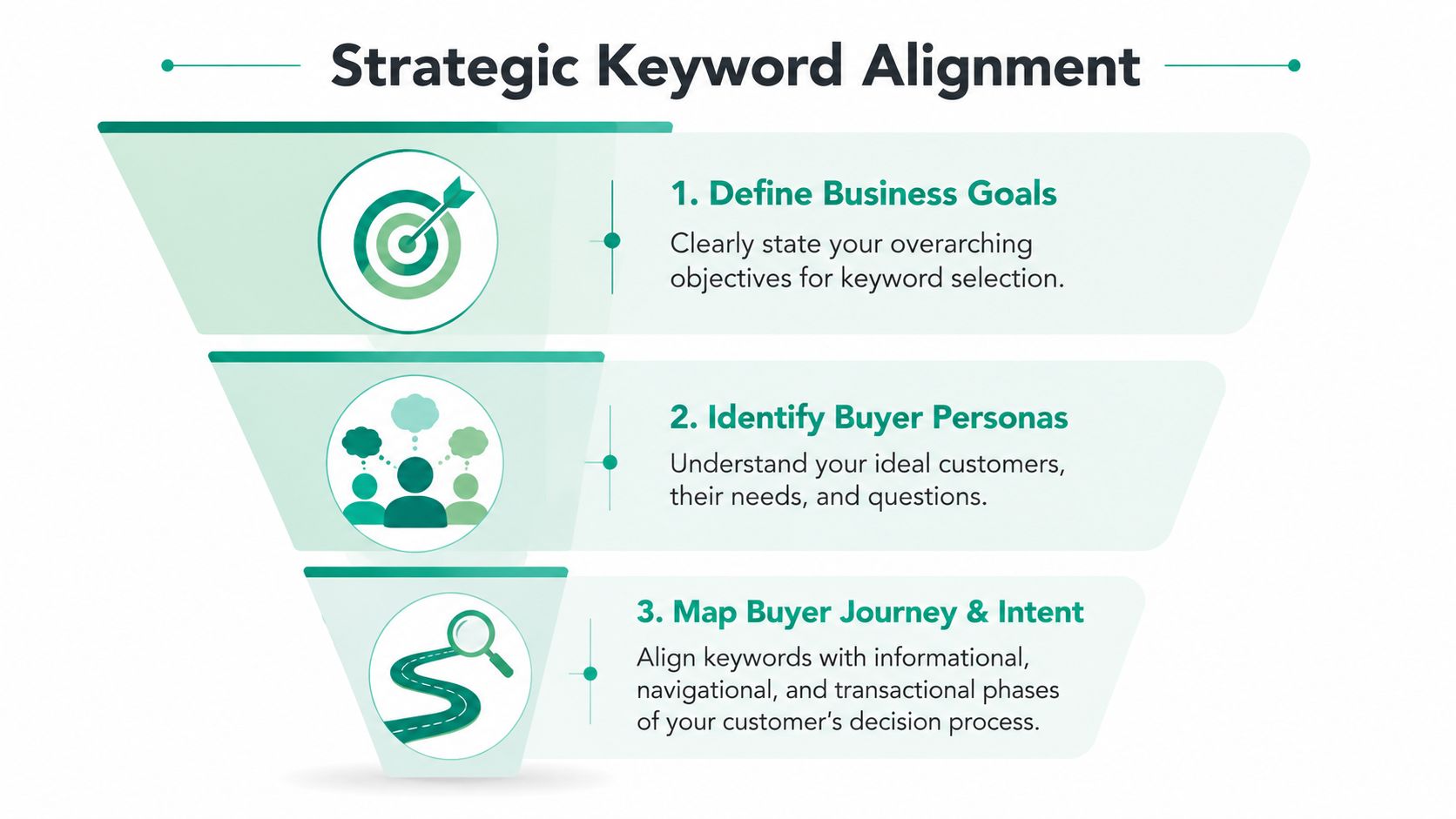
Keyword research works better when you group terms by informational, navigational, and transactional intent. That structure helps you decide what page should target each query, and it keeps your content tied to real business outcomes. Research on keyword methodology also recommends assigning each keyword to the right page type. Informational queries belong on blog posts, guides, and FAQs, while transactional terms belong on product pages and landing pages. It also recommends assigning no more than 2-4 keywords per page to avoid cannibalization and keep the page topically focused, as explained in this search intent mapping guide.
Here's the simple version:
- Informational intent means the searcher wants to learn. Think "how to fix a leaky faucet" or "what is ERP implementation."
- Navigational intent means the searcher wants a specific brand, website, or product category. Think "HubSpot pricing" or "Acme industrial pumps."
- Transactional intent means the searcher is moving toward action. Think "plumber near me" or "B2B SEO agency for manufacturers."
A B2B services company shouldn't treat all three the same. Informational content can bring in useful early-stage prospects, but it won't close the gap if the site has no pages built for transactional searches. The reverse is also true. A site full of service pages can miss buyers who begin with problem-aware research.
Practical rule: If a keyword doesn't support your sales process, content plan, or revenue model, it doesn't belong on your priority list.
Match the keyword to the page and the buyer stage
Start with two questions.
- What does this searcher want right now?
- What page on our site can satisfy that need clearly?
A local home services company might target "water heater repair near me" with a service page, but use "why is my water heater making noise" for an educational article. A B2B software company might publish a guide for "how to improve warehouse forecasting" and reserve "warehouse forecasting software demo" for a product or landing page.
That kind of mapping gives your keyword list structure. It also forces discipline. You stop creating random content and start building a search path that matches how buyers move.
If your team is thinking about search only as traffic acquisition, revisit how digital behavior shapes purchasing decisions in this breakdown of how much of the buyer's journey is digital. It helps explain why intent matching matters well before a sales conversation starts.
Generating Your Initial Keyword List From Within
Most companies already have the raw material for strong keyword research. They just don't store it in a keyword tool yet.
The fastest way to build a useful starting list is to mine the language your customers and prospects already use. That language usually beats internal marketing jargon. It also exposes the gap between how your team talks about a service and how a buyer searches for it.

Start with conversations, not software
Ask your sales team what prospects repeatedly ask in calls, meetings, and email threads. Those questions often reveal high-intent phrases that never show up in broad brainstorming sessions.
Support and account teams are another strong source. Review tickets, onboarding questions, service issues, and complaints. Repeated phrasing points to repeated search behavior.
Look at these internal sources:
- Sales call notes for phrases tied to buying objections, feature comparisons, and urgency
- Customer support tickets for problem-focused terms and troubleshooting language
- Contact form submissions for exact wording used by prospects
- Reviews and testimonials for benefits customers care about, in their own words
- Internal site search data for the terms visitors type after they arrive on your website
A manufacturer may describe a service as "predictive maintenance integration." Prospects may search "machine downtime monitoring system." Both matter, but only one reflects the customer's natural language.
Build a seed list that reflects reality
At this stage, don't worry about numbers. Focus on relevance and pattern recognition.
Create a list of product names, service categories, problems solved, use cases, industries served, and location modifiers if your business depends on local visibility. Then expand each one with the words people naturally add when they search, such as cost, services, company, consultant, near me, software, repair, setup, or support.
A simple worksheet works well here.
| Internal source | What to pull from it | Example output |
|---|---|---|
| Sales calls | Questions and objections | "crm migration consultant" |
| Support tickets | Recurring pain points | "website form not sending leads" |
| Reviews | Outcome language | "responsive ecommerce web design" |
| Service pages | Core offer terms | "industrial SEO agency" |
One of the clearest signs of weak keyword strategy is a list filled with terms your customers never say.
Your first list doesn't need to be huge. It needs to be usable. If you come out of this step with a focused set of seed keywords grounded in actual customer language, the next stage becomes much easier. You're no longer guessing what matters. You're validating what you've already heard in the market.
Mastering Keyword Research Tools and Metrics
Once you have a seed list, tools become useful. Before that, they mostly create noise.
The point of SEMrush, Ahrefs, Moz, and Google Keyword Planner isn't to hand you the answer. Their job is to help you judge trade-offs. That's where most keyword work either improves or falls apart.

Read the three core metrics together
The foundation of keyword selection rests on search volume, keyword difficulty, and user intent, not any one metric by itself. Guidance on keyword evaluation also notes that newer sites targeting terms with difficulty scores above 60-70 usually face longer timelines and heavier resource demands before they can reach page one. The same guidance points out that long-tail keywords of three or more words often have 40-60% lower competition than broad terms, which is why they fit many SMB SEO strategies better, as outlined in these keyword selection benchmarks.
Here's how to think about each metric:
- Search volume shows demand. It tells you whether people search for the term.
- Keyword difficulty estimates how hard it may be to rank, based on the existing competition.
- Intent tells you whether the query is worth pursuing for your business model.
Ignore one of those and your judgment gets distorted.
A keyword with large search demand can still be a poor target if the current results are dominated by major brands, strong domains, or pages that don't match your site type. A keyword with modest volume can be far better if it signals strong purchase intent and fits a page you already have or can build well.
Why SMBs lose when they chase broad terms
Think of keyword difficulty like traffic in a shipping lane. A small business site can move well through side channels where the traffic is lighter and the destination is still valuable. Point that same site at the busiest lane on the map and it gets boxed out by much larger vessels with more authority, more links, and more content depth.
That's why broad phrases often look attractive in tools and underperform in practice.
A practical workflow looks like this:
- Enter your seed keyword in Ahrefs, SEMrush, or Moz.
- Export related terms, questions, and phrase-match variations.
- Remove anything irrelevant to your offer, geography, or audience.
- Group surviving terms by theme and intent.
- Review the actual search results before deciding a keyword is realistic.
If you want an outside perspective on evaluating lower-difficulty targets, Vidito has a useful article with insights on keyword competition that complements this filtering process.
Use CPC as a commercial signal, not a final decision-maker
Cost-per-click data can help. It often signals commercial value because advertisers tend to bid more aggressively on terms tied to revenue. But CPC is only one clue. It doesn't replace relevance, and it doesn't tell you whether your page can satisfy the search.
That matters for B2B and service firms. Some highly qualified terms won't look glamorous in a tool, yet they connect tightly to a high-value offer. Those are often the terms worth building around.
Later in the process, rank tracking and page-level performance data help you validate whether your keyword choices are working in the field. This walkthrough gives a useful visual overview of how practitioners evaluate keyword opportunities and rankings over time.