

Some weeks feel off before the books show it. The phone is quiet. Your crew is ready. Then you search Google for one of your core jobs and see the same names sitting above you in the map pack and organic results.
That's where plumbing seo services stop being a marketing line item and start becoming a visibility problem with a real cost. If a homeowner needs an emergency plumber, they aren't browsing for fun. They're looking for someone they can call now, and the businesses that show up first get the first shot at the job.
A lot of owners know this already. The hard part is separating useful SEO work from busywork, and separating “more traffic” from booked jobs and revenue. That's the gap most discussions skip. They talk about rankings, blog posts, and keywords, but not enough about what a booked call is worth, how to track it, and how to know whether the spend is paying back.
Why Your Phone Stops Ringing and Google Starts Calling
A common pattern looks like this. Referrals slow down for a stretch. You run a Google search for “plumber near me” or one of your main service terms. A competitor shows up in the top spots, their reviews look active, their website loads fast, and their service pages are built around the exact jobs you do every day.
That competitor didn't win because Google likes them more. They built a stronger local search presence.
Plumbing SEO services are the set of work that make your business visible when someone searches for plumbing help in your service area. That includes your Google Business Profile, your website pages, your reviews, your directory listings, and the technical setup that helps Google understand what you do and where you do it.
The opportunity is plain. 46% of all Google searches are local, the top Google result captures 50% of clicks, and page-one plumbers receive 10x more calls than those on page two, according to Pinpoint Digital's plumbing SEO data.
What this means in practice
If you rank poorly, you don't just miss “traffic.” You miss emergency calls, quote requests, and routine jobs that go to whoever looks easiest to trust.
Three things usually decide whether a plumber gets that click:
- Position on the page: Most owners underestimate how steep the drop-off is once you slip below the top results.
- Review confidence: A strong review profile often decides who gets the call before a website visit even happens. If your review process is loose, fix that first with a clear Google review strategy for local businesses.
- Visible proof of relevance: If your competitors have pages for drain cleaning, water heater repair, leak detection, and emergency service by city, while your site has one generic “services” page, Google has less to work with on your side.
Practical rule: If your company can't be found for the jobs you want most, your sales pipeline is sitting on someone else's website.
Hiring help doesn't solve that by itself. A weak agency can waste months doing cosmetic work. Before you sign anything, use a solid guide to vetting local SEO vendors and ask how they connect rankings to actual booked jobs, not just dashboards.
The Blueprint for a Dominant Online Presence
A plumbing SEO campaign works best when you treat it like a build, not a trick. Four parts have to fit together. If one is weak, the rest underperform.

Local SEO
This is your street address in digital form. It covers your Google Business Profile, your service areas, your categories, your reviews, and the consistency of your business information across the web.
For plumbers, local SEO usually drives the fastest movement because it lines up with how customers search. Someone with a burst pipe or dead water heater wants a nearby provider and wants one fast. That means your profile needs accurate service categories, clear service areas, current hours, good photos, and a review flow that doesn't depend on memory.
If you want a practical framework for the local side, this local SEO guide for SMBs is a useful reference.
On-page SEO
Your website has to match the jobs people search for. A generic homepage and a broad “services” page won't carry much weight in a competitive market.
A stronger setup usually includes separate pages for high-intent services such as emergency plumbing, drain cleaning, water heater work, sewer repair, leak detection, and fixture installation. If you serve multiple cities, those services also need local relevance on the page. Not by stuffing city names everywhere, but by making it clear where you work and what the page is for.
Good on-page work also means clear titles, useful copy, visible phone numbers, booking actions, and content that answers the questions a homeowner asks right before hiring.
Off-page SEO
This is your reputation layer. Reviews are part of it, but not all of it. So are local directory listings, mentions from relevant sites, and the general consistency of your business across the web.
A lot of plumbers make one of two mistakes here. They either chase junk links that won't help, or they ignore off-page work entirely and assume the website will carry everything. Neither works well. Off-page SEO supports trust. Google wants to see that your business exists consistently beyond your own domain.
Technical SEO
Technical SEO is the foundation under everything else. If your site is slow, hard to use on mobile, or confusing for search engines to interpret, your content and local work have less impact.
One technical item is especially useful for plumbers: schema markup. Implementing LocalBusiness schema with plumbing-specific Service schema can increase rich snippet visibility by up to 30% in local search results and boost click-through rates by 15-20%, based on the benchmarks cited in Housecall Pro's plumbing business SEO resource.
That matters because richer search results make your listing easier to trust and easier to click.
For a broader view of how these pieces connect, this overview of strategies for search engine optimization gives helpful context without overcomplicating the basics.
A good plumbing SEO campaign doesn't rely on one lever. It aligns local signals, page relevance, reputation, and technical cleanup so each one reinforces the others.
Your Digital Toolbox What You Actually Get
If an agency says “we do SEO,” the next question should be, “What exactly are you building, fixing, and managing each month?”
That answer should be concrete. You should be able to point to assets, changes, reports, and workflows. If the deliverables sound fuzzy, the work usually is too.
Core deliverables worth expecting
A legitimate plumbing SEO service usually includes a mix of these:
- Google Business Profile management: Category updates, service additions, photo refreshes, post updates, Q&A cleanup, and review response support.
- Service page creation or repair: Pages built around actual revenue-driving jobs, not generic filler pages.
- Location relevance work: Clear service-area signals across your site for the cities or areas you want to rank in.
- Citation cleanup: Fixing incorrect or inconsistent directory listings.
- Technical fixes: Indexing issues, duplicate page problems, thin content, crawl issues, and schema implementation.
- Tracking setup: Call tracking, form tracking, lead-source tagging, and reporting that ties activity to business outcomes.
That citation layer matters more than many owners think. If your business details vary from directory to directory, Google gets mixed signals. This is one reason a clean directory listings SEO process belongs in the plan.
Technical work that affects lead quality
A fast site is not cosmetic. It changes whether a stressed homeowner stays on the page long enough to call.
Optimizing Core Web Vitals, such as getting Largest Contentful Paint under 2.5 seconds, can improve organic rankings by 10-15 positions for high-intent keywords, and CWV-passing sites convert 15% higher, according to Auxilium Technology's plumbing and HVAC SEO checklist.
That translates into tangible benefits in simple ways. The click-to-call button appears fast. The service page doesn't jump around while loading. The user can read the page on a phone without pinching and zooming. If those basics fail, traffic quality won't save you.
What monthly reporting should actually show
A monthly report should help you make decisions, not just admire graphs.
A useful report answers questions like these:
| What to check | Why it matters |
|---|---|
| Which pages gained visibility | Shows what content is pulling its weight |
| Which keywords moved into page one | Tells you where calls are likely to increase |
| How many calls and forms came from organic search | Connects SEO to lead flow |
| Which leads turned into booked jobs | Moves reporting past vanity metrics |
| Which service lines are underperforming | Helps direct next month's work |
If reporting stops at impressions and clicks, you still don't know whether SEO is making you money.
That's the piece many providers skip. They'll show you that traffic increased, but not whether that traffic became calls, estimates, and closed work.
The Timeline for Turning Clicks into Calls
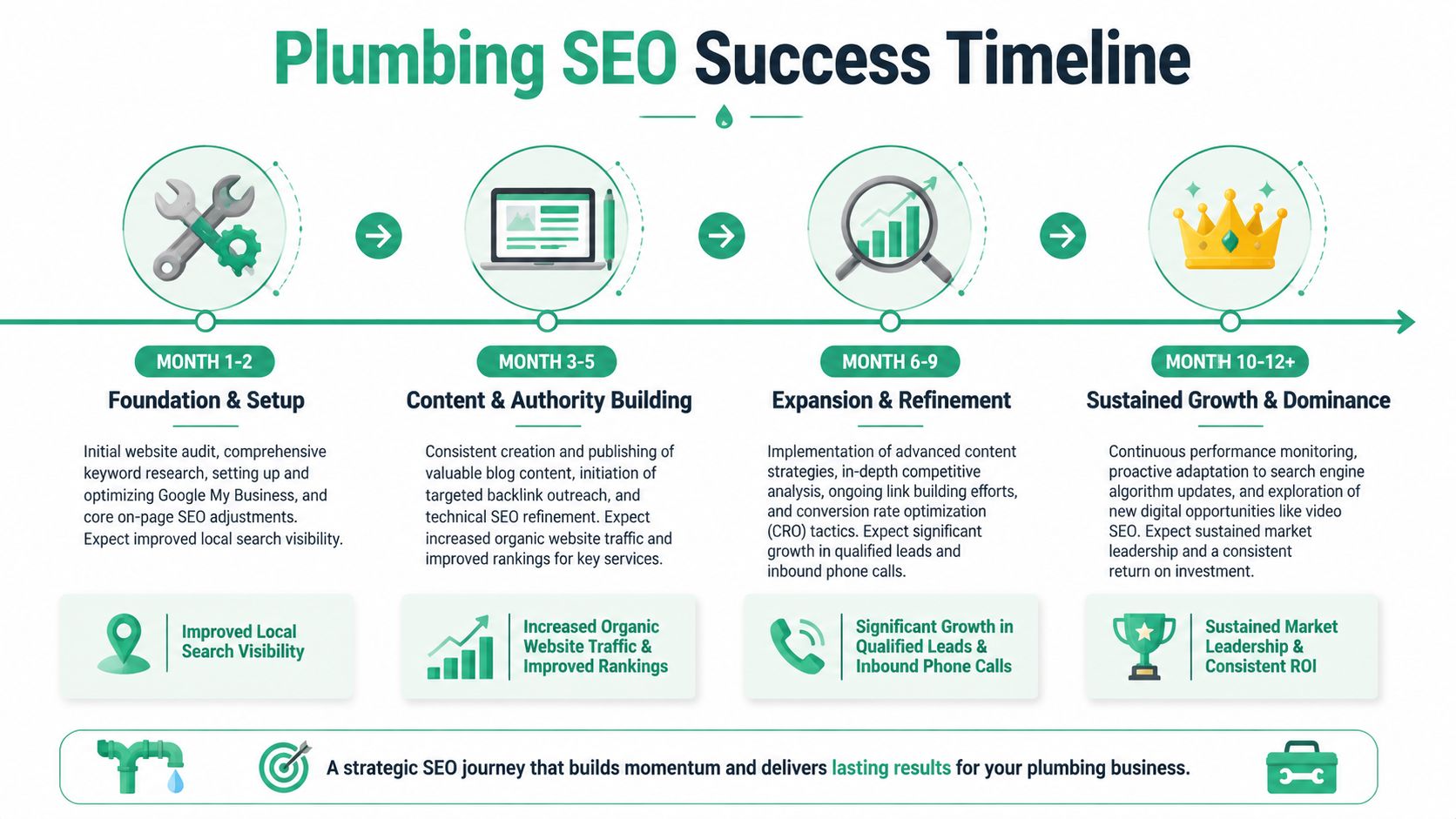
SEO doesn't work on the same clock as paid ads. You don't turn it on Monday and expect booked jobs by Friday. But the timeline doesn't have to be mysterious either. In plumbing, there are predictable phases if the work is being done properly.
Months one through three
This is foundation work. Expect audit findings, page fixes, tracking setup, Google Business Profile improvements, citation cleanup, and the first rounds of service-page work.
You may also begin to see movement on long-tail searches. These are often narrower searches tied to specific problems or service variations.
Professional local SEO typically costs $1,000 to $2,500 monthly, and it often takes 3 months for long-tail rankings and 5-10 enquiries, based on Try Webtec's plumber SEO benchmarks.
That's a realistic early phase. Not dramatic. Not useless either.
Months four through six
Many owners first feel the campaign in day-to-day operations at this stage. Rankings for higher-value services start improving. More service pages mature. Review momentum begins to support map visibility. Technical fixes have had time to settle in.
At this stage, stronger agencies are also looking at lead quality, not just count. Which keywords produce booked work? Which pages create calls that go nowhere? Which cities convert better? The ROI angle starts getting serious here.
By this point, the same benchmark source notes that businesses often reach page-one visibility on major keywords and 20-40 leads around the six-month mark.
Months seven through twelve and beyond
Now compounding kicks in. If the site architecture is sound, the local profile is active, and authority is improving, top positions become more realistic.
The benchmark continues. By 12 months, the target becomes top-three spots and 50-100+ leads per month.
That doesn't mean every plumber gets there. Market competition, service area size, site condition, and execution quality all change the outcome. But it does give you a grounded expectation for what “working” tends to look like.
How to think about the timeline as an owner
Use this simple frame:
- Early phase: Are the foundations being built correctly?
- Middle phase: Are rankings starting to move for revenue-driving services?
- Later phase: Are those rankings converting into booked jobs and steady lead flow?
SEO pays back in layers. First visibility. Then calls. Then pattern recognition about which pages and keywords produce revenue.
That last layer is the one that matters most. If you know your emergency water heater page drives booked work and your general plumbing page mostly attracts low-intent traffic, your next decisions get better fast.
The Build vs Buy Decision In-House vs Agency
Some plumbing companies should handle parts of SEO in-house. Others should outsource nearly all of it. The right choice depends on time, internal discipline, technical comfort, and whether someone on your team can own the process without dropping it when operations get busy.
The hidden cost of in-house work usually isn't software. It's interruption. Phones ring, trucks need dispatching, estimates pile up, and the “we'll get to the website Friday” plan slips another month.
In-House SEO vs Agency Comparison
| Factor | In-House SEO | Hiring an Agency |
|---|---|---|
| Cost | Lower cash outlay if you already have staff time | Predictable monthly spend |
| Expertise | Depends on who owns it and how fast they learn | Broader skill set across local, content, technical, and reporting work |
| Time commitment | Pulls owner or staff time away from operations | Frees internal team to focus on service delivery |
| Tools and systems | You may need to assemble separate tools for tracking, audits, and reporting | Usually comes with an established tool stack and workflow |
| Speed of execution | Often slower if SEO is a side responsibility | Usually faster because it has assigned ownership |
| Scalability | Harder when adding new service areas or locations | Easier to expand with a repeatable process |
| Accountability | Can get blurry if no one clearly owns outcomes | Easier to define deliverables and reporting cadence |
When in-house makes sense
It can work if you have a staff member who is organized, curious, and has real time each week to manage local updates, review generation, service-page requests, and reporting checks.
This setup is often enough for businesses that want to own basic tasks and move at a measured pace.
When an agency usually makes more sense
If you need technical fixes, content production, tracking, local SEO management, and ongoing strategic direction at the same time, an agency is usually the cleaner move.
The key is to avoid buying “SEO” as a black box. Whether you build or buy, someone has to own these questions:
- What work was completed this month?
- What changed in rankings and local visibility?
- What leads came from organic search?
- How many became booked jobs?
- Which service lines are producing the best return?
If those answers stay vague, the model is wrong even if the vendor isn't.
Decoding the Price Tag on Plumbing SEO Services
Owners usually ask about price in the wrong order. They ask “What does SEO cost?” before they ask “What does the campaign need to include to create booked work in my market?”
The cost matters, but the structure matters first.
The common pricing models
Two models show up most often.
Monthly retainer is the standard setup. It fits SEO because the work is ongoing. Rankings need maintenance, reviews need management, new content needs publishing, and technical issues don't stop appearing.
Project-based pricing can work for a site rebuild, a one-time audit, citation cleanup, or schema implementation. It's useful for fixing a known problem, but it won't replace ongoing local SEO if your goal is sustained lead flow.
Performance-based pricing sounds attractive, but it often creates bad incentives. If payment depends on a simplistic metric, the provider may chase the easiest numbers instead of the outcomes that matter to your business.
What the price is really buying
You're paying for labor, tools, process, prioritization, and tracking discipline.
A campaign that costs less but doesn't track calls to booked jobs is often more expensive in practice because you can't tell what's working. A campaign with a higher fee but clear attribution can be easier to justify because you can see what service pages, locations, and keywords produce revenue.
For plumbing companies trying to think more like operators than marketers, this guide to scaling plumbing businesses is useful because it frames digital work around growth systems, not isolated tactics.
How to judge value instead of just fee
Ask these questions before comparing proposals:
- Scope: Are they including technical work, local SEO, content, citations, and reporting?
- Depth: Are they building real service assets or just tweaking metadata?
- Attribution: Will they help track booked calls and revenue by source?
- Fit: Does the plan reflect your service mix and market conditions?
Cheap SEO is often just delayed clarity. You spend less now and spend more later trying to figure out why the phone still isn't ringing.
The goal isn't to buy the lowest fee. It's to buy a process that gives you enough visibility into revenue to keep, scale, or cut the investment with confidence.
Questions to Ask Before You Hire Any SEO Agency
Most plumbing SEO sales calls sound fine in the first ten minutes. The agency says they know local SEO. They mention rankings, content, and optimization. None of that tells you whether they can build a system that connects search visibility to booked jobs.
A better approach is to ask questions that force specifics.
Ask about ROI before rankings
Most plumbing SEO content fails to explain how to measure the actual dollar value of SEO investments against service revenue or how to attribute multi-touch conversions, and a strong agency should provide detailed reporting and a consultative process focused on measurable outcomes, according to Housecall Pro's guidance on local SEO companies for plumbers.
That should shape the first part of your conversation.
Ask:
- How do you track calls from organic search?
- Can you separate website leads from booked jobs?
- How do you handle a lead that finds us through search but books later after multiple touchpoints?
- What does your monthly report include beyond traffic and rankings?
- Can you help us understand revenue by lead source, not just lead count?
If the answers stay vague, move on.
Ask what they will actually do
Not “What is your SEO process?” Ask what they will touch, build, and fix.
Use questions like these:
- Which pages on our site would you create or rewrite first, and why?
- How do you handle Google Business Profile optimization for service-area businesses?
- What's your process for citation cleanup and directory consistency?
- How do you approach schema markup for plumbing services?
- What technical issues do you typically find on plumbing websites?
These questions reveal whether they have a repeatable operating process or just a pitch deck.
The best agency answers with examples, priorities, and trade-offs. The weak one answers with broad promises.
Ask about communication and control
A lot of frustration with agencies has nothing to do with SEO quality. It comes from poor communication, vague timelines, and a messy approval process.
Ask:
- Who will be our day-to-day contact?
- How often will we meet or review performance?
- What needs our approval each month?
- How do you prioritize work when several issues compete for attention?
- What happens if results stall?
That last question matters. SEO campaigns do stall sometimes. Strong providers diagnose and adjust. Weak ones stall and keep invoicing.
Use this short screening list on every call
| Question | What a strong answer sounds like |
|---|---|
| How do you measure success? | Mentions calls, forms, booked jobs, and revenue attribution |
| What gets done in the first 90 days? | Mentions audits, fixes, local setup, content priorities, and tracking |
| What do you need from us? | Mentions access, business context, review workflows, and sales feedback |
| What will reporting show? | Mentions business outcomes, not just visibility metrics |
| How do you adapt strategy? | Mentions decisions based on conversion and revenue patterns |
Before your next call, it helps to hear another practitioner explain how to screen vendors and think through the hire: