

Some months, leads come in from everywhere. Sales is busy, the CRM looks alive, and marketing gets credit. Then the flow slows down. Demo requests dry up. The contact form gets quiet. Pipeline reviews turn into guesswork.
That pattern usually doesn’t come from one bad campaign. It comes from a weak system.
A common approach to B2B lead generation online treats it as a pile of disconnected tactics. Practitioners run search ads for a while, post on LinkedIn when someone remembers, publish a blog post here and there, and send cold emails to a list that hasn’t been cleaned in months. Then they wonder why results swing between busy and dead.
A working lead engine looks different. It starts with a clear target, uses channels that match buyer behavior, sends traffic to pages built to convert, and measures quality after the click instead of celebrating raw form fills. That sounds simple. In practice, most companies skip one of those parts and pay for it later.
Your Sales Pipeline is a Ghost Town Now What
An empty pipeline creates bad decisions. Teams start broadening the audience, lowering standards, and chasing any lead source that promises quick volume. That usually makes the problem worse.
When a B2B company says lead generation isn’t working, one of three things is usually true. They’re targeting the wrong accounts, using the wrong channel mix, or sending decent traffic into a weak conversion path. Sometimes it’s all three.
Stop treating lead generation like a campaign
A campaign has a start and stop date. A lead engine keeps running.
For B2B lead generation online, that difference matters because buyers don’t move in a straight line. Some search for a solution today, read your site next week, ignore your email, see your founder on LinkedIn a month later, and only then book a call. If your process depends on a single touch, you’ll miss most of the market.
Recent reporting shows how digital that process has become. 87% to 88% of B2B businesses say they use email for lead generation, 89% of B2B marketers use LinkedIn for lead generation, 62% say LinkedIn produces quality leads, and another report says LinkedIn accounts for 80% of B2B social-media-generated leads, according to Dux-Soup’s 2025 B2B lead generation report. The same report says only 37% of B2B companies still use cold calling.
That doesn’t mean cold calling is dead. It means the center of gravity has moved.
Practical rule: If your lead process relies on one channel, one message, or one offer, it isn’t a system yet.
What a stable pipeline actually needs
A healthy pipeline usually comes from a few boring things done well and done consistently:
- A clear ideal customer profile so your team isn’t attracting the wrong companies
- An offer tied to a real buying problem instead of a generic “contact us”
- A coordinated channel mix where email, LinkedIn, content, and paid acquisition support each other
- A conversion path that turns interest into a qualified conversation
- A follow-up process that doesn’t leave good leads sitting untouched
Here’s the test. If someone asked your team why the last ten qualified leads converted, could you answer without guessing? If not, start there.
Think like an operator, not a promoter
The best lead generation teams don’t ask, “What tactic should we try next?” They ask, “Where is the system breaking?”
Use that lens and the work becomes clearer. Maybe traffic is fine, but forms are weak. Maybe content gets visits but no commercial intent. Maybe outreach is sharp, but list quality is poor. Fixing the right constraint changes the whole program.
Laying the Foundation for High-Quality Leads
A company decides it wants more pipeline, launches LinkedIn ads, publishes a few blog posts, and sends traffic to a generic contact form. Activity goes up. Qualified conversations do not.
The problem usually starts earlier than the campaign. It starts with loose targeting, a weak definition of lead quality, and no agreement between marketing and sales on what should happen after someone raises a hand.
High-quality B2B lead generation online starts with three connected decisions. Who you want to reach. What buying situation makes them act. What level of intent justifies sales follow-up. If those pieces are disconnected, every channel underperforms.
Build the ICP before you buy traffic
Your ideal customer profile should function as a filter for budget, messaging, and sales attention.
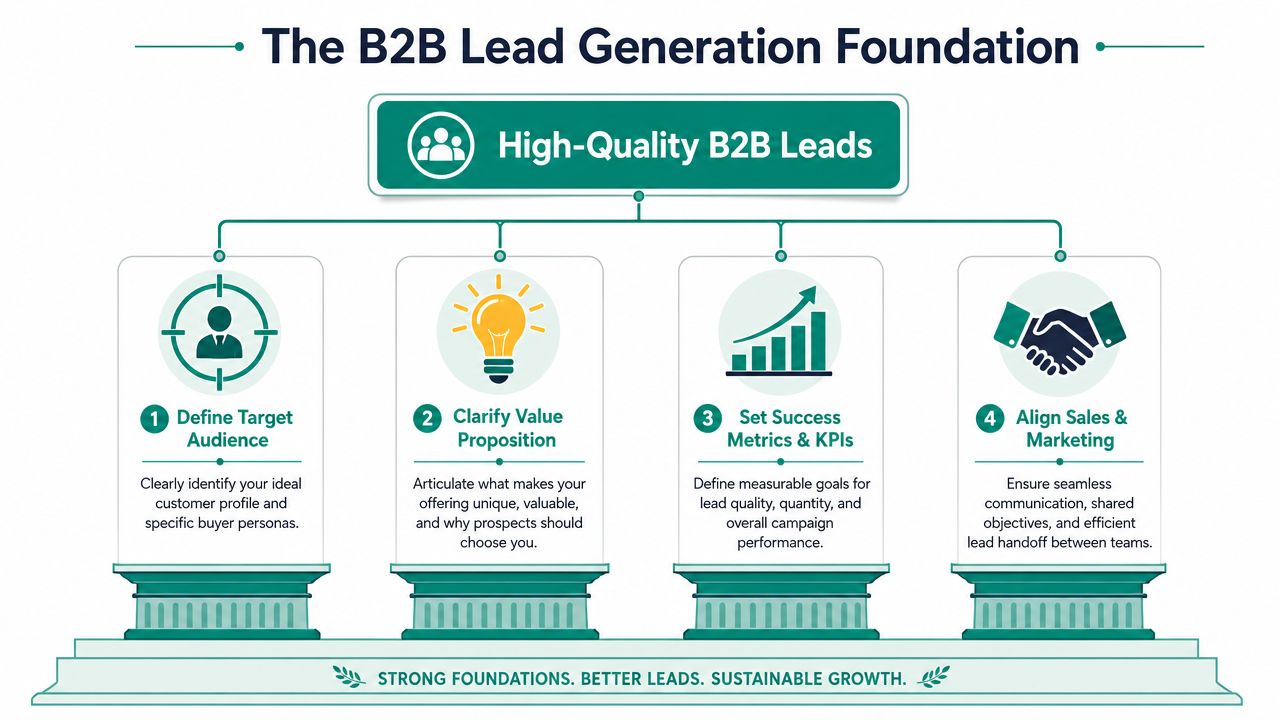
A useful ICP answers practical questions:
- Which companies fit by industry, business model, size, sales cycle, and operational complexity
- What problem creates urgency, such as stalled growth, poor attribution, manual processes, weak reporting, or low conversion rates
- Who starts the buying motion because the first pain owner is often different from the budget holder
- What has to be true to buy, including budget range, internal ownership, implementation capacity, and timing
Weak lead programs typically exhibit these characteristics. If the ICP is broad, paid campaigns widen, content drifts toward general education, and outbound messaging starts sounding interchangeable. Sales then spends time screening out accounts that should never have entered the funnel.
Many teams overlook the step of defining a negative profile. Spell out who should be excluded. That often includes very small accounts with no budget, enterprise accounts with procurement cycles your team cannot support, and verticals where your product rarely wins. This one step improves lead quality faster than many channel changes because it keeps bad-fit demand out of the system in the first place.
Set goals in qualified terms
Raw lead volume is a poor planning metric. Qualified pipeline is the target.
That means defining lead stages with enough precision that marketing can optimize toward them and sales can trust them. In practice, that usually starts with MQL and SQL criteria based on fit, intent, and action taken. A webinar attendee from the wrong segment is not equal to a demo request from an in-profile account. Treating them the same is how teams report success while revenue stays flat.
A weak goal sounds like this: get more leads from the website.
A useful goal sounds like this: generate more sales-qualified conversations from accounts that match the ICP and show buying intent.
That shift changes everything. Offer design gets tighter. Channel choices improve. Reporting becomes clearer because the team is measuring movement toward pipeline, not just form fills.
If marketing celebrates inquiries and sales rejects most of them, the issue is not volume. The issue is qualification.
Align sales and marketing before launch
Lead generation breaks at handoff more often than at click.
Before any campaign goes live, both teams should agree on the operating rules:
| Question | Why it matters |
|---|---|
| What counts as an MQL | Prevents weak inquiries from being passed to sales |
| What counts as an SQL | Gives sales a clear threshold for direct follow-up |
| Who follows up first | Prevents delay after conversion |
| What happens if a lead is interested but not ready | Keeps good accounts in nurture instead of losing them |
| Which segments matter most | Focuses spend and outreach on the accounts most likely to close |
I have seen teams spend weeks refining ad copy while leaving these decisions vague. The result is predictable. Marketing says the campaign worked. Sales says the leads were poor. Both are partly right because nobody defined quality in operational terms before launch.
If your site needs examples of how this foundation translates into page structure, forms, and conversion paths, review these B2B lead generation website patterns. Page mechanics matter, but they only perform when the targeting, offer, and qualification logic are already in place.
Dominating High-Impact Organic Channels
Organic channels don’t produce instant gratification. They do create strategic advantage.
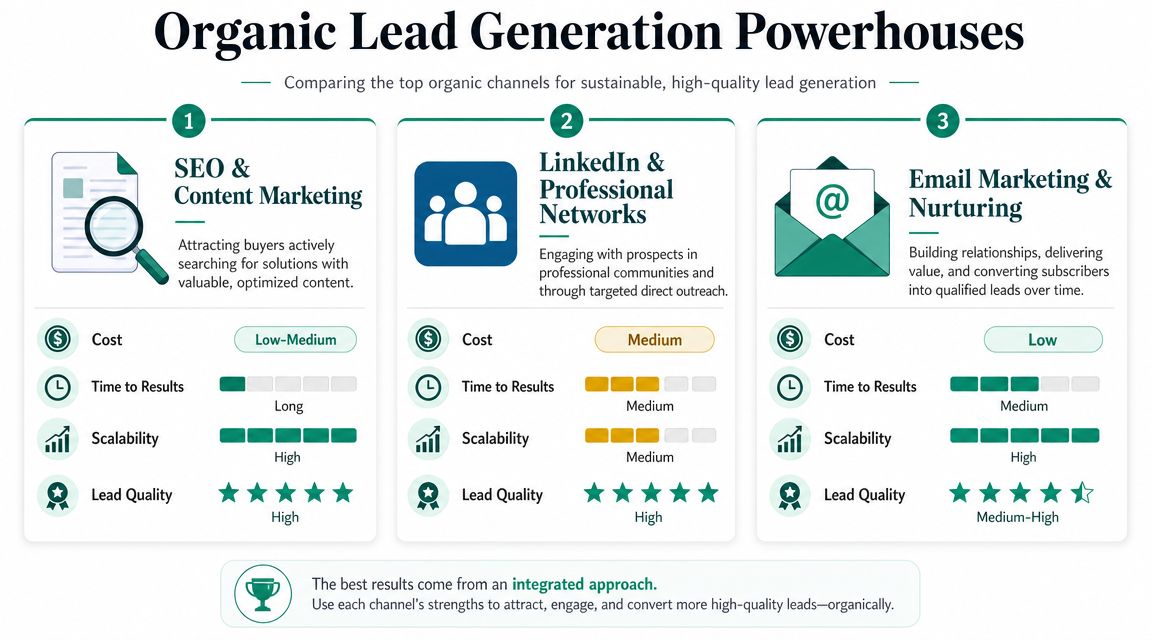
A good paid campaign stops when budget stops. Strong organic acquisition keeps pulling in demand because the assets stay live. In B2B, that usually means content, search visibility, LinkedIn presence, and email nurturing that keeps warm prospects moving.
Why inbound still pulls its weight
The case for inbound isn’t philosophical. It’s operational. Inbound tactics generate 54% more leads than traditional outbound practices; 87% of B2B marketers say content marketing generates demand and leads, and businesses using content marketing for lead generation see 6x the conversion rates of competitors that do not, based on BookYourData’s lead generation statistics roundup.
That lines up with what buyers do. They research before they talk. They compare vendors discreetly. They share links internally. They don’t announce intent early.
Content that attracts buyers, not just readers
A lot of B2B content looks polished and does nothing. The usual reason is simple. It answers broad awareness questions while ignoring buying-stage friction.
Content that generates leads tends to fall into a few useful buckets:
- Problem diagnosis content that helps a buyer name the issue clearly
- Comparison content that clarifies trade-offs between approaches
- Implementation content that shows what change looks like after purchase
- Decision support assets such as guides, webinars, and checklists that help internal champions sell the solution inside their company
Blog posts matter, but not every post deserves to exist. If a topic won’t attract the right buyer or support a sales conversation later, skip it.
For companies trying to connect search demand to pipeline, this guide to SEO lead generation is a useful reference because it sits in the overlap between visibility and conversion intent.
LinkedIn works when you act like a person
LinkedIn is crowded with fake thought leadership and low-effort outreach. Buyers ignore most of it.
The platform still matters because decision-makers are there, and the earlier channel data already showed how central LinkedIn is inside B2B lead generation online. But the win doesn’t come from posting motivational filler or sending instant pitch messages after a connection request.
Use LinkedIn in three layers:
Authority layer
Publish short observations from client work, implementation lessons, objections you hear, and mistakes you see repeatedly.Network layer
Connect with target accounts, comment intelligently on relevant posts, and show up where your buyers already spend attention.Conversation layer
Move to direct outreach only when the account fit is strong, and the message is specific.
Buyers respond to relevance. They don’t respond to “just checking in.”
Email is still the backbone
Email remains one of the most practical tools in the stack, not because it’s glamorous, but because it supports direct response and nurturing at the same time.
Organic email performs best when it isn’t asked to do everything. Use it to distribute useful content, re-engage past leads, follow up after webinars, and move warm accounts toward a specific next step. If your entire email strategy is “send newsletter monthly,” you’re leaving money on the table.
Scaling Lead Volume with Paid Strategies
Paid channels are useful when you already know who converts and why. If that foundation isn’t there, paid media helps you waste money faster.
The role of paid acquisition in B2B lead generation online is acceleration. It shortens feedback loops, reaches targeted buyers faster, and fills gaps while organic assets mature. It doesn’t replace organic. It gives you speed while organic builds durability.
Google Ads versus LinkedIn Ads
These two channels solve different problems.
Google Ads captures existing intent. Someone is searching because they already feel a problem. If your offer matches that search and the landing page is tight, search traffic can move fast.
LinkedIn Ads creates targeted exposure. The user may not be searching, but you can reach specific roles, industries, and company types based on professional data. That makes LinkedIn useful when the market is narrow, and the buyer profile is clear.
Here’s the practical split:
| Channel | Best use case | Common mistake |
|---|---|---|
| Google Ads | Capture buyers already researching solutions | Sending traffic to generic service pages |
| LinkedIn Ads | Reach defined decision-makers by role or company type | Running broad campaigns with weak messaging |
If your service solves an urgent, obvious pain, search often gets the first budget. If your offer needs education or your audience is highly specific, LinkedIn often deserves a test first.
Match the offer to the traffic temperature
Paid traffic fails when the ask is too big for the buyer’s level of awareness.
Use a direct offer such as a consultation, demo, or audit when the buyer likely understands the problem already. Use softer conversion assets such as a guide, benchmark, or webinar when you’re reaching a colder audience.
The page matters as much as the ad. A lot of B2B teams obsess over targeting and underinvest in the landing experience. One weak headline, too many form fields, or a muddy CTA can sink the whole spend.
If you want a sense of how different ad structures and offer types play out, these PPC marketing examples help show the range between broad traffic campaigns and focused lead capture.
Paid programs break when operations lag behind
A hidden bottleneck in paid lead generation is response handling. Teams buy clicks but don’t build the follow-up muscle behind them. Leads arrive, and nobody works them quickly. Or one overloaded coordinator becomes the choke point.
That’s why campaign scale often depends on support capacity as much as ad budget. If your team needs more administrative bandwidth for follow-up, scheduling, inbox management, or list cleanup, this guide on how to grow your business using a virtual assistant is worth reviewing. Paid lead flow creates downstream work, and somebody has to own it.
How to Design Your First Lead Generation Campaign
Monday morning. Sales asks why there are no qualified meetings on the calendar, marketing points to click volume, and nobody can explain where the handoff broke. A first lead generation campaign usually fails before launch because the team treats audience, offer, channel, and follow-up as separate decisions.
They are one system.
A workable first campaign starts with restraint. Pick one audience segment, one painful problem, one offer that fits buyer intent, and one path to conversion. The narrower setup feels limiting, but it gives you something far more useful than breadth. It gives you signal. You can see which message pulled response, which channel produced qualified interest, and where the funnel lost momentum.
Pick a slice of the market
Start with a segment from your ICP that has an obvious pain, a reachable buyer, and enough commercial value to matter if the campaign works. Broad categories sound ambitious and produce vague messaging. Tight segments produce relevance.
Good campaign inputs look like this:
- Audience such as operations leaders at multi-location service businesses
- Problem like poor lead routing, weak visibility into attribution, or low website conversion
- Offer such as a practical guide, short audit, or consultation tied to that problem
- Primary channel based on where that audience gives its attention
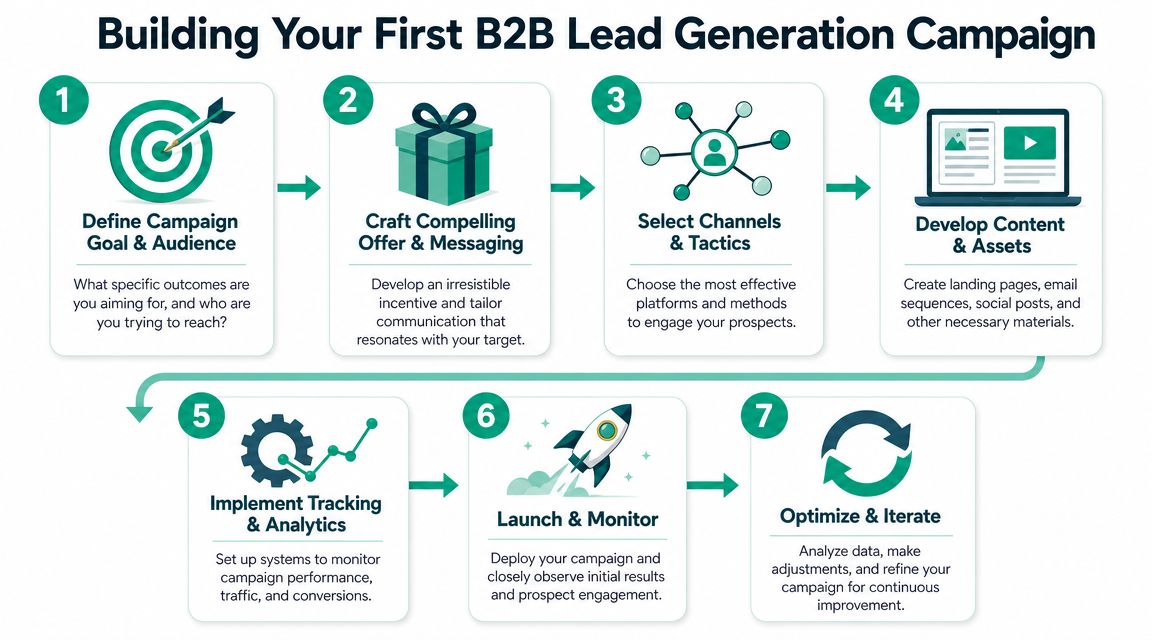
That combination does more than help targeting. It forces alignment across the whole program. If the audience is clear but the offer is weak, response drops. If the offer is strong but the wrong channel carries it, volume stalls. If both work but qualification is loose, sales loses trust in the campaign.
Build the campaign assets in the right order
Teams often begin with emails or ads because those feel like the campaign. They are distribution. The actual campaign starts at the conversion point.
Build the destination first. Create the landing page or booking page, define the CTA, and make sure the proof matches the problem you are claiming to solve. Then write outreach that earns the click. This order matters because weak destination pages distort channel performance. Good traffic can look bad when the page does not carry the message.
A strong first campaign usually includes:
- Landing page with a problem-led headline, clear value, short form, and one action
- Offer asset such as a guide, checklist, webinar registration, or consultation page
- Email sequence for outbound or nurture
- LinkedIn message or post support if that channel fits the audience
- Tracking setup so leads can be tied to source and qualified outcome
This walkthrough is useful if you want to see a campaign process explained visually before building your own.
Use AI where the work is repetitive
AI helps on the tasks that consume time without adding much strategic value. Clay’s breakdown of AI lead generation explains this well. AI tools are most useful for finding leads, enriching records, and initiating outreach at scale. That can remove hours of manual research and make personalization more consistent across larger lists.
The trade-off is straightforward. Automation increases output, but it also increases the cost of bad strategy. If your ICP is sloppy or your messaging is generic, AI helps you scale mistakes faster. Keep human judgment on targeting, positioning, and qualification rules. Use automation for preparation and pattern-based execution.
Use automation on the prep work first. Keep human review on targeting, messaging, and qualification.
A simple campaign sequence
For a first campaign, keep the sequence simple enough to measure and strong enough to learn from. One practical model is outbound plus light nurture.
Email one
Lead with the problem, show that you understand the context, and make a small ask.Email two
Share a useful resource tied to that problem. No hard pitch.Email three
Add a short observation about what companies usually get wrong and offer a direct conversation.LinkedIn touch
Connect only if the account fits and the profile looks active.Retargeting or nurture email
Follow up with related content if they clicked but didn’t convert.
The sequence only works if the offer matches the buyer’s stage. Warm prospects can respond to a call or consultation. Colder audiences usually need a lower-friction step first, such as a guide, benchmark, or short diagnostic. That is why campaign design is not just copywriting or media buying. It is offer strategy, channel selection, and conversion design working together.
If you’re in a niche model, studying adjacent examples can help tighten your structure. For teams in franchise growth, this overview of a franchise lead generation company shows how offer-message-channel alignment changes when the buyer journey is more specialized.
Optimizing Your Funnel and Measuring What Matters
A campaign goes live, leads start coming in, and the dashboard looks healthy. Then sales reviews the list and finds thin-fit accounts, weak intent, and too many contacts who were never likely to buy. That is the point where lead generation stops being a traffic problem and becomes an operating system problem.
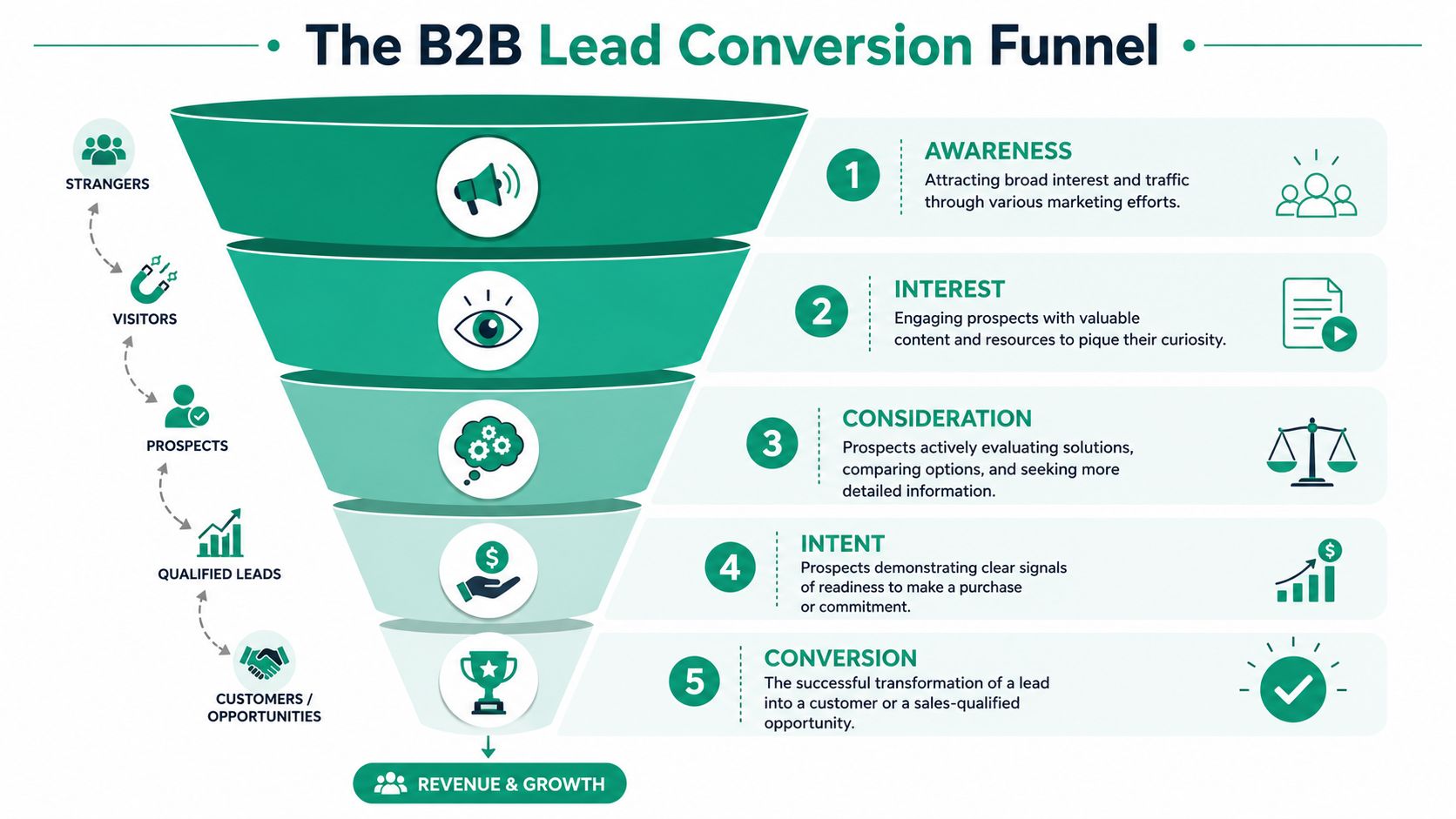
While many teams succeed at generating inquiries, a smaller number consistently convert them into qualified opportunities. The difference usually comes down to how well three pieces work together: qualification rules, landing page experience, and follow-up speed. If those pieces are disconnected, more spend just feeds a weak funnel.
Raw lead volume can hide a broken funnel
Form fills are an activity metric. Pipeline is the business metric.
One campaign can produce fewer conversions and still be the better investment because sales accepts a higher share, meetings hold, and opportunities progress. Another can stuff the CRM with names that never clear qualification. I have seen both. The second campaign usually gets praised first because the numbers look bigger in the weekly report.
That is why funnel optimization has to connect back to the ICP work from earlier sections. A lead is only valuable if the account fits, the contact has credible buying context, and the handoff rules push the right records to sales at the right time. Everything else belongs in nurture, not in an SDR queue.
Fix conversion friction before you buy more traffic
Improving conversion efficiency usually pays back faster than launching another acquisition test. More traffic helps only when the page, offer, and routing logic are already doing their job.
The highest-impact fixes are rarely flashy:
- Landing pages that try to serve multiple audiences usually lower response because no one feels directly addressed
- Long forms too early in the journey cut conversions before trust is established
- Multiple CTAs on one page split attention and reduce commitment
- Weak post-submit steps create uncertainty and lower the odds of a real sales conversation
Use a single page for a single audience and a single offer. Ask only for the information needed for the next step. If the traffic is cold, a diagnostic, benchmark, or focused guide often converts better than a hard demo ask. If the traffic is warm and already problem-aware, a demo or consultation can work. The page has to match buyer temperature, not just the campaign goal.
Score leads in a way sales will trust
Lead scoring fails when marketing builds it in isolation. A useful model combines fit and behavior.
Fit covers account-level factors such as company size, industry, geography, and use case alignment. Behavior covers what the contact did, such as requesting a demo, visiting pricing, or engaging with bottom-of-funnel content. Fit without behavior creates bloated nurture lists. Behavior without fit sends bad accounts to sales.
The practical rule is simple. Build routing around signals that change action. If a lead meets your ICP and shows buying intent, send it to sales fast. If it fits but intent is still light, keep it in nurture until the next meaningful action. That keeps sales focused on real opportunities and gives marketing a cleaner feedback loop.
A dashboard that supports decisions
A good dashboard helps the team decide where to fix the system. It does not just report activity.
| Metric | What it tells you |
|---|---|
| MQLs | Whether campaigns are generating relevant early-stage interest |
| SQLs | Whether leads are qualifying for direct sales action |
| Lead source by qualified outcome | Which channels produce accounts that match your ICP |
| Landing page conversion by offer | Which message and offer combinations create response |
| Follow-up status | Whether leads are being worked quickly and consistently |
I would add two operational checks behind this table even if they never make the executive dashboard: time to first follow-up and percentage of MQLs accepted by sales. Those two numbers expose misalignment fast. If follow-up is slow, conversion drops. If acceptance rate is weak, the problem is usually targeting, offer quality, or scoring logic.
The marketing to sales handoff should run on rules, not debate.
When that handoff is clear, optimization gets easier. You can trace problems back to the actual constraint. Bad-fit traffic, weak offer-page match, poor routing, or slow response. That is the fundamental point of measurement in B2B lead generation online. It ties strategy, channels, and conversion into one system you can improve with intent instead of guesswork.
Common Pitfalls and When to Call for Backup
A weak pipeline usually looks like a traffic problem at first. In practice, the breakdown is often operational. The market is responding, but the system is leaking. Leads reach the form and never get routed. SDRs work stale records. Marketing reports MQL growth while sales rejects half the names. By the time the team notices, the issue gets blamed on channel performance instead of the handoff, targeting, or process design behind it.
That matters because B2B lead generation online is a connected system. ICP, channel mix, offer, routing, and follow-up all affect one another. If one part is loose, the rest of the program gets harder to read and harder to improve.
The traps that keep showing up
These problems show up across inbound, outbound, paid, and organic programs:
Poor list quality
Bad data wrecks outreach fast. Even strong copy cannot recover a campaign aimed at the wrong accounts or sent to invalid contacts.No lead routing rules
Good inquiries stall when ownership is unclear. Speed matters, especially for high-intent conversions.Too much faith in intent signals
Visitor identification, topic surges, and engagement spikes can help prioritize accounts. They are still signals, not proof that a buying process is active.Overdependence on one channel
A program built on one platform is fragile. Inbox placement drops, paid costs rise, search visibility slips, and pipeline slows with it.
That last issue is getting harder to ignore. Outfunnel’s lead generation guide points to a real shift in B2B acquisition: privacy changes, inbox filtering, and dark social make attribution less clean and single-channel plans less reliable. The practical response is to build a channel mix that can absorb disruption. Search can capture existing demand. Paid can create controlled volume. Outbound can open targeted conversations. Retargeting and nurture keep interested accounts warm while sales timing catches up.
Build in-house or bring in help
This decision comes down to operating capacity, not pride.
Keep it in-house if the business already has clear positioning, one owner for pipeline performance, enough execution coverage across content or paid, and a sales team that follows up quickly and consistently. Add outside help when the team needs channel depth, faster implementation, cleaner measurement, or a senior operator to connect strategy, execution, and reporting into one working model.
A rushed demand for “more leads next month” usually produces bad-fit traffic, short-lived campaigns, and frustration on both sides. Outside support makes more sense when the company needs a repeatable system, and the current team does not have the time or experience to build it properly.
I have seen companies waste months changing tactics when the core constraint was simple: no one owned the full funnel. Once ownership became clear, the fixes were straightforward. Tighten ICP rules. Clean the database. Rework routing. Match offers to funnel stage. Review channel quality by accepted pipeline, not by raw lead count.
If the pipeline is thin because the system is unfinished, that can be fixed. If the team keeps treating lead generation as a set of disconnected campaigns, the same problems will keep coming back.
If you need a partner to build or tighten that system, Ascendly Marketing can help with B2B lead generation, SEO, PPC, websites, content, email outreach, and conversion-focused execution tied to measurable business goals.