

TL;DR:
- A digital footprint is the trail of data left by online actions, including active sharing and passive collection. Managing it is essential because combined data increases privacy risks, and footprints are effectively permanent. Regularly auditing and controlling your online presence helps protect privacy, reputation, and brand perception.
A digital footprint is the unique trail of data you leave behind through every online action, from browsing a website to posting on LinkedIn. This trail splits into two categories: active footprints, which you create deliberately, and passive footprints, which platforms collect without your direct input. The eSafety Commissioner defines a digital footprint as traceable data from personal or organizational online activity. For individuals, that means your search history, social media comments, and app usage. For business owners, it includes your company’s entire online presence, from Google reviews to press mentions, and every piece shapes how the world perceives you.
What is a digital footprint, and what are its two types?
Every online action you take generates data. That data accumulates into a profile that search engines index, advertisers exploit, and employers review. Understanding the two types of digital footprints is the foundation of managing them.

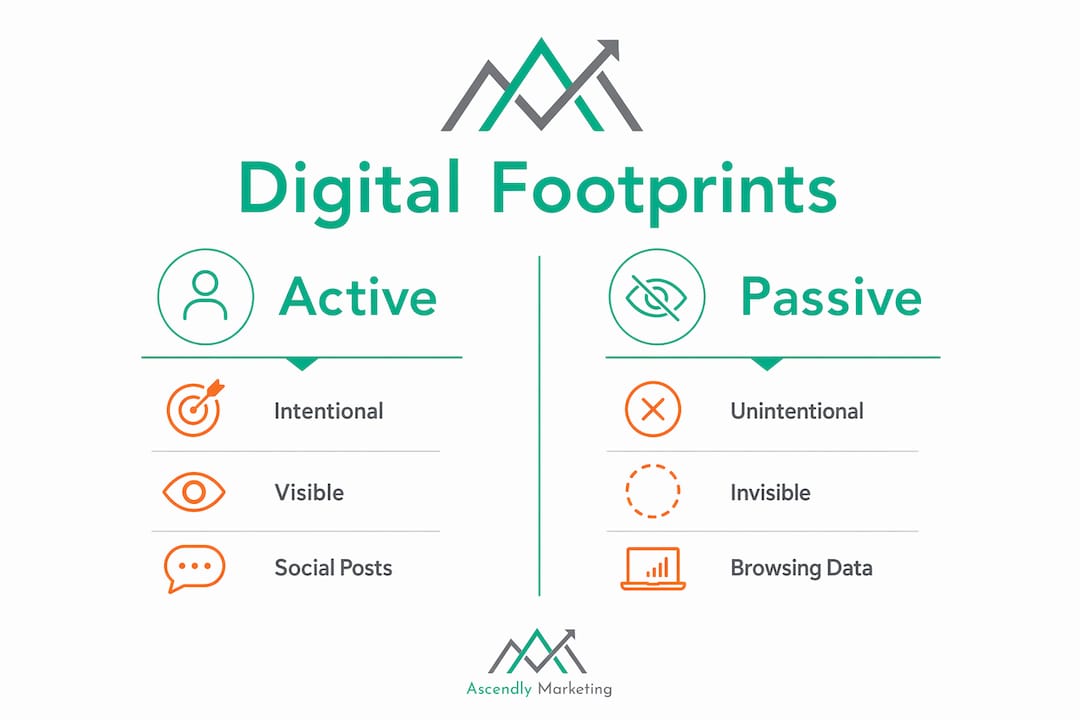
Active digital footprints are created when you intentionally share information online. Examples include publishing a Facebook post, submitting a contact form, writing a product review on Yelp, or uploading a photo to Instagram. You choose to put that data out there.
Passive digital footprints are collected without your direct knowledge. When you visit a website, cookies track your behavior. Streaming platforms like Netflix log what you watch and for how long. Google Analytics records your location, device type, and time on page. You never clicked “share,” but the data exists regardless.
The scope difference between the two matters enormously. Active footprints are visible and often searchable by name. Passive footprints are less visible to you but far more detailed. Advertisers and data brokers combine passive data points to build behavioral profiles that are more accurate than anything you would voluntarily disclose.
| Type | Origin | Examples | Visibility to you |
|---|---|---|---|
| Active | Intentional sharing | Social posts, form submissions, reviews | High |
| Passive | Automated collection | Cookies, browsing data, app telemetry | Low |
| Active | Deliberate uploads | Photos, comments, emails | High |
| Passive | Platform tracking | Location data, watch history, ad clicks | Very low |
Pro Tip: Search your full name in Google, Bing, and DuckDuckGo right now. The results are your active footprint as the public sees it. What does not appear in those results is your passive footprint, and it is far larger.
How does a digital footprint impact online privacy and security?
The privacy risk of a digital footprint grows not from any single data point but from the combination of many. Harvard’s Privacy Tools project confirms that combining data pieces dramatically increases identification risk. A username alone means little. Pair it with a zip code, a job title, and a browsing pattern, and you have a detailed profile that can identify someone with near certainty.
“The internet remembers more than users expect, making footprint management not optional but necessary for anyone with an online presence.” — eSafety Commissioner
Here are the top privacy and security threats tied to your digital footprint:
- Identity theft. Exposed personal data, such as your email, phone number, and birthdate, gives criminals enough to open accounts in your name or bypass security questions.
- Phishing and social engineering. Attackers use publicly visible footprint data to craft convincing, personalized scam messages that reference your employer, location, or recent purchases.
- Unwanted profiling. Online platforms create virtual pictures from user data used for advertising and stored long-term. You may never see this profile, but it influences the prices you are shown and the content you receive.
- Credential exposure. Services like Have I Been Pwned let you check whether your email address has appeared in a known data breach. Millions of credentials from platforms like LinkedIn and Adobe have been leaked and are actively traded.
- Reputational damage. Old posts, deleted accounts, and cached pages can resurface. A comment made years ago can appear in a search result today, affecting job prospects, business partnerships, or personal relationships.
The permanence factor is what makes this serious. Digital footprints are effectively permanent because removing original content does not always remove search engine references or cached copies. You can delete a tweet, but screenshots and archive tools may have already preserved it.
What is the impact of digital footprints on personal and business branding?
Your digital footprint is your reputation, whether you manage it or not. For individuals, a Google search before a job interview or a first date pulls up whatever your footprint contains. For businesses, the stakes are higher because every customer interaction, review, and social mention becomes part of a permanent public record.
Businesses carry their own digital footprints that include traceable online activity across every platform where they operate. A restaurant’s Yelp reviews, a law firm’s LinkedIn posts, and a retailer’s Google Business profile all contribute to a composite reputation that potential customers evaluate before making contact.
Several specific footprint sources shape brand perception most directly:
- Review platforms. Google, Yelp, and Trustpilot aggregate customer sentiment into star ratings that appear in search results. A single unaddressed negative review can suppress conversion rates for months.
- Social media history. Platforms like Twitter/X and Facebook retain years of posts. Inconsistent messaging or past controversies are searchable and can undermine current brand positioning.
- Press and media mentions. Articles, blog posts, and news coverage create high-authority footprint entries that rank well in search and are nearly impossible to remove.
- Employee activity. Staff LinkedIn profiles, public comments, and professional associations all feed into a company’s broader digital footprint.
The practical implication for business owners is that online reputation management is not a reactive task. It requires proactive content creation, consistent social media presence, and regular monitoring. A business that publishes authoritative content, responds to reviews, and maintains accurate directory listings controls its footprint narrative. A business that does nothing cedes that control to whoever posts about it next. Understanding digital branding strategy is the logical next step for any owner who wants to shape rather than react to their online presence.
How can you trace and manage your digital footprint effectively?
Complete online anonymity is impossible. The practical goal is managing your exposure and controlling what data you share. That starts with knowing what already exists.
Step 1: Map what is publicly visible
Search your name, business name, and email address across Google, Bing, and DuckDuckGo. Note every result on the first three pages. This is your publicly searchable baseline, and it is the essential first step before any removal or control effort begins. Use Google Alerts to receive notifications whenever your name or brand appears in new content.
Step 2: Check for data breaches
Visit Have I Been Pwned and enter every email address you use. The service cross-references your address against hundreds of known breach databases. If your credentials appear, change those passwords immediately and enable two-factor authentication on affected accounts.
Step 3: Audit and tighten privacy settings
Review privacy settings on Facebook, Instagram, LinkedIn, Google, and any other platform you use. Most platforms default to maximum data sharing. Switch location tracking, ad personalization, and third-party data sharing to the most restrictive settings available. Incognito mode does not prevent footprint growth when you are logged into an account. Platform settings and sharing behaviors matter far more than browser mode.
Step 4: Reduce unnecessary accounts
Every account you create is a new data vector. Delete accounts on platforms you no longer use. Use tools like JustDeleteMe to find deletion instructions for hundreds of services. Fewer accounts mean fewer breach exposures and less passive data collection.
| Tool | Purpose | Cost |
|---|---|---|
| Have I Been Pwned | Breach detection by email | Free |
| Google Alerts | New mention monitoring | Free |
| JustDeleteMe | Account deletion guide | Free |
| DuckDuckGo Privacy Browser | Reduced tracking browsing | Free |
| DeleteMe | Professional data removal | Paid |
Pro Tip: Run a full footprint audit every six months. Set a calendar reminder for January and July. Platforms update their data policies regularly, and settings you locked down last year may have reset after an app update.
Key takeaways
Managing your digital footprint requires consistent action across privacy settings, account hygiene, and content strategy because passive data collection never stops on its own.
| Point | Details |
|---|---|
| Two footprint types exist | Active footprints come from deliberate sharing; passive footprints are collected automatically by platforms. |
| Data combination amplifies risk | Individual data points seem harmless, but combined they enable precise identification and profiling. |
| Footprints are effectively permanent | Deleting content does not remove cached pages or search engine references. |
| Businesses carry brand footprints | Every review, post, and press mention shapes public perception and requires active management. |
| Anonymity is not the goal | Controlling exposure and limiting unnecessary data sharing is more effective than seeking invisibility. |
Why most people are managing their digital footprint wrong
After working with businesses and individuals on their online presence since 2013, I have seen the same mistake repeated constantly. People treat digital footprint management as a one-time cleanup project rather than an ongoing practice. They Google themselves once, delete a few embarrassing photos, and consider the job done.
The reality is that data retention and targeting practices by platforms amplify the significance of footprints far beyond social perception into commercial data exploitation. The footprint you create today is being processed, sold, and used to influence decisions about you that you will never see.
The other misconception I encounter constantly is that privacy is binary. Either you are exposed, or you are protected. That framing leads people to either do nothing because “it’s too late” or to pursue extreme measures like deleting all social media, which often hurts their professional reputation more than it helps. The most effective approach focuses on managing exposure, not eliminating it.
For business owners specifically, the footprint conversation needs to shift from defense to offense. Your digital footprint is also your marketing asset. A well-managed footprint means your brand appears in the right searches, your reviews reflect your actual service quality, and your content positions you as credible in your industry. The businesses I have seen grow fastest are not the ones hiding from their footprint. They are the ones deliberately building it.
— Ascendly Marketing
How Ascendly Marketing can help you take control
Your digital footprint directly affects your search rankings, customer trust, and revenue. Ascendly Marketing has helped businesses across industries audit, repair, and build their online presence since 2013.

Our team runs full digital marketing audits that identify exactly where your footprint is helping or hurting your business. From there, we build strategies covering SEO, content creation, social media management, and reputation monitoring that keep your brand visible for the right reasons. Whether you are starting from scratch or recovering from a reputation issue, our digital marketing services are built around measurable outcomes. Book a consultation with Ascendly Marketing today and find out what your digital footprint is saying about you right now.
FAQ
What is a digital footprint in simple terms?
A digital footprint is the trail of data you leave behind through online activity, including browsing, social media posts, app usage, and form submissions. It includes both data you share intentionally and data collected automatically by platforms.
Can you completely erase your digital footprint?
Complete erasure is not realistic. Removing original content does not always remove cached pages or search engine references, so the practical goal is managing and minimizing your footprint rather than eliminating it.
How does a digital footprint affect a business?
A business’s digital footprint includes every review, social post, press mention, and directory listing that appears online. This composite record shapes customer trust and search visibility, making active management a direct factor in revenue.
Does incognito mode protect your digital footprint?
No. Incognito mode prevents local browser history from being saved, but it does not stop platforms from collecting data when you are logged into an account. Privacy settings and limiting data sharing are far more effective strategies.
How often should you review your digital footprint?
A full audit every six months is a practical standard. Use Google Alerts for continuous monitoring between audits, and check Have I Been Pwned any time a major data breach is reported in the news.