
You’re already paying for traffic.
Some of it comes from Google. Some from ads. Some from email, social, referrals, or repeat visitors who typed your URL directly. The dashboard says people are arriving, but the sales, leads, or demo requests don’t match the effort. That gap is where most businesses start asking the right question: what is conversion rate optimization, really, and why does it matter so much once traffic is already coming in?
The short answer is simple. CRO is the work of getting more of your existing visitors to take the action your business cares about. The useful answer is more specific. It’s a disciplined way to find friction, remove it, test changes, and tie those changes back to revenue rather than vanity metrics.
The Common Problem CRO Solves
A familiar scenario plays out like this.
A company launches a new site or starts investing harder in SEO and paid campaigns. Traffic rises. Landing pages look polished. The offer seems clear internally. Then the reports come in, and people are leaving after one page, abandoning forms, or dropping out during checkout. Nothing is technically broken, but the website still isn’t doing its job.
That’s not a traffic problem. It’s a conversion problem.
When the website attracts attention but not action
Take a service business running PPC to a quote page. The ads bring in clicks, but the quote form asks for too much too early. Visitors hesitate, back out, and the ad spend keeps running. Or think about an e-commerce store that gets solid product-page traffic but loses buyers when shipping details appear too late in the process.
In both cases, the business already did the expensive part. It got the visitor to the site. CRO focuses on what happens next.
A website can look modern and still leak revenue if the path to action feels unclear, risky, or time-consuming.
That’s why teams often pair CRO work with pages where engagement problems already show up. If visitors land and leave quickly, fixing that behavior becomes part of the conversion job. A useful starting point is understanding how to reduce bounce rate on a website, because bounce is often the first visible sign that your message, page structure, or offer isn’t lining up with visitor intent.
Why businesses get stuck
Many owners respond by asking for more traffic, more content, or more ad budget. Sometimes that helps. Often it just pushes more people into the same weak funnel.
CRO solves a more direct business problem. It asks:
- Where are people dropping off
- Why are they hesitating
- Which page, message, or form element is creating friction
- Which fix is worth testing first
That’s what makes CRO practical. You’re not guessing which button color “wins.” You’re identifying where money leaks out of the funnel and fixing the leak.
Defining Conversion Rate Optimization and Its Business Impact
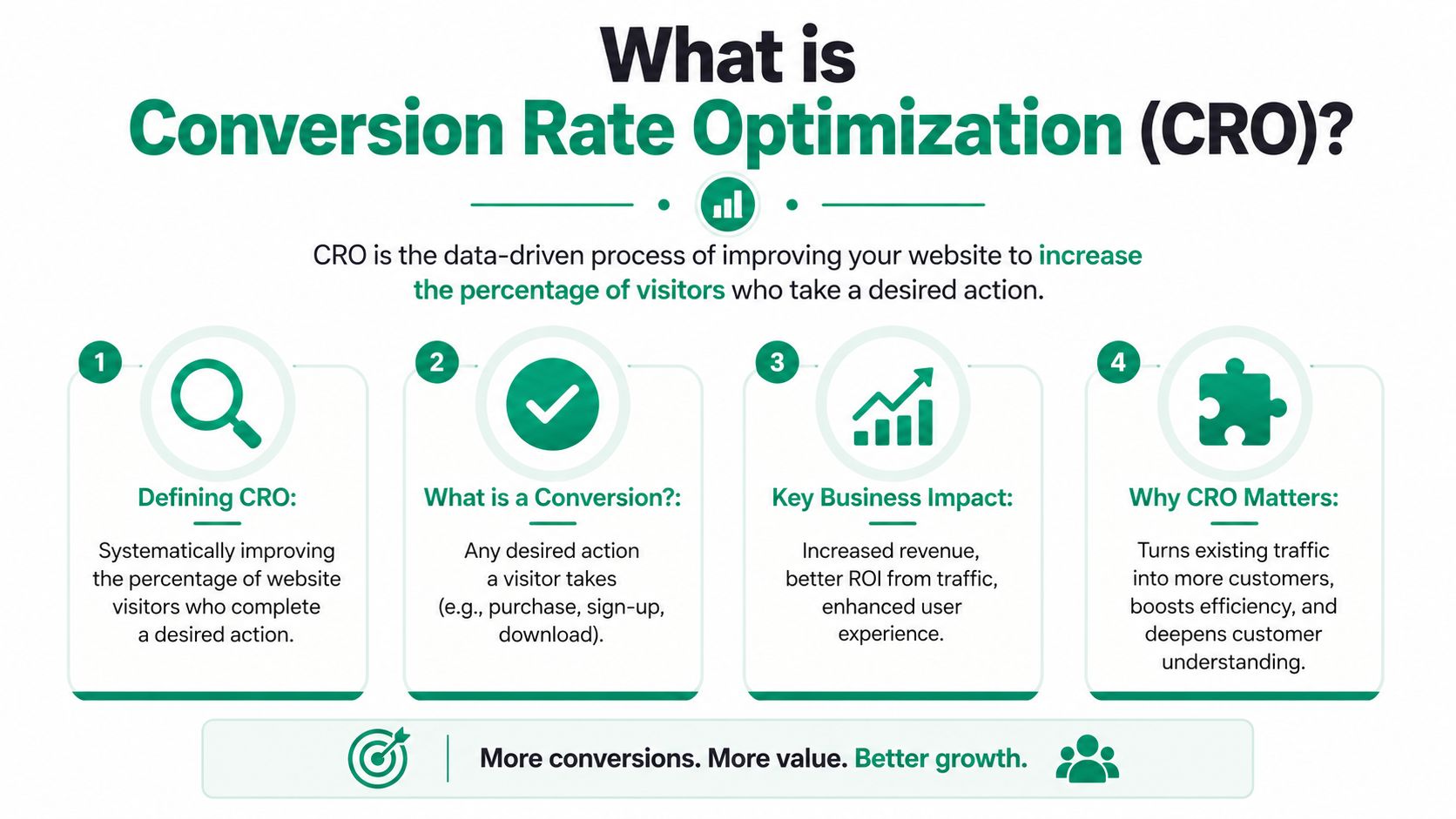
Conversion rate optimization is the process of improving the percentage of visitors who complete a desired action on a website or app. That action might be a purchase, form submission, booked call, demo request, signup, or download.
A conversion rate is usually tracked as the percentage of visitors who take that action. Across industries, common published averages cluster around 2% to 5%, with one roundup citing an overall average of 2.9% and another guide stating the average is 2% to 5%. That’s why CRO usually means lifting a site from a low single-digit baseline into a materially stronger range through testing and page improvements, rather than chasing abstract engagement metrics (conversion rate benchmarks and CRO methods).
What counts as a conversion
A conversion depends on the page and the business model.
| Page type | Typical conversion |
|---|---|
| E-commerce product page | Purchase or add to cart |
| SaaS pricing page | Trial signup or demo request |
| Local service landing page | Contact form or phone call |
| B2B content page | Download, consultation request, or email capture |
That definition matters because bad tracking creates bad decisions. If your team only measures final purchases, you may miss useful signals earlier in the funnel. If you only measure micro-actions, you can fool yourself into thinking the site is improving when it isn't producing revenue.
CRO is not just about raising a percentage
At this point, many basic explainers stop too early.
A higher conversion rate sounds good, but it doesn't automatically mean better business performance. The better lens is profitability. Matomo's 2024 guidance recommends combining analytics and attribution with AOV or CLV versus CAC analysis, and looking beyond “converted” to see which channels and customer segments produce the most profit (profit-focused CRO guidance).
That changes how you prioritize.
- If CAC is high, improving conversion efficiency can reduce pressure on acquisition.
- If AOV is low, increasing purchase size may matter more than getting slightly more checkouts.
- If CLV varies by segment, the best conversion may be the one that brings in better customers, not just more customers.
Practical rule: Don't ask only, “Will this page convert more visitors?” Ask, “Will this page convert the right visitors at an economics profile the business can keep?”
A discount-heavy landing page might convert well and still hurt margin. A cleaner product page with stronger trust signals might convert fewer people overall but attract more serious buyers. A lead form that removes qualification questions may drive more submissions and create more wasted sales time.
For B2B teams, that's why CRO often overlaps with sales process design. If you're trying to improve B2B sales conversion, the work doesn't stop at the form fill. Lead quality, follow-up speed, offer clarity, and qualification all affect whether a conversion creates pipeline or just noise.
The Four Stage CRO Framework
CRO works when it follows a repeatable cycle. Without a framework, teams jump from opinion to redesign, and then wonder why results are murky.
The simplest version has four stages.
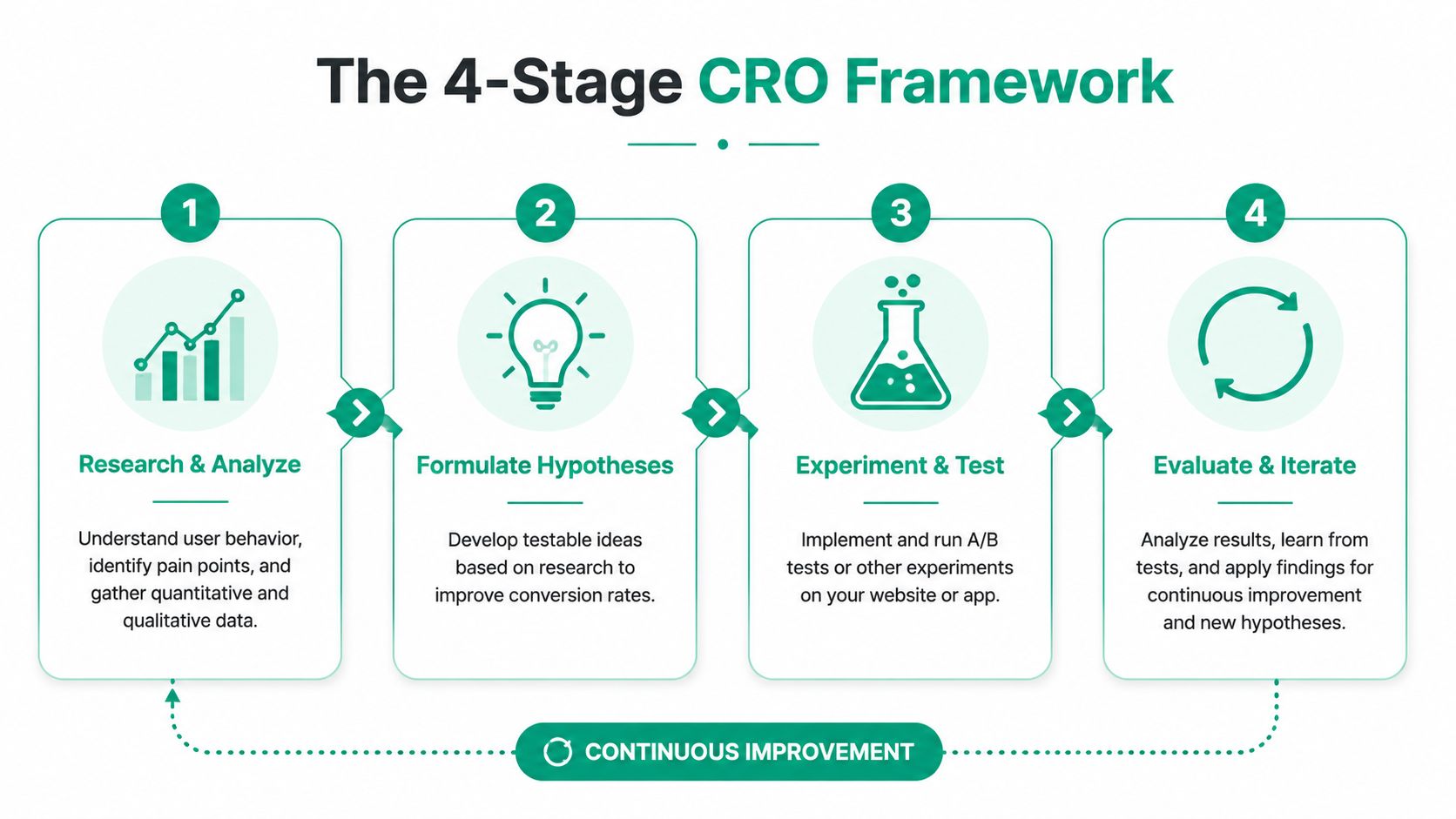
Research and analysis
Start with evidence. Find where the funnel is underperforming and where visitors appear confused, distracted, or blocked.
This stage usually includes:
- Analytics review for landing pages, traffic sources, form starts, cart activity, and exits
- Page-level inspection to spot weak hierarchy, unclear calls to action, or missing trust elements
- Behavior data such as heatmaps, scroll maps, session recordings, and on-page feedback
- Sales and support input to surface recurring objections or questions
The main goal isn't to collect more reports. It's to answer one question: where is the highest-friction point in the journey?
A homepage with low engagement might not matter if your paid landing pages carry the buying intent. A checkout issue matters more than a blog CTA issue if checkout is where qualified visitors disappear.
Hypothesis formation
Once you've found a problem, turn it into a testable idea.
A weak hypothesis sounds like this: “Let's simplify the page.”
A useful hypothesis sounds like this: “If we shorten the quote form and move proof points closer to the submit button, more qualified visitors will complete the request because the page will ask for less effort and create more trust.”
Good hypotheses have three parts:
- The change
- The expected behavior
- The reason that behavior should improve
That discipline keeps teams from testing random cosmetic changes.
Strong CRO teams don't test because they have ideas. They test because the data suggests a specific reason visitors aren't moving forward.
Testing and implementation
Now you validate the hypothesis.
A/B testing is the most common method because it compares a control against a variation under similar conditions. Multivariate testing can work too, but it's usually harder to interpret and easier to misuse on lower-traffic sites.
At this point, keep the process tight:
- Change one meaningful variable or one tightly related set of variables
- Define the primary conversion before launch
- Watch for technical errors before traffic is split
- Avoid redesigning half the page unless your research supports it
What doesn't work? Testing tiny details with no research behind them. Button color debates. Hero image swaps nobody can explain. Copy changes disconnected from the actual objection.
Learning and iteration
Every test should produce a decision, not just a report.
If a variation wins, document why you think it worked and where else the lesson applies. If it loses, that still helps. You've ruled out one assumption and learned something about buyer behavior on that page.
A simple operating habit helps here:
| Test outcome | What to do next |
|---|---|
| Variation wins | Roll out, monitor, and apply the insight elsewhere |
| No clear difference | Revisit the hypothesis or test a bigger change |
| Variation loses | Keep the control, document the lesson, and move to the next friction point |
That is the engine of CRO. Not one lucky test. Repeated learning.
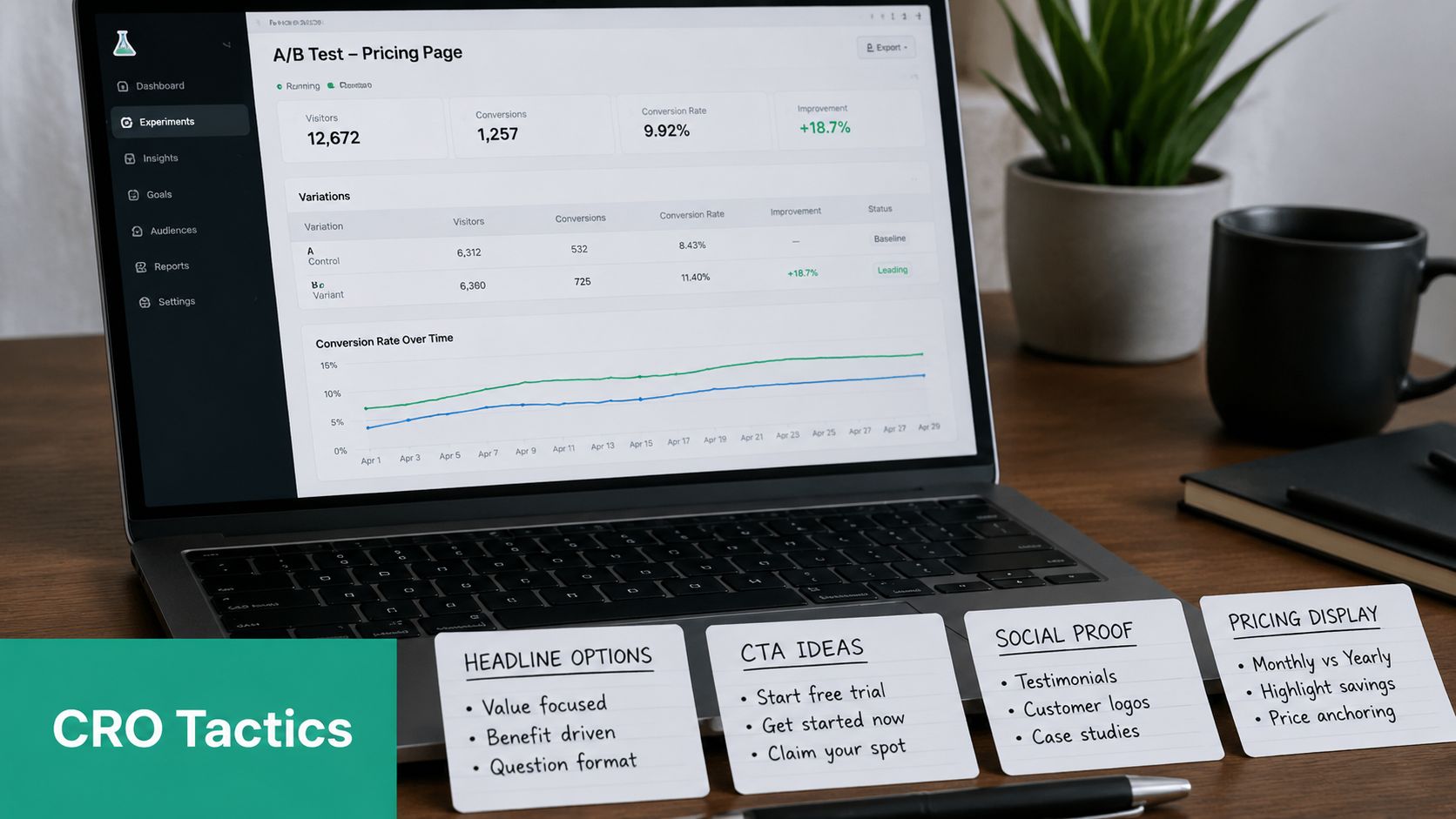
Practical CRO Tactics to Test
Frameworks keep the work organized. Tactics give you something concrete to test.
The mistake is treating this as a checklist. A tactic only makes sense when it addresses a specific conversion blocker. Still, certain categories produce useful tests more often than others.
User experience and layout
Visitors make quick judgments about effort. If the page feels hard to process, they leave before they evaluate the offer.
Useful tests include:
- Navigation reduction on landing pages so visitors don’t wander away from the main action
- Mobile layout fixes that keep the primary CTA visible and easy to tap
- Page hierarchy changes that move pricing, delivery, FAQs, or proof higher on the page
- Checkout simplification by removing unnecessary steps or distractions
For many sites, UX work produces the fastest gains because it removes friction directly. If your team is reviewing page-level issues, this guide on how to enhance website UX and drive more conversions is a useful companion to the CRO process.
Copy and message tests
A page can be technically sound and still underperform because the message doesn’t answer the visitor’s real question.
Try testing:
- Headlines that state the offer more plainly
- CTA copy that reflects the next step with less ambiguity
- Value proposition order so the strongest reason to act appears first
- Objection handling near forms or purchase buttons
One product page may need better feature explanation. Another may need fewer features and more reassurance. The point isn’t “write more copy.” It’s “write the copy that removes hesitation.”
For e-commerce operators working through store-specific issues, this piece on how to optimize your Shopify store’s conversion rate is helpful because it stays close to real store mechanics rather than generic CRO advice.
Offers and funnel design
Sometimes the page isn’t the problem. The offer is.
Consider tests around:
| Area | Example test |
|---|---|
| Offer structure | Bundle vs single-item presentation |
| Pricing display | Monthly-first vs annual-first framing |
| Incentive placement | Showing shipping or return details earlier |
| Funnel step order | Asking for email first vs full form upfront |
A lead-generation business might test whether a shorter initial form increases qualified conversations or merely fills the CRM with weaker leads. An online store might test whether surfacing delivery details on the product page reduces purchase hesitation.
Here’s a useful way to think about it. If visitors understand the product but still don’t move, test the offer. If they don’t understand the offer, test the message. If they want the offer but struggle to complete the action, test the experience.
A quick walkthrough can help teams see how these tactics show up in practice:
Essential Tools and Data Sources for Your CRO Program
You don’t need a giant stack to start. You do need enough visibility to answer two different questions: what users are doing, and why they’re doing it.
Analytics first
Analytics tools tell you where to look. Google Analytics 4 is the usual starting point because it shows page paths, traffic sources, conversion events, and funnel drop-off.
Use it to answer practical questions:
- Which landing pages attract visits but fail to move people deeper
- Which traffic sources produce action
- Where users abandon the funnel
- Which devices create friction
If event tracking is messy, fix that before you test anything. CRO falls apart when the measurement layer is unreliable.
Behavior tools next
Analytics alone won’t tell you why people stall. Behavior tools fill that gap.
Heatmaps show where attention goes. Session recordings reveal hesitation, repeated clicks, backtracking, and confusion. On-page surveys can expose unanswered objections, especially on pricing, shipping, demo, or checkout pages.
A simple phased setup works well:
- Install analytics and define key conversions
- Add heatmaps and recordings on your highest-value pages
- Use short surveys where abandonment is common
That order keeps costs under control while giving you usable insight fast.
If analytics tells you the form is underperforming, recordings often show whether users are confused, distracted, or simply unconvinced.
Testing platforms and operating support
Once your team has a clear hypothesis backlog, use a testing platform to run controlled experiments. The exact tool matters less than process discipline. You need clean version control, reliable traffic splitting, and a way to document outcomes.
Some businesses run this in-house. Others use a partner when the internal team lacks bandwidth for research, design, development, and reporting. In that category, Ascendly Marketing is one option because it offers conversion rate optimization alongside website design and broader digital marketing services, which makes it relevant when CRO changes also require page design or campaign alignment.
The practical rule is simple. Don’t buy advanced testing software before you’ve built a habit of identifying real problems and prioritizing hypotheses.
Your First 90 Days: A Practical CRO Roadmap
The first quarter should produce clarity, not chaos. Most small and mid-sized businesses don’t need a giant experimentation program on day one. They need a structured start.
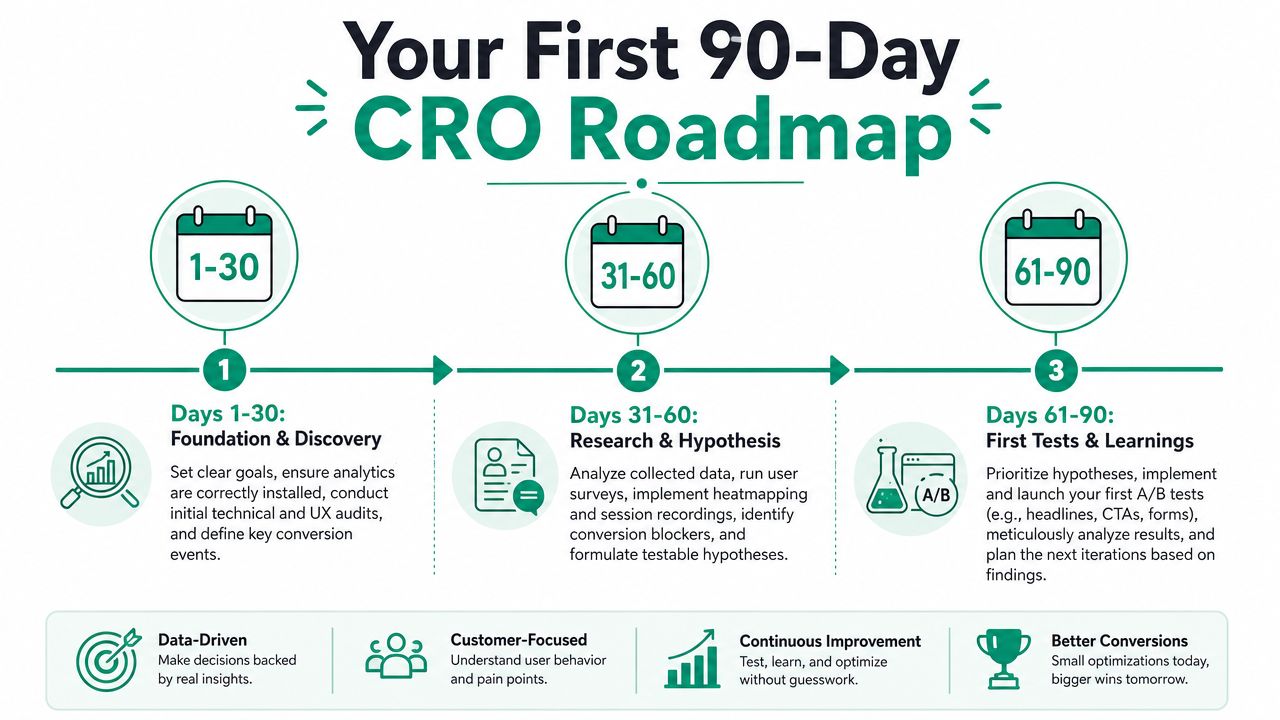
Days 1 to 30
Begin with tracking, page selection, and baseline review.
Pick the conversion actions that matter most. For an e-commerce brand, that may be purchase completion. For a B2B service company, it may be booked calls or qualified form submissions. Then confirm that analytics is capturing those events correctly.
At the same time, choose the pages that deserve immediate attention. Don’t spread effort across the whole site. Focus on pages that sit close to revenue, such as product pages, pricing pages, checkout, demo pages, or main lead forms.
A solid first-month checklist looks like this:
- Audit analytics setup so conversions and major funnel steps are recorded
- Review high-intent pages rather than lower-value informational pages
- Install behavior tools on those pages
- Collect objections from sales calls, chat transcripts, or support questions
Days 31 to 60
Now the goal shifts from observation to prioritization.
Look for repeated patterns. Are mobile users struggling to submit forms? Are people reaching the pricing section and dropping off? Are buyers spending time on shipping or return details but not converting?
Turn those findings into a small hypothesis backlog and rank it by likely business value, implementation effort, and confidence in the evidence.
A simple table can keep the team honest:
| Opportunity | Evidence | Priority |
|---|---|---|
| Shorten lead form | High abandonment during completion | High |
| Move trust signals closer to CTA | Visitors hesitate near submit area | Medium |
| Rewrite headline on pricing page | Low engagement with core offer message | Medium |
This is also where traffic quality matters more than many teams realize. With organic search clicks projected to fall by about 25% by 2026 as users rely more on AI chatbots and zero-click experiences, and with Google reporting that AI Overviews reached 1.5 billion monthly users in 2025, modern CRO has to account for visitors who arrive with lower intent and less pre-qualification from traditional search results (AI-driven search shift and CRO implications).
That changes what you test. Stronger trust signals, clearer qualification, sharper offer framing, and better post-click guidance matter more when visitors arrive less certain about what they want.
Days 61 to 90
Launch the first meaningful test.
Choose one page. One main hypothesis. One primary success metric. Keep the test focused enough that the result will teach you something useful even if the variation doesn’t win.
Good first tests often involve:
- Headline clarity
- Form length or field order
- CTA placement
- Trust element placement
- Product or pricing page structure
If you want a structured starting point before launching those tests, a conversion rate optimisation audit helps surface the pages and friction points worth prioritizing first.
At the end of the first ninety days, the most valuable output isn’t only the test result. It’s a ranked backlog, a clearer view of visitor behavior, and a tighter operating habit around evidence instead of opinion.
Putting Your CRO Plan into Action
CRO isn’t a one-time redesign task. It’s an operating discipline.
That’s why the businesses that get value from it don’t treat it like a list of tricks. They track the right actions, study the pages that matter, test changes tied to real friction, and judge success by business outcomes, not by whether a page “looks better.” When that process is done well, traffic becomes more valuable without automatically increasing ad spend or publishing volume.
For many teams, the obstacle isn’t understanding the concept. It’s finding the time and internal coordination to run the work properly. Research, analytics, UX review, testing setup, copy changes, development support, and reporting all need attention. When those pieces are fragmented, CRO slows down fast.
If you want help building a practical CRO program around your site, traffic mix, and business goals, Ascendly Marketing can help you evaluate the gaps, prioritize the highest-impact fixes, and map out a conversion strategy without a long learning curve.