

TL;DR:
- Inbound marketing is a customer-centric strategy that attracts prospects through valuable content, aligning with their buying journey. It operates in four interconnected stages—attract, convert, close, and delight—to build sustainable growth for SMBs by using SEO, automation, and engagement tactics. Combining inbound with outbound efforts maximizes ROI, lowers costs, and shortens sales cycles over time.
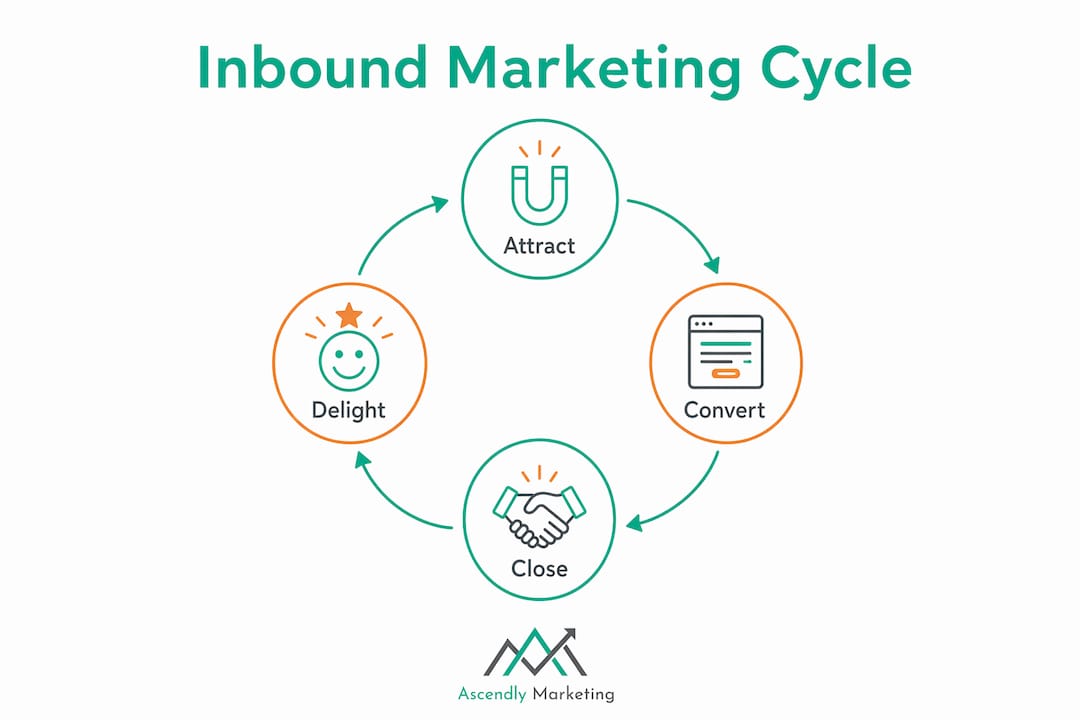
Inbound marketing is defined as a customer-centric strategy that attracts prospects by delivering valuable, relevant content aligned with their needs rather than interrupting them with unsolicited ads. Unlike traditional outbound methods such as cold calls and display advertising, inbound earns attention by solving problems and aligning with the natural buying journey. HubSpot pioneered this methodology, and today it operates through four interconnected stages: attract, convert, close, and delight. For small to medium-sized businesses working with limited budgets, this framework offers a way to build compounding growth through SEO, content marketing, CRM automation, and net promoter score (NPS) tracking rather than paying for every click.
What is inbound marketing and how does it work?
Inbound marketing creates a systematic approach to attract, engage, convert, and retain customers by addressing the real problems they are already searching to solve. It is not a single tactic. It is a connected system where content marketing serves as the engine, but SEO, social media, email automation, and conversion optimization are all working together as the full vehicle.
The four stages operate in sequence and reinforce each other:
- Attract: Draw the right visitors through blog content, SEO-optimized pages, and social media posts that answer questions your audience is already asking. A local accounting firm, for example, might publish a guide on quarterly tax deadlines that ranks on Google and pulls in small business owners at exactly the right moment.
- Convert: Turn anonymous visitors into known leads using calls-to-action (CTAs), dedicated landing pages, and short forms. A well-placed CTA offering a free checklist or consultation converts passive readers into contacts you can follow up with.
- Close: Nurture leads through CRM-integrated email sequences and lead scoring until they are ready to buy. Tools like HubSpot CRM and Salesforce allow you to track behavior, assign scores, and trigger personalized follow-ups automatically.
- Delight: Retain customers and turn them into advocates through surveys, loyalty content, and community building. Tracking NPS after purchase tells you exactly how well this stage is performing.
Pro Tip: Do not treat these stages as a linear funnel you complete once. They form a cycle. A delighted customer shares your content, which attracts new visitors, restarting the loop.
The interconnected nature of these stages means that neglecting one weakens the entire system. Businesses that invest in content but skip conversion architecture, such as landing pages and forms, generate traffic without leads. Traffic without conversion is just an expensive vanity metric.

How does inbound marketing differ from outbound marketing?
The fundamental difference between inbound and outbound marketing lies in who controls the engagement. Outbound marketing interrupts people to buy their attention. Inbound earns attention by meeting people where they already are in their buying journey.
| Factor | Inbound marketing | Outbound marketing |
|---|---|---|
| Engagement type | Permission-based, value-driven | Interruption-based, broadcast |
| Cost model | Compounds over time | Stops when budget stops |
| Lead quality | Higher intent, self-selected | Broader, lower average intent |
| Control | Customer chooses when to engage | Business pushes message |
| Examples | Blog posts, SEO, email nurture | TV ads, cold calls, paid display |
Outbound tactics like paid search ads and sponsored social posts are not the enemy of inbound. They serve a different purpose. Outbound accelerates awareness for product launches or time-sensitive promotions. Inbound builds the sustainable, long-term brand authority that reduces your dependence on paid media over time.
“Combining inbound and outbound marketing yields the highest ROI. Experts stress complementarity rather than choice.” — HubSpot
For SMBs, the practical implication is clear. Use outbound lead generation to fill the top of your funnel quickly while inbound content builds the organic foundation that pays dividends for years. A business that runs Google Ads while simultaneously publishing SEO-optimized blog content is not being inconsistent. It is being strategic.
What are the main benefits of inbound marketing for SMBs?
Inbound marketing produces lower cost per lead, higher quality leads, improved customer retention, better organic traffic and keyword rankings, and shorter sales cycles compared to purely outbound approaches. Each of these outcomes compounds. An article that ranks on page one of Google today continues generating leads next year without additional spend.
The specific benefits that matter most to small and medium-sized businesses include:
- Lower cost per lead: Organic content and SEO require upfront investment but do not charge per click. Once a page ranks, leads arrive at near-zero marginal cost.
- Higher lead quality: Prospects who find you through a search query or educational blog post have already demonstrated intent. They are further along in the buying process before they ever contact you.
- Improved retention: The delight stage of inbound marketing keeps existing customers engaged through relevant content, surveys, and community touchpoints. Retention is cheaper than acquisition in every industry.
- Shorter sales cycles: When leads arrive pre-educated about your product or service, your sales team spends less time on basic explanations and more time closing.
- Measurable outcomes: Inbound marketing success is tracked through conversion rate, NPS, retention rate, cost per lead, and sales cycle length. These metrics connect marketing activity directly to revenue.
For a concrete example, consider a mid-sized HR software company that publishes a weekly blog covering compliance topics. Over 18 months, that content library builds keyword rankings, attracts HR managers searching for answers, and converts them into demo requests. The sales team receives leads who already understand the product category. That is inbound working as designed.
How to implement an inbound marketing strategy
A strong inbound marketing plan integrates audience insight, keyword strategy, conversion architecture, distribution, nurture sequencing, and a measurement framework. Missing any single component produces underperforming results, even when traffic is strong.
Follow this sequence to build your plan:
- Define your buyer personas. Document who your ideal customers are, what problems they face, what questions they ask, and where they spend time online. Personas are not demographic sketches. They are behavioral maps.
- Build your keyword and content strategy. Use tools like Google Search Console, Ahrefs, or Semrush to identify the questions your audience is searching. Map content topics to each stage of the buyer journey.
- Design your conversion architecture. Every piece of content needs a next step. Landing pages, CTAs, and lead capture forms convert readers into contacts. Your website design directly determines how well this layer performs.
- Integrate CRM and marketing automation. Connect your content to a CRM like HubSpot or Zoho so that lead behavior triggers the right follow-up. Marketing automation removes the manual work from nurture sequences and lead scoring.
- Plan your distribution. Publishing content is not enough. Share it through email newsletters, LinkedIn, and relevant online communities. Distribution multiplies the reach of every piece you create.
- Build your nurture sequences. Email drip campaigns move leads from initial interest to purchase-ready over days or weeks. Each email should address a specific objection or question relevant to the buyer’s stage.
- Set measurable goals and review regularly. Define what success looks like before you start. Track organic traffic, conversion rate, cost per lead, and sales cycle length monthly.
Pro Tip: Run a 90-day inbound pilot before committing to a full-scale program. Test your core tactics, monitor your metrics, and use the data to justify scaling. This approach reduces risk and builds internal buy-in.
What are common challenges in inbound marketing?
The most common reason inbound marketing underperforms is not a lack of content. It is poor coordination across content, sales, and social teams combined with content that lacks conversion architecture. Publishing blog posts without CTAs, landing pages, or lead capture is the single most expensive mistake SMBs make.
Other challenges worth preparing for:
- Content quality over quantity: Ten well-researched, SEO-optimized articles outperform fifty thin posts every time. Search engines and readers both reward depth.
- Misaligned sales and marketing teams: Inbound generates leads, but sales must follow up with context. If your CRM does not pass behavioral data to your sales team, warm leads get treated like cold ones.
- Impatience with timelines: Inbound marketing builds compounding returns, but organic rankings take time. Most SMBs see meaningful traction between months three and six.
- Neglecting the delight stage: Most businesses invest heavily in attract and convert, then abandon customers after the sale. Delight-stage tactics like NPS surveys and loyalty content are where long-term revenue lives.
Pro Tip: Audit your existing content before creating anything new. Identify which pages already receive traffic but have no CTA. Adding a single lead capture element to those pages can generate leads from traffic you are already earning.
Key takeaways
Inbound marketing works because it aligns your content and outreach with the exact problems your buyers are already trying to solve, creating a self-reinforcing system of attraction, conversion, and retention.
| Point | Details |
|---|---|
| Four-stage framework | Attract, convert, close, and delight form a cycle, not a one-time funnel. |
| Inbound vs. outbound | Inbound earns attention through value; use both together for maximum ROI. |
| SMB benefits | Lower cost per lead, higher lead quality, and shorter sales cycles compound over time. |
| Implementation sequence | Start with personas and keyword strategy before building content or automation. |
| 90-day pilot | Test core tactics for 90 days before scaling to validate results and build buy-in. |
Why inbound marketing is the best long-term bet for SMBs
After working with small and medium-sized businesses since 2013, Ascendly Marketing has seen one pattern repeat without exception: businesses that invest in inbound marketing consistently outperform those that rely on paid ads alone, but only when they commit to the full system.
The mistake most SMBs make is treating inbound as a content calendar rather than a revenue architecture. They publish articles, see modest traffic, and conclude that inbound does not work. What they actually built was the attract stage without the convert, close, or delight stages attached to it. That is like building a store with no checkout counter.
The businesses that win with inbound are the ones that treat patience as a competitive advantage. While competitors are paying for every click, your organic content library is compounding. A blog post published today can rank for three years. A paid ad disappears the moment you stop funding it.
One more thing worth saying directly: inbound and outbound are not rivals. The SMBs Ascendly Marketing has seen grow fastest use outbound tactics like PPC and social ads to generate immediate pipeline while inbound builds the organic foundation underneath. The combination of both is not a compromise. It is the actual strategy.
— Ascendly Marketing
Ready to build your inbound marketing engine?
Ascendly Marketing has helped SMBs across industries build inbound marketing systems that generate consistent, qualified leads without depending entirely on paid media. From organic SEO services that strengthen your attract stage to social media management that amplifies your content distribution, every service is designed to work as part of a connected inbound system.
If your business is ready to move beyond one-off tactics and build a marketing strategy that compounds over time, Ascendly Marketing offers a free consultation to map out where your biggest opportunities are. Explore our SEO and digital marketing services and see what a structured inbound approach can do for your growth.
FAQ
What is inbound marketing in simple terms?
Inbound marketing is a strategy that attracts customers by creating content and experiences that address their questions and needs, rather than interrupting them with ads. It works through four stages: attract, convert, close, and delight.
How long does inbound marketing take to show results?
Most SMBs see meaningful traction from inbound marketing between months three and six, with organic rankings and lead volume compounding significantly after the first year. A 90-day pilot phase is recommended to validate tactics before scaling.
What are the main inbound marketing tactics?
Core inbound marketing tactics include SEO-optimized blog content, social media publishing, landing pages with CTAs, CRM-integrated email nurture sequences, lead scoring, and post-purchase surveys to measure NPS. These tactics work as a system, not in isolation.
How is inbound marketing different from content marketing?
Content marketing is one component of inbound marketing, specifically the engine that drives the attract stage. Inbound marketing is the full system that includes content creation plus conversion architecture, CRM automation, lead nurturing, and customer retention strategies.
Is inbound marketing right for small businesses?
Inbound marketing is particularly well-suited for small businesses because it produces lower cost per lead and compounds over time without requiring large ongoing ad budgets. Starting with a focused keyword strategy and a single conversion-optimized content track is enough to build early momentum.