

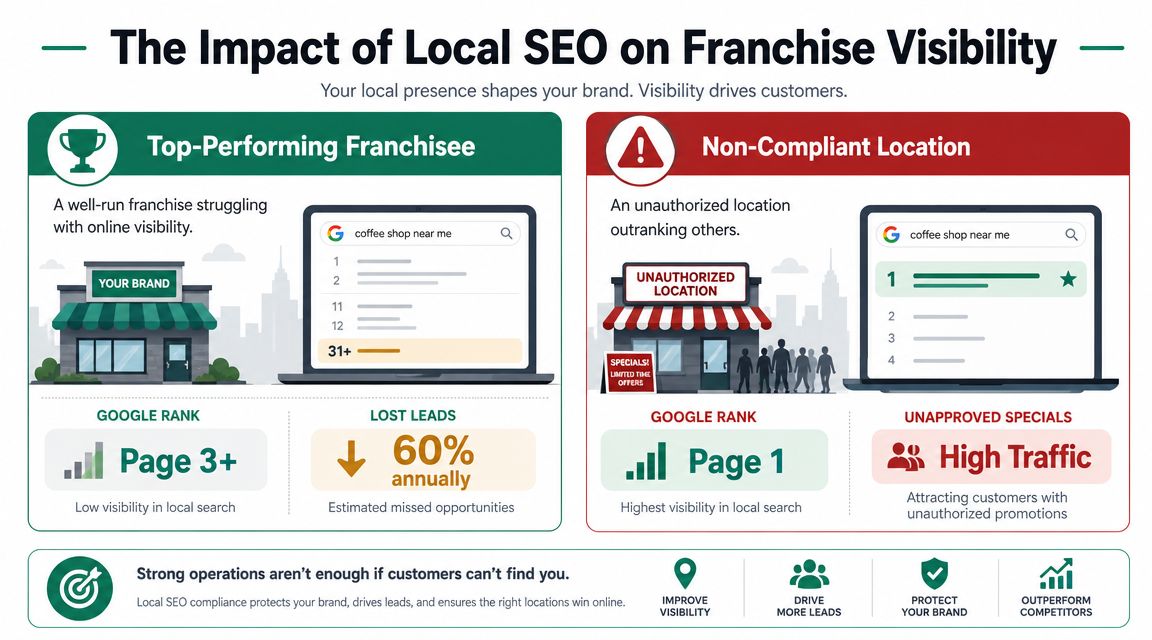
A common franchise problem looks like this. One location follows brand standards, serves customers well, and still sits deep in search results for its own city. Another location ignores the playbook, runs its own offers, uploads off-brand photos, and shows up first in Google Maps.
That gap usually isn’t caused by one tactic. It comes from a weak operating model. The website structure is fragmented, Google Business Profiles are half-managed, location pages repeat the same copy, and no one has clear authority over what local franchisees can publish.
Local SEO for franchises works when corporate controls the foundation and local operators supply the proof that they serve their market. That means one domain, one location page per branch, one process for listings and reviews, and one governance model that people can follow without constant escalation.
Why Your Franchise Needs a Local SEO Strategy Now
A franchise doesn’t compete in one search market. It competes in every city, suburb, and service area where a location operates. If one branch is invisible, that branch doesn’t borrow visibility from the brand. It loses calls, visits, and bookings to a nearby competitor.
The scale of the opportunity is hard to ignore. LocaliQ reports that 46% of Google searches are local, Google handles about 8.5 billion searches per day, and 28% of local searches result in a purchase within 24 hours. For a franchise, that means local search isn’t a side channel. It sits close to purchase intent.
What this looks like in practice
When local SEO for franchises is handled loosely, the same pattern shows up again and again:
- Corporate owns the brand, but not the listings. Location details drift across Google, directories, and the website.
- Franchisees want speed. They publish local updates wherever they can, often outside the system.
- The customer sees confusion. Different phone numbers, different hours, weak reviews, and thin location pages all reduce trust.
The result isn’t abstract. A customer searches for a nearby service, compares the map pack, reads reviews, checks hours, and clicks the business that looks easiest to trust.
Local visibility decides which location gets the next action. Not the next impression. The next action.
Why franchises feel this more than single-location brands
Single-location businesses only need one local presence to be accurate and competitive. A franchise has to repeat that standard across the whole network. One weak location page, one unmanaged profile, or one franchisee going off-script can drag down performance where demand already exists.
That’s why local SEO for franchises belongs near the center of the growth plan. It shapes discovery at the branch level, where revenue is won or lost.
Choosing Your Franchise Governance Model
Before you touch the website or fix a listing, decide who controls the system. Most franchise local SEO failures start with a governance problem, not a keyword problem.
If corporate assumes franchisees will handle local execution, but franchisees assume marketing is managed centrally, nothing gets maintained. If everyone has access, brand drift starts fast. If nobody has access, local pages become lifeless and stale.
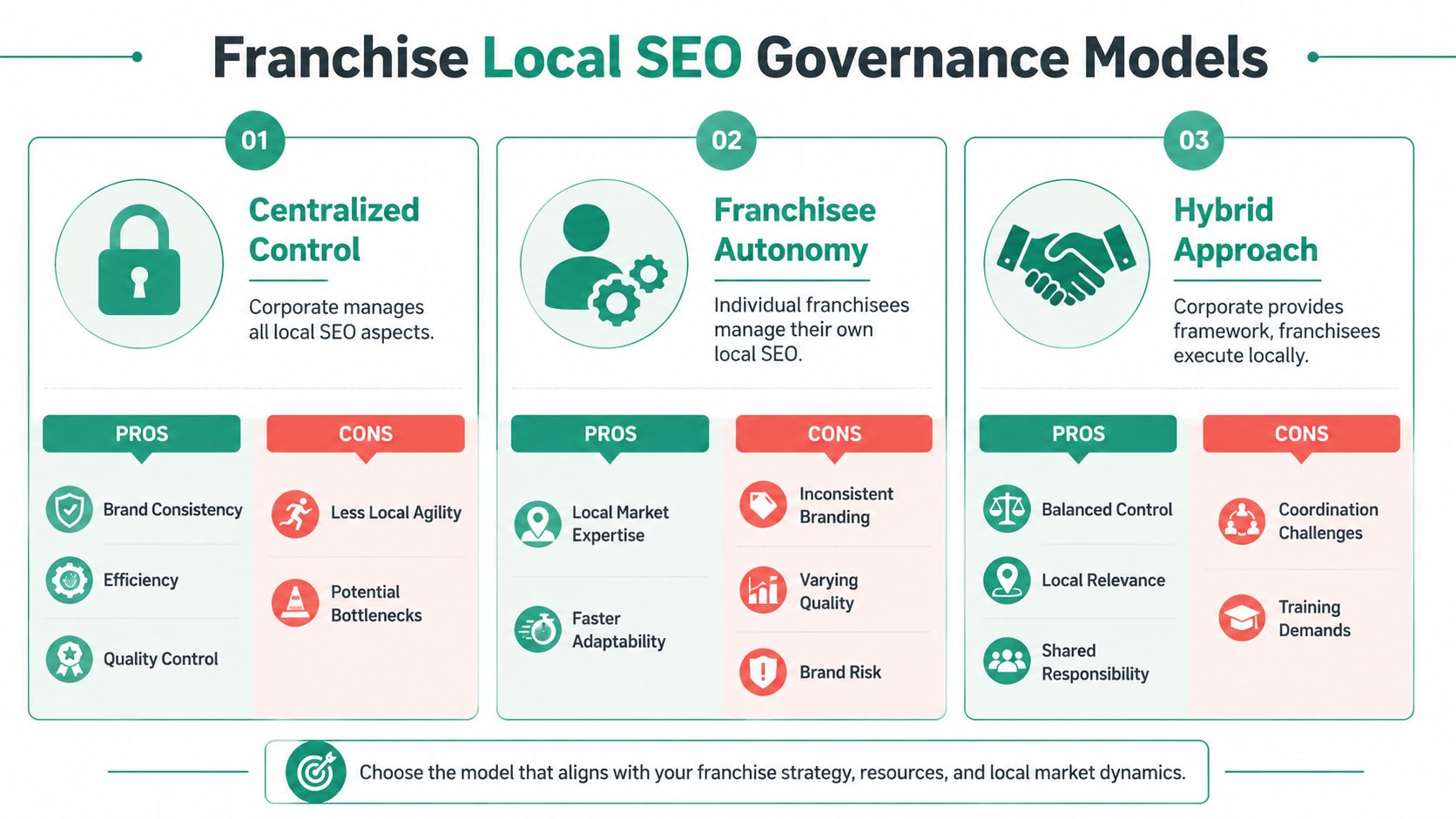
The three models most franchises use
| Model | What corporate controls | What franchisees control | Main trade-off |
|---|---|---|---|
| Centralized | Website, listings, content, reviews, photos | Very little | Strong consistency, slower local response |
| Decentralized | Minimal standards | Most local marketing activity | Faster local action, higher brand risk |
| Hybrid | Technical foundation and standards | Approved local inputs and updates | Better balance, heavier coordination |
Fully centralized control
This model works when the brand has strict compliance requirements or limited trust in local execution. Corporate manages the website, Google Business Profiles, citation cleanup, review response workflows, and local page updates.
The upside is obvious. Brand consistency stays tight. Data quality is easier to audit. Reporting is cleaner.
The downside shows up in local relevance. Corporate teams rarely know which school event a franchise sponsored last weekend, which staff member customers keep mentioning in reviews, or which neighborhood terms locals use themselves.
Fully decentralized control
Some franchise systems let operators handle their own local marketing with minimal oversight. That can create sharper local content because the people on the ground know the market.
It also creates uneven execution. One franchisee updates photos weekly and responds to every review. Another forgets to fix holiday hours. A third hires an outside vendor who creates duplicate pages and off-brand messaging.
Practical rule: If a franchisee can publish anything anywhere without review, the brand will eventually pay for it.
The hybrid model usually holds up better
A hybrid system tends to match how local SEO for franchises operates. Savage Global Marketing describes the recommended direction as centralizing technical architecture and brand standards while creating a system for franchisees to contribute local proof-of-work, because pages with unique local details rank better than templated copy.
That means corporate owns the parts that need control:
- Site architecture
- Templates and content rules
- User access and approvals
- GBP ownership and permissions
- Reporting and QA
Franchisees supply the parts that need proximity:
- Local photos
- Staff updates
- Community involvement
- Offer requests
- Answers to location-specific questions
How to pick the right model
Ask a few blunt questions.
- Do franchisees reliably follow process? If not, don’t decentralize publishing.
- Does corporate have bandwidth to manage every branch? If not, pure centralization will bottleneck.
- Can you review local submissions fast enough? If not, good local content will die in drafts.
- Are digital assets contractually owned by the brand? If not, fix that before scale makes it painful.
The strongest setup usually isn’t the one with the most control. It’s the one with the clearest lanes.
Structuring Your Website for Local Dominance
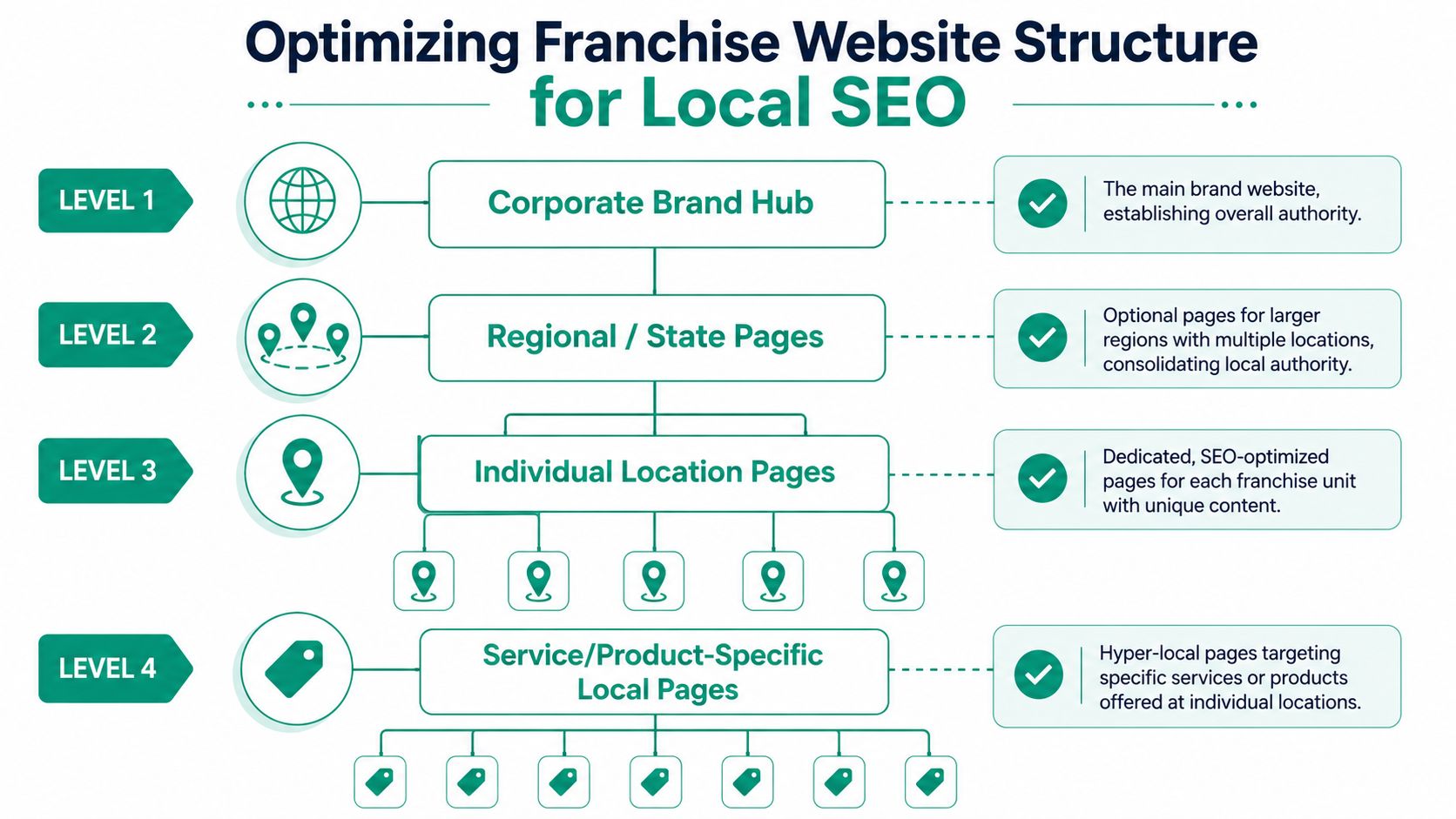
The website is where most franchise systems either simplify local SEO or make it harder than it needs to be. The cleanest setup is one parent domain with a dedicated page for every location.
One domain beats a pile of microsites
Franchises often inherit messy structures. A corporate site lives on one domain, older franchisees have separate microsites, and a few branches run their own domains entirely. That setup spreads authority thin and creates duplicate content problems fast.
A better structure looks like this:
- Brand hub on the main domain
- Location finder that lists all branches
- Individual location pages under the same domain
- Optional local service pages only when there’s enough unique content to justify them
If you’re planning a broader multi-location rollout, this multi-location local SEO framework is the right model to evaluate against your current structure.
What each location page needs
A location page can’t just swap city names into the same template. Search engines can detect reused copy, and customers can too.
Build each page with these elements:
Exact location identity
Use the accurate business name, address, and phone number for that branch.Locally written page elements
Titles, headings, descriptions, and on-page copy should reflect the specific market and location.Operational details
Hours, service area details, parking notes, and appointment information belong here when relevant.Real local proof
Staff introductions, photos from the location, neighborhood references, and local FAQs make the page distinct.Internal links
Link from the homepage, service pages, and the location finder into the branch page.
What doesn’t work
The biggest technical mistake is duplication. Franchises try to scale by reusing one approved paragraph across every market. That saves time and weakens the page.
Another common issue is burying location pages such that users and crawlers barely reach them. If a branch page only exists in an XML sitemap and nowhere else in visible navigation, it won’t pull its weight.
A location page should answer one simple question without friction. Why should someone in this specific area choose this specific branch?
A practical page blueprint
Use a repeatable block structure, but not identical copy:
| Page block | Keep standardized | Keep local |
|---|---|---|
| Header and brand elements | Yes | No |
| NAP and contact details | Format only | Yes |
| Main intro copy | Structure only | Yes |
| Staff and photo modules | No | Yes |
| FAQs | Base questions | Local answers |
| CTAs | Yes | Light local wording |
Local SEO for franchises becomes operational, not theoretical. The architecture stays fixed. The evidence changes by location.
Mastering Google Business Profiles and Citations
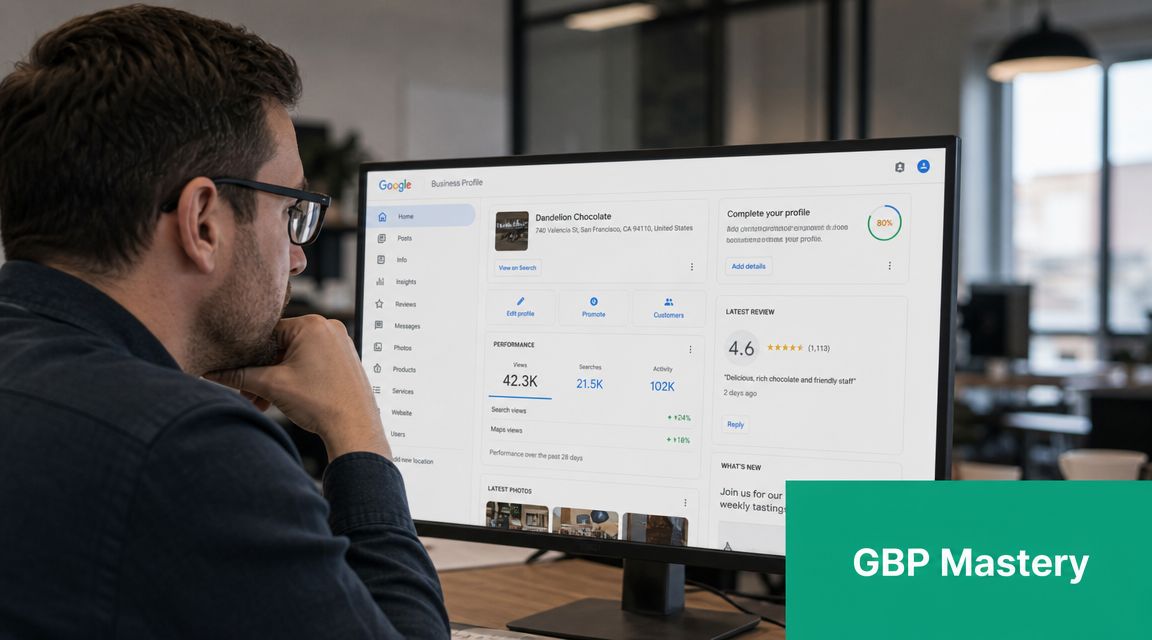
Your website is the foundation you own. Google Business Profile is the storefront many customers see first.
For a franchise network, that makes profile control and citation accuracy a discipline, not a side task.
Set ownership before you optimize
The first question isn’t which photo to upload. It’s who owns the profile.
Corporate should retain primary control of the asset, with location managers or franchisees added through permission layers where appropriate. That reduces the risk of losing access when staff leaves or when a franchise relationship changes.
Then build one standard operating process:
- Claim or verify every branch
- Match NAP exactly to the website
- Standardize hours and categories
- Create a review and update cadence
- Document who can request edits
If you need a reference point for map visibility work, this guide on ranking higher on Google Maps covers the core profile signals that support local performance.
Clean the citation layer
Franchise systems often carry years of listing errors. Old suite numbers, tracking phone numbers, duplicate profiles, and inconsistent abbreviations all pile up.
A practical cleanup process usually follows this order:
Start with the website
Confirm the canonical NAP for each location.Fix Google Business Profile next
The branch page and GBP should agree without exceptions.Audit major directories
Correct mismatches and remove duplicates.Log every change
A shared spreadsheet or listings platform keeps teams from reintroducing errors later.
One wrong phone number doesn’t stay one wrong phone number. It spreads through aggregators, local apps, and old citations.
A centralized listings tool can help at scale. Some systems also use agency support or a managed local SEO service such as Ascendly Marketing’s local SEO and Google Business Profile optimization offering when internal teams don’t have enough bandwidth.
Keep profiles active without losing control
A complete profile isn’t a finished profile. Locations need fresh photos, updated hours, and localized descriptions that reflect the branch rather than the franchise in general.
Use a submission workflow. Franchisees upload photos, holiday hour changes, or local updates into one form. Corporate or a designated local marketing team reviews and publishes them.
A short walkthrough can help teams see what “good” looks like:
That process keeps local signals moving without turning each listing into a free-for-all.
Building a System for Reviews and Reputation
A franchise can have clean listings, solid location pages, and still lose the click because the review profile looks weak. Customers compare branches at the location level, not just the brand level.
BrightLocal reports that 42% of consumers regularly check reviews, 81% use Google as their primary review site, and 37% expect at least four stars before they’ll consider a business. For franchise systems, that turns reviews into a local operating metric, not a marketing extra.
Reviews need a system, not reminders
Telling franchisees to “ask for reviews” usually produces uneven results. One location asks consistently. Another forgets. A third only asks after unusually happy interactions.
A workable review system has four parts:
Prompt timing
Ask soon after the transaction or service interaction, while the experience is still fresh.Clear ownership
Assign responsibility at the branch level. If everyone owns it, no one owns it.Central monitoring
Corporate should still see review flow, sentiment, and response gaps across all locations.Response rules
Give staff approved language for praise, complaints, and escalation cases.
If you need practical ideas for increasing review volume without turning the process into spam, these Google review strategies are useful to adapt into a franchise workflow.
What strong review operations look like
Good review management doesn’t sound robotic. It sounds specific. A positive response should mention the visit, product, or staff interaction if the reviewer gave those details. A negative response should acknowledge the issue and move resolution offline when needed.
Use templates as guardrails, not scripts.
| Review type | Bad response | Better response pattern |
|---|---|---|
| Positive | “Thanks for your feedback” | Thank them, mention the location, reference the visit |
| Negative | “Call corporate” | Acknowledge issue, apologize when appropriate, offer a direct next step |
| Mixed | “We appreciate your input” | Address both the compliment and the complaint |
A four-star threshold changes behavior before a customer ever reaches your site.
Keep brand protection built into the process
Corporate should define what can’t happen in responses. No arguments. No defensive language. No disclosure of private details. No invented explanations.
Franchisees can still sound local and human within those boundaries. That’s the balance local SEO for franchises needs across every public touchpoint.
Activating Local Content Across Your Network
Most franchise content programs fail for one of two reasons. Corporate writes everything, so every page sounds generic. Or franchisees publish whatever they want, so the brand voice breaks apart.
A better model uses controlled inputs. Corporate creates the templates, review process, and publishing standards. Franchisees supply the raw material from the field.
A workflow that actually gets used
Consider a simple example. A franchisor creates a “Community Spotlight” form with a few required fields: event name, date, summary, photo upload, and the staff member involved. A franchisee submits photos from a school fundraiser. Corporate reviews the copy, checks the branding, adds on-page optimization, and publishes the update on that location page.
That process works because it asks franchisees for facts, not polished marketing copy.
Content types that scale well
These formats usually hold up across a network:
- Meet the team with short bios and location photos
- Community updates tied to local events or sponsorships
- Location FAQs based on real customer questions
- Service-area notes that explain where the branch commonly works or delivers
- Local testimonials or review highlights when usage rights and policy allow
One thing doesn’t belong here. Thin “city swap” pages built from the same paragraph. Those create maintenance work without adding real local value.
Corporate should edit for quality. Franchisees should supply the evidence.
The strongest local SEO for franchises content doesn’t try to sound hyper-optimized. It proves the branch exists, operates actively, and belongs in the local market.
Measuring Performance and Reporting for Growth
Franchise reporting gets noisy when teams track everything. A useful local SEO dashboard should help two groups make decisions: corporate and the local operator.
Corporate needs to see system health across locations. Franchisees need to see whether their branch is becoming easier to find and contact.
Metrics that deserve space on the dashboard
Start with branch-level visibility and action metrics tied to actual discovery:
- Local pack rankings by location
- Organic traffic to each location page
- Calls, direction requests, and website clicks from GBP
- Review volume and response coverage
- Landing page engagement by branch
- Citation accuracy status
- Open issues such as duplicate listings or missing content
Don’t overload franchisees with channel jargon. A branch operator doesn’t need twenty charts. They need a short report that answers three questions. Are we visible? Are customers taking action? What do you need from us this month?
Build two report views
| Audience | Primary need | Best reporting format |
|---|---|---|
| Corporate marketing | Compare locations, spot system issues | Network dashboard with filters |
| Franchisee | Understand local progress and tasks | Branch scorecard with actions |
| Leadership | Budget and accountability | Summary view with exceptions and trends |
Use reports to drive action
A reporting system should trigger tasks, not just archive numbers. If one location has strong rankings but poor review flow, the next step belongs in the report. If another branch has a polished profile but low location-page traffic, the content and internal linking may need work.
Good reporting also exposes the governance model in real life. If local tasks stay open for months, the workflow is too loose or too hard to follow. If every small edit requires corporate intervention, the system is too centralized.
Frequently Asked Questions about Franchise SEO
Who should own the Google Business Profile listing
Corporate should hold primary ownership whenever possible. Franchisees and managers can be given appropriate access, but the brand needs continuity if staff changes, agencies are replaced, or a location leaves the system. Shared access works. Scattered ownership doesn’t.
What happens to digital assets when a franchisee exits
That answer should be set before the problem appears. The franchise agreement and internal process should define control of the location page, profile access, phone numbers used in listings, directory accounts, and review management tools. If ownership is vague, transitions turn messy fast.
Can a franchisee hire their own SEO agency?
Yes, but only within a defined policy. Local operators may need help gathering reviews, submitting local content, or improving branch-level execution. They shouldn’t be free to launch separate domains, rewrite brand messaging, or alter structured assets that affect the network. Give outside vendors a lane, not the whole map.
How should budgets be split between corporate and local
Split the budget by responsibility. Corporate usually funds the platform pieces that benefit the network, such as website architecture, templates, listings governance, reporting, and system-wide tools. Local budgets often cover branch photography, community content collection, and approved market-level support. The exact split depends on the franchise model, but the principle stays the same. Pay centrally for shared infrastructure. Pay locally for local inputs.
Should every location get its own page even if two branches are close together?
Yes. Each branch is a separate operating unit with its own NAP data, reviews, staff, and service reality. Merging nearby locations into one page usually creates confusion for users and weakens branch-level relevance.
How much control should franchisees have over local content
Enough to provide useful local detail. Not enough to break the brand. The practical middle ground is a submission model. Franchisees send photos, event notes, local FAQs, and staff updates. Corporate or an approved marketing team reviews, edits, and publishes.
What should happen if a franchisee changes hours, phone numbers, or address details
There should be one update path. The local operator submits the change through a standard form or ticket. The central team updates the website, Google Business Profile, and citations in the right order. Random direct edits by multiple people usually create mismatches.
What if one location refuses to participate
Then the report should show the cost clearly. Missing photos, stale hours, weak reviews, and thin page content tend to map directly to weaker local visibility. Franchise SEO gets easier when participation is tied to simple responsibilities that operators can complete.
Ascendly Marketing helps franchisors and multi-location businesses manage local SEO systems that include location page strategy, Google Business Profile optimization, and reporting workflows. If you need a partner to tighten governance while keeping local execution practical, you can review their services at Ascendly Marketing.