

TL;DR:
- Targeted advertising delivers personalized messages to specific audiences, significantly increasing conversion rates and ROI for SMBs. It relies on first-party data and machine learning to optimize delivery, reducing costs and building customer loyalty through personalization. Continuous testing, audience refinement, and creative alignment are essential for maximizing its long-term effectiveness.
Targeted advertising is the practice of delivering personalized promotional messages to specific audience segments selected by data signals such as demographics, behavior, purchase history, and location. For small and medium-sized businesses, the reasons for using targeted advertising come down to one core reality: every dollar spent on a broad audience that will never buy from you is a dollar wasted. Platforms like Google Ads and Facebook Ads give SMBs access to the same precision tools that Fortune 500 companies use, and the performance gap between targeted and non-targeted campaigns is not marginal. Targeted campaigns can deliver conversion rates up to 2x higher than broad-reach approaches, with retargeting efforts reaching 4.2x higher return on ad spend. That is the difference between a campaign that breaks even and one that funds your next quarter.
Why use targeted advertising: The core benefits for SMBs
Targeted advertising, also called audience-based advertising or precision marketing in industry practice, gives SMBs a structural advantage that traditional broadcast advertising never could. The benefits are measurable, repeatable, and directly tied to revenue.
Higher conversion rates and stronger ROI
The most direct advantage is conversion performance. Advertisers using data-driven segmentation report a 150% lift in conversions over broad marketing, and personalized campaigns produce transaction rates six times higher than generic versions. For an SMB with a limited budget, that multiplier is the difference between a campaign that generates leads and one that generates growth.
Lower cost per acquisition and cost per click
Precision targeting reduces waste at the budget level. Companies that shift from broad-match to audience-targeted campaigns achieve CPA reductions of 30 to 60% and cut cost per click by approximately 50%. That means you are not just getting better results. You are spending less to get them.

Personalization that builds loyalty
84% of customers say they want to be treated as individuals rather than numbers, and brands that deliver personalized experiences see 78% higher consumer recommendation rates. Recommendations are free acquisition. When your ads speak directly to a customer’s need at the right moment, you are not just closing a sale. You are creating an advocate.
Competing on equal footing with larger brands
SMBs that use tailored advertising are 16 times more likely to report sales growth compared to those that do not. Precision targeting lets a regional business with a $5,000 monthly ad budget outperform a national competitor spending ten times more on untargeted placements.
| Feature | Targeted advertising | Non-targeted advertising |
|---|---|---|
| Audience reach | Specific, data-defined segments | Broad, undifferentiated mass |
| Conversion rate | Up to 2x to 6x higher | Baseline performance |
| Cost per acquisition | 30 to 60% lower | Higher due to wasted impressions |
| Personalization level | High, matched to intent | Low, generic messaging |
| ROI tracking | Precise, platform-level data | Difficult to attribute |
Pro Tip: Start with your existing customer list. Upload it to Google Ads or Facebook Ads as a custom audience, then use lookalike modeling to find new prospects who share the same behavioral profile. This single step often cuts your cost per lead in half before you change a single ad creative.
How does targeted advertising work?
Targeted advertising works by collecting and processing data signals, grouping users into segments, and then serving ads matched to each segment’s profile and intent. The mechanism is more specific than most SMB owners realize.
The primary data sources feeding these systems include:
- Demographic data: Age, gender, income bracket, education level, and job title collected from platform profiles and third-party data providers.
- Behavioral data: Pages visited, content consumed, products viewed, and time spent on site, tracked via cookies, pixels, and app events.
- Purchase history: Past transactions used to predict future buying behavior and identify high-value customer profiles.
- Location data: Geographic signals from IP addresses and mobile GPS used for local targeting and proximity-based campaigns.
- Intent signals: Search queries on Google, keyword behavior, and in-market audience classifications that indicate active purchase consideration.
Once data is collected, platforms like Google Ads and Facebook Ads use machine learning to optimize delivery in real time. The algorithm learns which users within your target segment are most likely to convert and shifts budget toward them automatically. Successful targeting campaigns require avoiding early over-segmentation so the algorithm has enough data to learn effectively. Starting too narrow starves the machine learning model and produces unreliable results.
First-party data is now the most valuable targeting asset an SMB can own, particularly as third-party cookies continue to phase out across browsers. Your CRM data, email subscriber lists, and website pixel data are signals no competitor can replicate. Feeding that data into your ad platforms creates a targeting advantage that compounds over time.
Pro Tip: Do not launch with ten tightly defined audience segments on day one. Start with two or three broader segments, let the platform optimize for two to three weeks, then narrow based on actual performance data. This approach gives the algorithm room to work and produces more reliable signals for future segmentation.
How does targeted advertising compare to broad marketing?
The performance gap between targeted and non-targeted campaigns is not a matter of opinion. It is documented across industries and campaign types.
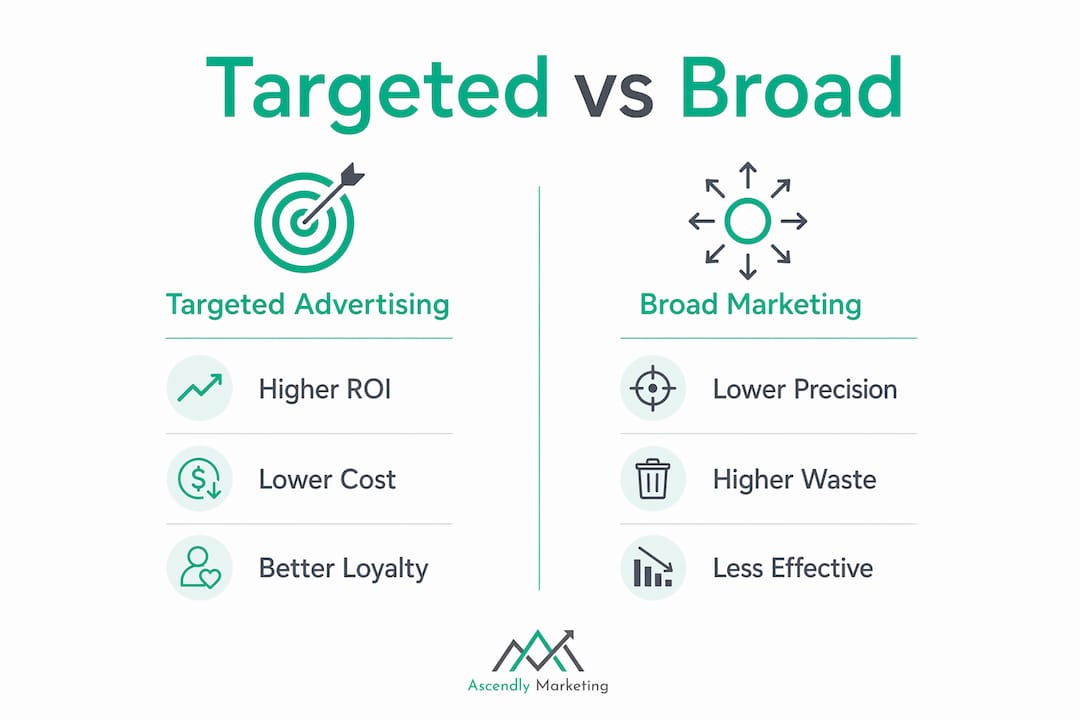
Behavioral retargeting campaigns, which serve ads to users who have already visited your site or engaged with your content, consistently outperform cold prospecting campaigns. Retargeting alone can lift ROAS to 4.2x or higher by focusing budget on high-intent audiences who are already familiar with your brand. A user who visited your pricing page three times in the past week is not the same as a stranger who has never heard of you. Treating them the same way is a budget error.
The consumer preference data reinforces this. Personalized ads are not just more effective. They are actively preferred. When ads match a user’s demonstrated interests and current needs, they stop feeling like interruptions and start feeling like useful information. That shift in perception directly affects click-through rates, time on site, and purchase probability.
Long-term customer lifetime value also improves with targeted advertising. When you acquire customers through precision targeting, you are selecting for fit. Customers who found you because your ad matched their specific need tend to have higher repeat purchase rates and lower churn than customers acquired through broad awareness campaigns. The shift from demographic labels to intent-based signals is what separates campaigns that build lasting customer relationships from those that generate one-time transactions.
One metric that broad marketing cannot replicate is attribution clarity. With targeted campaigns running on Google Ads or Facebook Ads, you know exactly which audience segment, creative variant, and placement drove each conversion. That data feeds your next campaign and makes every subsequent dollar more efficient. Broad campaigns produce impressions. Targeted campaigns produce intelligence.
Pro Tip: Run a 30-day split test with identical budgets: one broad audience campaign and one targeted audience campaign using your first-party data. The results will give you a concrete ROI comparison specific to your business, which is far more persuasive than industry averages when making the case for budget reallocation.
Practical strategies for SMBs to implement targeted advertising
Knowing why targeted advertising works is only half the equation. Here is how to put it into practice without wasting months on trial and error.
Define your audience before you define your budget. Build two or three detailed customer personas based on your best existing customers. Include job title or life stage, primary pain point, preferred content format, and typical purchase trigger. These personas become the foundation for every targeting decision you make.
Leverage first-party data from day one. Upload your email list and customer database to Google Ads and Facebook Ads as custom audiences. This gives you a targeting baseline that is grounded in real purchase behavior rather than platform assumptions.
Match creative to audience intent and journey stage. Diverse creative libraries yield 2x to 3x conversion rate lifts compared to single-creative campaigns. A user in the awareness stage needs educational content. A user who abandoned your checkout needs a direct offer. Serving the same ad to both is a creative mismatch that kills performance.
Integrate CRM data with your ad platforms. Targeting based on CRM intent data outperforms generic interest-based targeting, particularly in B2B contexts. Syncing your CRM with Google Ads or Facebook Ads lets you suppress existing customers from acquisition campaigns and prioritize high-value prospects.
Monitor, test, and optimize on a weekly cadence. Review your cost per conversion, click-through rate, and ROAS every week. Pause underperforming ad sets, scale what works, and test one new variable at a time. Consistent iteration is what separates campaigns that plateau from those that compound. For a structured approach to improving these numbers, the conversion rate optimization strategies outlined by Ascendly Marketing provide a practical framework for SMBs.
Respect privacy and build trust. Be transparent about data use. Use consent-based data collection, honor opt-outs, and avoid hyper-personalization that feels intrusive. Customers who trust your brand convert at higher rates and stay longer.
Key takeaways
Targeted advertising outperforms broad marketing because it matches the right message to the right person at the right moment, reducing waste and increasing conversion rates across every stage of the customer journey.
| Point | Details |
|---|---|
| Conversion rate advantage | Targeted campaigns deliver up to 6x higher transaction rates than generic advertising. |
| Cost efficiency | Precision targeting cuts cost per acquisition by 30 to 60% compared to broad-match campaigns. |
| Personalization drives loyalty | 84% of customers prefer personalized experiences, and brands that deliver them see 78% higher recommendation rates. |
| First-party data is your edge | CRM and pixel data outperform platform interest categories and become more valuable as third-party cookies disappear. |
| Creative quality determines results | Diverse, intent-matched creative libraries produce 2x to 3x conversion lifts independent of targeting precision. |
What we have learned running targeted campaigns since 2013
The biggest mistake I see SMB owners make is treating targeted advertising as a set-and-forget system. They spend two weeks building the perfect audience, launch the campaign, and then check back in a month expecting results. The algorithm needs feedback. The creative needs iteration. The audience definition needs refinement based on what the data actually shows, not what you assumed at the start.
The second mistake is over-investing in audience precision while under-investing in creative quality. I have watched campaigns with textbook targeting fail because the ad itself was generic. High-quality targeted interactions matter more than sheer volume of impressions. A smaller, highly relevant audience seeing a compelling, intent-matched ad will always outperform a large audience seeing a forgettable one.
The privacy conversation is also shifting faster than most SMBs realize. The businesses that are building first-party data assets right now, through email capture, loyalty programs, and CRM integration, will have a structural targeting advantage in three years that no ad platform can replicate. Start collecting that data today, even if you are not ready to use it at full scale.
The SMBs I have seen grow fastest with targeted advertising share one trait: they treat every campaign as a data collection exercise, not just a revenue event. Each campaign teaches them something about their customer that makes the next campaign cheaper and more effective. That compounding effect is the real reason to use targeted advertising.
— Ascendly
Ready to put targeted advertising to work for your business?
Ascendly Marketing has been building precision advertising campaigns for SMBs since 2013, and the results are documented in real case studies, not hypothetical projections. Whether you are starting from zero or looking to improve an underperforming campaign, the team at Ascendly Marketing builds strategies grounded in your actual customer data and business goals.
From PPC campaign management to full-scale digital marketing services, Ascendly Marketing delivers targeted advertising strategies built specifically for SMB growth. Every campaign is tracked, reported, and optimized on a regular cadence so you always know what your ad spend is producing. If you are ready to stop guessing and start converting, explore what Ascendly Marketing offers and book a consultation with the team.
FAQ
What is targeted advertising?
Targeted advertising is the practice of delivering ads to specific audience segments selected by data signals such as demographics, behavior, location, and purchase intent. It is the standard approach used on platforms like Google Ads and Facebook Ads to improve relevance and reduce wasted ad spend.
How much can targeted advertising improve conversion rates?
Targeted campaigns can deliver conversion rates up to 2x higher than broad campaigns, with retargeting efforts achieving up to 4.2x higher return on ad spend by focusing on high-intent audiences.
Why should SMBs use targeted advertising instead of broad campaigns?
SMBs that use tailored advertising are 16 times more likely to report sales growth than those that do not, and they achieve CPA reductions of 30 to 60% compared to broad-match campaigns. The cost efficiency and precision make targeted advertising the most practical growth channel for businesses with limited budgets.
What data does targeted advertising use?
Targeted advertising uses demographic data, behavioral signals, purchase history, location data, and intent signals such as search queries and in-market audience classifications. First-party data from your CRM and website pixel is the most valuable input because it reflects your actual customers.
How do I start with targeted advertising as an SMB?
Upload your existing customer list to Google Ads or Facebook Ads as a custom audience, build two or three audience segments based on your best customers, and launch with intent-matched creative for each segment. Review performance weekly and optimize based on cost per conversion and ROAS before expanding your budget.