

You publish a blog post. A few visits show up in analytics. Maybe a handful of people stay on the page. Then nothing happens. No calls. No demo requests. No qualified leads.
That pattern usually doesn’t mean content is broken. It means the plan behind the content is missing.
At Ascendly Marketing, this is the split we see all the time. One business treats content like a checklist item. Another treats it like a search and revenue system. Both publish. Only one builds assets that support sales.
Moving Beyond Random Acts of Content

Most disappointing content programs have the same problem. They produce articles without a defined job for each article. One post targets a broad keyword. Another answers a common question. A third was written because someone on the team had an idea on Friday afternoon. The site grows, but authority doesn’t.
A real content marketing SEO strategy fixes that by assigning a purpose to every piece. One page attracts first-touch searchers. Another helps buyers compare options. Another supports a service page that closes leads. Once content has a role, measurement gets easier and weak pages become easier to improve or remove.
Publishing isn’t the strategy
Content has become standard practice. A 2026 content marketing roundup reported that 95% of marketers incorporate content into their strategies, 67.3% use digital PR to earn links and mentions, and 93.8% prioritize links from authoritative sites over weaker ones. That tells you two things fast. Almost everyone publishes. Fewer teams build content that earns trust signals.
Practical rule: If a page can’t support rankings, links, leads, or sales conversations, it probably shouldn’t be on the roadmap.
A common difficulty for many business owners is this: they assume they need more posts. In most cases, they need fewer posts with better targeting, stronger structure, and a clearer path to conversion.
What useful content looks like in practice
Useful content isn’t just “educational.” It lines up with a real business objective.
A practical content plan usually includes a mix like this:
- Demand capture pages that answer high-intent searches tied to your services or products
- Trust-building articles that show how you think, how you solve problems, and what buyers should look for
- Linkable assets that other sites may reference, which helps strengthen authority
- Conversion support content that handles objections your sales team hears every week
If your current blog feels busy but revenue hasn’t moved, ask a simple question. Which pages are supposed to create buying momentum?
That question changes the whole program. It moves content from expense to asset. It also forces better editorial decisions. You stop chasing topics that bring the wrong audience, and you start building a library that supports discovery, evaluation, and conversion.
Laying the Strategic Foundation
A content program usually fails before writing starts. The issue isn’t the draft. The issue is that nobody defined the audience, the search environment, or the terms worth pursuing.
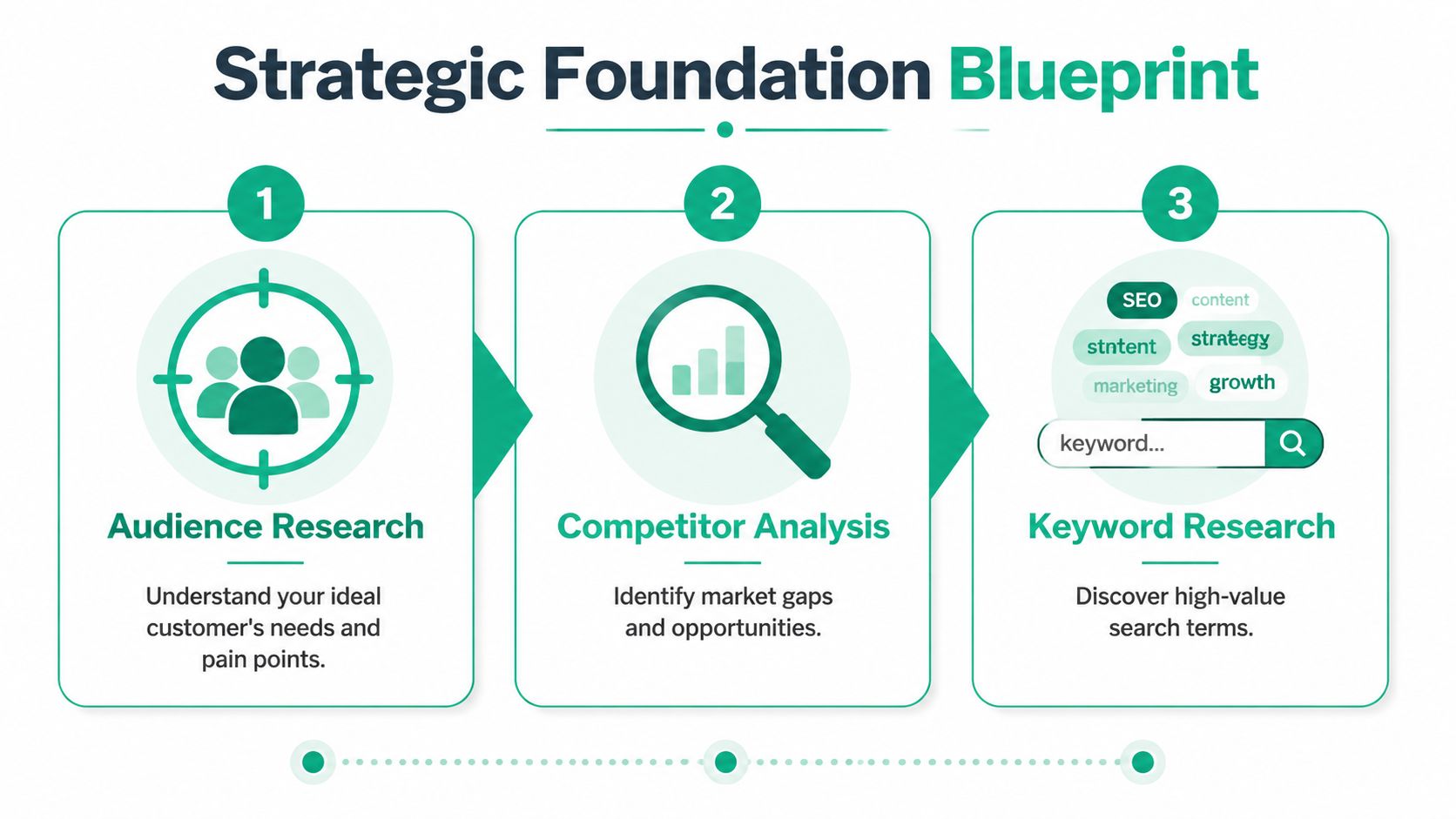
Strong planning starts with three inputs. Audience reality. Competitive context. Search intent.
Start with audience behavior
Don’t build this around fictional personas with vague labels like “operations manager, age 42.” Build it around language buyers use.
List the questions prospects ask on calls. Pull common phrases from emails, sales notes, chat logs, and proposal objections. Look for repeated concerns such as pricing, implementation, timelines, risk, or fit. Those are content inputs.
Then sort those questions by intent:
| Search situation | What the prospect wants | What you should publish |
|---|---|---|
| Early research | Basic understanding | Definitions, frameworks, how-it-works pages |
| Vendor evaluation | Comparison and confidence | Service pages, comparison content, process pages |
| Decision stage | Proof and next step | Case-oriented pages, FAQs, conversion pages |
When teams need a simple workflow to organize topics, outlines, and priorities, a content marketing plan template from Ascendly Marketing can help structure the calendar around goals instead of guesses.
Review competitors for gaps, not inspiration
Competitor research gets misused all the time. People open three rival blogs, copy the categories, and call that strategy. That only produces a late, weaker version of what already exists.
A better review asks sharper questions:
- Where are they thin on depth, examples, or clarity?
- Which buyer questions are missing from their content library?
- What do they rank for that doesn’t match your business model, meaning you should ignore it?
- Which topics look crowded enough that a different angle would be smarter?
Competitor content should tell you where the market is underserved, not where to imitate the loudest publisher.
A broader SEO overview from CRO Benchmark reported that organic search accounts for 53.3% of all website traffic, and in a survey of 140+ companies, the most-used SEO tactics were on-page SEO (91.60%), keyword research (87.39%), and internal linking (87.39%). That lines up with what works in practice. The basic research layer isn’t optional because search is still where much of the demand begins.
Before you map your own editorial calendar, it also helps to see how other teams plan captivating content across channels so your SEO topics don’t live in isolation from email, social, and distribution.
Later in the process, a short walkthrough can help your team align around the workflow and priorities.
Choose keywords by value, not vanity
Keyword research gets distorted when teams chase volume first. A term can have search demand and still be a bad target for your business.
Use four filters together:
Relevance
If the query doesn’t connect to your offer, the traffic won’t matter.Intent
Some searches signal casual learning. Others signal active buying. Treat them differently.Competition
A smaller, better-matched topic often produces more pipeline value than a broad term you won’t realistically win.Commercial fit
Ask whether ranking for the term can support a service page, a lead magnet, a sales conversation, or a product page.
That combination gives you a keyword plan with business logic behind it. Not a spreadsheet full of terms that look impressive and convert poorly.
Designing Your Content Architecture
A site full of disconnected articles rarely builds much authority. Search engines and visitors both need structure. That’s where the topic cluster model earns its place.
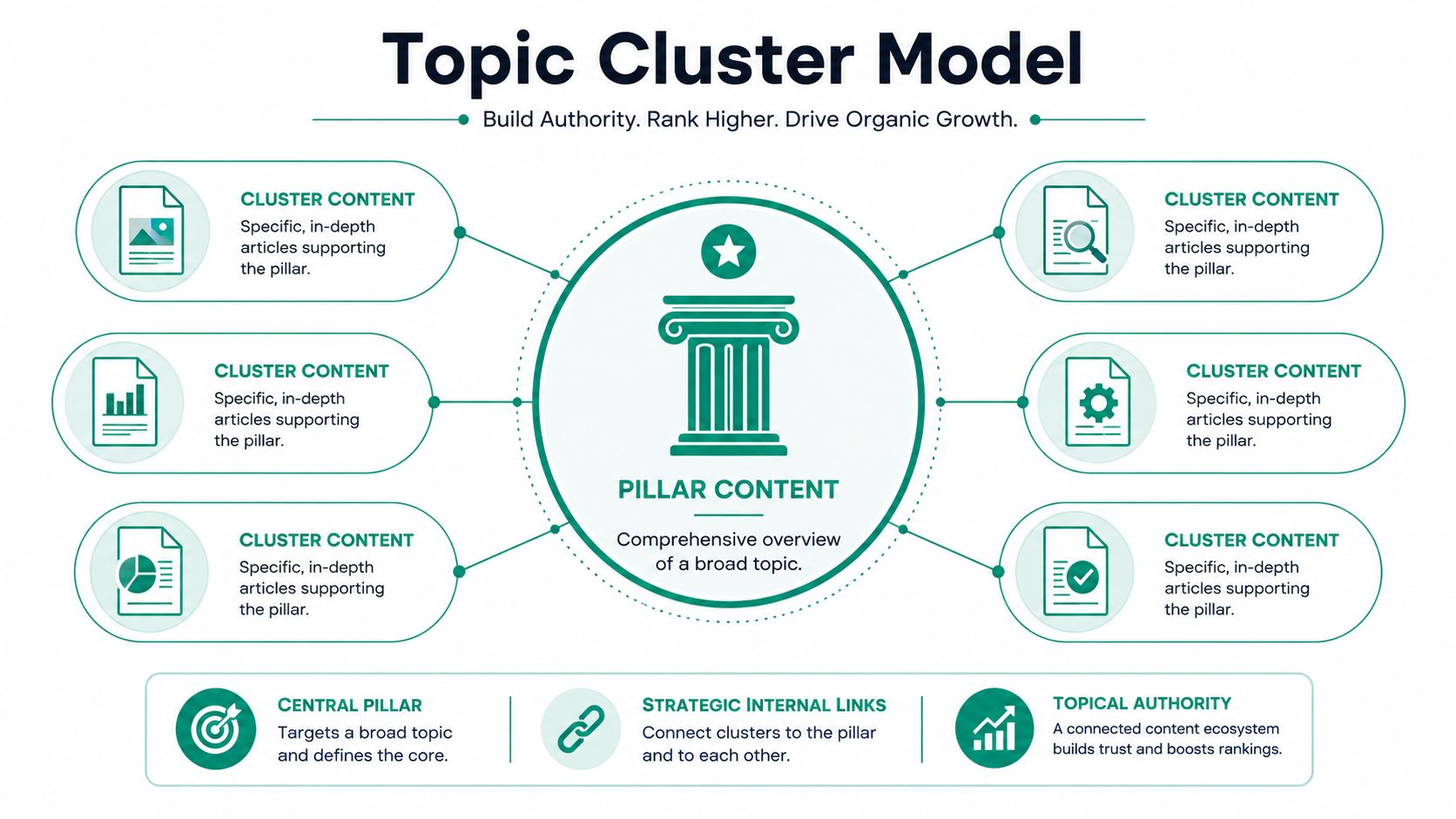
The idea is simple. You create one broad page on a core topic, then support it with narrower pages that answer related questions. Those pages link back to the main page and to each other where it makes sense.
Why clusters outperform scattered posts
A Siteimprove guide to SEO content strategy describes a technically sound strategy as a topic-cluster system built around a primary pillar page and supporting sub-articles connected with internal links. That structure helps authority accumulate around one subject instead of being spread across isolated pages.
In practice, this changes how a site grows. Instead of adding random URLs month after month, you build depth around the topics tied to your offers. That makes editorial planning cleaner, internal linking easier, and performance analysis more useful.
A simple B2B example
Say you run a B2B lead generation service. One pillar page might target a broad commercial topic such as lead generation strategy. Around that pillar, you could build cluster pages like these:
- Qualification content focused on how sales teams define strong leads
- Channel-specific pages on cold email, paid search, SEO, or referral programs
- Process content covering lead scoring, handoff, and follow-up
- Decision content answering pricing, timeline, or fit questions
Each page has a clear role. The pillar offers the wide-angle overview. The cluster pages handle specific intents in more depth.
A keyword selection process also gets easier when structure comes first. If you’re mapping clusters and need support deciding which phrases belong on which page, this guide on how to choose keywords for search engine optimization fits well into the planning stage.
How to build the architecture without overcomplicating it
Teams often make one of two mistakes. They either create one giant page that tries to answer everything, or they split a topic into so many fragments that the site becomes thin and repetitive.
Use this decision frame:
| Content type | Best use | Common mistake |
|---|---|---|
| Pillar page | Broad topic with multiple related subtopics | Making it too shallow |
| Cluster article | Specific question or intent | Targeting nearly identical keywords across several pages |
| Service page | Conversion-focused offer page | Writing it like a blog post instead of a sales asset |
A cluster works when each page has a distinct intent and a clear relationship to the rest of the topic.
This model also helps with updates. If one cluster page underperforms, you can improve it without rebuilding the whole strategy. If one pillar starts gaining traction, you know exactly which supporting topics deserve expansion.
Creating and Optimizing High-Performance Content
Good writing alone doesn’t carry search performance. A useful article with weak structure, poor metadata, and no internal links often gets buried. On the other side, a page that’s technically tidy but thin on substance won’t hold rankings or earn trust.
The better position is to treat creation and optimization as one job.
Build pages for readers first, then sharpen the signals
The American Marketing Association overview of SEO marketing notes that high-performing content is unique, helpful, and well organized. It also points to familiar failure points: weak internal linking, thin content, poor readability, and missed technical basics such as mobile-friendliness and site speed.
That matches what shows up in audits. Underperforming content usually isn’t failing because of one dramatic issue. It fails because several ordinary details were ignored at the same time.
A strong page typically needs:
- A clear title that matches the searcher’s problem and sets expectations fast
- A useful opening that confirms the page will answer the query
- Heading structure that breaks the page into logical sections
- Internal links to related resources, service pages, and supporting articles
- Images that load efficiently and reinforce the topic rather than decorate it
- Readable formatting with short paragraphs, lists, and direct language
If your team needs a writing process that covers both clarity and search performance, this guide on how to write SEO content that drives growth is a practical reference.
What doesn’t work anymore
A lot of weak SEO content still follows an outdated formula. Hit the keyword a set number of times. Stretch the article to an arbitrary word count. Add generic subheads. Publish and move on.
That approach creates pages that feel assembled instead of written.
The page should satisfy the query completely enough that the reader doesn’t need to keep searching for the same answer.
Here are the common misses that drag performance down:
Thin intent match
The page discusses the topic broadly, but doesn’t answer what the searcher wanted.Weak readability
Dense paragraphs, vague language, and buried answers increase friction.Missing metadata discipline
Titles and descriptions don’t frame the value of the click.Broken linking logic
The article exists alone, with no paths to related content or conversion pages.
Use a checklist before publishing
This doesn’t need to be complicated. A short pre-publish review catches most issues.
- Does the page match one specific search intent?
- Does the introduction answer the core question quickly?
- Are the headings useful on their own?
- Are internal links supporting both discovery and conversion?
- Does the page load well and read cleanly on mobile?
- Is there a next step for the visitor?
Some teams manage this with editorial checklists in Notion or Google Docs. Others use CMS plugins or broader SEO workflows. For businesses that want implementation help rather than another template, Ascendly Marketing is one option among the agencies that handle SEO strategy, content production, and on-site optimization together.
Amplifying Your Content to Earn Authority
Publishing is the midpoint, not the finish line. If nobody sees a new piece beyond the small group already visiting your site, its impact stays limited no matter how strong the writing is.
The right promotion plan turns a page into an asset that can earn links, mentions, and qualified visits over time.
Repurpose before you create something new
A single strong article can support multiple formats. Content teams often skip this and start from scratch for every channel, which wastes good source material.
Take one pillar page and break it into smaller assets:
- Short social posts that pull out one argument, one mistake, or one question
- Email segments that summarize a section and point readers to the full article
- Sales enablement snippets that reps can send when prospects ask recurring questions
- Video talking points for a brief walkthrough or answer clip
That approach also improves message consistency. The article becomes the source document, and each channel distributes a version of the same core idea.
Outreach should feel selective
Link outreach fails when it reads like bulk outreach. Editors, partners, and industry publishers can spot that immediately.
A better approach is smaller and more relevant. Send a note when your content supports something they’ve already published, expands on a topic they care about, or offers a resource their audience may find useful. Keep it short. Mention the exact overlap. Don’t force the ask.
You can also earn authority without formal outreach by making content easier to reference. Original frameworks, useful visuals, plain-language explainers, and pages that settle common confusion tend to attract more mentions than generic opinion posts.
Promotion works better when the content already deserves to be shared.
Connect authority-building to commercial pages
A backlink to an article is helpful. A backlink to an article that strengthens the surrounding cluster is better. That’s because authority should flow into the pages that support your services, product categories, or key lead paths.
Many content teams lose value. They promote educational assets but never connect that visibility to pages that move deals forward. Your internal links have to finish the job. If a promoted article attracts attention, the next click should have somewhere useful to go.
Measuring What Matters for Business Growth
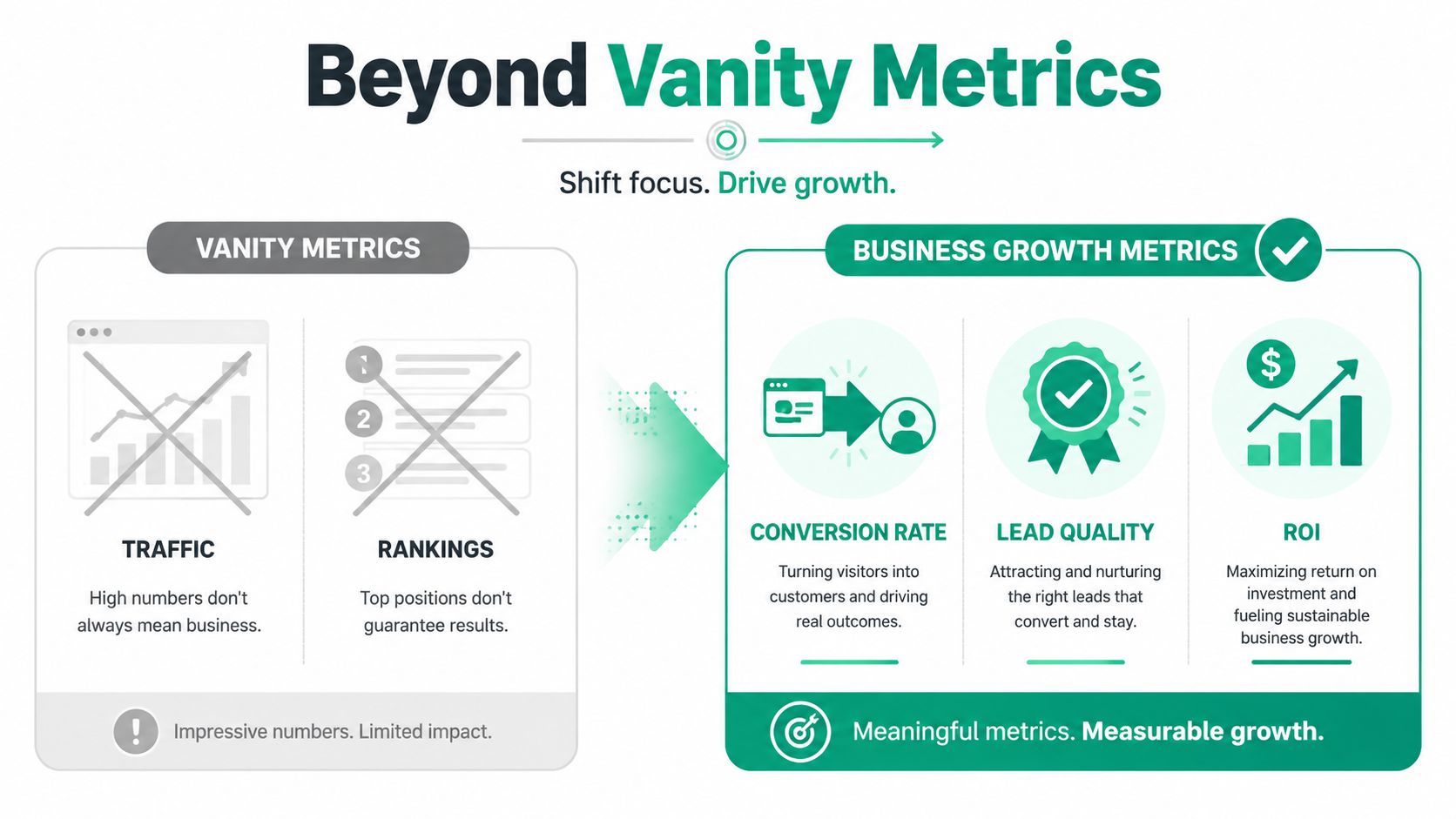
Traffic is easy to celebrate because it looks clean on a dashboard. Rankings feel satisfying for the same reason. But neither metric tells you enough about business impact on its own.
A page can rank, attract visits, and still do almost nothing for revenue.
Why traffic is no longer the whole story
A recent analysis from Proofed pointed to the harder measurement problem many guides skip. Google’s AI Overviews now reach over 1.5 billion monthly users, which means businesses need to design and measure content for citation, brand recall, and qualified actions in a lower-click environment.
That changes the KPI conversation. If searchers get part of the answer before visiting your site, then your content still needs to do useful work even when the click doesn’t happen right away.
A better scorecard for content SEO
Instead of asking, “How much traffic did this article get?” ask questions closer to revenue.
| Metric type | Weak question | Better question |
|---|---|---|
| Visibility | Did impressions rise? | Did the brand appear in the searches that matter to buyers? |
| Engagement | Did people visit? | Did the right visitors continue to service, product, or contact pages? |
| Conversion | Did the blog convert last click? | Did the content assist lead creation or influence a sales path? |
This is the shift from vanity metrics to business metrics.
Track signals such as:
- Lead generation from content through form fills, demo requests, calls, or quote requests that start on or pass through content pages
- Assisted conversions when content supports a later action on another page
- Lead quality by checking which topics attract the right kind of prospect
- Sales relevance by reviewing which articles sales teams use in conversations
- Search feature visibility, including whether your content is positioned to be cited or referenced
A high-value article doesn’t always close the lead by itself. Sometimes its job is to create trust before the buying page gets the conversion.
How to make this workable month to month
Keep the reporting simple enough that your team will use it. For each core content asset, assign one primary goal and one secondary goal. A comparison page might target lead generation first and assisted conversions second. A broad educational article might target visibility first and qualified traffic second.
Then review content in groups, not just one URL at a time. A cluster may be producing revenue together even if one supporting page looks average in isolation.
If your current reports are heavy on traffic graphs and light on sales contribution, the strategy isn’t finished yet. Measurement is part of the content system, not an afterthought added at the end.
If you’re building a content marketing SEO strategy and need a plan tied to leads, sales conversations, and measurable growth, Ascendly Marketing can help map the strategy, build the content architecture, and connect reporting to business outcomes instead of vanity metrics.