

TL;DR:
- Measuring marketing ROI shows the true profitability of marketing efforts, guiding smarter budget allocations. It requires comprehensive cost assessment, accurate attribution, and matching measurement windows to sales cycles. Most SMBs rely on vanity metrics and platform reports, which misrepresent actual revenue impact, emphasizing the need for disciplined data integration.
Marketing ROI measures the net financial return your business earns from every dollar spent on marketing, making it the clearest signal of whether your campaigns are generating real profit or just activity. For small and medium-sized businesses with limited budgets, this distinction is not academic. It determines which channels get funded next quarter and which get cut. 31.1% of marketing teams now rank Return on Marketing Investment as a top KPI, a figure that reflects a broad shift from reporting impressions to proving revenue impact. This guide explains why measuring marketing ROI matters, how to do it accurately, and what it means for your growth strategy.
Why measure marketing ROI: The core business case
Marketing ROI, formally called Return on Marketing Investment (ROMI), is the percentage of revenue attributable to marketing relative to what you spent to generate it. The formula is straightforward: subtract marketing costs from marketing-attributed revenue, divide by marketing costs, and multiply by 100. What makes it powerful is not the math. It is the decisions the number forces you to make.
Global ad spending is forecast to exceed $1 trillion in 2026. That scale means every business, including yours, is competing for attention in a more expensive environment. Without ROI data, you are bidding blind. With it, you can identify which campaigns earn their keep and which are quietly draining your budget.
The benefits of measuring ROI extend well beyond accounting. Here is what consistent ROI tracking delivers for SMBs:
- Budget clarity. You stop allocating spend based on gut feel and start directing money toward channels with proven returns.
- Stakeholder confidence. Departments that document financial contribution via ROI are significantly more likely to protect and grow their budgets during downturns. If you ever need to justify your marketing spend to a board, investor, or business partner, ROI data is your strongest argument.
- Campaign optimization. ROI tracking reveals which ads, emails, or content pieces are converting at the highest rate, so you can replicate what works.
- Strategic accountability. When every campaign has a measurable return target, your team focuses on outcomes rather than outputs.
- Smarter growth planning. ROI data feeds directly into forecasting. If a paid search campaign consistently returns $4 for every $1 spent, you can model what doubling that budget would produce.
Marketing metrics have evolved from simple reporting tools into a strategic discipline that connects campaigns to customer value and long-term business growth. For SMBs, that evolution is not optional. It is the difference between marketing that scales and marketing that stalls.
Why is measuring marketing ROI so difficult?
Most businesses already track something. The problem is that most focus on activity metrics like reach and clicks rather than actual business outcomes, which undermines accurate ROI measurement and decision-making. Knowing your Facebook ad reached 50,000 people tells you nothing about whether it sold anything.
Beyond that, several structural challenges make accurate ROI measurement genuinely hard:
Attribution errors. When a customer sees a Google ad, clicks a retargeting banner, reads a blog post, and then converts through a direct visit, which channel gets credit? Platform-reported ROAS can overstate actual ROI by 2 to 4 times due to attribution of non-incremental sales. This means your Google Ads dashboard may be telling you a campaign is profitable when the real incremental lift is far smaller.
Time lag effects. Monthly ROI measurement undervalues brand and long-cycle campaigns because the revenue effect of brand awareness or content marketing may not materialize for months. A business that evaluates a content strategy after 30 days will almost always conclude it failed, even if it is building compounding organic traffic.
Offline and anonymous interactions. Trade shows, word-of-mouth referrals, and in-store visits rarely appear in your CRM automatically. If you are not tracking these touchpoints, you are systematically undervaluing certain channels.
Incomplete cost accounting. Many SMBs calculate ROI using only ad spend, ignoring agency fees, software subscriptions, and internal staff time. This produces inflated ROI figures that lead to overconfident budget decisions.
Siloed data. When your ad platform, CRM, and website analytics do not talk to each other, you cannot connect a campaign impression to a closed sale.
Pro Tip: Partner with your finance team when building your ROI model. Cross-team collaboration with finance improves credibility and frames marketing performance in terms of business profitability, which is the language that protects budgets.
How to calculate marketing ROI accurately
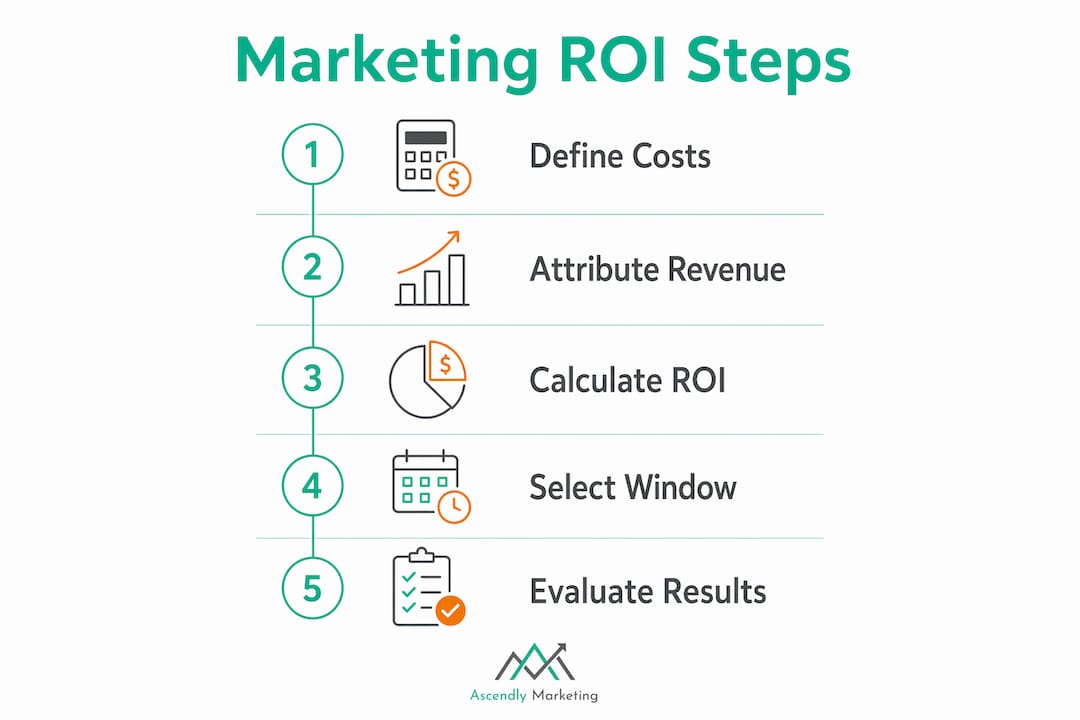
Accurate ROI calculation requires three things: a complete cost picture, a reliable revenue attribution method, and the right measurement window. Miss any one of these and your number will mislead you.

Building a complete cost picture
Fully loaded marketing costs include ad spend, agency fees, technology subscriptions, creative production, and internal staff time. If you pay a content writer $2,000 per month and run $5,000 in paid ads, your true marketing cost for that channel is $7,000, not $5,000. Using only ad spend inflates your ROI and causes you to overfund campaigns that are less profitable than they appear.
Choosing a revenue attribution method
The table below compares the three most common attribution approaches for SMBs:
| Method | How it works | Best for |
|---|---|---|
| Last-click attribution | Credits 100% of revenue to the final touchpoint before conversion | Short sales cycles, direct response campaigns |
| Multi-touch attribution | Distributes credit across all touchpoints in the customer journey | Businesses with multiple marketing channels active simultaneously |
| Marketing Mix Modeling (MMM) | Uses aggregate data to model the contribution of each channel over time | Brands with longer sales cycles and significant offline activity |
Marketing Mix Modeling remains vital because it uses aggregate data, is privacy-durable, and accounts for cross-channel and time lag effects. For SMBs running both digital and offline campaigns, MMM provides a more honest picture than any single-platform report.
Incrementality tests comparing exposed and control groups give the closest approximation of true marketing ROI by isolating the revenue that marketing actually caused. Running a holdout test on your email list, for example, shows you exactly how much revenue your email program generates versus what would have happened without it.
Selecting the right measurement window
Match your measurement window to your sales cycle. An e-commerce store can measure ROI monthly. A B2B software company with a 90-day sales cycle needs at least a quarter, and ideally two, before concluding. Forcing a long-cycle campaign into a short reporting window is one of the most common reasons SMBs abandon strategies that would have paid off.
Pro Tip: Use a CRM like HubSpot or Salesforce to connect campaign touchpoints to closed revenue. Without this link, you are calculating ROI from estimated data rather than actual sales records, which makes your numbers far less defensible.
How ROI measurement improves your marketing strategy
Measuring ROI is not just a reporting exercise. It changes how you allocate resources and how you think about growth. Small business teams that align metrics to business outcomes and integrate data foundations see earlier issue detection and better ROI measurement across the board.
Here is what that looks like in practice:
- Budget reallocation. A regional retail brand running both paid social and Google Search discovers through ROI tracking that Search delivers three times the return per dollar. They shift 40% of their social budget to Search and increase total revenue without increasing total spend.
- Identifying saturation. ROI data reveals diminishing returns. If your cost per acquisition on a paid channel rises 30% over three months while conversion rates hold steady, you have likely saturated your audience. Without ROI tracking, you would keep spending at the same rate and wonder why growth slowed.
- Improving customer lifetime value. When you know which acquisition channels bring in customers who spend more over time, you can prioritize those channels even if their upfront ROI looks lower. A customer acquired through organic search may convert at a lower rate than one from a paid ad, but spend twice as much over 12 months.
- Campaign-level optimization. ROI data at the campaign level tells you which creative, offer, or audience segment performs best. You can then apply those lessons across all active campaigns rather than waiting for a quarterly review.
- Smarter agency conversations. If you work with a marketing agency, ROI data gives you a shared language for performance. You can evaluate proposals based on projected return rather than deliverable counts, which produces far better outcomes for your business.
You can explore how marketing analytics drives growth for SMBs specifically, including how to connect campaign data to customer value metrics that actually move the needle.
Key takeaways
Measuring marketing ROI is the single most effective way to connect marketing spend to business profit and make budget decisions that compound over time.
| Point | Details |
|---|---|
| ROI is the primary performance signal | ROMI links marketing spend directly to revenue, making it more credible than reach or click metrics. |
| Full cost inclusion is non-negotiable | Include agency fees, tools, and staff time to avoid inflated ROI figures that mislead budget decisions. |
| Attribution method determines accuracy | Multi-touch attribution and MMM give more honest results than platform-reported ROAS, which can overstate returns by 2 to 4 times. |
| Measurement window must match sales cycle | Monthly snapshots undervalue brand and long-cycle campaigns; align your reporting period to your actual buyer journey. |
| ROI data drives strategic reallocation | Consistent tracking reveals which channels saturate, which compound, and where to shift budget for maximum return. |
What most SMBs get wrong about ROI measurement
Here is the honest version of what we see working with small and medium-sized businesses at Ascendly Marketing since 2013. Most SMBs do not have a measurement problem. They have a prioritization problem. They track what is easy, which means platform dashboards and vanity metrics, and then make budget decisions based on numbers that were never designed to reflect business profitability.
The most damaging pattern is trusting a single platform’s reported ROAS as the truth. Google tells you your campaign returned 5x. Meta tells you its campaign returned 4x. Add those up, and you are supposedly printing money. But when you look at actual revenue in your CRM, the numbers do not match. That gap is where budgets get wasted.
The fix is not complicated, but it requires discipline. Start with a complete cost model. Connect your ad platforms to your CRM. Pick one attribution method and stick with it long enough to generate meaningful data. Then compare periods rather than chasing monthly snapshots.
The businesses we work with that grow fastest are not the ones with the biggest budgets. They are the ones who know, with confidence, which dollar of marketing spend is working and which is not. That knowledge compounds. Every quarter of clean ROI data makes the next budget decision faster, smarter, and more profitable. Start simple, improve your data quality progressively, and resist the pressure to declare campaigns successful or failed before the measurement window closes.
— Ascendly Marketing
How Ascendly Marketing helps you measure and maximize ROI
Knowing why you should measure marketing ROI is the first step. Building the systems to do it consistently is where most SMBs need support.

Ascendly Marketing is a full-service digital marketing agency that has worked with small and medium-sized businesses since 2013, building ROI-focused strategies across SEO, paid advertising, content marketing, and analytics. The team connects your campaign data to real revenue outcomes, so you stop guessing and start making decisions backed by numbers. Whether you need a complete performance marketing strategy or help interpreting your current metrics, Ascendly Marketing provides the tools and expertise to turn your marketing spend into measurable growth. Book a consultation to see what your marketing is actually returning.
FAQ
What is marketing ROI and why does it matter?
Marketing ROI, also called ROMI, measures the net revenue return on your marketing investment as a percentage. It matters because it connects marketing spend directly to business profit, enabling smarter budget decisions.
How do you calculate marketing ROI?
Subtract total marketing costs from marketing-attributed revenue, divide by total marketing costs, and multiply by 100. Fully loaded costs must include ad spend, agency fees, tools, and staff time for an accurate result.
Why is platform-reported ROAS unreliable?
Platform-reported ROAS can overstate actual ROI by 2 to 4 times because it attributes credit to non-incremental sales. Use incrementality testing or multi-touch attribution alongside platform data for a more accurate picture.
How often should SMBs measure marketing ROI?
Measurement frequency should match your sales cycle. E-commerce businesses can review ROI monthly, while B2B companies with longer sales cycles should measure quarterly at minimum to avoid concluding incomplete data.
What tools help SMBs track marketing ROI?
CRM platforms like HubSpot and Salesforce connect campaign touchpoints to closed revenue. Combined with Google Analytics 4 and Marketing Mix Modeling, these tools give SMBs a reliable measurement foundation without requiring enterprise-level resources.