

Most advice about B2B websites is too polite. It tells you to refresh the brand, tighten the layout, add better visuals, and sprinkle in a few calls to action. Then the redesigned site launches, traffic holds steady, form fills trickle in, and sales still says the leads are weak.
That’s not a design problem. That’s a system problem.
A lot of B2B lead generation websites fail because they were built like presentation layers. They explain the company, list services, and look current enough to survive stakeholder review. But they don’t control who arrives, what message each visitor sees, how intent is captured, how leads are qualified, or how CRM data feeds back into optimization. They attract attention without building a pipeline.
The websites that perform well usually do something less glamorous. They connect positioning, content, conversion paths, lead scoring, routing, and reporting into one operating model. The pages matter. The forms matter. But the fundamental difference sits behind the interface.
Your Website is not a Brochure, and it is not Generating Leads
A redesign rarely fixes the pipeline.
I have seen B2B teams spend months rewriting copy, approving visuals, and debating homepage modules, then act surprised when sales still rejects inbound. The problem usually starts earlier. The site was built to satisfy internal stakeholders, not to control buyer intent, qualification, and handoff.
That creates a predictable failure pattern. Leadership pushes for a broad story. Marketing asks for a stronger brand presentation. Sales asks for volume. RevOps asks for cleaner data. The finished site tries to please everyone, so it says very little to the right buyer and asks almost nothing useful at the point of conversion.
A site like that can still generate form fills. It just does not generate a healthy sales pipeline.
The difference matters. Traffic is not a pipeline. MQL volume is not in the pipeline either. If the website attracts the wrong companies, hides pricing logic, sends high-intent buyers to generic pages, or captures leads without enough context for routing, sales inherits a filtering problem that marketing created upstream. That is why website performance should be judged by opportunity creation, sales acceptance, and CRM data quality, not by whether the new design looks current.
The strongest B2B sites operate like revenue systems. They guide different buyers to different paths, capture intent in ways sales can use, and pass clean data into the CRM, so follow-up reflects what the prospect focused on. That is the core work behind optimizing B2B sites for lead generation.
A polished site with weak qualification logic often makes the sales problem worse. It increases lead volume, lowers average fit, and wastes rep time on contacts that were never likely to close.
If sales keeps questioning inbound quality, treat the website as part of the revenue engine and audit it accordingly. Review message-to-market fit, CTA structure, form design, routing rules, enrichment, and CRM feedback loops. That is where lead quality usually breaks.
Laying the Strategic Foundation Before You Build
Before design starts, the team needs agreement on who the site is for, what action matters, and what happens after conversion. Skip that work, and the build becomes expensive guesswork.
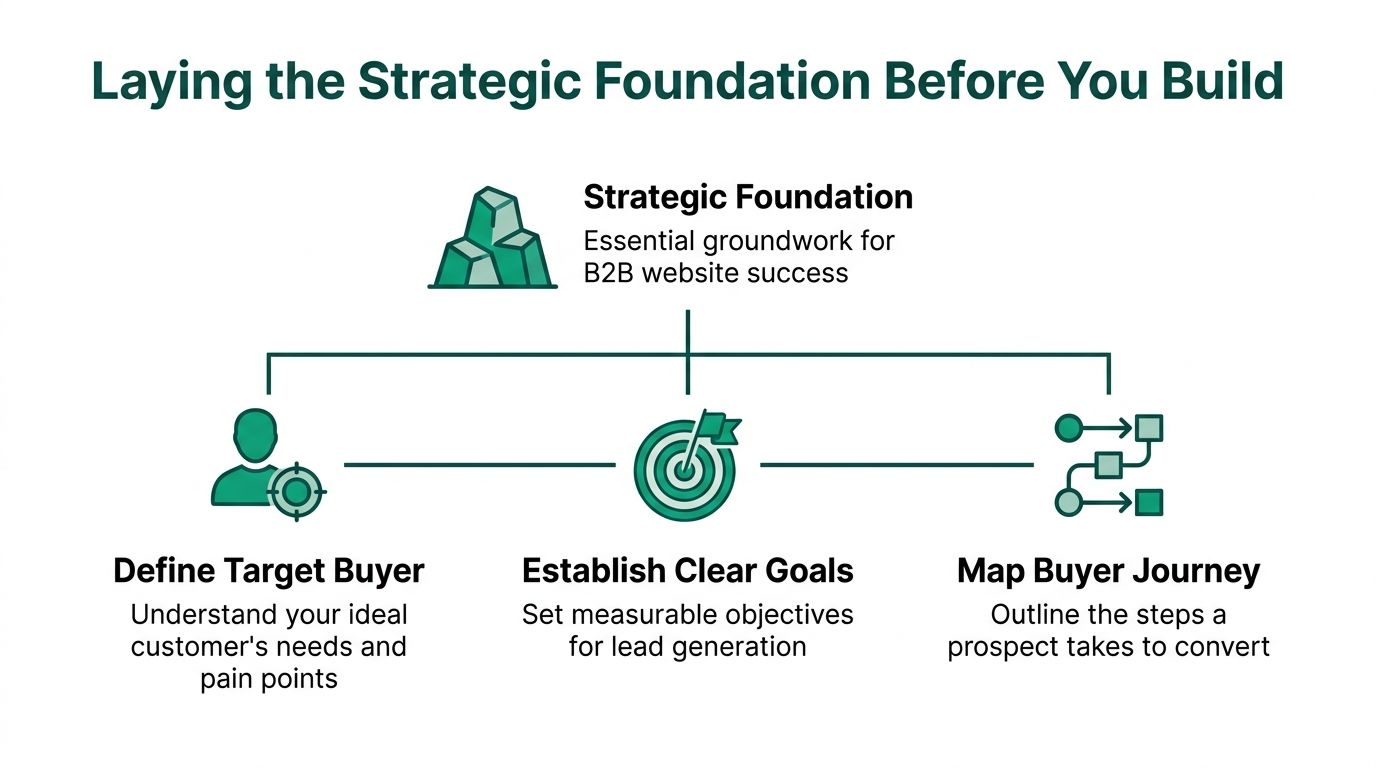
Define the buyer with enough detail to make decisions
“Ideal customer” often gets reduced to industry and company size. That isn’t enough. A useful ICP tells you what pages to create, what proof to show, what forms can ask for, and what follow-up sequence should trigger.
Start with questions that force specificity:
What triggers the search
Is the buyer reacting to a compliance issue, a revenue shortfall, a tool migration, a hiring gap, or an internal mandate?Who feels the pain first?
The user, the department head, procurement, or the executive sponsor might all enter the process differently.What gets a deal stuck
Internal approval, budget timing, technical compatibility, legal review, or weak urgency will shape the site’s content and CTA strategy.
A page written for a director trying to solve a live problem won’t read like a page written for a junior researcher collecting vendor options. It shouldn’t.
Set the site’s primary conversion goal
A surprising number of teams still try to make every action equal. Newsletter signup. Demo request. Contact us. Download. Webinar registration. General inquiry. Careers. Partner application.
That creates noise.
Pick the conversion event that has the strongest relationship to revenue, then support it with secondary actions for earlier-stage visitors. If the business closes through demos, the site architecture should make demos the main path. If the sales cycle starts with consultation calls, build around that motion. If education is required before a hand-raise, content subscriptions and mid-funnel offers may deserve more weight.
A practical planning resource that aligns channel, offer, and workflow is this guide to B2B lead generation for teams. It’s useful when internal stakeholders are still lumping “more traffic” and “more pipeline” into the same goal.
Map the journey before choosing page templates
Most buyers won’t enter through the homepage. They’ll land on a service page, a comparison article, a blog post, a webinar replay, or a campaign page. That means every important page needs to answer three things fast:
- What is this page about
- Who is it for
- What should happen next
Here’s a simple planning model:
| Decision area | What to define before design | Why it affects performance |
|---|---|---|
| Buyer segment | Industry, role, problem, urgency | Changes messaging, proof, and CTA |
| Entry points | Search pages, campaign pages, referral pages | Determines what must stand alone |
| Conversion paths | Demo, consultation, download, signup | Prevents competing CTAs |
| Qualification rules | Required fields, lead score inputs, routing logic | Improves downstream lead quality |
Practical rule: if your team can’t describe the exact visitor a page is built for, that page will drift into generic copy.
Write the value proposition in operational language
Broad positioning sounds fine in a brand workshop and falls apart on a landing page. Buyers need a plain answer to a plain question. What problem do you solve, for whom, and why should they trust this approach?
The strongest messaging usually has these traits:
- Specific audience fit instead of “for businesses of all sizes”
- Clear problem framing instead of abstract benefit language
- Concrete process language instead of vague claims
- Visible proof points tied to the claim being made
That foundation will decide the sitemap, page hierarchy, content priorities, form logic, and CRM handoff rules. Without it, teams end up polishing pages that were pointed at the wrong buyer from the start.
Designing for Conversion, Not Just Aesthetics
A good-looking B2B site can still be hard to use, vague in its claims, and weak at conversion. Buyers don’t reward visual effort. They respond to relevance, clarity, and reduced friction.

Clarity beats cleverness
The first screen has a short job description. Confirm the visitor is in the right place. State who the service is for. Offer a next step that matches the likely intent.
Many B2B sites miss this because they open with a slogan that could apply to half the market. Buyers then scan the menu, scroll for specifics, and leave when they don’t find them quickly. Busy people don’t decode positioning statements for fun.
A stronger page structure usually looks like this:
Headline with category clarity
Say what you do in plain language.Subhead with audience and problem
Name the buyer or use case.Primary CTA with intent fit
Demo for high-intent pages. Guide, checklist, or webinar for evaluation-stage pages.Immediate proof
Use testimonials, client examples, product visuals, process snapshots, or implementation details that support the core claim.
Navigation should reflect buying questions
Most navigation menus mirror internal org charts. Buyers don’t think in departments. They think in tasks, risks, and vendor comparisons.
A useful navigation system answers:
- What do you offer?
- Who is it for?
- How does it work?
- Why should I trust you?
- What do I do next?
Page hierarchy matters more than graphic style. A clean interface that hides important information still loses.
For teams reworking these fundamentals, this article on how to design a business website that converts is a practical reference because it keeps the focus on page purpose rather than pure design trends.
Proof has to sit near the claim
Too many sites bury credibility in a testimonials page or a PDF case study. That’s a waste. Proof should appear where doubt appears.
If a service page claims fast implementation, show evidence on that page. If a landing page asks for a consultation, answer the obvious concerns before the form. Buyers want signs that the team understands their problem, can work with a company like theirs, and won’t waste their time.
Good conversion design removes unanswered questions before the form appears.
A few examples of useful proof placement:
| Page type | Common claim | Better proof placement |
|---|---|---|
| Service page | We solve a complex problem | Add process steps, buyer-fit copy, and relevant testimonial excerpts directly below the intro |
| Landing page | This offer is worth your data | Show what the visitor will learn, who it’s for, and what happens after submission |
| Pricing or demo page | This is a serious buying step | Include qualification notes, meeting expectations, and implementation context |
Friction usually comes from confusion, not from color choices
Teams love to debate visual details because they’re visible and easy to discuss. Buyers care more about whether the page makes sense. Button color won’t rescue a message that doesn’t match intent.
Design for scanning. Use descriptive headings. Keep forms in view on high-intent pages. Break content into sections that answer distinct questions. Make each page work as a landing page, not as a chapter in a brochure.
The best B2B lead generation websites feel easy to use because they were organized around decisions, not around aesthetics.
The Mechanics of Lead Capture
Lead capture decides whether a website produces a pipeline or just produces names.
A lot of B2B teams treat forms as a front-end task. Sales feels the consequences later. The site collects vague inquiries, the CRM fills with low-context records, and SDRs waste time chasing people who were never a fit. Good lead capture fixes that upstream. It sets the right expectation, collects the data needed for routing, and pushes each response into the right follow-up path.
As noted earlier, benchmark data shows a wide spread between average visitor-to-lead conversion rates and the performance of stronger landing pages. That gap matters because capture mechanics directly affect both volume and quality.
Calls to action need to match buying intent
“Contact us” tells the visitor almost nothing. It also tells sales almost nothing about what the person wanted.
Better CTAs frame the next step in plain language:
- Book a product demo
- Request a technical consultation
- Download the implementation checklist
- Watch the webinar replay
- Get pricing guidance
Each CTA signals a different level of intent. That matters operationally. A pricing request may belong to sales. A checklist download usually belongs in a nurture sequence. If both actions feed the same workflow, teams lose context before the first follow-up even starts.
Context on the page matters just as much. A blog post about a compliance change should offer a relevant next step, not force a premature sales conversation. A high-intent service page should not hide the conversion path behind soft language.
Forms should collect enough to route, score, and respond
Long forms are not the problem. Unfocused forms are.
The job of a form is to gather the minimum information required to decide what happens next. For many B2B offers, that first pass includes:
- Business email
- Name
- Company
- Role
- A short need or use-case field
That set is usually enough to support basic qualification and routing. From there, enrichment tools, CRM lookups, and follow-up emails can add firmographic detail without forcing every buyer to complete a ten-field interrogation on the first visit.
One field often gets overlooked. An open text field asking what the prospect needs can outperform several dropdowns because it gives sales real buying context. It also helps marketing identify intent patterns that should shape future pages and offers.
Ask for the minimum data needed to decide owner, priority, and next action.
Gated and ungated content should serve different jobs
Gating should match the value of the asset and the stage of the buyer. Teams that gate every guide, checklist, and article usually get more form fills and worse lead quality. They also make it harder for serious buyers to evaluate the company before raising their hands.
A practical structure looks like this:
| Funnel stage | Lead magnet type | Primary goal | Recommended gating |
|---|---|---|---|
| Awareness | Blog posts, educational articles, checklists | Build trust and attract search demand | Ungated |
| Consideration | Webinars, templates, guides, comparison content | Capture engaged prospects | Selectively gated |
| Decision | Demo requests, consultations, implementation calls | Start sales conversation | Gated with qualification |
This approach aligns with Salesgenie’s lead generation framework guidance, which supports ungated top-of-funnel content, selectively gated mid-funnel assets, and higher-friction bottom-of-funnel offers.
The key is operational clarity. If someone downloads a mid-funnel asset, that should not trigger the same sequence as a demo request. Different intent should create different CRM stages, lead scores, and alerts.
Landing pages need one conversion job
Campaign traffic should land on pages built for a single action. Not a page trying to educate, qualify, cross-sell, and explain the entire company at once.
A focused landing page usually includes:
- A headline tied to the offer
- A short explanation of value
- Bullets that define who it’s for
- Evidence or trust cues
- A form or booking path
- A confirmation state with a clear next step
The confirmation step matters more than teams assume. A thank-you page can route visitors to a case study, a scheduler, a product overview, or the next asset in the sequence. That keeps momentum high and gives marketing another signal to pass into the CRM.
Teams refining campaign pages can review these examples of B2B lead generation landing pages when they need cleaner separation between paid traffic, organic traffic, and core site navigation.
Common failure points
Underperforming lead capture systems usually break in predictable ways:
Generic gated assets
Broad offers attract broad interest. Sales gets names that match the content topic but not the buying profile.One form standard for every offer
Newsletter subscribers, webinar registrants, and demo requests should not enter the same workflow with the same field logic.No routing logic behind the form
If territory, segment, product line, or company size do not affect assignment, speed to lead drops and ownership gets messy.Weak thank-you pages and autoresponders
Submission should trigger a useful next step and confirm what happens next. Silence lowers trust fast.No sales feedback in the CRM
If sales cannot mark fit, source quality, or opportunity outcome, marketing keeps optimizing for submissions instead of pipeline.
Lead capture works best when the form, CTA, page, automation, and CRM are designed as one system. That is how websites produce leads sales wants to work, not just leads marketing can count.
Fueling the Engine with Targeted Traffic
Traffic quality matters more than traffic volume. A site that attracts the wrong audience will create activity without a pipeline. A site that attracts the right audience can support sales even with a smaller audience base.
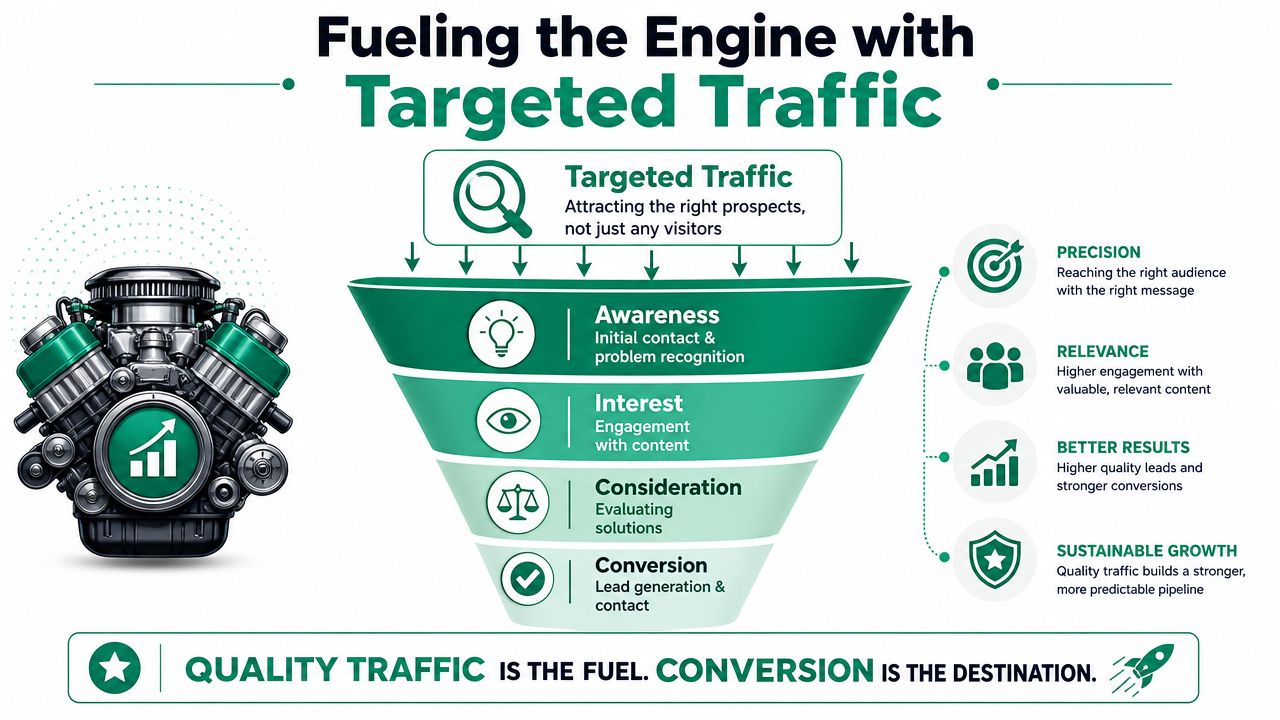
The strongest channel mix for many B2B lead generation websites is some combination of search, content, and LinkedIn distribution. That’s not because those channels are fashionable. It’s because they align well with how business buyers research.
Recent industry statistics compiled by Snov.io’s lead generation statistics summary report that 80% of B2B prospects from social media come from LinkedIn, 94% of B2B marketers use LinkedIn for sales and lead generation, and 89% of B2B firms use content marketing for lead generation. The same source states that content marketing produces 3x more leads than traditional outbound at about 62% lower cost.
Search traffic works when pages match buyer questions
SEO for B2B isn’t about chasing every keyword with volume. It’s about building pages around real commercial and research intent.
That usually means covering several page types:
- problem-aware educational content
- solution pages
- service pages
- industry pages
- comparison pages
- webinar and resource pages
A buyer searching for a definition needs a different page from a buyer comparing vendors. Treating both queries with the same template weakens performance.
Content should support distribution, not just publishing
A lot of teams produce content in isolation. Blog first. Promotion later, maybe. That’s backwards.
Start with the question, objection, or buying stage. Then decide what format carries it best. Some topics deserve a short article. Others need a webinar, a checklist, a comparison page, or a resource center entry that sales can reuse in follow-up.
This short video is a useful complement to that planning approach.
LinkedIn matters because B2B attention is concentrated there
LinkedIn performs well for many B2B teams because buyer identity is visible. Role, company, industry, and conversation context are easier to infer than on broader social platforms. That makes it useful for both organic distribution and paid promotion of content offers, webinars, and category education.
A practical traffic system often looks like this:
| Channel | Best use | Common mistake |
|---|---|---|
| Organic search | Capture active demand and research intent | Publishing broad content with no buyer specificity |
| LinkedIn organic | Distribute ideas, proof, and point-of-view content | Posting company updates nobody asked for |
| LinkedIn paid | Promote high-intent resources or segment-specific offers | Sending cold traffic to generic homepage paths |
| Email distribution | Re-engage known audiences with useful assets | Treating every contact the same regardless of stage |
Field note: targeted traffic is easier to scale when content topics are tied to one audience segment and one conversion path at a time.
What doesn’t work well is building a site full of broad pages, then hoping a paid campaign or SEO program somehow fixes relevance. Traffic channels only amplify what the site already is. If the page is generic, the channel will deliver generic outcomes.
Measuring What Matters for B2B Growth
Most website reporting is still stuck at the activity layer. Sessions. Clicks. Form fills. Bounce rate. Time on page. Those metrics can help diagnose page behavior, but they don’t tell sales leadership whether the site is producing qualified pipeline.
That gap is usually a data design failure, not an analytics platform failure.
A 2025 benchmark summary from ZoomInfo’s B2B lead generation statistics notes that 42% of sales reps say the lack of quality data is their biggest barrier to lead generation, and 79% of marketing leads never convert to sales. Those numbers point to a familiar pattern. Teams focus on generating more submissions while ignoring qualification, enrichment, attribution, and handoff quality.
Track conversion events that connect to the pipeline
You need more than pageview reporting. Start with a clean event structure tied to business actions:
- demo request submitted
- consultation booked
- webinar registration completed
- high-value resource downloaded
- contact form submitted
- return visit from a known prospect
- sales-qualified lead created in CRM
- opportunity opened
That event structure should carry through from website analytics into the CRM. Without that connection, reporting stops at the form.
Separate raw lead volume from qualified lead volume
A lead count without context can hide serious problems. One campaign may generate more submissions and less revenue. Another may attract fewer leads but produce stronger sales conversations.
Teams benefit from tighter KPI definitions. Resources like Grou’s lead generation insights are useful because they push measurement beyond top-line lead totals and into quality and efficiency questions.
A practical scorecard usually includes two layers:
| Website metric | Revenue-linked companion metric |
|---|---|
| Form submissions | Sales-accepted leads |
| Demo bookings | Opportunities created |
| Landing page conversion | Qualified meeting rate |
| Content downloads | Follow-up engagement and progression |
| Traffic by channel | Pipeline by channel |
Fix attribution where it actually breaks
Attribution gets messy when channels fragment and CRM hygiene slips. Paid traffic enters through campaign pages. Organic visitors return later through branded search. Sales outreach creates direct visits. A webinar attendee comes back after seeing a LinkedIn post. Then the deal gets credited to the final form fill.
That doesn’t mean attribution is pointless. It means you need a model that reflects how buying happens. At minimum:
- Tag traffic cleanly
- Pass the source and offer the data in forms
- Sync fields to the CRM
- Stamp lifecycle stage changes
- Review influenced opportunities, not just last-touch conversions
Vanity metrics reward busy marketing. Closed-loop reporting rewards useful marketing.
If your team can’t answer which pages, offers, and channels create sales-accepted leads, the website is operating without feedback. In that setup, optimization turns into opinion. The fix isn’t another dashboard. The fix is connecting website actions to revenue stages and making those stages visible across marketing and sales.
Closing the Loop with Automation and CRM
A lead doesn’t become a pipeline because a form was submitted. Pipeline starts when the right lead is identified, routed, worked, and tracked without delay or confusion.
That’s where B2B lead generation websites either become valuable or start leaking demand.
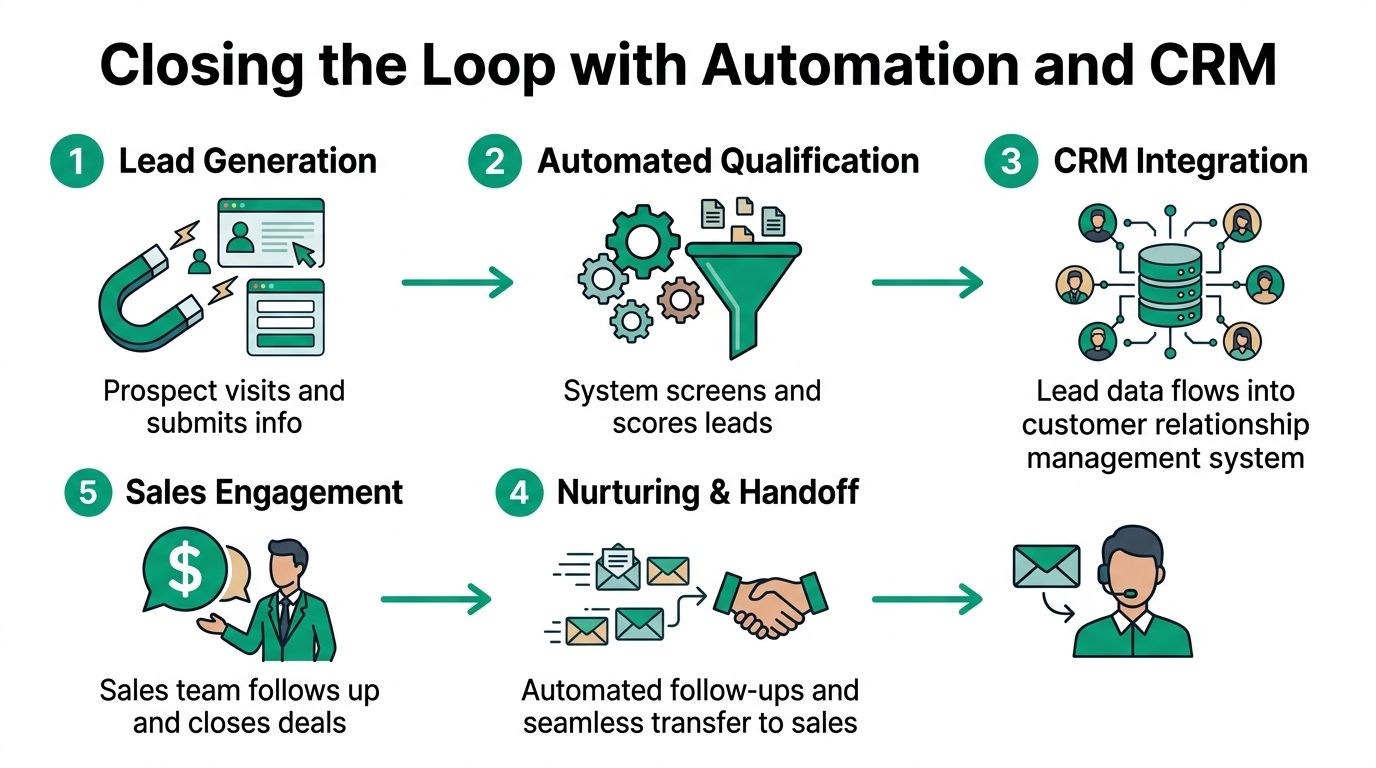
Build the handoff before traffic scales
A lot of teams wait too long to define routing logic. They launch forms, drive traffic, and then manually sort submissions in shared inboxes. That creates delay, inconsistency, and data loss.
Instead, define these operational rules early:
Ownership rules
Decide who receives inbound leads by territory, industry, product line, account type, or named-account status.Lifecycle stages
Distinguish inquiry, marketing-qualified lead, sales-accepted lead, sales-qualified lead, opportunity, and customer inside the CRM.Response expectations
Set rules for what happens after submission. Instant confirmation email, internal alert, task creation, calendar route, or nurture entry.
If a demo request from a target account sits untouched because nobody knew who owned it, the website didn’t generate pipeline. It generated admin work.
Use scoring to filter for fit and intent
Lead scoring works when it reflects buying reality, not when it turns into a math exercise. Guidance from Superhuman Prospecting on B2B lead qualification workflows recommends defining buyer personas, segmenting prospects, and scoring leads using explicit fit signals and implicit engagement signals to reduce wasted spend and keep sales and marketing aligned.
That means separating two questions:
| Scoring dimension | What it looks at | Example signals |
|---|---|---|
| Fit | Whether this account matches your target customer | Role, company size, industry, geography |
| Intent | Whether this person is acting like a buyer | Demo page visits, repeat sessions, downloads, email clicks |
A student downloading a guide may show engagement but low fit. A director at a target account visiting pricing and booking a demo shows both. Those leads should not enter the same workflow.
Automation should change speed and consistency
Automation isn’t there to impersonate a salesperson. It handles repeatable actions reliably so sales can focus on judgment.
Useful automations include:
- Immediate confirmation emails that set expectations after form submission
- CRM record creation and deduplication
- Lead routing based on account or territory rules
- Lead score updates based on profile and behavior
- Nurture enrollment for leads that aren’t ready for direct outreach
- Task creation for sales when a threshold is met
For companies building these workflows, marketing automation for B2B is one operational path. Ascendly Marketing is one option among agencies that help connect website forms, automation logic, and CRM workflows for lead generation programs.
Nurture should follow the buying stage, not just the form type
One of the biggest mistakes in automation is treating all non-demo leads as the same audience. They aren’t.
A better nurture structure separates:
- early education contacts
- evaluators comparing approaches
- high-fit accounts with low recent engagement
- existing opportunities needing supporting content
Each stream should send different material. A top-of-funnel subscriber may need educational articles and webinar invites. A high-fit evaluator may need implementation details, objection handling, and consultation prompts.
The website captures intent. The CRM decides what that intent means. Automation makes sure the next step actually happens.
Recalibration matters more than setup
Scoring models drift. Offers lose relevance. Sales teams change target account criteria. New content creates new high-intent signals. If the system stays static, lead quality degrades subtly.
Review these items on a routine basis:
- Which sources create sales-accepted leads
- Which pages appear most often before opportunities
- Which form fields help qualification, and which only add friction
- Which scores correlate with real sales readiness
- Which nurture sequences lead nowhere and should be retired
The best closed-loop systems are not “set and forget.” They are operational assets that get tuned as buyer behavior changes.
If your website is attracting traffic but sales still question lead quality, Ascendly Marketing can help connect the missing pieces. The team builds B2B websites, conversion paths, and automation workflows that tie front-end experience to CRM follow-through. You can learn more or start a conversation at Ascendly Marketing.