

You’re probably in one of two situations right now.
You’re paying for traffic and sending it to a homepage that tries to do five jobs at once. Or you’ve already built a landing page, but the leads coming through don’t turn into real conversations. Sales says the form fills look busy, then ignores half of them.
That’s the gap most advice misses. B2B lead generation landing pages aren’t just pages that collect contact details. They’re screening devices. A good one gets the right person to raise a hand. A bad one gets anybody curious enough to click.
When I build these pages, I’m not trying to maximize form fills in isolation. I’m trying to create a message match, remove the wrong friction, add the right friction, and give sales a cleaner pipeline to work with. That changes the page structure, the offer, the copy, the form, and how performance gets judged after launch.
Why Your Website Traffic is not Converting
A common setup looks like this. A company runs paid search for a specific service, the ad is tightly written, the keyword intent is solid, and the click lands on the homepage. The homepage talks about the company, lists multiple services, shows a navigation menu with ten options, and asks the visitor to figure out what to do next.
That click didn’t fail because the traffic was bad. It failed because the page asked the visitor to restart their decision process.
A dedicated landing page fixes that by narrowing the conversation to one problem, one offer, and one action. That’s why landing pages outperform broader site pages for lead capture. Industry data compiled by Involve.me reports an average landing page conversion rate of about 6.5% to 6.6%, cites 13.3% for B2B landing page conversion, and says landing pages average 23% signup conversion while accounting for only about 5% of total signup form volume on websites, which points to an underused format with stronger conversion potential for targeted traffic (Involve.me landing page statistics).
The mismatch that kills conversion
If someone clicks an ad about a demo, audit, checklist, or consultation, they expect to land on a page that continues that exact thread.
They don’t want to browse. They want confirmation.
Here’s what usually breaks:
- Too many paths: Navigation, footer links, service menus, and blog links give the visitor exits.
- Weak message match: The ad promised one thing. The page talks about something broader.
- No clear next step: Generic pages often offer several CTAs, none of them tied closely to the original click.
Practical rule: If the visitor has to decide where to click next, the page is doing less selling than it should.
What a focused page change
A proper landing page acts more like a sales call opener than a website section. It says: you came here for this, here’s what you’ll get, here’s why it matters, here’s what to do next.
That’s also why teams that need to build lead generation teams fast often pair outbound capacity with dedicated landing pages instead of relying on general site forms. When traffic is intentional, the destination has to be intentional too.
If you’re diagnosing an existing page, start with a conversion rate optimisation audit. Not because audits are glamorous. They aren’t. But they force you to identify where intent gets lost between click and submission.
Matching Your Offer to Buyer Intent
Most B2B landing pages fail before the copy is written. The offer is wrong for the visitor’s stage of awareness.
If the person is still diagnosing a problem, a “Book a Demo” CTA can feel premature. If they’re comparing vendors, an ungated blog-style page can feel vague and low value. The page only works when the offer matches the reason for the click.
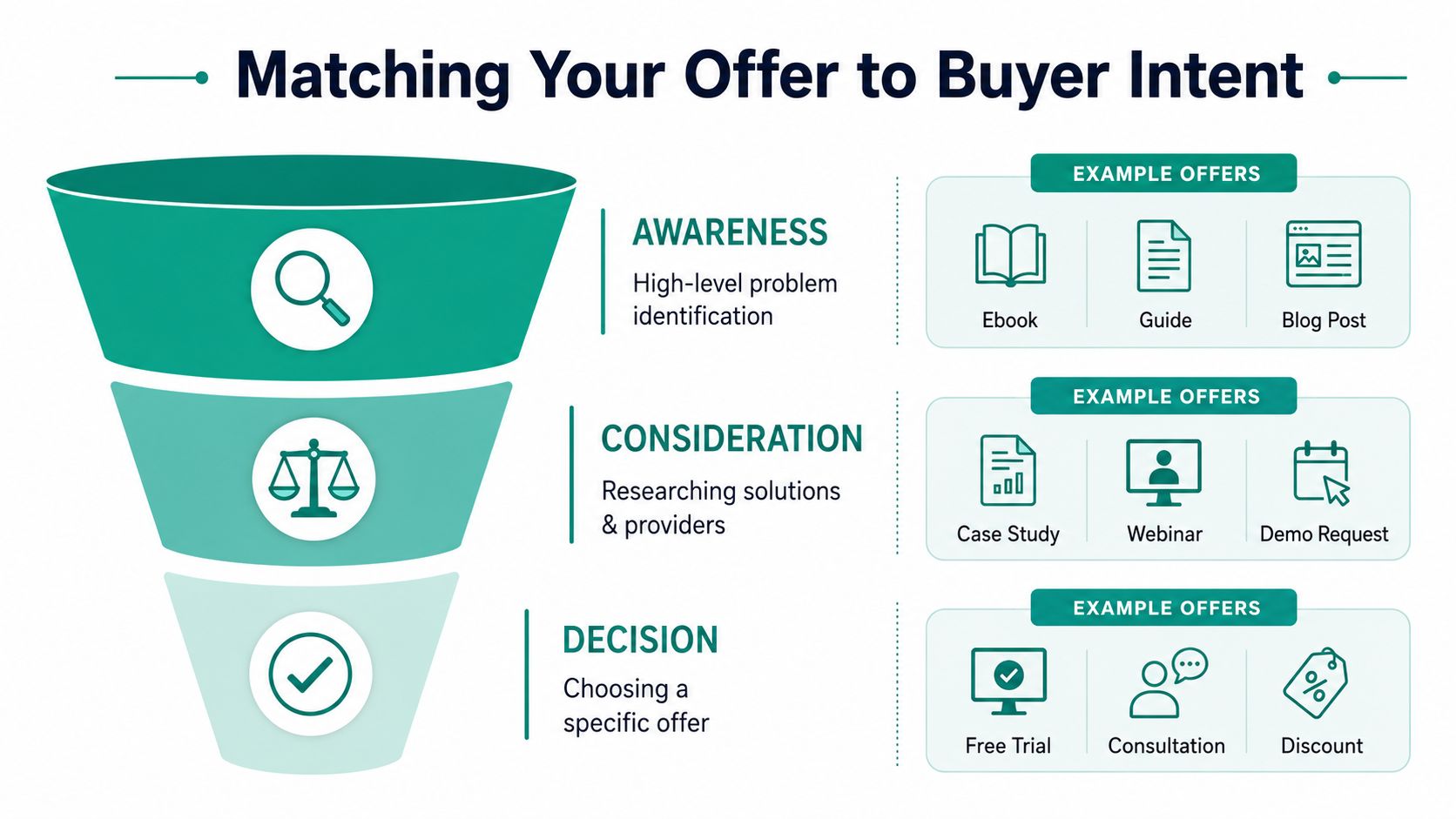
Start with the click source
Before choosing the offer, look at where the visitor came from and what that channel usually signals.
According to Elementor, a B2B lead generation landing page can convert at 5% to 15% or higher, and performance should be benchmarked by traffic source because intent changes significantly by channel (Elementor B2B lead generation strategies). That has practical consequences. LinkedIn visitors often arrive in research mode. Paid search traffic often arrives with a sharper problem statement. Referral traffic may already trust you more than either.
If you’re building campaigns around social acquisition, this guide to B2B lead generation on LinkedIn is useful because it forces a more precise view of audience intent before the page gets built.
Match the offer to the decision stage
I use a simple sorting rule. Ask what the visitor is ready to do right now, not what you wish they were ready to do.
| Buyer stage | What the visitor wants | Offer that fits |
|---|---|---|
| Awareness | Understand the problem | Ebook, guide, checklist, educational resource |
| Consideration | Compare approaches | Case study, webinar, demo overview, framework |
| Decision | Evaluate a vendor | Consultation, free trial, audit request, direct demo |
That table looks obvious, but teams skip it all the time. They run all traffic to one generic “contact us” page and then wonder why submission quality is erratic.
Keep the value exchange honest
A strong offer solves an immediate problem. A weak one asks for information in exchange for something the visitor could ignore without consequence.
Use these checks before you publish:
- Does the offer match the promise in the ad or email? If not, fix the page or fix the campaign.
- Is the value concrete? “Get industry insights” is weak. “Get a checklist for evaluating vendors” is clearer.
- Is the commitment level appropriate? A consultation request asks more than a download. The page has to earn that ask.
The best-performing offer usually feels like the next logical step, not a leap.
Don’t force high intent too early
A lot of B2B teams push demos because demos feel closer to revenue. That logic makes sense internally. It often fails externally.
If a visitor doesn’t know enough yet, a lighter offer can produce a better path to pipeline because it starts the relationship at the right level of commitment. On the other hand, if someone clicks a bottom-funnel keyword, giving them a generic guide instead of a direct meeting option slows them down.
This is why good B2B lead generation landing pages are built around offer fit, not templates alone.
Crafting a Persuasive Message Framework
Once the offer is right, the next job is turning it into a clear argument.
Most B2B landing page copy is either too abstract or too self-focused. It talks about the company’s capabilities, its process, or its platform features before answering the visitor’s first question, which is simpler: why should I care right now?

Build the message in this order
A page usually needs five layers of persuasion, stacked in the right sequence.
Headline
The headline should identify the problem or desired outcome fast. Clever phrasing usually loses to direct wording in B2B because the visitor is scanning for relevance, not style.
Subheading
Context is vital. Explain what the offer is, who it’s for, and why it’s worth the exchange.
Benefit bullets
These work when they translate the offer into usable outcomes. Don’t list topics covered. Show what the visitor will be able to do, evaluate, avoid, or decide after engaging.
Proof
Proof reduces hesitation. On B2B pages, that can be logos, testimonial excerpts, review snippets, process screenshots, or a short case-study reference if you have verified material.
Call to action
The CTA should feel consistent with the offer and page tone. “Get the guide,” “Book the consultation,” or “Request the demo” is stronger than generic button copy because it reflects the value being claimed.
Use direct response logic without sounding like an ad
Good landing pages borrow from direct response. Not hype. Structure.
This primer on DMpro on direct response is useful because it frames the page as a response engine. A visitor sees a claim, weighs the relevance, and decides whether the exchange feels worthwhile. That’s exactly what happens on a B2B landing page, even when the design is clean and understated.
Write for scanning, then for detail
Most visitors won’t read from top to bottom. They’ll skim the heading, check the bullets, glance at the form, and look for something that confirms trust.
That means your copy should work in layers:
- Top layer: Headline, subheading, CTA
- Middle layer: Bullets, short sections, form labels
- Lower layer: Objection handling, FAQs, supporting detail
Field note: If the page only makes sense when read in full, it’s too dependent on perfect attention.
Translate features into buying relevance
A lot of teams still write as if features persuade by themselves. They don’t. Features need interpretation.
Compare these approaches:
| Weak copy | Stronger copy |
|---|---|
| Includes a detailed assessment | Shows where your current process is blocking qualified pipeline |
| Personalized reporting | Gives your team a clearer basis for the next buying decision |
| Access to expert guidance | Helps buyers compare options with less internal guesswork |
The point isn’t to manufacture drama. It’s to reduce ambiguity.
Put proof near the claim it supports
Don’t isolate trust signals in one section and hope the visitor connects the dots. If you claim the offer is practical, show a preview. If you claim the process is low friction, show the short form or explain what happens next. If you claim the offer suits a specific audience, use proof that reflects that audience.
That’s what separates persuasive messaging from descriptive messaging. Descriptive copy explains what the page contains. Persuasive copy shows why the visitor should act now.
Designing for Clarity and Conversion
Design doesn’t rescue weak positioning. What it can do is remove visual friction that stops a good message from being understood.
The pages that underperform most often aren’t ugly. They’re busy. They ask the eye to process too much, too quickly, and they hide the main action among decorative choices that don’t help the decision.
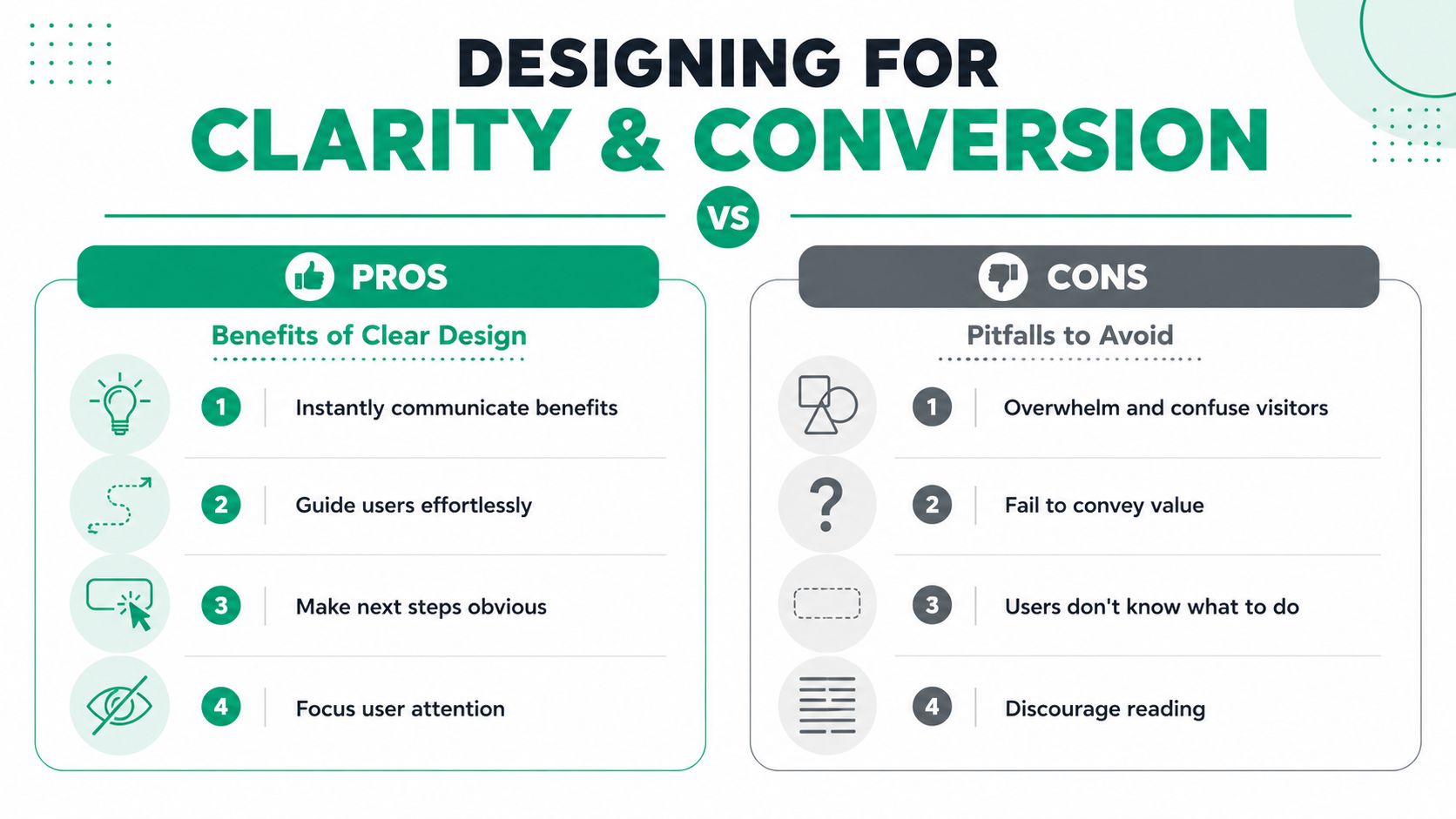
Remove everything that competes with the CTA
For B2B lead generation landing pages, I default to a minimalist layout unless there’s a strong reason not to.
That usually means:
- No top navigation
- One dominant CTA
- One clear visual path down the page
- Short sections with strong spacing
- Mobile-first form placement
The logic is simple. Every extra choice weakens the page’s job.
Use hierarchy, not decoration
A visitor should know what matters in a few seconds. Good hierarchy does that. It tells the eye where to look first, second, and third.
That usually comes from:
- Large, direct headline
- Supportive subhead placed immediately below
- Primary CTA visible without effort
- Supporting proof positioned close to the pitch
- Whitespace that separates ideas instead of cramming them together
Here’s a useful walkthrough on optimizing your lead generation engine because it reinforces the system view. The landing page is one part of the conversion chain, so design choices should help movement through that chain, not compete for attention.
A quick visual example helps here:
What usually hurts performance
I see the same design mistakes repeatedly.
| Design choice | What it does to the visitor |
|---|---|
| Multi-column hero section | Splits attention early |
| Carousels and sliders | Hide information and reduce control |
| Stock imagery with no relevance | Adds visual noise without trust |
| Dense paragraphs | Make the page look harder than it is |
| Repeated equal-weight CTAs | Weakens the main action |
A landing page should feel easier to act on than to leave.
Single-column wins more often in practice
Single-column layouts aren’t magic. They’re just easier to control. They let you guide sequence, tighten mobile behavior, and reduce competing focal points.
That matters more in B2B than many teams expect. Buyers may be evaluating a serious purchase, but the page-level decision is small. They’re deciding whether to submit a form, request a call, or start a conversation. Clear pages support that decision. Overdesigned pages interrupt it.
If you want one test for whether your design is helping, blur your screen slightly and step back. Can you still identify the headline, the form, and the main CTA? If not, the hierarchy is weak.
Developing a Smart Form and Qualification Strategy
The shortest form doesn’t always produce the best outcome.
That’s the part many teams resist, especially if they’ve been taught to strip every field until the conversion rate goes up. Higher submission volume can look good in a dashboard while making sales follow-up worse, slower, and less focused.
The better question is this. What information does the business need at this stage, and what amount of friction helps screen for intent without choking response?
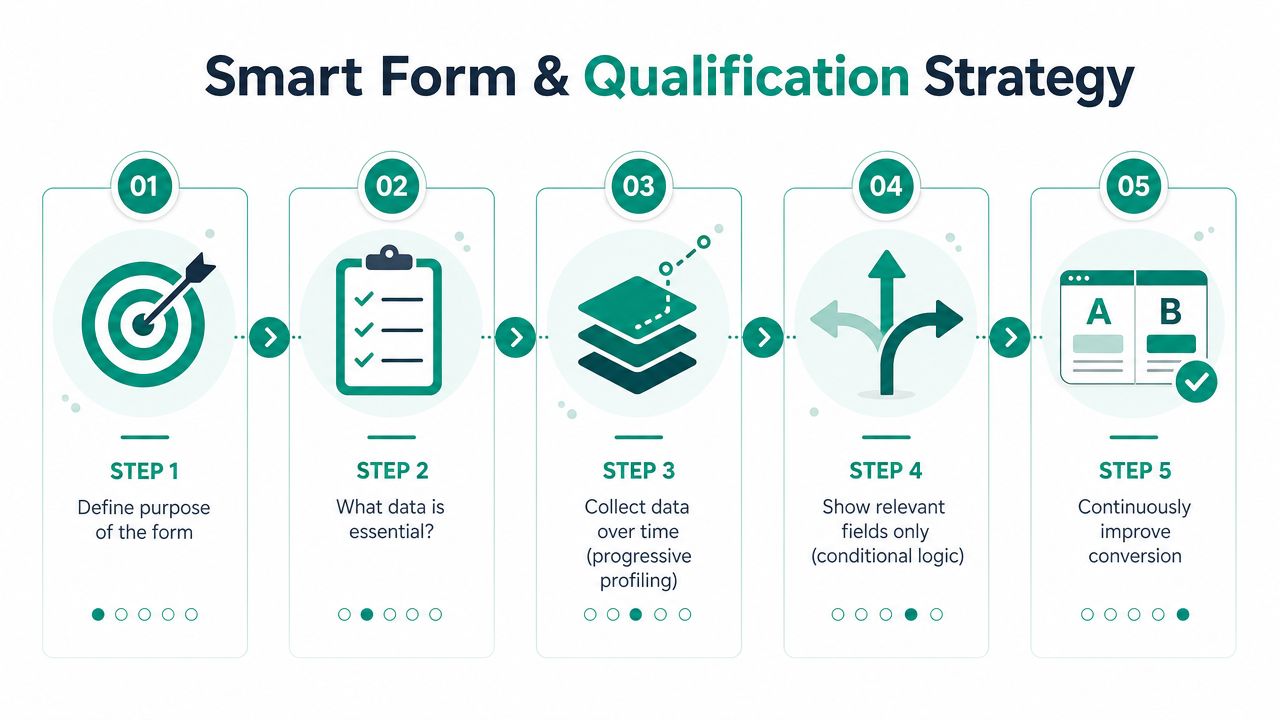
Raw conversion can mislead you
A lot of landing-page advice still treats form friction as the main problem. That’s incomplete.
SalesHive notes that teams should track downstream metrics such as lead-to-opportunity and lead-to-close, not just conversion rate, because the goal is to see whether the page is converting the right accounts rather than just generating more submissions (SalesHive on B2B lead quality).
That changes form strategy immediately. If a shorter form brings in more low-intent contacts, the page may be “improving” while pipeline quality gets worse.
If your team needs a common qualification standard after form submission, this explanation of what a sales-qualified lead is helps align marketing and sales before the page goes live.
When short forms work
Short forms make sense when the offer is light, early-stage, and educational.
Examples include:
- Top-of-funnel resources: A guide, checklist, or educational asset where the visitor isn’t making a vendor decision yet
- Retargeting campaigns: Audiences already familiar with your brand often need less explanation and less friction
- Mobile-first campaigns: If the traffic source skews heavily mobile, overlong forms can become a practical usability problem
In these cases, the page can collect minimal information and let nurturing or later enrichment do more of the qualification work.
When extra friction helps
For higher-consideration offers, some added friction can improve fit.
That may include asking about:
- Role or department
- Company name
- Primary use case
- Timeline
- A short qualifying multiple-choice question
This isn’t about making people work harder for the sake of it. It’s about stopping the wrong submissions from inflating conversion reports.
Operational test: If sales keeps saying “these leads aren’t ready,” the page probably needs better qualification, not just more traffic.
Consider interactive qualification
One of the more useful changes in recent guidance is the move toward interactive flows for uncertain-intent traffic. Perspective argues that quizzes can improve opt-in quality by setting context and filtering intent before the form ask (Perspective on lead generation landing pages).
That approach works well when the offer depends on fit. Instead of asking for an email immediately, the page asks a few diagnostic questions first, then tailors the CTA or follow-up path.
This can outperform the standard “shortest possible form” approach because it creates strategic friction. The visitor invests a little attention, the page learns more, and both sides get a cleaner next step.
A practical form decision model
I usually choose between three form structures.
| Form type | Best use | Trade-off |
|---|---|---|
| Short static form | Low-commitment offers | More submissions, less immediate qualification |
| Standard qualifying form | Demo or consultation offers | Lower volume, stronger screening |
| Multi-step or interactive flow | Complex or mixed-intent traffic | More setup work, better context and routing |
Not every campaign needs an interactive build. But if your offer serves multiple segments, or if low-intent leads are eating sales time, a quiz or two-step path often gives you a better result than cutting fields again.
For teams that want implementation help, Ascendly Marketing offers website execution and conversion rate optimization services that are directly relevant to landing-page builds and testing. That’s useful when the issue isn’t just copy or design, but how the page connects to the wider lead process.
Launching and Measuring What Truly Matters
Launch week often creates the wrong kind of confidence.
A B2B team sees form fills come in, the cost per lead looks acceptable, and the page gets labeled a win. Then sales starts follow-up, and the problem shows up fast. The leads are early-stage researchers, tiny accounts, competitors, or companies that will never buy. The page converted. The campaign still failed.
That is why I do not judge a landing page on submissions alone. For B2B lead generation landing pages, the key question is whether the page produces qualified conversations and pipeline, by channel, at a cost the business can support.
Break performance out by source and by lead quality
One blended conversion rate hides too much.
Traffic from paid search, LinkedIn, partner referrals, and retargeting does not arrive with the same intent. A page can look healthy in aggregate while one channel drives strong-fit opportunities and another drives cheap but weak leads that waste sales time.
I want reporting split at least three ways:
- By source and medium, so channel intent stays visible
- By campaign or ad set, so spend decisions are tied to real outcomes
- By lead quality band, so volume does not mask poor fit
That last piece matters most. If 40 people convert and only 4 match your ICP, the landing page is not performing well. It is collecting names.
Set up the full reporting chain before you buy traffic
Teams lose months here.
If tracking stops at the thank-you page, marketing can report conversions but cannot prove business impact. Before launch, I want a clean path from click to closed-loop revenue review.
At minimum, that means:
- Reliable conversion tracking: Form submits, booked meetings, and key micro-conversions should fire correctly
- Consistent UTM structure: Source, medium, campaign, and creative naming should be standardized
- CRM field mapping: Qualification answers, source data, and offer context need to pass into the CRM cleanly
- Lifecycle visibility: Marketing needs to see which leads were accepted, disqualified, progressed, or stalled
- Sales feedback capture: Reps need a simple way to log why a lead was good, bad, or mistimed
HubSpot’s guidance on measuring lead generation performance aligns with this closed-loop approach. The point is not more dashboards. The point is being able to connect landing-page decisions to pipeline outcomes.
Use a scorecard that reflects sales reality
I usually review landing pages with a short scorecard, not a long one.
| Metric | What it answers |
|---|---|
| Conversion rate | Does the page get the right visitors to act? |
| Cost per qualified lead | Are we buying usable demand or just cheap form fills? |
| Lead-to-opportunity rate | Does sales see enough fit to open real deals? |
| Opportunity rate by source | Which channels deserve more budget? |
| Sales rejection reasons | Is the problem targeting, offer, message, or form strategy? |
That scorecard changes the conversation. Teams stop asking, “How do we raise conversion rate?” and start asking, “How do we increase qualified pipeline without flooding sales with weak leads?”
Those are different optimization paths.
Watch for early false positives
Some launch results look strong and still point to a weak page.
Common examples include:
- High submission volume from broad audience targeting
- Low cost per lead paired with poor sales acceptance
- One strong traffic source covering up weak performance elsewhere
- Booked calls that no-show or disqualify immediately
- Form completions from students, job seekers, vendors, or agencies outside your target market
I have seen pages lift conversions after reducing qualification friction, only to hurt the pipeline because the extra volume came from bad-fit traffic. I have also seen the opposite. A stricter path lowered the raw conversion rate and improved opportunity creation because the message and form screened out casual interest earlier.
That is the trade-off to manage. More leads are not automatically better. Better leads usually are.
Review launch data on two timelines
The first read happens fast. A deeper read takes longer.
In the first few days, check for technical issues, source-level conversion gaps, and obvious message mismatch. After that, wait for enough sales follow-up to judge lead quality. A page that looks average on day three can become the top performer once opportunity data catches up. A page that looks excellent on day three can collapse once disqualification reasons come in.
B2B landing pages should be measured like revenue assets, not like isolated forms. If the page helps the right buyers enter a real sales process, keep building on it. If it only produces attractive top-of-funnel numbers, fix the targeting, message, or qualification before you scale spend.
A Continuous Optimization and Testing Process
A B2B landing page can look healthy in week one and still fail in the pipeline. I see it happen when teams optimize for the easiest lift on the dashboard instead of the changes that improve sales-qualified lead rate.
Testing needs structure. Otherwise, the page turns into a collection of opinions, quick edits, and false wins.
Start with a business hypothesis, not a page idea
“Test a new headline” is not a useful brief.
A useful brief connects the page change to buyer intent, traffic source, and sales outcome. For example, paid search visitors are arriving with a defined problem, so a hero that names that problem and sets expectations for who the offer is for should improve the qualified submission rate. That gives the team something real to evaluate. It also prevents a common mistake. Running tests that raise conversions by attracting more low-fit contacts.
I use one question to pressure-test every experiment: if this version wins, what should improve besides form fills?
Prioritize the big levers first
Early tests should focus on the parts of the page that shape both conversion rate and lead quality.
Offer
If the offer does not match buyer intent, the page will struggle no matter how polished the copy looks.
Hero message and framing
Within the hero message and framing, the message match is won or lost. The headline, supporting copy, and CTA should tell the right buyer they are in the right place and signal to the wrong one that this is not for them.
Form and qualification flow
Field count matters less than what the form is doing. Sometimes a shorter form increases junk. Sometimes an extra qualifying question improves sales acceptance enough to justify the drop in raw conversions.
Proof near hesitation points
Put customer evidence, outcomes, or credibility markers where buyers hesitate, not in a generic block near the bottom.
CTA language
Clarify what happens after the click or submission. Ambiguity hurts response quality.
Secondary elements
Section order, FAQs, visual choices, and page length matter. They usually matter after the core strategy is right.
That order saves time. It keeps the team working on changes that can alter buying behavior, not just page cosmetics.
Run clean tests
Test design matters as much as the idea.
As noted by TSL Marketing on landing page A/B testing, teams should change one variable at a time and wait for enough traffic before calling a winner. That guidance is practical. Early lifts disappear all the time, especially on lower-volume B2B pages where a handful of conversions can distort the read.
Keep the control stable while the test runs. Do not change audience targeting, page copy in other sections, and sales follow-up at the same time unless there is a real operational reason. If several things move together, nobody can say what caused the result.
One clean test is more useful than a month of mixed signals.
Keep a backlog that sales can read
Strong optimization programs do not run on random ideas from Slack.
Use a simple backlog with four fields: test idea, why it matters, effort, and expected business impact. Sales should be able to read that list and understand the logic. If they cannot, the testing plan is probably too focused on page behavior and not focused enough on qualification.
A backlog might include:
- Rewriting the hero to speak to one buying trigger by source
- adding a company-size or use-case question to screen obvious bad fits
- replacing a static form with a two-step flow that sets expectations before the ask
- moving proof closer to the form for visitors who hesitate late
This keeps marketing, sales, and leadership aligned on why each test is running.
Judge winners by downstream performance
A variation that produces more leads can still be the wrong choice.
Review tests on two levels. First, check page metrics such as conversion rate, form starts, completion rate, and source-specific performance. Then check what happened after handoff: sales acceptance, meeting show rate, opportunity creation, and disqualification reasons.
That second read is where B2B landing page optimization gets serious. The goal is not to squeeze more submissions out of the same traffic. The goal is to improve the percentage of submissions that can become a real pipeline.
If Variant B lifts conversions by 20% but floods the team with poor-fit leads, it did not improve the page. It made the page easier to fill out. Those are not the same thing.
If you want a second set of eyes on your page strategy, tracking setup, or qualification flow, Ascendly Marketing can help with landing page execution, website CRO, and the reporting structure needed to connect submissions to actual pipeline.