
TL;DR:
- Most SMBs fail to achieve social media success due to unstructured campaign planning and lack of measurable goals. Effective campaigns require setting specific objectives, conducting social listening, building a rolling content calendar, and tracking performance with a structured measurement process. Continuous review and data-driven adjustments turn scattered posts into strategic campaigns that deliver real business results.
Most small business owners launch social media campaigns the same way: post something, hope it gets traction, and wonder why the results never match the effort. The problem is not the content. It is the absence of structured social media campaign steps that connect every decision, from goal setting to post-launch measurement, into a repeatable system. This guide walks you through the exact social media marketing process that turns scattered posts into campaigns with real business outcomes. No padding, no vague advice. Just the steps that work.
Table of Contents
- Key takeaways
- The social media campaign steps that matter before launch
- Building and running your campaign
- Measuring what actually happened
- Common pitfalls to avoid
- What I have learned running campaigns for SMBs
- Ready to run campaigns that actually convert?
- FAQ
Key takeaways
| Point | Details |
|---|---|
| Set goals before creating content | Every campaign decision should trace back to a specific, measurable business objective. |
| Use social listening throughout | Monitor audience language and sentiment before, during, and after launch for sharper targeting. |
| Build a rolling content calendar. | A 4-week calendar with dates, captions, and asset references keeps execution consistent and on track. |
| Track with multiple data layers | Combine native platform analytics, UTM data, and post-purchase surveys for accurate attribution. |
| Treat campaigns as a cycle | Each campaign should feed the next with data, not start from scratch every time. |
The social media campaign steps that matter before launch
Most campaigns fail in the planning phase, not the execution phase. Skipping preparation to get to posting faster is the most expensive mistake an SMB can make.
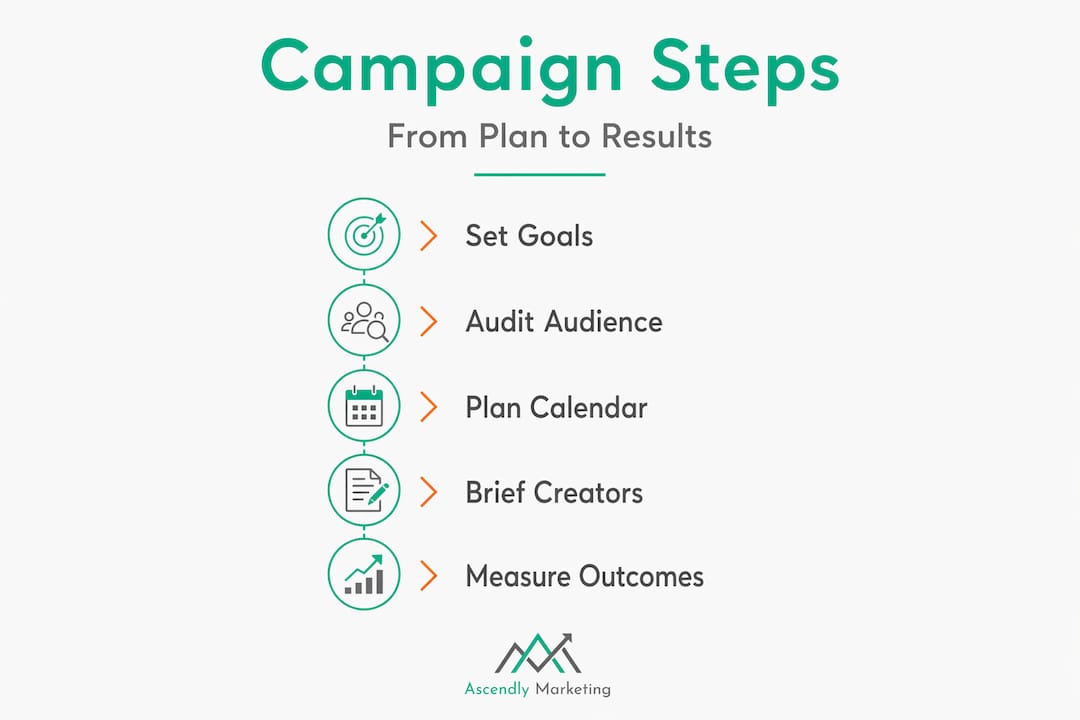
Start with SMART goals tied to real business outcomes. A goal like “get more followers” is not a campaign goal. A goal like “generate 50 qualified leads in 30 days via Instagram DM” is. Every creative decision, budget allocation, and platform choice should trace back to that specific outcome. If you are building a social media plan without this anchor, you will struggle to measure success or justify spend.
Before you write a single caption, run a pre-brief audience audit. This means going into the communities, subreddits, Facebook groups, and comment sections where your audience actually lives. You are not looking for demographics. You are looking for the exact language they use to describe their problems, the words they trust, and the phrases that make them scroll past. Social listening supports every stage of a campaign, from this initial audit to monitoring conversations the moment a campaign goes live.
Here is what solid pre-launch preparation looks like in practice:
- Audit your own accounts first. What content earned real engagement in the last 90 days? Identify patterns in format, topic, and timing before guessing at what to create next.
- Run competitive listening. What conversations are competitors owning? Where are they missing? Gaps in competitor narratives are your creative opportunities.
- Define your content pillars. A cyclical 7-step strategy recommends anchoring content to 3 to 4 pillars built directly from audience insights and business priorities, not internal assumptions.
- Pick platforms intentionally. Focus only on platforms where your specific audience is active. Spreading budget across four channels when your buyers are mainly on two is a fast way to get mediocre results everywhere.
Pro Tip: Before writing your content calendar, spend 30 minutes reading the comment sections on your top competitors’ highest-performing posts. You will find the exact objections, desires, and phrases your campaign needs to address.
Building and running your campaign
With foundations in place, the social media marketing process becomes far more mechanical. Here is a practical workflow for executing a campaign without dropping creative quality or missing deadlines.
Step 1: Build a 4-week rolling content calendar
A 4-week rolling content calendar should include every post date, the platform it targets, the content format, the caption draft, the asset reference file name, and the scheduled publication time. Every column serves a purpose. If a team member is sick or a creative asset is delayed, the calendar tells everyone exactly what is needed and when.
Step 2: Use a combined campaign calendar to prevent channel silos
Run one master calendar for all platforms, not separate spreadsheets per channel. When your Instagram Reels, TikTok videos, and Facebook posts all live in the same document, you spot conflicts, redundancies, and gaps much faster.

Step 3: Brief creators with specificity
Vague briefs produce vague content. Whether you are briefing an in-house creator or an external one, your brief should include the campaign goal, the specific message you want the audience to leave with, the call to action, platform specifications, and any phrases or frames to avoid. The 80/20 rule applies here. Roughly 80% of your content should serve audience value or education, with the remaining 20% driving direct offers or conversions.
Step 4: Adapt to platform nuances
A TikTok video and an Instagram Reel are not the same thing repurposed. TikTok rewards native-feeling, lo-fi content with strong hooks in the first two seconds. Instagram Reels currently favor slightly more polished visuals with on-screen text for sound-off viewing. Publishing the same video to both without adapting the format, caption, and hook leaves real reach on the table.
Pro Tip: When planning for social media, schedule your highest-performing content types for your two best-performing days of the week. Reserve experimental formats for lower-traffic days so you do not risk your peak engagement windows on unproven assets.
Here is a quick reference for content planning decisions:
| Content type | Best platform fit | Primary goal |
|---|---|---|
| Short-form video (under 60s) | TikTok, Instagram Reels, YouTube Shorts | Reach and brand awareness |
| Carousel posts | Instagram, LinkedIn | Education and saves |
| Long-form video | YouTube, Facebook | Trust building and depth |
| Static image with strong copy | Facebook, LinkedIn | Direct response and clicks |
| Stories with polls or questions | Instagram, Facebook | Engagement and research |
Measuring what actually happened
Measurement is where most SMBs either get lazy or get lost. Setting up tracking after a campaign launches is like trying to build the scoreboard after the game ends.
Effective campaign measurement requires pre-launch tracking setup, establishing baselines before the campaign starts, and structured weekly reviews to identify what to cut and what to scale. Here is what that looks like in practice:
- Set up your instrumentation before day one. This means UTM parameters on every link, Meta pixel or Conversion API for server-side event matching, promo codes for offline attribution, and unique creator links if you are working with influencers or partners.
- Establish a baseline. Before the campaign runs, record your current engagement rate, reach, website traffic from social, and conversion rate. Without a baseline, a 20% lift sounds good, but you have no way to know if it is meaningful.
- Monitor early signals within 24 to 48 hours. Social listening detects early signals like sentiment ratio shifts, unexpected audience segments amplifying your message, or message misinterpretation happening in comment sections. These signals tell you whether to accelerate, pause, or adjust messaging before problems compound.
- Run weekly reviews with a clear agenda. Test one variable at a time: format, hook style, creator tier, CTA placement, or paid amplification level. Document every test so learning accumulates.
- Use a three-layer measurement stack. Complete measurement stacks combine native platform data (reach, impressions, engagement), web analytics via UTMs (traffic, behavior, conversions), and post-purchase surveys asking customers how they heard about you. Attribution alone misses too much.
Pro Tip: Define your kill criteria before the campaign starts. For example: “If this ad set does not hit a 2x return on ad spend by day 10, we pause and reallocate.” Having that threshold written down before emotions get involved removes hesitation when results are mixed.
For paid ads specifically, Meta requires roughly 50 optimization events per ad set per week to exit its learning phase. You can calculate your minimum daily budget using: target CPA multiplied by 50, divided by 7. If your target cost per acquisition is $20, your minimum daily budget per ad set is approximately $143. Running below that threshold means your ads will deliver erratically and your data will be unreliable.
Common pitfalls to avoid
Even well-planned campaigns run into trouble. Most of these problems have been solved before. Here is where SMBs consistently lose ground:
- Spreading budget across too many platforms at once. Pick two channels, own them, then expand. Splitting a $1,500 monthly budget across five platforms means none of them get enough data to optimize.
- Launching without measurable goals. “Increase brand awareness” is not a goal. “Reach 50,000 unique accounts with a 3% engagement rate over 4 weeks” is a goal.
- Ignoring Meta’s learning phase. Low daily budgets cause erratic performance and unreliable data. Underfunded ad sets never exit the learning phase and never scale.
- Neglecting negative sentiment early. If your campaign messaging is being reinterpreted in a way you did not intend, those first comment threads will tell you. Check them within the first 24 hours and respond.
- Poor asset naming and version control. Chaos in your file system costs hours and leads to the wrong version of a creative going live. A simple naming convention like “CampaignName_Platform_Version_Date” fixes 80% of this.
“The difference between SMBs that grow on social and those that plateau is almost always the same: the ones that grow treat every campaign as a source of data, not just content.”
Automating repeatable logistics like outreach sequences, posting reminders, and asset tracking frees your team to focus on the creative and strategic decisions that actually require human judgment.
What I have learned running campaigns for SMBs
I have worked on enough campaigns to know that the planning phase is where most SMBs lose. Not because they are not trying, but because they rely on assumptions about their audience rather than evidence from actual listening.
The businesses that see real traction treat building a social media plan as an ongoing cycle, not a one-time project. Every campaign ends with a structured review that feeds the next one. Over time, this builds a compounding advantage. Your creativity gets sharper, your audience’s understanding deepens, and your budget works harder because you are not starting from zero every quarter.
One of the hardest lessons I keep watching SMBs learn the expensive way is the Meta learning phase trap. Running at half the minimum budget to “test” a campaign does not produce a valid test. It produces noise. Spend up to the threshold or do not run paid ads at all.
The most underrated step is the 24 to 48-hour post-launch check. The campaign measurement process shows that real patterns emerge fast. Catching a message misinterpretation or an unexpected audience segment early is not just damage control. It is your best optimization signal of the entire campaign. Act on it.
— Ascendly Marketing
Ready to run campaigns that actually convert?
Running through the full social media campaign steps on your own takes time, tools, and a learning curve that costs real money while you figure it out. Ascendly Marketing has been helping small and medium-sized businesses build and run campaigns that produce measurable results since 2013.
Whether you need a team to handle your social media marketing end-to-end or expert support scaling your paid reach through PPC advertising, Ascendly Marketing builds strategy around your specific goals, not generic templates. You get transparent reporting, a team that has worked with major brands, and a process that removes the guesswork from campaign planning. If you are ready to stop winging it and start building campaigns with real structure, book a consultation and see what a proper campaign workflow looks like in action.
FAQ
What are the first steps for a social media campaign?
Start by setting a specific, measurable goal tied to a business outcome, then conduct an audience audit using social listening to understand where your audience is active and what language resonates with them before creating any content.
How do you measure social media campaign success?
Use a three-layer measurement approach combining native platform analytics, UTM-tracked web analytics, and post-purchase surveys. Establish baseline metrics before the campaign launches so you have a meaningful point of comparison.
How much should an SMB budget for paid social ads?
Calculate your minimum daily budget per ad set by multiplying your target cost per acquisition by 50, then dividing by 7. Running below this threshold keeps Meta ads stuck in the learning phase, which produces unreliable data and poor performance.
How often should you review a live campaign?
Run structured weekly reviews during the campaign and check early signals within the first 24 to 48 hours of launch. Early monitoring lets you catch sentiment shifts or message misinterpretation before they affect overall results.
What is a content pillar in campaign planning for social media?
A content pillar is a core theme that anchors your content strategy. Most effective campaigns use 3 to 4 pillars built directly from audience research and business priorities, with roughly 80% of content providing value and 20% driving direct conversion.