

You can do strong work, have good crews, answer the phone, and still lose jobs because Google doesn’t connect your business to the search that matters. A homeowner types “drainage contractor near me” or “patio installation in [city],” sees three map listings and a few organic results, then calls one of the companies that showed up first. If your site has one broad Services page and a half-finished Google Business Profile, you won’t make that shortlist.
That’s the frame for SEO for landscaping. This isn’t about chasing broad traffic. It’s about showing up for local, high-intent searches and turning that visibility into calls, quote requests, and booked jobs.
The Modern Blueprint for Landscaping SEO
A lot of outdoor service professionals still build websites like online brochures. Home page, gallery, contact page, maybe a single services page. That setup used to be enough to at least give you an online presence. It doesn’t carry local search anymore.
Modern outdoor service SEO runs on location-specific search intent. Industry guidance for outdoor service providers now centers on phrases like “lawn care services in [city],” dedicated service pages, and technical elements that help Google connect your business to a service area and a service type, as outlined in Real Green’s lawn care SEO guide.
What changed in practical terms
Google no longer needs a general signal that you do landscaping. It needs clear evidence of:
What you do
Lawn maintenance, drainage, patios, retaining walls, irrigation, cleanup, planting, or design.Where do you do it
Cities, neighborhoods, and service areas that match the searches your buyers make.Why your listing and site are trustworthy
Consistent business details, reviews, page quality, and a site that works well on mobile.
That changes the whole playbook. A generic page called “Landscaping Services” won’t compete well against a business that has separate pages for paver patios, sod installation, drainage correction, and seasonal cleanup, each tied to actual service areas.
Practical rule: Google ranks specific answers for specific searches. Broad pages usually lose to focused ones.
The basic structure that works
When I map out SEO for a new landscaping client, I start with a simple question. What are the exact jobs people hire you for, and where do they want them done?
From there, the site gets built around a clear structure:
| Page type | Job it does |
|---|---|
| Homepage | States core services and primary service area |
| Service pages | Targets each revenue-producing service |
| Location pages | Matches the towns or neighborhoods you serve |
| Support content | Answers questions and builds topical depth |
This structure gives Google cleaner signals and gives buyers a shorter path to the page that matches what they need.
What doesn’t work anymore
A few patterns show up again and again on weak landscaping sites:
- One page trying to rank for every service
- No location relevance beyond the footer
- Thin city pages copied with the town name swapped
- A website that says one thing while business listings say another
If you fix those four issues, you move from “has a website” to “has a search system.”
Dominate Your Local Map Pack
The map pack is where local grounds care SEO usually pays off first. Ignite Visibility reports that grounds care professionals can see up to 126% more traffic and 93% more calls, clicks, and requests when they rank in the local map pack, according to its guide on SEO for landscapers.
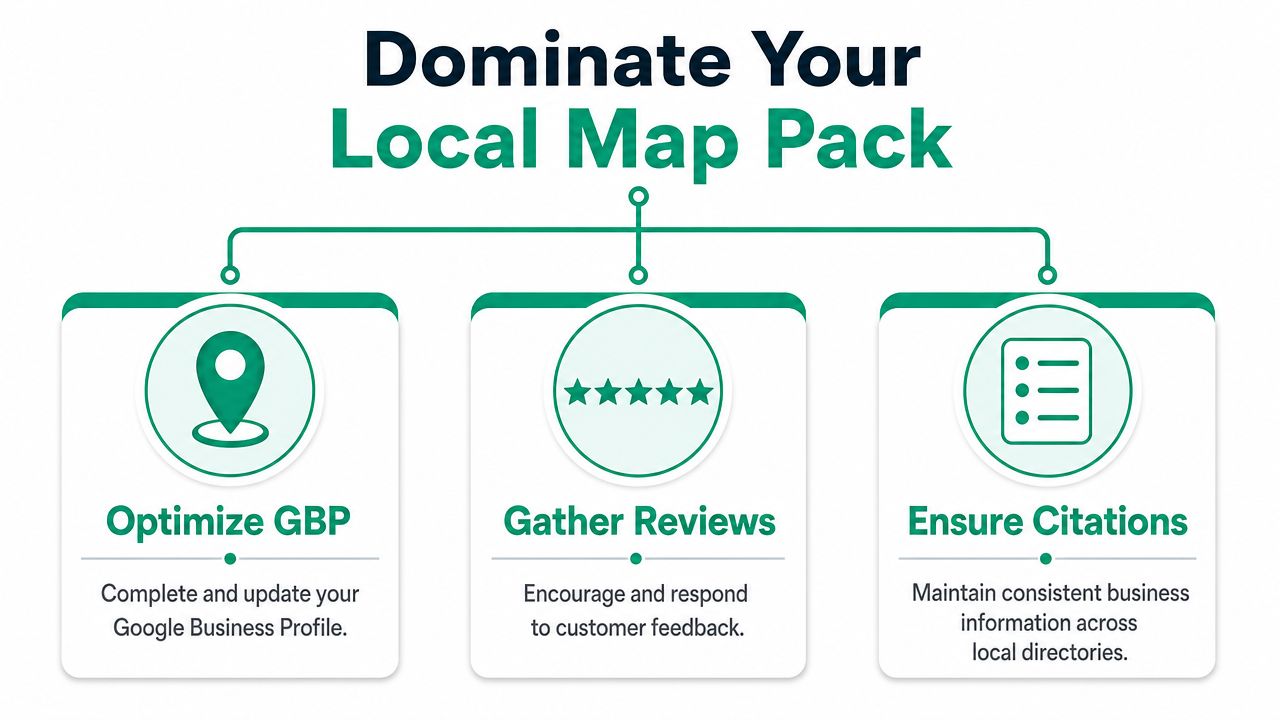
That stat lines up with what outdoor service providers already know from the field. Searchers in the map pack aren’t browsing casually. They’re comparing options and looking for someone to call.
Fill out the entire Google Business Profile.
Partial profiles underperform. A landscaping business should complete every relevant field in Google Business Profile and keep it current.
Start with the basics:
Business name
Use your real operating name. Don’t stuff extra keywords into it.Primary and secondary categories
Choose categories that match your actual services.Service areas
Add the areas you serve. Don’t stretch this beyond your operating reality.Phone, website, and hours
These need to match your website and local citations.Photos
Add real project photos, crew photos, equipment shots, and before-and-after work where appropriate.
A polished profile helps in two ways. Google gets stronger business signals, and homeowners get fewer reasons to hesitate.
Reviews need a process, not good intentions
Most outdoor service providers ask for reviews randomly. That creates long gaps and uneven momentum. A better system is simple.
Ask right after a positive handoff
If the client is happy at walkthrough or job completion, ask them.Send one direct review link
Don’t make the customer search for your profile.Reply to every review
Short, specific responses work better than canned ones.
A steady review flow beats a burst followed by silence.
The address problem for service-area businesses
Many professionals in exterior grounds care encounter difficulties. Your operations might span a wide area, often without a traditional storefront. This dynamic creates friction with Google Maps verification and local pack visibility.
The hard truth is that setup shortcuts usually create bigger problems later. If your profile depends on a shaky address situation, rankings can become unstable, and verification can become a recurring headache.
Recent guidance for grounds care professionals has put more attention on securing a legitimate operating location, passing video verification, and handling the compliance side of being a service-area business, as discussed in this Google Maps guide for lawn care and landscaping companies.
What to do if you serve a broad territory
Don’t try to force one profile to represent every market equally. Usually, the smarter move is to center your profile on the area where you can legitimately operate and where lead quality is strongest.
Use your website to expand coverage more intelligently:
- Build local relevance with service-area pages
- Keep your business information consistent across directories
- Support your Maps strategy with stronger on-site content
If you want a practical checklist for the listing side, this guide on how to rank higher on Google Maps is a useful companion.
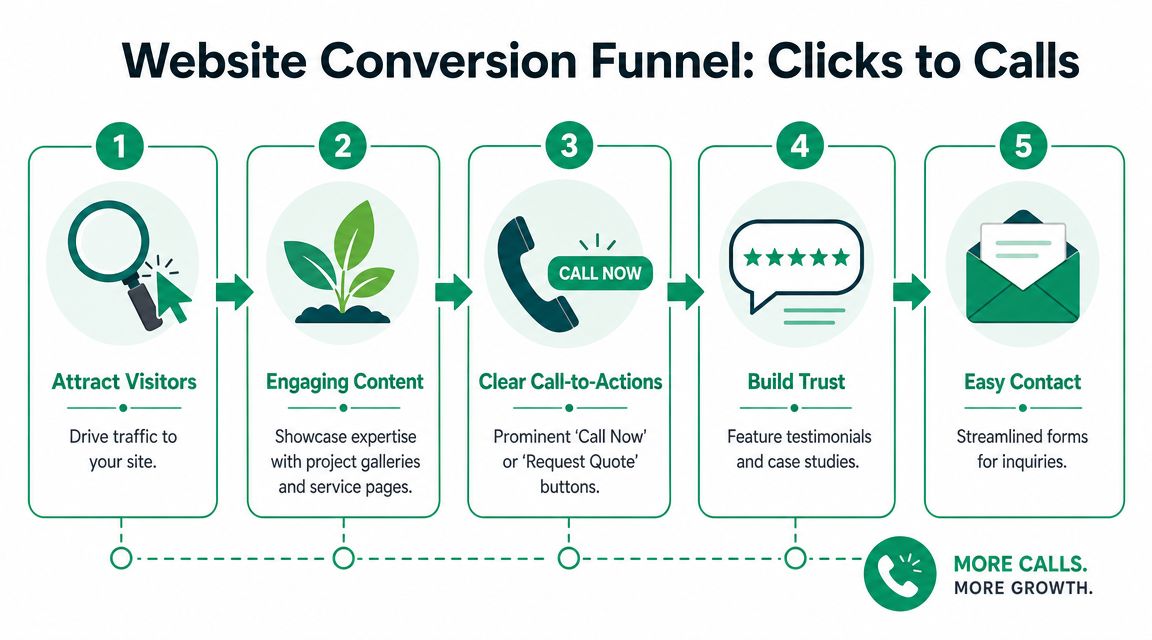
Build a Website That Converts Clicks into Calls
A strong Google Business Profile gets you discovered. Your website closes the gap between interest and contact.
For local landscaping SEO, Aspire recommends pages that load in under 3 seconds, paired with a mobile-friendly design and consistent NAP data, in its guide to landscaping business SEO. That benchmark matters because most local buyers are visiting from a phone, often while comparing several companies at once.
Start with speed and mobile use
If a landscaping site feels slow on a phone, people leave. You don’t need a fancy explanation for that. They tap back and choose the next result.
Run your pages through Google PageSpeed Insights. Then check them manually on your own phone.
Look for these friction points:
Heavy image files
Galleries often slow landscaping sites down first.Buttons that sit too low on the page
Make phone and quote actions visible early.Tiny text or cramped layouts
Mobile users won’t work to read your content.
Build the site around how buyers search
A landscaping website should have a clean hierarchy. Home page at the top. Then the service pages. Then the location pages are needed. Then support content that answers specific questions.
Here’s the structure I use most often:
| Site element | What belongs there |
|---|---|
| Homepage | Core services, service area, proof of work, primary contact actions |
| Service pages | One page per major service |
| Location pages | One page per core town or neighborhood you actively target |
| Project galleries | Photos tied to real services, not a random image dump |
| Contact page | Short form, phone number, business details |
A homepage shouldn’t carry the whole SEO load. If you install patios, fix drainage, maintain lawns, and build retaining walls, each one needs its own page.
Keep business details consistent
Your name, address, and phone number need to match across your website and local listings. Small mismatches create trust issues for both search engines and people.
Place your core contact details in predictable spots:
- Header or top bar
- Footer
- Contact page
- Relevant schema and page metadata if your site setup allows it
This walkthrough on how to design a business website that converts is useful if your site gets traffic but not enough inquiries.
A short video can also help you think more clearly about the conversion side of local traffic:
Calls to action should be obvious
A landscaping site doesn’t need clever calls to action. It needs visible ones.
Field-tested advice: If someone has to hunt for your phone number, the page is underperforming.
Use direct actions such as call now, request a quote, or schedule an estimate. Repeat them in the header, near the middle of long service pages, and at the bottom.
Create Content That Attracts Ready-to-Hire Clients
Most landscaping websites stop at the obvious pages. Lawn care. Landscaping. Contact. Maybe a gallery. That’s where they flatten out.
A major gap in landscaping SEO content is the lack of service-area pages and project-type pages built around niche buyer intent. Many guides cover the basics, but they rarely show how to create pages for work like drainage, patio installation, or seasonal cleanup in specific neighborhoods, as noted in this guide on SEO for landscapers.

That’s the opening most competitors leave on the table.
Stop writing only broad service pages
“Landscaping services” is too broad to carry your whole content strategy. A homeowner looking for drainage correction is not the same searcher as someone pricing spring cleanup. A buyer comparing patio builders is not looking for weekly mowing.
Split your content into two layers.
Project-type pages
These pages match a narrow, commercial search. Examples include:
- Drainage solutions
- Paver patio installation
- Retaining wall construction
- Seasonal cleanup
- Sod installation
- Irrigation repair
These are money pages, not blog filler. They should explain the job, common homeowner concerns, relevant photos, service areas, and a clean path to contact.
Hyperlocal service-area pages
These pages connect those services to priority locations.
A weak version says, “We serve Town A, Town B, and Town C.”
A strong version creates pages such as:
- Patio installation in a specific town
- Drainage contractor in a specific neighborhood
- Seasonal cleanup in a targeted service area
That structure matches how ready-to-hire buyers search.
A simple page framework that works
Every page doesn’t need to be long. It does need to be distinct.
Use this structure:
Clear page title
State the service and place directly.Specific opening copy
Describe the job and the local context without generic filler.Scope of work
Explain what’s included.Project photos or examples
Show the type of result tied to that service.Common questions
Address buyer concerns before they call.Direct CTA
Make the next step obvious.
Don’t build location pages by swapping city names into the same paragraph. That creates weak pages and weak rankings.
Use inspiration content the right way
Some content supports conversion even when it isn’t a direct service page. Retaining walls are a good example. Buyers often want ideas before they ask for a quote, so design inspiration can bring in early-stage interest and help move visitors toward a project page. A helpful example is this roundup of creative retaining wall landscaping ideas, which shows the kind of visual angle homeowners respond to.
The key is linking that inspiration back to a local service page. Don’t let informational traffic hit a dead end.
What to write next if your site is thin
If you’re staring at a sparse site and wondering what pages to build first, use this order:
| Priority | Page type |
|---|---|
| First | Highest-margin core service pages |
| Second | Highest-demand niche project pages |
| Third | Service-area pages for top locations |
| Fourth | Support content that answers common pre-sale questions |
For the writing side, this guide on how to write SEO content that drives growth is a useful reference.
Earn Links That Build Local Authority
Most grounds care professionals hear “link building” and think of something technical, expensive, or shady. Local link building is simpler than that when you treat it as relationship building with a digital follow-through.
A link from a relevant local organization, business partner, or community page helps search engines trust your geographic presence. It also sends referral traffic from people who already live in your market.

Three scenarios that work in the real world
The first one is straightforward. A landscaping company sponsors a youth sports team. Their logo goes on the sponsor page, and the league links back to the company website. That’s a real local signal tied to a real local entity. No tricks.
The second one comes from partnerships. A pool installer, fence company, or real estate agent already serves the same homeowner at a different stage of the property cycle. Create a referral page, a co-branded resource, or a simple local vendor roundup. If both businesses publish it, both can link to each other naturally.
The third path is event or project visibility. If your team contributes to a community cleanup, a neighborhood beautification effort, or a public-facing project, send photos and a short write-up to local publications, neighborhood blogs, and chamber pages. Some won’t publish it. Some will. One relevant local link is worth pursuing.
What to say when you reach out
Most outreach fails because it sounds like outreach.
Try language that reflects a real business reason:
For partners
“We work with homeowners at a similar stage. Want to create a local resource page and include each other?”For community groups
“We’re supporting this event and can send a short company description, logo, and website if you’re listing sponsors.”For local editors or bloggers
“We completed a project that may be useful for your local home and garden audience. I can send photos and a summary.”
Local links are earned offline first. The website mention comes after the relationship exists.
What not to spend time on
Skip low-value activity that looks like SEO work but rarely builds useful authority:
- Mass directory submissions beyond the core listings you maintain
- Paid links from unrelated websites
- Generic guest posts on sites with no local or industry relevance
- Comment spam and forum drops
Good local authority usually looks ordinary. Sponsorships. Partnerships. Community involvement. Press mentions. Vendor relationships. Those are easier to sustain and easier to defend.
Measure What Matters for Business Growth
A common scenario. A new client sees more organic traffic in GA4 and assumes SEO is working. Then we trace the leads and find that the pages getting visits are not the pages producing estimate requests, map actions, or qualified calls.
SEO for outdoor service providers should be measured by booked opportunities, not by visibility alone. Rankings and clicks matter because they create lead opportunities. If they do not produce calls, form submissions, or estimate requests in the service areas you want, they are only partial progress.
Start with a simple scorecard built around buyer actions:
- Phone calls from the website
- Contact form submissions
- Mobile tap-to-call clicks
- Google Business Profile calls, direction requests, and website clicks
- Landing pages that assist or produce inquiries
Google Analytics 4 and Google Search Console cover the basics. The missing piece is usually the setup. Many companies have analytics installed but no event tracking on calls, forms, quote buttons, or location page engagement.
A useful monthly dashboard answers four questions:
| Question | What to check |
|---|---|
| Which pages bring in organic visitors? | Organic landing pages in GA4 and Search Console |
| Which pages create leads? | Conversion events tied to calls and forms |
| Which towns and service pages perform best? | Page-level conversions and Google Business Profile activity |
| Where are you losing demand? | Pages with traffic but weak inquiry rates |
That last row matters more than many owners realize.
Here, many companies lose the plot. They see a service-area page getting impressions and clicks, but the page says almost the same thing as five other town pages. It does not mention local project types, common property conditions, pricing expectations, or proof from jobs in that area. Google struggles to separate the pages. Homeowners do not see a reason to call.
This is one of the clearest gaps in SEO for outdoor service providers. Generic advice says to make location pages. The better play is to build hyper-specific service-area and project-type pages, then measure which combinations generate leads. A drainage page for one suburb may convert well because that area has grading issues. A patio page in another town may draw stronger demand because homeowners there are upgrading older backyards. That pattern should shape what you publish next.
Measurement also helps catch Google Maps problems that hurt lead flow. Service-area businesses often deal with verification issues, suspended profiles, or listings that lose visibility after an address change. If calls from the Business Profile drop while rankings on the site stay stable, check the profile before rewriting pages. The issue may be operational, not content-related.
Tie this back to sales workflow. If your organic traffic produces a high volume of low-fit cleanup requests and very few profitable design-build estimates, change the page mix, calls to action, and qualification steps. For teams that want a cleaner handoff from lead to proposal, Exayard landscaping estimating software is a practical example of a system that helps organize incoming opportunities after the inquiry comes in.
Use a monthly review process that leads to decisions:
- Pull your top organic landing pages
- Compare traffic against calls and forms
- Flag pages with visits but weak conversion rates
- Rewrite, merge, or narrow overlapping pages
- Expand the service-area and project-type pages that bring qualified inquiries
Ascendly Marketing can support the SEO strategy, site updates, and conversion tracking setup if your team needs outside execution help.