

TL;DR:
- Omni channel marketing creates a seamless customer experience by connecting multiple platforms and data sources. It focuses on journey continuity, personalization, and cross-channel attribution rather than simple presence. Implementing it involves unifying customer data, mapping key journeys, and addressing operational silos to drive higher engagement and revenue.
Most business owners hear “omni-channel marketing” and assume it means showing up on Instagram, sending emails, and having a website. That’s multi-channel presence. Omni-channel marketing is something more deliberate. It’s a strategy where every platform, touchpoint, and interaction feeds into one connected customer experience. When a customer browses your site, visits your store, and then gets a follow-up text, omni-channel means all three moments feel like one conversation. This guide breaks down exactly what that looks like and how to build it without a Fortune 500 budget.
Table of Contents
- Key Takeaways
- What is omni-channel marketing, really?
- Benefits of Omni-channel for Small Businesses
- How to implement an omni-channel strategy
- Common myths and challenges to know
- Real-world omni-channel marketing examples
- My honest take on what actually makes this work
- Ready to build your omni-channel strategy?
- FAQ
Key Takeaways
| Point | Details |
|---|---|
| Omni-channel is integration, not presence | Connecting your channels with shared data creates continuity that multi-channel alone cannot deliver. |
| Customer data is the engine | A unified customer profile built from real-time data across every touchpoint is what makes personalization possible. |
| Start with 1–3 journeys | Trying to orchestrate all channels at once leads to failure. Pick priority journeys and prove the model first. |
| The business case is real | Omni-channel customers spend 30% more and shop more frequently than single-channel customers. |
| Metrics must cross channels | Measuring success channel by channel misses the point. Cross-channel attribution reveals what actually drives results. |
What is omni-channel marketing, really?
At its core, omni-channel marketing delivers a seamless, integrated experience across every digital and physical channel by using customer interaction data for personalization. Email, your website, social media, a mobile app, your physical store. They all talk to each other. That is the distinction.
Think of it this way. A customer finds you through a Google ad, clicks to your site, adds a product to their cart, then leaves without buying. A week later, they walk into your store. In a multi-channel setup, your store associate has no idea who this person is. In an omni-channel setup, that cart data exists in a unified profile, and a smart associate or a point-of-sale system can surface it, pick up the conversation, and close the sale.
How it compares to multi-channel marketing
The difference between omni-channel and multi-channel is not about how many platforms you use. It’s about how those platforms relate to each other. Multi-channel treats channels independently, with separate messaging, separate data, and separate performance goals. Omni-channel focuses on journey continuity, using what happened on one channel to inform the next.
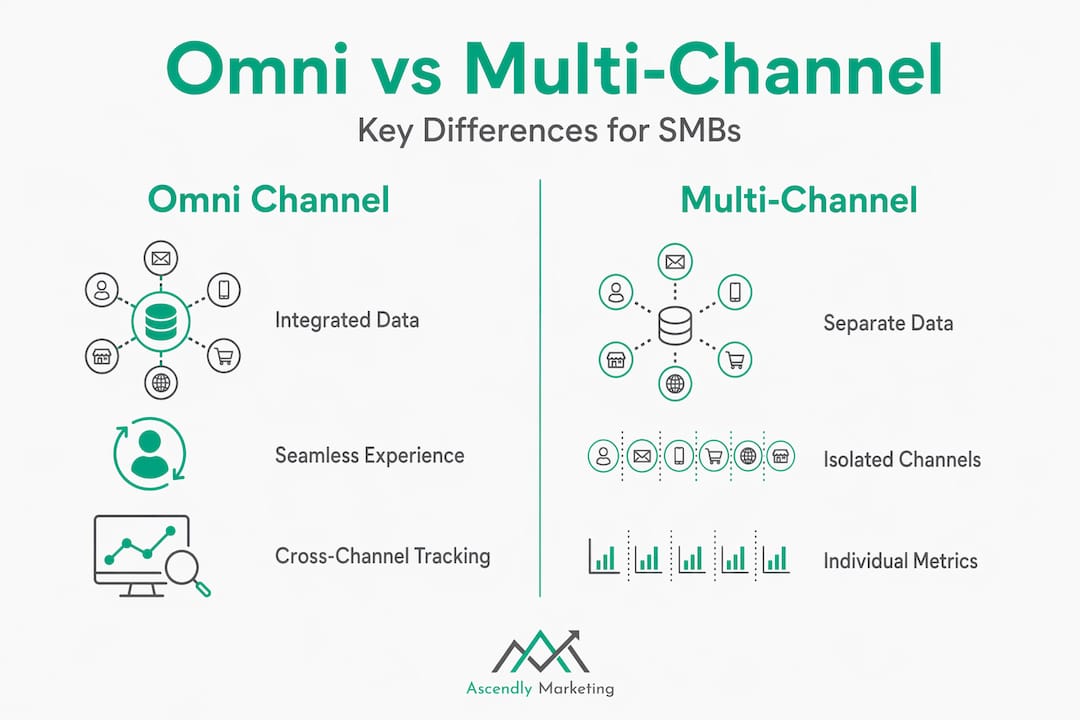
| Feature | Multi-channel | Omni channel |
|---|---|---|
| Channel relationship | Independent | Integrated and interconnected |
| Customer data | Stored by channel | Unified across all touchpoints |
| Messaging | Consistent branding only | Personalized to individual context |
| Customer experience | Fragmented | Continuous and context-aware |
| Measurement | Per-channel KPIs | Cross-channel attribution |
The core components that make omni-channel work include:
- Channel integration: Online and offline platforms share data and trigger actions with each other.
- Unified customer profiles: A real-time customer profile consolidates behavior from every touchpoint to enable personalization.
- Consistent messaging: The tone, offer, and context carry forward from one channel to the next.
- Customer journey mapping: You design sequences around how customers actually move, not around how your departments are structured.
Benefits of Omni-channel for Small Businesses
The business case is not abstract. Omni-channel customers spend 30% more and shop 70% more frequently than customers who only interact with a single channel. For an SMB, that kind of lift does not come from a new platform. It comes from connecting the ones you already have.
Here is what you actually gain when you implement an omni-channel strategy well:
- Higher customer retention: When customers don’t have to repeat their information or re-explain their situation every time they switch channels, they stay. Avoiding those dead ends is one of the clearest loyalty drivers available to small businesses.
- Better purchase decisions: Customers who research on mobile and buy in-store convert at higher rates when the experience is continuous. Their confidence builds across the journey instead of resetting at each channel.
- Richer data for decisions: Every interaction across your connected channels feeds your understanding of customer behavior. Over time, that data tells you which journeys convert, which channels assist, and where customers drop off.
- Reduced friction: When a customer’s cart syncs between their phone and desktop, or when your email references the product they looked at on your site, they move toward purchase faster.
Pro Tip: Don’t measure omni-channel success by how well each channel performs. Use cross-channel metrics like assisted conversions, customer lifetime value by journey type, and cross-device attribution to see the full picture.
The operational side matters too. When your teams share customer context instead of working from separate data sets, they make faster, better decisions. Data-driven marketing is not just a growth tactic for big brands. For SMBs, it’s the difference between guessing and knowing.

How to implement an omni-channel strategy
The biggest mistake businesses make is trying to connect everything at once. That leads to half-built integrations and unclear results. Here is a practical sequence that actually works.
Collect and unify your customer data. Before you can personalize anything, you need one place where customer behavior from all channels lives together. This might be a CRM, a customer data platform, or even a well-structured email marketing tool that connects to your e-commerce and ad platforms. The goal is a single customer view.
Map your priority customer journeys. Start with 1 to 3 core journeys to orchestrate before expanding. For most SMBs, those are acquisition (how someone discovers you), purchase (how they convert), and retention (how you keep them). Map each journey step by step across the channels your customers actually use.
Segment your audience by behavior, not just demographics. Knowing a customer is a 35-year-old woman in Texas is less useful than knowing she abandoned a cart twice, opened three emails, and visited your store once. Segment based on what people do, then tailor your messaging to that behavior pattern. Personalized marketing performs significantly better when it reflects real customer context.
Audit your current channels and fill integration gaps. Look at the channels you already operate and ask whether they share data. Does your email platform know what someone bought in your store? Does your social ad retargeting exclude people who already converted? Identify the disconnects and prioritize fixing the ones on your top 1 to 3 journeys first.
Establish cross-channel success metrics before you launch. Decide in advance how you will measure whether the strategy is working. This means tracking customers across sessions and channels, not just within them. Attribution models that give credit to assisted touchpoints are far more useful than last-click reporting.
Run A/B tests and optimize continuously. Effective omni-channel programs rely on behavioral insights and iterative testing. Test different message sequences, timing between touchpoints, and channel combinations. Your first version will not be your best version. Build iteration into the plan from day one.
Pro Tip: The most common early failure is siloed data. Before investing in new channels or tools, check whether your existing platforms can share customer data through native integrations or API connections. Fixing the data layer first makes every other step easier.
Common myths and challenges to know
Getting omni-channel marketing right requires getting past some persistent misconceptions that hold SMBs back.
Myth: Consistent branding is enough. Many businesses believe that using the same logo, colors, and tone across channels means they are doing omni-channel. Operational failure happens when teams share consistent branding but have no unified customer data. Branding consistency is table stakes. The actual differentiator is knowing what the customer did before they arrived at the current channel and responding to that context.
Myth: Omni-channel requires massive technology investment. Small businesses assume they need an enterprise-grade stack to make this work. In practice, many modern CRMs and email platforms already offer basic cross-channel data sharing. Start with what you have, connect the highest-impact gaps, and scale the tech as your program matures.
The real challenges tend to be operational, not technological:
- Siloed teams: Marketing, sales, and customer service often work from different data sets. Sharing customer context across these teams is a process and culture change, not just a tech problem.
- Lack of real-time profiles: Batch data processing means the customer profile your team sees is often hours or days old. Real-time data is what allows asynchronous shopping experiences to retain transaction progress across devices.
- Attribution complexity: Understanding which channel combination drove a sale requires more sophisticated measurement than most SMBs set up by default.
“True omni-channel success demands data and identity integration across teams and channels, not just creative alignment.” (Salesforce)
Pro Tip: Schedule a monthly cross-team review where marketing, sales, and customer service share what they are hearing from customers. This informal data sharing often surfaces journey gaps faster than any analytics dashboard.
Real-world omni-channel marketing examples
Looking at how omni-channel works in practice helps make the strategy tangible. Consider a specialty outdoor gear retailer with a physical store, an e-commerce site, and an email list.
| Channel | Without omni-channel | With omni-channel |
|---|---|---|
| Website visit | Anonymous session tracked separately | Visitor identified, cart saved to profile |
| Email follow-up | Generic promotional blast | Triggered message referencing browsed products |
| In-store visit | No connection to online behavior | Associate can see previous interactions |
| Post-purchase | Separate loyalty program | Cross-channel points and personalized reorder suggestions |
A customer who browses hiking boots online receives an email with those exact boots the next morning, and then walks in to find an associate who mentions the deal they received. That is omni-channel retail in action. It does not require Amazon’s infrastructure. It requires connected data and a clear sequence.
Amazon is worth studying specifically because their omni-channel strategy centers on one thing: removing friction at every moment. Cart sync across devices, purchase history that informs every recommendation, and fulfillment options that span digital and physical. The customer never has to start over. That principle scales down to any business size. The buyer’s journey today is heavily digital, and capturing intent at each stage is where omni-channel pays off.
Pro Tip: Track conversions with a “path to purchase” report that shows every channel a customer touched before buying. This reveals which channel combinations drive the most revenue and where to invest next.
My honest take on what actually makes this work
I’ve worked with enough SMBs to know that the thing that separates businesses that succeed with omni-channel from those that spend money and get frustrated is this: they fix the data before they build the experience.
What I’ve seen over and over is teams spending time on creative consistency, coordinating colors and copy across platforms, while their CRM still can’t tell you whether a customer made a purchase last week. The experience feels unified visually but completely falls apart the moment a customer calls support and has to re-explain their situation from scratch.
My take is that omni-channel is less a marketing tactic and more an operational philosophy. You are deciding to put the customer’s journey at the center of how your business functions. That means breaking down the wall between marketing data and sales data. It means customer service knows what the last email said. It means your ad spend is informed by in-store behavior.
Starting small is not just acceptable; it’s the right move. Pick one journey, get the data connected, measure what changes, and build from there. The businesses I’ve seen try to do it all at once rarely get past the planning phase. The ones who start with the acquisition-to-first-purchase journey and nail it first. Those are the ones who scale it into something that genuinely changes their revenue.
— Ascendly Marketing
Ready to build your omni-channel strategy?
If you’ve been running separate campaigns across different channels without a shared data layer connecting them, you are leaving real revenue on the table. At Ascendly Marketing, we help SMBs tie their channels together into a strategy that actually moves customers forward.

From SEO that drives qualified traffic to paid advertising that retargets across platforms, and social media marketing that connects with customers where they spend time. We build integrated programs tailored to your business size and budget. Our team has worked with SMBs since 2013, and we know what a realistic, high-impact omni-channel program looks like at every stage of growth. Book a consultation and let’s map out where your biggest opportunities are.
FAQ
What is the main difference between omni-channel and multi-channel?
Multi-channel marketing uses multiple platforms independently, with separate data and goals for each. Omni-channel integrates those platforms so that customer data and context carry forward from one channel to the next, creating a continuous experience.
Do small businesses need expensive software to do omni-channel?
Not necessarily. Many small businesses can start with a connected CRM and email platform that shares data with their e-commerce site. The priority is unifying customer data, not buying the most expensive tool.
How do omni-channel customers behave differently?
Omni-channel customers spend 30% more and shop 70% more frequently than single-channel customers, making them significantly more valuable over time.
Where should an SMB start with omni-channel?
Start by mapping one to three priority customer journeys, such as acquisition or purchase, and identify the data gaps between the channels involved. Closing those gaps first gives you a measurable foundation to build on.
Is omni-channel only relevant for retail businesses?
No. Any business with multiple customer touchpoints benefits from an omni-channel approach, including service businesses, B2B companies, and subscription brands. The core principle of connected, context-aware interactions applies across industries.