

Referrals still close jobs. They also leave gaps in the calendar.
A lot of painting companies hit the same ceiling. One month is full because a past customer told a neighbor about your crew. The next month slows down, and you start wondering why another painter keeps showing up in Google Maps every time someone searches for interior painting, exterior painting, or a house painter nearby.
That gap is where painting company SEO stops being a side task and becomes a lead system. The point isn’t to chase vanity rankings. The point is to show up when a homeowner is ready to call, compare, and book an estimate.
From Word-of-Mouth to a Flood of Online Leads
A common pattern looks like this. The business does solid work, customers are happy, and referrals come in often enough to keep things moving. But the owner still has no predictable way to control lead flow. When referrals slow down, the schedule softens. When the busy season hits, competitors with stronger local visibility catch the calls first.
Search behavior explains why. Searches for “near me” on mobile have grown by over 500%, and 76% of people who search for something nearby on a smartphone visit a business within a day, while 28% of those searches lead to a purchase, according to Google search behavior data summarized by SEO Sherpa. For painters, that means local search isn’t casual browsing. It’s often someone with a project in mind and a short list of contractors they want to contact now.
Why painters lose leads online
Most painting websites don’t fail because of one dramatic mistake. They fail because they create friction.
- No clear next step means a visitor has to hunt for a phone number or form.
- Thin service pages leave homeowners unsure whether you handle their type of project.
- Weak proof, such as outdated photos or no project details, makes every company look the same.
- Poor lead handling wastes the traffic you worked to earn.
A lot of owners spend time trying to get more visitors before fixing what happens after the click. That’s backwards. If your estimate request process is clunky, even strong rankings won’t turn into booked work. Simple templates to qualify leads can help you collect the details that matter before you call back, such as project type, location, timeline, and budget range.
Practical rule: SEO for painters works when Google sees local relevance and homeowners see proof they can trust.
The companies that win local search usually aren’t using secret tactics. They have a clean local setup, clear service pages, recent photos, review momentum, and a site built to make calling easy. That’s the playbook.
Building Your Unshakeable Local SEO Foundation
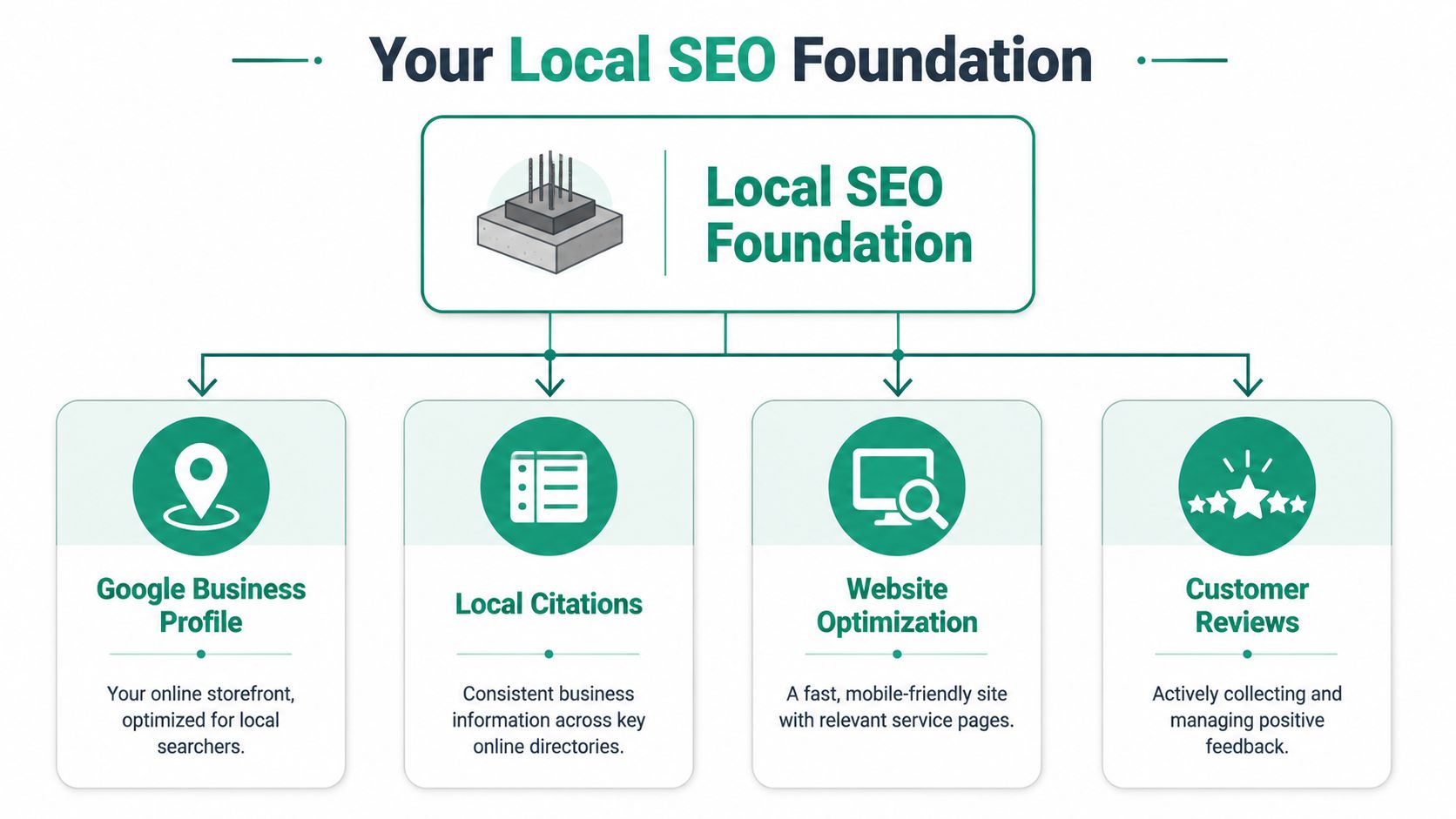
Local SEO for painters starts with a short list of assets that carry most of the weight. A fully completed Google Business Profile, consistent business information across the web, service and location pages on your site, and a process for generating reviews form the highest-yield setup for local service businesses, as noted in Sixth City Marketing’s guidance on SEO for painters.
Start with your Google Business Profile
Your Google Business Profile is often the first page a homeowner sees. Treat it like your storefront.
Complete every field you can. Add your core services. Keep hours current. Upload recent project photos on a steady basis. Use the Q&A area to answer the questions people ask before they call, such as whether you handle interior jobs, exterior work, or estimate appointments. If you serve multiple towns, define your service area clearly.
Just as important, make sure the primary phone number is visible and matches what appears on your website and listings elsewhere.
Clean up your citations
Citations are simple in theory and messy in practice. Your name, address, and phone number need to match across major directories, local listings, and your own website. Small inconsistencies create confusion. A suite number on one listing and no suite number on another may look minor to you, but local search relies on consistency.
Work through your listings one by one.
- Lock your master version of the business name, address, and main phone number.
- Update the website first, then your Google Business Profile, then major directories.
- Remove duplicates where possible, so Google isn’t seeing multiple versions of the same company.
- Check seasonal edits because owners often change hours or service descriptions and forget to carry the update everywhere else.
If you’re trying to improve map visibility, a focused guide on how to rank higher on Google Maps will help you tighten the local side without overcomplicating it.
Build pages around services and places
A single generic “painting services” page rarely does enough work. Homeowners search with specific intent. They want interior painting, exterior painting, cabinet painting, commercial work, or help in a specific city.
Your site should reflect that. Create service pages for the work you want more of, and location pages for the areas you actively target. Keep those pages useful. Don’t stuff every town name into a block of text. Show photos, describe the service, and make the contact step easy.
The page should answer three questions fast. What do you do, where do you do it, and how does someone contact you right now?
Choose the market before you chase the ranking
Most painter SEO advice often gets thin. It tells you how to optimize a page, but not whether the market is worth pursuing in the first place.
If your main city is packed with established competitors in the map pack, don’t assume your only option is to fight there first. Look at adjacent towns, suburbs, and secondary service areas where search demand still exists, but competition may be lighter. In practice, some painters get better lead flow by building a strong position around a winnable area instead of trying to force visibility in the hardest ZIP codes from day one.
That decision shapes every page you build after it.
Designing Service Pages That Convert Visitors
A service page has one job. Turn a searcher into a lead.
Too many painting websites treat service pages like keyword containers. They mention the service name, add a few city names, and hope Google does the rest. That approach misses the actual sale. When someone lands on your interior painting page, they aren’t grading your SEO technique. They’re deciding whether to call you or go back to the search results.
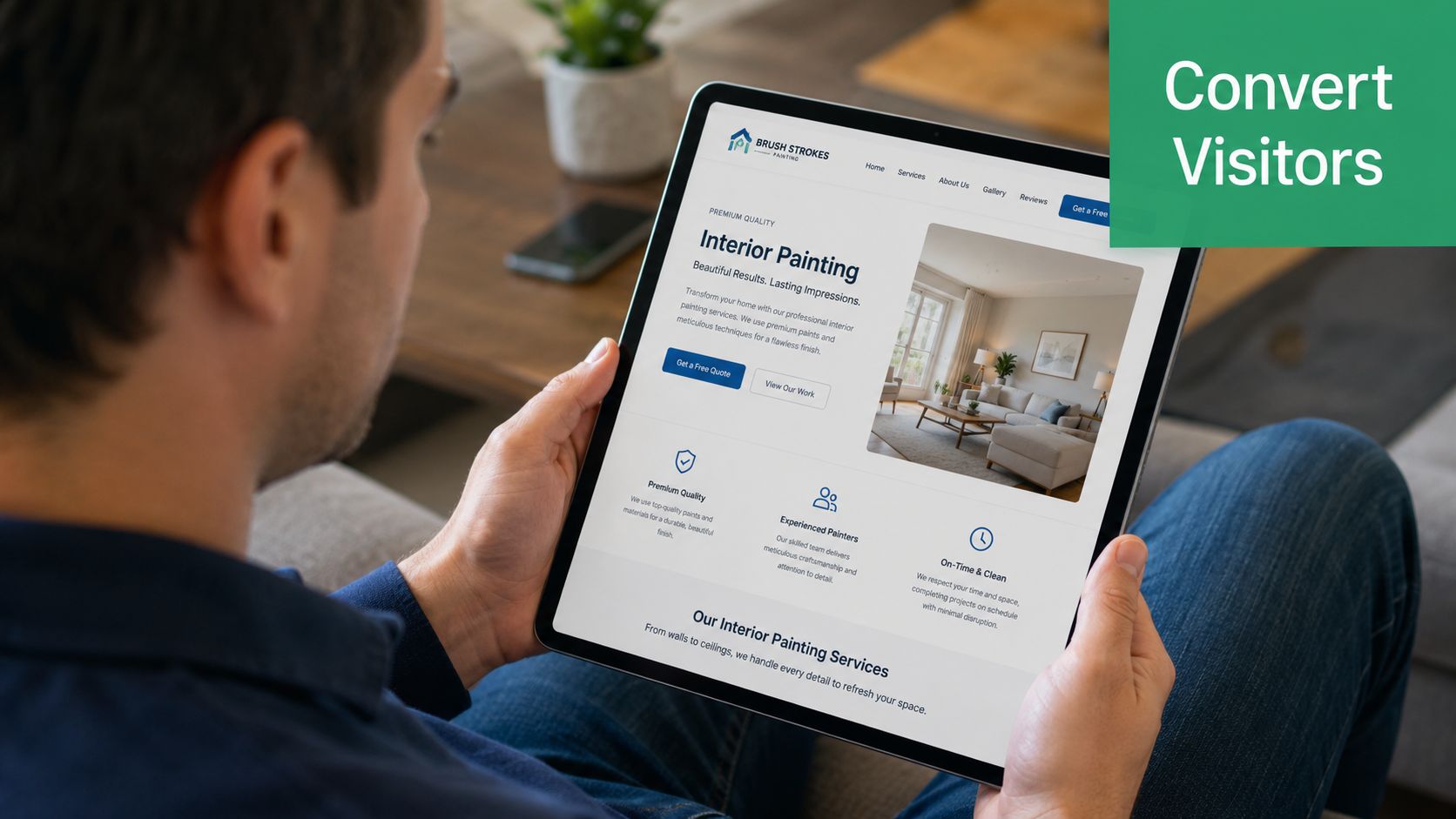
Emerging guidance for 2026 points toward media-rich local pages with photos, videos, and click-to-call elements because those signals help prove trust and reduce friction for potential customers, according to Gushwork’s painter SEO analysis.
What a strong page needs above the fold
The top of the page should remove doubt quickly. A visitor shouldn’t have to scroll to figure out whether they’re in the right place.
Put these elements near the top:
- A clear service headline that matches the page intent, such as Interior Painting or Exterior House Painting
- A short location cue that confirms the areas you serve
- A primary call action with a visible phone number and a request-estimate option
- Project imagery that shows real work, not generic stock art
- A brief proof section, such as reviews, testimonial excerpts, or recent project references
For page structure, a practical reference on how to design a business website that converts is useful because the conversion layer matters as much as the keyword target.
Show the work before you explain it
Painting is visual. Your website should sell that way.
Before-and-after photos do more than fill space. They answer the silent question every homeowner has. Can this company deliver a clean result on a home like mine? Organize galleries by service type. Interior photos belong on the interior page. Exterior work belongs on the exterior page. Keep images recent and relevant.
A short walkthrough video can do the same job faster than a long paragraph. This is the kind of media that keeps a visitor engaged and helps them trust what they’re seeing.
Here’s an example of the style of video content that fits naturally on a painting service page:
Structure the middle of the page around objections
Most visitors aren’t asking for more words. They’re looking for reassurance.
A service page should answer common objections in plain English:
| Page element | What it answers |
|---|---|
| Service area section | Do you work where I live? |
| Gallery or project examples | Are you any good? |
| Process overview | What happens after I contact you? |
| Testimonial or review snippets | Have other customers had a good experience? |
| Click-to-call and estimate form | How do I reach you right now? |
If you’re building pages in WordPress and want a practical helper for titles, structure, and on-page checks, an Elementor on-page SEO plugin can simplify the editing side without turning the page into an SEO science project.
A page that ranks but doesn’t convert is unfinished work.
The strongest painter pages read like a sales conversation. They don’t ramble. They guide the visitor from service match to proof, to contact.
Your Content Roadmap for Attracting Homeowners
Service pages capture ready-to-book visitors. Content picks up everyone else.
That matters because homeowners don’t always start with “hire a painter near me.” Many start with a question. Which paint finish works in a kitchen? How long does exterior paint last? What should I ask a painter before getting an estimate? If your site answers those questions well, you earn the visit before the customer has chosen a contractor.
One wording choice can change visibility more than most owners expect. Content built around “house painter” can generate 200% more impressions than content using “residential painter,” according to ServiceTitan’s guide to SEO for painters. That’s a reminder to write around the words homeowners use, not the terms a business prefers internally.
Build topics around intent
The easiest content plan is intent-based. Match the article to the stage the homeowner is in.
| Funnel Stage | Customer Question | Sample Blog Post Title |
|---|---|---|
| Awareness | What paint sheen works in busy rooms? | How to Choose the Right Paint Sheen for a Kitchen |
| Awareness | How often should exterior paint be redone? | When Should You Repaint a House Exterior |
| Awareness | What’s involved before painting starts? | How to Prepare Your Home Before a Painting Crew Arrives |
| Consideration | Which paint brand should I compare? | Comparing Benjamin Moore and Sherwin-Williams for Home Projects |
| Consideration | Should I paint cabinets or replace them? | Cabinet Painting vs Cabinet Replacement |
| Consideration | What should I ask before hiring a painter? | Questions to Ask Before You Request a Painting Estimate |
| Decision | What will this job likely cost in my city? | What’s the Average Cost to Paint a House Exterior in Your City |
| Decision | Which service fits my project? | Interior Painting vs Full Home Repaint |
| Decision | How do I choose a local company? | How to Compare House Painters in Your Area |
Use content to support revenue pages
A blog post shouldn’t sit alone. It should push readers toward a service page, estimate form, or call.
For example, an article about paint sheen should link naturally to your interior painting page. A post about exterior repaint timing should connect to your exterior painting service. A cost article should point to your estimate request form. That internal path is what turns informational traffic into leads.
If you want a practical framework for planning and structuring those articles, this guide on how to write SEO content that drives growth is a useful reference.
What to write first
Don’t publish randomly. Start with the topics that support active service demand.
- Decision-stage content should come first because it sits closest to booked work.
- Consideration content helps homeowners compare options while keeping your brand in the mix.
- Awareness content fills out the topical depth of the site and attracts earlier research traffic.
A good content roadmap for painting company SEO usually blends service support with homeowner education. You don’t need endless posts. You need the right posts, tied to the right pages, written in the language your customer already uses.
Earning Local Links and Building Your Reputation
For a local painter, the best links usually come from real-world relationships, not elaborate outreach templates.
Think about a painter who builds a referral relationship with a realtor. The realtor needs fast prep work before listings go live. The painter needs steady introductions to homeowners who are making decisions on a deadline. That relationship can lead to referrals, mentions on a partner page, and local credibility that generic link tactics won’t match.

The links worth pursuing
Local links work best when they reflect actual community ties.
- Partner businesses such as realtors, interior designers, and property managers can mention your company on resource pages or vendor lists.
- Community groups often publish sponsor pages, event recaps, or local business spotlights.
- Charities and neighborhood organizations may feature businesses that contribute labor or supplies for local projects.
- Industry-adjacent businesses like hardware stores or home service partners can lead to co-marketing opportunities.
These links are useful because they make sense. Search engines can see local relevance, and homeowners can see that your business exists in the market beyond your own website.
Reviews are part of off-page SEO
A review strategy doesn’t need to be complicated. It needs to be consistent.
Ask at the right moment, usually when the customer has seen the final result and the experience is still fresh. Make the review process easy. Send a direct link. Keep the ask short. Respond to every review, especially when someone mentions specifics about communication, punctuality, or the finished work.
A steady flow of fresh reviews does two jobs at once. It strengthens local visibility and gives the next prospect a reason to trust you.
Market selection changes your link strategy
Local authority and market choice intersect. Some painting companies keep trying to rank in a highly saturated core market when they’d have a cleaner path in nearby areas. One of the sharper points in painter SEO advice is that owners should evaluate whether a location is too competitive and consider another area or even a secondary location, as noted in Painters Academy’s guidance for painting contractors.
That shifts how you build a reputation. If you decide to focus on a surrounding town, your partnerships, sponsorships, local press mentions, and review collection should reflect that area. Local relevance isn’t abstract. It’s tied to where you want the phone to ring from.
A simple weekly routine
A practical off-page rhythm looks like this:
- Request reviews from recent customers.
- Follow up with local partners for referral and mention opportunities.
- Add fresh project photos to your key profiles.
- Check brand mentions and ask for a link when someone already references your business.
This side of painting company SEO works because it’s tied to how local businesses already grow. You formalize the relationships you already depend on.
Tracking What Matters and Launching Your SEO Plan
A common scenario looks like this. A painting company invests in a new website, posts a few blogs, cleans up a profile or two, then waits for results without a clear way to judge what is working. Three months later, traffic is up a bit, but the owner still cannot tell which service pages are producing estimate requests or whether the company is targeting the right towns.
That is where SEO stalls.
A painting company needs a simple scorecard tied to jobs. Start with a baseline before changing pages, profiles, or target locations. Search results can move quickly in a smaller market and take longer in a crowded one, as noted in Portland SEO Growth’s guide for painters. Without that starting point, it becomes hard to tell whether a gain came from better targeting, stronger content, improved trust signals, or simple seasonality.
Track the numbers that connect to jobs
Keep the measurement tight. If a metric does not help you generate more calls, more estimate requests, or better lead quality, it should not get much attention.
Focus on these:
- Organic traffic to service and location pages. This shows whether the pages that matter are getting found.
- Rankings for high-intent local searches. Terms like “interior painter in [city]” matter more than broad vanity keywords.
- Phone calls from organic visitors. Many painting leads convert by calling first, especially on mobile.
- Estimate form submissions. This catches homeowners who want to compare options before they talk.
- Google Business Profile actions. Calls, website clicks, direction requests, and photo views show whether local visibility is turning into interest.
Google Analytics and Google Search Console handle the basics. Call tracking and form tracking fill in the rest. If call volume rises but estimate quality drops, the issue may be market selection or weak page copy. If rankings improve but calls stay flat, the page may need stronger proof, better photos, tighter service descriptions, or a clearer next step.
Your launch sequence
Roll this out in phases so the work compounds instead of competing with itself.
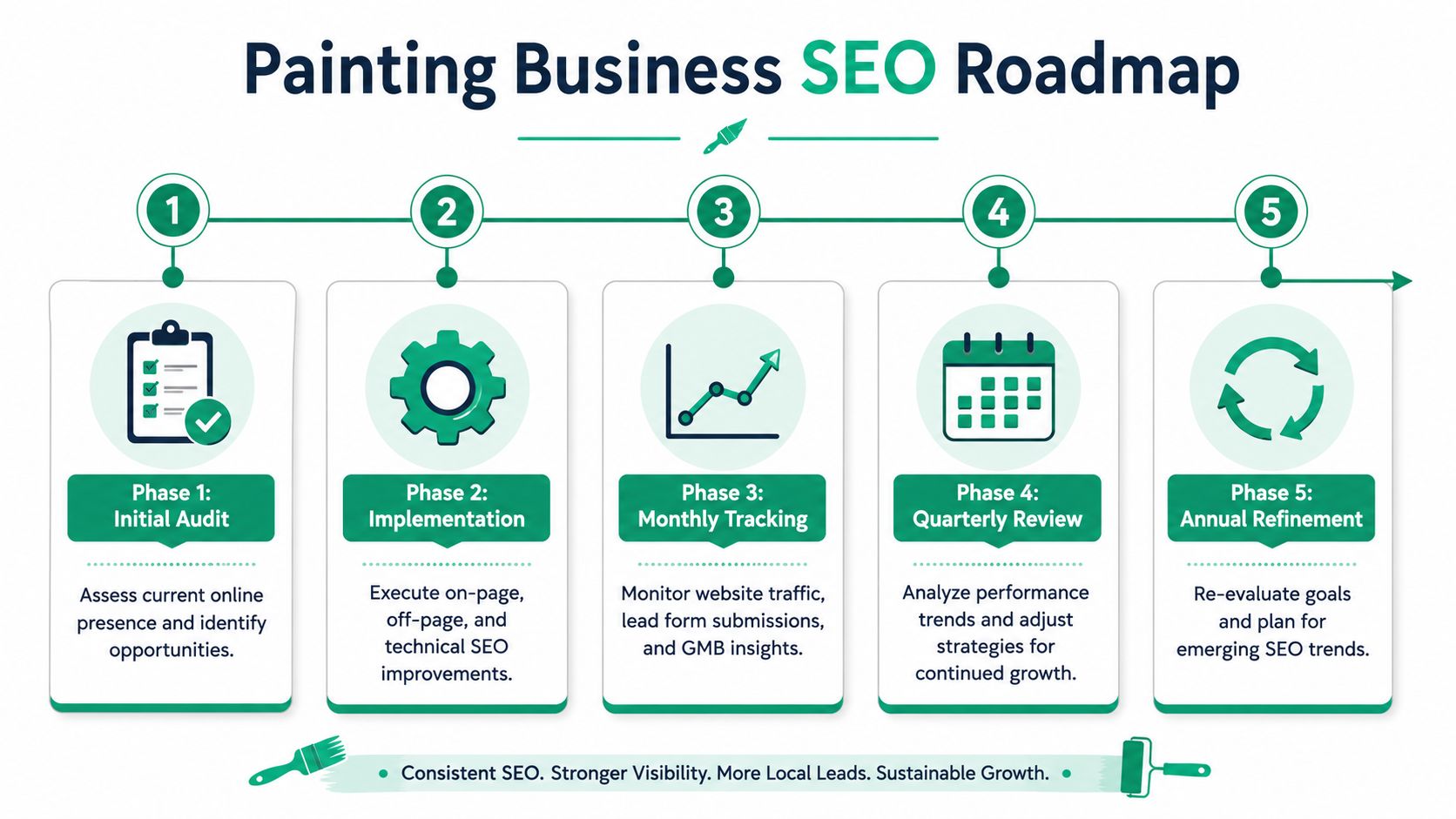
Month 1
Audit the current setup and record the baseline. Check indexed pages, title tags, broken links, duplicate location pages, form tracking, call tracking, and Google Business Profile performance. Confirm the service areas that deserve attention first, as a painter can waste months chasing a saturated city while nearby towns offer a better path to visibility and booked estimates.
Month 2
Fix the pages closest to revenue. That usually means your core service pages, main city pages, and contact flow. Add project photos from actual jobs, short jobsite videos, and before-and-after examples where possible. Rich media helps rankings indirectly, but its bigger job is conversion. Homeowners want proof that your crew does clean, professional work in homes like theirs.
Month 3 and beyond
Build supporting content around the questions homeowners ask before they hire. Keep reviews coming in. Add fresh project media to key pages and your business profile. Review which towns, services, and page types are producing estimate requests, then put more effort behind those areas.
How to review performance without getting lost
Use one monthly review and one rule. Judge SEO by lead quality and sales opportunities, not by traffic alone.
| What to review | What to ask |
|---|---|
| Top service pages | Are they getting qualified visits and producing calls or forms? |
| Location pages | Which towns are gaining visibility, and which ones may not be worth pushing harder? |
| Calls and forms | Are the leads a fit for your pricing, service mix, and target jobs? |
| Google Business Profile | Are reviews, photos, service details, and engagement trends staying active? |
One more point matters here. A page that ranks but does not convert is not doing its job. In many painting markets, the fix is not more text. It is better to trust signals. Add finished project photos, short walkthrough videos, clearer service-area language, and stronger proof that you complete the kind of work the prospect wants.
That is how a painting company should launch SEO. Pick the right markets, build pages that earn trust, measure what leads to estimates, and keep improving the assets that bring in work.
Painting Company SEO Questions Answered
Should you use a citation service or build listings manually
A lot of painters ask this after they find three versions of their company online, an old phone number in one directory, and a wrong address in another. At that point, speed is not the priority. Accuracy is.
Manual citation work takes longer, but it gives you control over the cleanup. That matters if you have duplicates, old branding, a moved office, or tracking numbers that were used inconsistently. A paid listing tool is useful once your core business details are settled and you want an easier way to keep directories aligned.
The key question is whether your listings are stable.
If your name, address, phone, hours, and service area are already consistent, a service can save time. If your data is still messy, fix the problem by hand first. For a painting company, bad listing data does more than hurt rankings. It can send a high-intent prospect to the wrong phone number right when they are ready to book an estimate.
How should you respond to a negative review?
A bad review is a sales moment in disguise. The homeowner who reads it next is deciding whether your company is steady, respectful, and accountable when a job gets tense.
Keep your response calm and specific. A strong reply does three things:
- Acknowledge the customer’s frustration
- State that you want to review what happened
- Move the conversation to phone or email so you can resolve it directly
Avoid long explanations, blame, or a generic template that sounds copied from every other business profile. Prospects notice that.
A short response is often stronger than a detailed one. It shows restraint. Then make sure your profile keeps gaining fresh reviews, project photos, and recent job activity, because one negative review carries less weight when the rest of the profile shows consistent, credible work.
SEO or Google Ads for a painting company
These channels solve different problems, and the right mix depends on timing, margins, and market competition.
Google Ads can produce estimated opportunities faster, especially if you want leads for interior painting, cabinet painting, or other high-intent services right away. SEO takes longer, but it keeps producing opportunities after the click is no longer tied to ad spend. That makes it a better long-term asset, especially in markets where lead costs are climbing.
Here is the trade-off. Ads can buy visibility. They do not fix weak trust signals.
If a homeowner lands on a thin page with no project photos, no service-area clarity, and no proof that your crew does the kind of work they want, both channels underperform. Good painting company SEO is not just keyword targeting. It is market selection, page structure, and media that help a prospect trust you enough to call.
Do you need separate pages for every service and city
Usually, yes. Separate pages help when a service or town is important enough to deserve its own message, proof, and examples.
The mistake is building near-duplicate pages that only swap out the city name. Those pages rarely help much, and they often create a maintenance problem. A strong service page should show what you do, who it is for, what makes your process reliable, and what the finished work looks like. A strong location page should prove you work in that area and understand the housing stock, project types, or neighborhood expectations there.
Photos and short videos become important. A homeowner in one town may care more about exterior durability, while another market may respond better to clean interior finishes or cabinet work. Showing the right proof on the right page helps rankings, but it also improves conversion quality. That is the part many basic SEO guides miss.
If your painting company needs a clearer SEO system, Ascendly Marketing can help with local SEO strategy, conversion-focused website improvements, and tracking setup that ties search visibility to calls and estimate requests.