

TL;DR:
- Many small businesses fail to increase online sales because they neglect store speed and checkout optimization, which are critical revenue drivers. A strategic plan connecting marketing tactics to specific sales goals improves effectiveness, while AI cart recovery significantly boosts abandoned cart conversions. Consistently measuring ROI across channels and fixing site issues before marketing efforts lead to sustainable online growth.
You’re putting real effort into your online store, but the numbers aren’t moving the way you need them to. You’re not alone. Figuring out how to increase sales online is the most pressing challenge for small and medium-sized business owners right now, and the gap between “getting traffic” and “making sales” is wider than most people expect. This guide cuts straight to what actually works: strategic planning, site optimization, the right marketing channels, and modern recovery tools that can turn lost revenue into completed orders.
Table of Contents
- Key takeaways
- How to increase sales online starts with a real plan
- Optimizing your store to cut cart abandonment
- Digital marketing tactics that actually drive sales
- Measuring results and improving over time
- My honest take on what moves the needle for SMBs
- Ready to grow your online sales faster?
- FAQ
Key takeaways
| Point | Details |
|---|---|
| Plan before you market | Link every marketing tactic to a specific sales outcome before spending a dollar. |
| Cart abandonment is your biggest leak | Roughly 70% of shoppers abandon carts. Fixing checkout friction recovers significant lost revenue. |
| Page speed is a conversion lever | Every extra second of load time costs about 7% of your conversions. |
| AI recovery beats email alone | Behavioral AI tools can recover up to 38% of abandoned carts, far above standard email rates. |
| Measure and iterate consistently | Track ROI against revenue regularly, not just traffic or impressions. |
How to increase sales online starts with a real plan
Most small business owners skip straight to tactics. They run an ad, post on social media, maybe send an email. Then they wonder why nothing sticks. The problem is almost always the absence of a plan that ties marketing activity directly to sales outcomes.
The U.S. Small Business Administration recommends building a marketing plan that explicitly maps the customer’s journey from the moment they discover you to the moment they buy. That means defining your sales methods upfront. Are you selling through your own online store, through wholesale partners, through a marketplace, or some combination? Each path requires a different strategy.
Once you know your channels, set measurable goals. Not “sell more,” but “increase average order value by 15% in Q3” or “convert 4% of paid traffic by October.” These specifics tell you what to track and when to adjust. Your plan should also include your pricing approach, any promotional calendar you intend to run, and a basic outline for customer support. A well-structured marketing plan does more than organize your thinking. It tells you where your money is actually going and whether it is working.
Here is what a solid planning checklist looks like for an SMB:
- Define your primary sales channel (your store, Amazon, wholesale, etc.)
- Set three to five measurable sales goals with a timeframe
- Map the customer journey from first touch to purchase
- Outline your promotional schedule for the next 90 days
- Identify your customer support plan before issues arise
Pro Tip: Write your sales goal first, then work backward to choose your marketing tactics. This prevents the common mistake of choosing channels because they seem popular rather than because they serve your specific goal.
Optimizing your store to cut cart abandonment
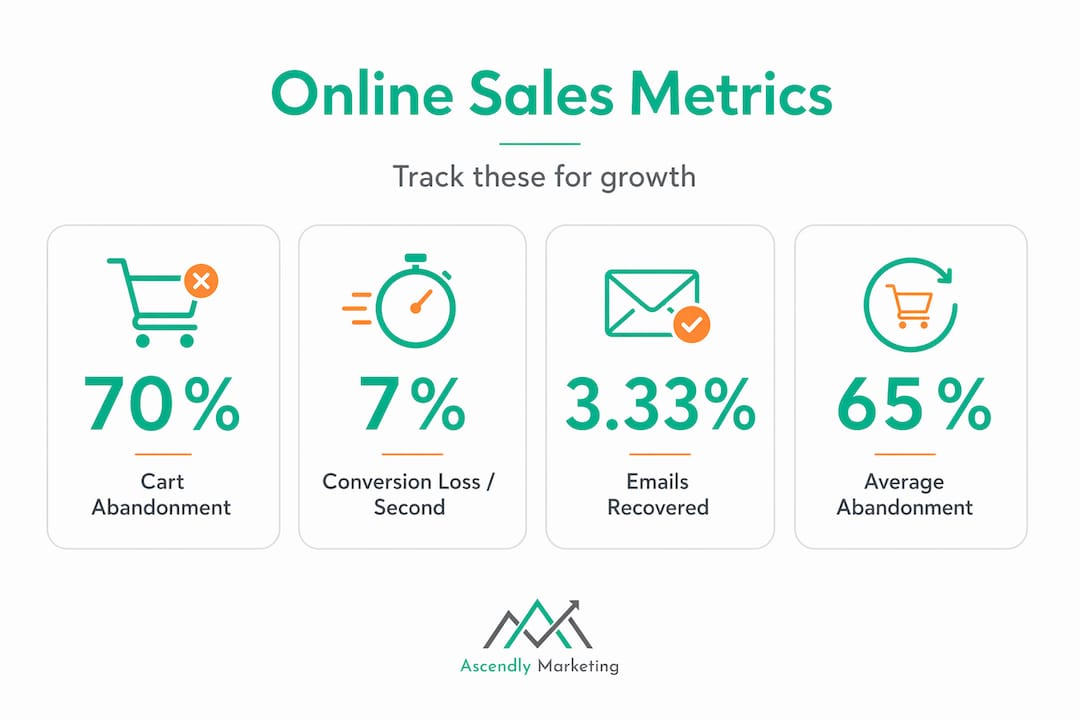
Here is a number that should stop you cold. About 70% of online shoppers abandon their carts before completing a purchase. On mobile devices, that rate climbs to nearly 86%. That means for every ten people who show intent to buy, seven walk away. This is not a marketing problem. It is a conversion problem.
The reasons shoppers abandon are well documented. Unexpected shipping costs at checkout are the most common culprit. Slow page load times, forced account creation, and complicated checkout flows all contribute. Each additional second of load time reduces your conversion rate by approximately 7%, which compounds painfully as your site grows. Page speed is not a technical nicety. It is a revenue variable.
Compare the impact of common checkout problems and their fixes:
| Problem | Revenue impact | Fix |
|---|---|---|
| Unexpected shipping costs | Highest abandonment trigger | Show total costs early or offer a free shipping threshold |
| Slow page load (3+ seconds) | ~7% conversion loss per second | Compress images, use a CDN, optimize server response time |
| Forced account creation | Significant drop-off at checkout | Add guest checkout as the default option |
| Complex checkout flow | Increased friction at each step | Reduce to three steps or fewer |
| Limited payment options | Lost sales at final stage | Add PayPal, Apple Pay, and Buy Now Pay Later options |
Once you have tightened the checkout experience, you need a recovery system for shoppers who still leave. Standard abandoned cart email sequences recover about 3.33% of lost orders on average. That is better than nothing, but it leaves most of that revenue on the table. The real gains come from behavioral AI tools that detect exit intent before the shopper leaves your site and intervene in real time. These tools can recover up to 30 to 38% of abandoned carts by presenting a targeted offer or message at exactly the right moment.
For your email recovery flow, timing matters more than most people realize. Sending the first reminder within an hour of abandonment consistently outperforms late follow-ups. Your sequence should be specific to what the shopper left behind, not a generic “you forgot something” message.
Pro Tip: Start your recovery sequence with a plain reminder email, then follow with a social proof email (reviews of the product they viewed), and only introduce a discount in the third message if needed. Discounting too early trains customers to abandon on purpose.
To see how site performance affects conversions at every stage of the funnel, the connection between load time and revenue is more direct than most SMB owners realize.
Digital marketing tactics that actually drive sales
Getting your store right is necessary but not sufficient. You also need consistent traffic from people who are ready to buy. That requires a coordinated approach across several channels, not just whichever one you feel most comfortable with.

SEO for e-commerce is a long-term investment that compounds over time. Focus on product and category page optimization first, since that is where purchase intent lives. Use specific, buyer-intent keywords in titles and meta descriptions. Build internal links between related products. A strong organic SEO strategy reduces your dependence on paid traffic and lowers your cost per acquisition over time.
Email marketing remains one of the highest-ROI channels available to SMBs. Beyond cart recovery, use drip campaigns to nurture new subscribers, re-engage inactive customers, and promote seasonal offers. A well-constructed email drip sequence moves subscribers through a defined path from awareness to conversion without requiring manual effort every time.
Social media works best when it creates urgency and exclusivity. Social exclusives, contests, and targeted hashtags increase both reach and engagement, which translates to traffic spikes around promotional events. A focused social media strategy ties platform activity directly to traffic and sales goals rather than treating engagement as an end in itself.
Paid advertising (PPC) gives you immediate visibility and precise targeting. For SMBs, the key is starting with tightly defined audience segments rather than broad campaigns. Test one offer per ad set, track cost per acquisition from day one, and pause what is not working within two weeks. PPC advertising works best as a complement to organic efforts rather than a replacement.
Here is a practical sequence for building your digital marketing presence:
- Fix your on-site SEO and ensure product pages are fully optimized
- Launch a basic email welcome and nurture sequence for new subscribers
- Set up one paid campaign targeting your highest-converting audience segment
- Add social media promotions tied to your promotional calendar
- Review all channel performance monthly and reallocate budget toward what is working
Pro Tip: Do not try to be everywhere at once. Pick two channels that match where your buyers already spend time, and do those well before expanding. Spreading thin across five channels produces mediocre results on all of them.
Measuring results and improving over time
Running campaigns without measuring them is the equivalent of guessing. The U.S. SBA is clear that digital campaigns should be evaluated by ROI, comparing what you spend to what you actually generate in revenue. Impressions and clicks are signals, not outcomes.
The metrics that matter most for SMB e-commerce:
| Metric | What it tells you | Review frequency |
|---|---|---|
| Conversion rate | Percentage of visitors who buy | Weekly |
| Cart abandonment rate | Where checkout friction exists | Weekly |
| Cart recovery rate | Effectiveness of email or AI recovery tools | Weekly |
| Customer acquisition cost | How much do you spend to get one buyer | Monthly |
| Revenue per visitor | Overall monetization efficiency | Monthly |
| Organic traffic growth | Long-term SEO health | Monthly |
Benchmarking matters as much as tracking. If your cart abandonment rate is 65%, that sounds alarming until you realize the industry average is closer to 70%. Context tells you whether to prioritize a fix or redirect energy elsewhere.
Testing is where real improvement happens. Change one variable at a time: a checkout page layout, a button color, a subject line, a landing page headline. Give each test enough traffic to reach statistical significance before concluding. Gut instinct is a starting point, not a measurement tool.
Customer feedback also deserves a formal place in your review process. Post-purchase surveys and support ticket analysis often surface friction points your analytics cannot see. A customer who says “your site made me create an account before I could see my total” is giving you more useful data than a bounce rate spike.
Pro Tip: Set a 30-minute monthly review session specifically for your conversion funnel metrics. Consistency beats intensity. A monthly check catches problems before they compound into quarter-level losses.
My honest take on what moves the needle for SMBs
I have worked with small and medium-sized businesses on their online sales for over a decade, and the pattern that kills growth is almost always the same. Owners invest in marketing before they fix what breaks on their site. They pay to send traffic to a slow, confusing checkout process, then wonder why the ads are not working. The ads are fine. The destination is the problem.
What I have learned is that page speed and checkout friction are the most underestimated factors in e-commerce performance. Most SMB owners treat them as technical concerns for their web developer. They are actually the most direct levers on revenue, and speed improvements compound because they also lift your search rankings.
I have also seen the difference AI-driven cart recovery makes compared to a standard three-email sequence. It is not incremental. The gap between 3% and 35% recovery rates represents a fundamentally different business outcome for most SMBs. If you are still relying on a single abandoned cart email going out two hours after the fact, you are leaving most of that revenue unrecovered.
My advice is to work in this order: fix your store first, build your plan second, then market aggressively. Every dollar you spend on marketing before those first two steps are solid is a dollar working against you.
— Ascendly Marketing
Ready to grow your online sales faster?
Understanding the strategy is one thing. Executing it while running a business is another challenge entirely.
Ascendly Marketing has helped small and medium-sized businesses generate real, measurable revenue through SEO, PPC, social media management, and conversion-focused website design. Since 2013, our team of specialists has built digital programs that connect marketing activity directly to sales outcomes. If you want a partner who understands your growth goals and builds strategies around them, explore our full range of digital marketing services or visit Ascendly Marketing to book a consultation. Your next step toward stronger online sales starts there.
FAQ
What is the average cart abandonment rate for online stores?
About 70% of online shoppers abandon their carts overall, with mobile abandonment rates reaching nearly 86%. Reducing checkout friction is the fastest way to recover that lost revenue.
How much does page speed affect online sales?
Each second of load time delay reduces conversion rates by approximately 7%. Faster pages also improve your search rankings, so the revenue effect works on multiple levels.
How effective are abandoned cart emails?
Standard cart recovery emails recover around 3.33% of lost orders. Sending the first email within an hour of abandonment and using product-specific messaging improves those results significantly.
What digital marketing channels work best for small businesses?
SEO, email marketing, and paid advertising each serve different stages of the buying journey. The most effective approach combines all three, starting with organic SEO for long-term traffic and using PPC to generate immediate results while building that foundation.
How do I know if my marketing is actually increasing sales?
Track revenue against what you spend on each channel, not just traffic or engagement. The U.S. SBA advises evaluating campaigns by ROI, comparing marketing costs to generated revenue to confirm positive returns.