

Streaming now takes a larger share of U.S. TV viewing than any other category. Nielsen reported that streaming reached 44.8% of all TV viewing in May 2025, the highest share ever recorded, and the same report said 56% of marketers globally planned to increase OTT/CTV spend in 2025, which tells you where attention and ad budgets are moving at the same time (Nielsen on connected TV advertising trends).
For a small or mid-sized business, that changes the old math on TV. You no longer need to treat television as a blunt, expensive awareness channel that only big brands can afford to waste money on. Connected television advertising gives you TV-style reach on premium screens, but it behaves more like digital media when you buy it, target it, and measure it.
What is Connected Television Advertising and Why it Matters Now
Connected television advertising means buying video ads that run inside streaming content watched on internet-connected TVs and TV devices. That includes smart TVs and platforms people already use in their living rooms. The ad appears in a TV environment, but the campaign is planned and measured with much more control than traditional linear TV.

The simplest way to think about it
Linear TV buys broad audience estimates. Connected TV buys actual ad opportunities delivered through streaming.
That difference matters because a business owner usually doesn’t ask, “Did I buy television?” Instead, the question is, “Did the right people see the ad often enough to remember it and do something after?”
With connected TV, you can answer that much more directly.
Why business owners are paying attention
Traditional TV has always been strong in visibility. Its weakness has been accountability. You could get reach, but you often couldn’t control frequency very well, isolate households precisely, or connect exposure to downstream actions in a useful way.
Connected TV changes that setup. You still get the big-screen format, but your campaign can be shaped around who you’re trying to reach, where they are, and what happens after the ad runs.
TV used to be bought like a billboard with moving pictures. CTV is bought more like a targeted media campaign.
For an SMB, that opens up a practical use case. You can use connected television advertising to introduce your brand to a local or regional audience, support a product launch, or stay visible in a market where search and social are already crowded.
Where it works best
CTV is usually a strong fit when your business needs one or more of these:
- Local or regional awareness: You want a visible presence in a defined market without paying for broad national spillover.
- Higher-consideration purchases: The sale doesn’t happen in one click, so you need to recall before the customer searches, visits, or asks for a quote.
- Multi-channel support: Search, social, and email already do part of the job, and you need a stronger top-of-funnel feeder.
What doesn’t work is treating connected television advertising like a magic switch. If your offer is weak, your landing page is messy, or your follow-up path is unclear, the TV screen won’t fix that.
The Technology Behind Your TV Screen Ads
Connected TV sounds more mysterious than it is. If you’ve ever run display, YouTube, or paid social, the buying logic is familiar. The main difference is the screen where the ad appears and the kind of inventory being traded.
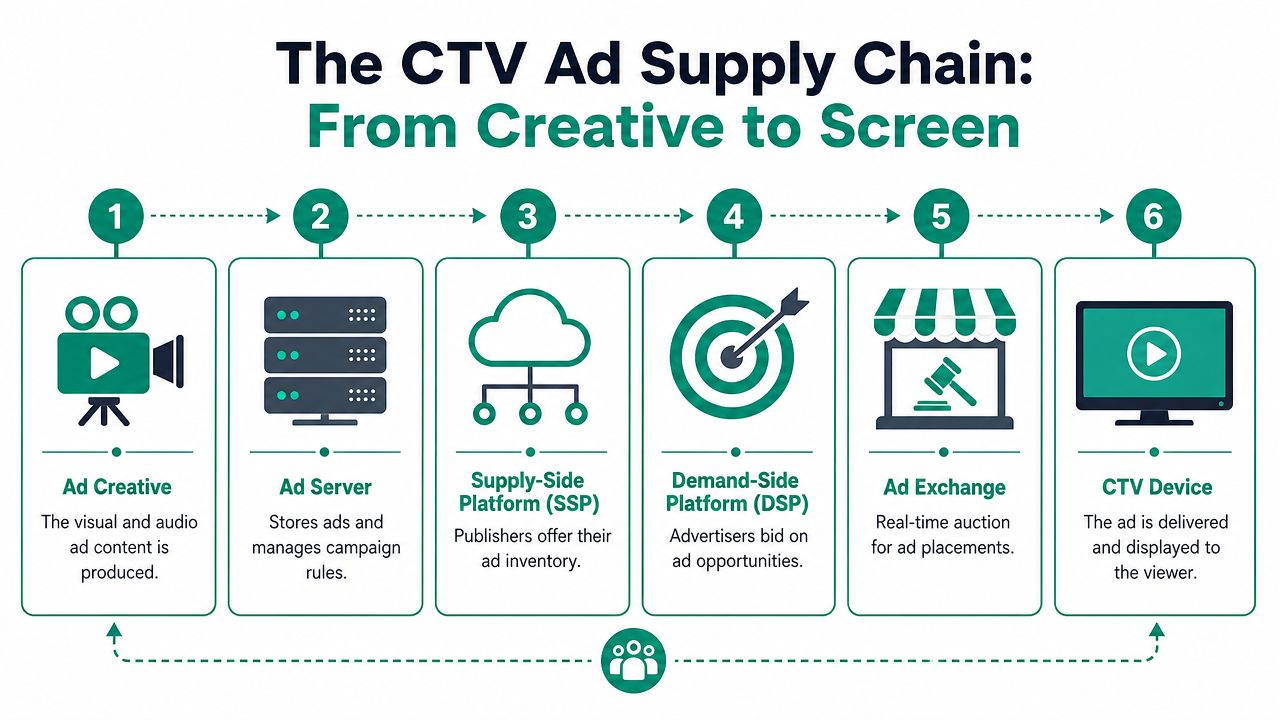
The core mechanics
A streaming publisher has ad space inside content. An advertiser wants to buy access to the right viewers. Software systems handle the transaction.
Here are the three acronyms that matter most:
- DSP: The demand-side platform; advertisers utilize it to set audience, geography, budget, bids, and campaign rules.
- SSP: The supply-side platform; publishers make their ad inventory available through it.
- Ad exchange: The marketplace where buying and selling meet, often in automated auctions.
If you’ve read a good overview of programmatic advertising for SMB marketing success, you already understand the general model. CTV uses that same logic in a television environment.
What happens when a viewer presses play
A person opens a streaming app on a smart TV or device. The app identifies an available ad break. Information tied to that viewing opportunity flows into the bidding process. An advertiser’s DSP decides whether that impression matches the campaign settings. If it does, the platform bids. If the bid wins, the ad is served on the screen.
The process is fast. To the viewer, it feels like a normal commercial break.
To the buyer, it isn’t normal TV buying at all.
Why CTV is different from linear TV
The technical shift is the story. Streaming delivery creates deterministic, device-level exposure signals that support household targeting, frequency control, and attribution, which moves TV buying away from broad audience estimates and toward addressable campaigns (Agility Ads on how CTV differs from linear TV).
That one change affects almost every decision you make.
What you can do with that data
| Capability | What it changes in practice |
|---|---|
| Household targeting | You can focus on defined audience groups instead of buying an entire broad broadcast audience |
| Frequency control | You can reduce waste from showing the same ad too often |
| Attribution | You can connect exposure to later actions more clearly |
| Optimization | You can shift spend based on performance instead of waiting for a post-buy recap |
Where campaigns go wrong
The supply chain is useful, but it also creates trade-offs.
Some buyers chase cheap inventory and then wonder why the campaign didn’t help the business. Others over-target too early and squeeze delivery so tightly that the campaign can’t scale. A third group ignores frequency controls and burns impressions on the same households.
Practical rule: Start with a clear market, a realistic audience definition, and one business outcome. Complexity should be earned, not assumed.
Good connected television advertising isn’t about using every targeting switch in the platform. It’s about choosing the few controls that improve relevance without strangling reach.
Precision Targeting and Measuring Your CTV Campaigns
The two questions most business owners ask are simple. Who sees the ad, and how do I know whether the campaign did anything useful?
CTV gives better answers than old-school TV, but only if the campaign is set up with discipline.
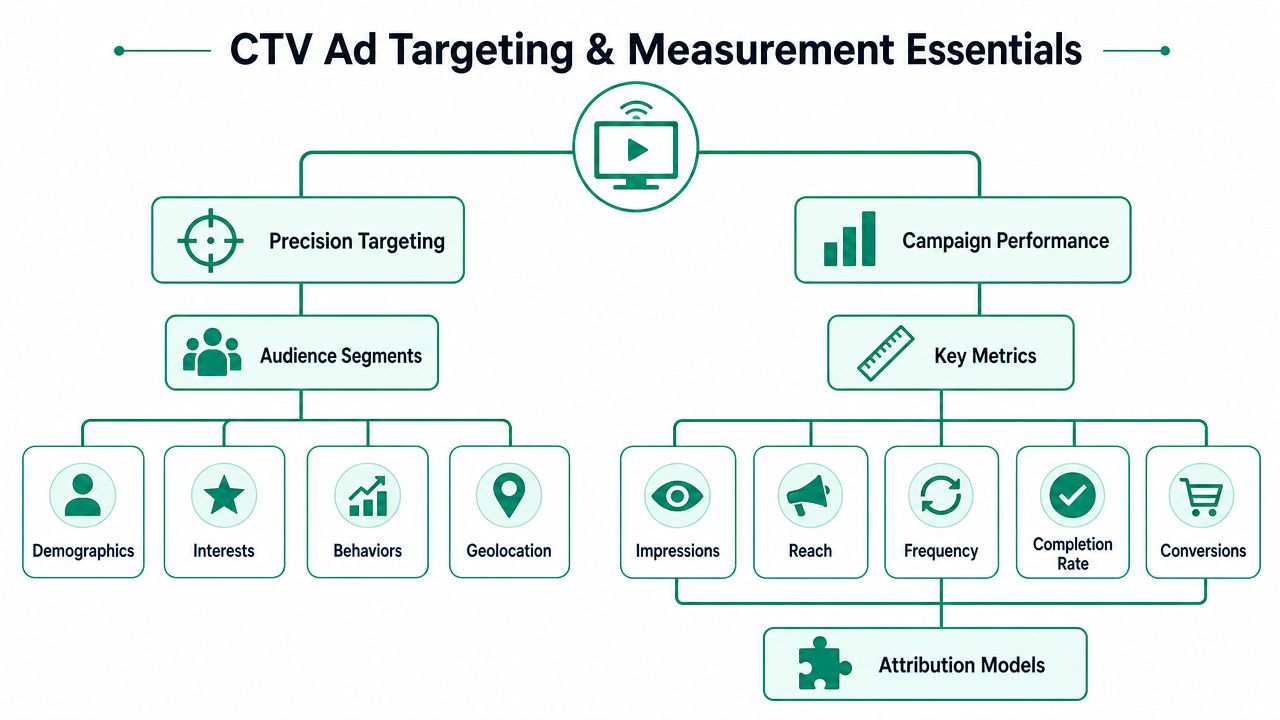
What targeting usually looks like in practice
Most SMB campaigns don’t need exotic audience models. They need sensible filters.
A buyer might start with geography, then layer in audience traits that align with the offer. For a local service business, geography tends to do more work than people expect. For an e-commerce brand, product interest and household relevance usually matter more than broad demographic assumptions.
Useful targeting options often include:
- Geographic targeting: Narrow the campaign to the markets you serve.
- Audience segments: Reach viewers whose behavior or interests line up with your offer.
- First-party audience use: Match known customer or prospect data where the platform allows it.
- Retargeting paths: Build follow-up audiences for other channels after someone has been exposed to the ad.
The mistake is trying to make TV behave like paid search. CTV is still an upper- and mid-funnel channel in many campaigns. You use targeting to improve relevance, not to force instant intent where it doesn’t exist.
This short explainer helps if you want a quick visual before reading deeper:
What to measure first
A lot of marketers drown in reporting because the platform offers too many dashboards. Start with a short measurement stack.
Look at these first:
- Impressions and reach: Did the campaign deliver meaningful visibility?
- Frequency: Did enough households see the ad more than once without being overexposed?
- Completion rate: Did viewers stay with the ad?
- Site engagement and conversion actions: Did exposure correspond with visits, searches, leads, or purchases?
One benchmark is worth knowing. 15-second CTV ads often achieve about 94.5% completion rates, in part because many placements are unskippable, which makes full-view measurement more dependable than in many other video formats (Skybeam on CTV completion benchmarks).
What “worked” really means
A campaign can succeed in more than one way.
Sometimes CTV drives direct response signals such as site visits or conversions. In other cases, it improves branded search behavior, lifts returning traffic, or makes search and social campaigns convert more efficiently because the audience already knows the brand.
That is why a clean measurement plan matters more than a long one. If your team wants to understand perception and downstream effects, brand lift studies are useful because they help separate raw delivery from actual movement in awareness, recall, or intent.
Don’t judge a CTV campaign only by last-click conversions. Judge it by whether it made the next marketing touch easier to win.
Common measurement mistakes
Chasing the wrong signal
Some advertisers focus on low-level delivery metrics and ignore business outcomes. Delivery matters, but it isn’t the finish line.
Mixing channels without a plan
If CTV runs at the same time as search, paid social, and email, your attribution model has to reflect that reality. Otherwise, you under-credit the channel that introduced the customer in the first place.
Looking too early
CTV usually works through repeated exposure. Checking for immediate sales after launch can lead to bad decisions, especially for services or products with longer consideration cycles.
Budgeting for CTV and Understanding Pricing Models
Budget conversations around connected television advertising usually go wrong in one of two ways. A business either assumes TV is automatically too expensive, or it enters the channel with no pricing framework and ends up reacting to invoices instead of planning spend.
The market signal is clear. In 2025, 68% of marketers viewed CTV as a “must-buy,” with projected spend reaching $26.6 billion, and 36% of marketers increasing CTV budgets planned to move money from linear TV, which shows that this isn’t just experimental spend but part of a real budget shift (Mountain research summary on 2025 CTV planning).
The pricing language you need to know
The most common pricing model is CPM, or cost per thousand impressions. You pay for ad delivery at the impression level.
A second model you’ll hear is CPCV, or cost per completed view. In that setup, the completed watch becomes the billing event or the lens through which the campaign is evaluated.
Neither model is automatically better. They answer different buying goals.
Comparing CTV pricing models
| Model | What You Pay For | Best For |
|---|---|---|
| CPM | Delivered impressions | Reach, awareness, broad household coverage |
| CPCV | Completed ad views | Video attention, creative validation, completion-focused campaigns |
What actually changes your costs
Pricing moves based on inventory quality, audience tightness, geography, seasonality, and deal structure. Premium streaming inventory usually costs more than broad open-market supply. Narrow audience filters can raise costs because you’re asking the system to find a smaller set of viewers.
That doesn’t mean you should buy the cheapest available inventory. Cheap delivery often creates expensive waste.
A better budgeting approach looks like this:
- Set the business objective first. Awareness, product demand, local market entry, and retargeting support need different pacing.
- Choose the geographic footprint. A single metro area behaves very differently from a multi-state campaign.
- Limit audience layers early on. Start broad enough to learn.
- Match the budget to the test period. A campaign needs enough runway to reach people with useful frequency.
If you need a broader paid media framework before assigning dollars channel by channel, this paid advertising guide with proven strategies gives a good planning baseline.
How SMBs should think about a starting budget
Don’t start by asking, “What is the cheapest way to get on TV?” Ask, “What budget lets me generate enough delivery to learn something real?”
That changes the conversation.
A reasonable test budget should be large enough to support:
- Consistent delivery: Not a stop-start campaign that resets every few days
- A workable creative set: At least one strong primary ad, with a clear landing path after exposure
- Measurement clarity: Enough volume to compare performance by market, audience, or creative
Buyers waste more money underfunding CTV tests than they do paying a fair rate for quality inventory.
Designing CTV Ads That Capture Attention
A common mistake in connected television advertising is taking an old TV spot, uploading it to a platform, and calling the job done. That approach often wastes the one advantage CTV gives you: a digital delivery environment on a premium screen.
Portada, citing TripleLift, reported that 49% of CTV ads still use traditional TV formats, which suggests many advertisers still haven’t adapted their creative to the streaming environment (Portada on CTV format stagnation and innovation).
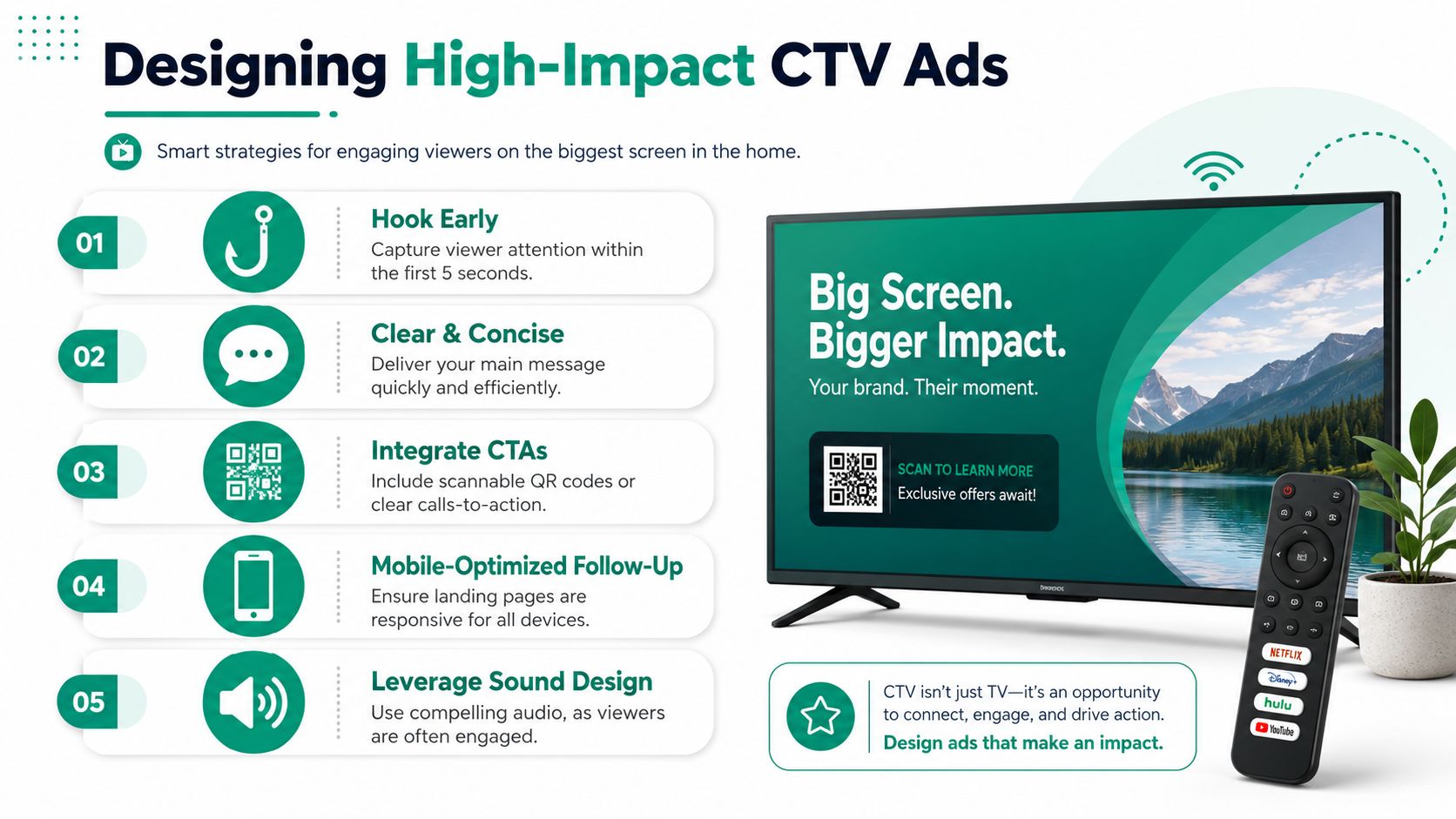
What strong CTV creative does differently
CTV viewers are watching on a large screen in a lean-back setting. That doesn’t mean you can be slow. You still need to earn attention early.
The ad should communicate four things fast:
- Who you are
- What problem do you solve
- Why the viewer should care now
- What to do next
If the brand shows up too late, if the message takes too long to unfold, or if the call to action is vague, the ad may be watched but not remembered.
Practical creative rules that hold up
Start with the offer, not the setup
Many legacy TV spots spend too much time establishing mood. That can work for big brand campaigns. It usually doesn’t work for SMB budgets.
Lead with the product, service, or problem.
Design for sound-on, but keep visuals self-explanatory
The television environment supports audio well, so voiceover and sound design matter. But the visual sequence should still make sense quickly without requiring the viewer to decode a long story.
Use a direct call to action
Most CTV ads aren’t clickable in the way a display ad is. The CTA needs to respect that. Tell people to visit a simple URL, search the brand name, scan a QR code if that fits the execution, or take a next step they can remember without effort.
A strong CTV ad doesn’t ask for perfect recall. It gives the viewer an easy path they can act on later.
What doesn’t work
A few patterns fail again and again:
| Creative problem | Why it hurts performance |
|---|---|
| Slow opening | Viewers notice the ad but don’t register the brand or offer early enough |
| Generic branding | The ad looks polished but doesn’t leave a specific memory |
| No next step | Exposure happens, but action doesn’t |
| Mobile-weak follow-up | The ad creates interest, then the landing experience loses it |
The best connected television advertising creative isn’t just “good video.” It is built backward from the viewer’s next move.
Making CTV a Team Player in Your Digital Strategy
CTV performs best when it isn’t asked to do every job by itself. Treat it as a stand-alone channel, and you’ll get partial value. Use it as part of a coordinated media system, and it becomes much easier to measure and improve.
Where CTV fits in the funnel
For most SMBs, CTV is strongest near the top and middle of the funnel. It introduces the brand, builds recognition, and gives later channels a warmer audience to work with.
That changes how you should read the numbers.
A person might see your ad on a streaming platform, then search your brand later, click a paid search ad a week after that, and convert through a direct visit. If you’re only looking at the last click, search gets all the credit, and CTV looks weaker than it was.
The channel combinations that make sense
The most practical use cases tend to look like this:
- CTV plus paid search: Streaming creates demand; search captures it when people act on interest.
- CTV plus paid social: CTV handles broad video exposure, while social retargeting follows with tighter messaging.
- CTV plus SEO: Branded search and direct traffic often become easier to win when more people already know the name.
- CTV plus email or CRM follow-up: Existing customers or known prospects see reinforcing messages across screens.
This is why smart teams build the campaign path before launch. If the CTV ad tells viewers to look you up, your branded search presence and landing pages need to be ready for that behavior.
Why cross-channel planning beats isolated reporting
A lot of business owners have felt this problem even if they haven’t named it. One vendor shows video metrics. Another shows search conversions. A third shows social engagement. Nobody ties the customer journey together.
That’s where multi-channel planning helps. If you want a practical outside example set, these top multi-channel marketing strategies are useful because they show how channels can support each other instead of competing for credit.
Signals worth watching after a CTV launch
| Downstream area | What to watch qualitatively |
|---|---|
| Search | More branded queries, stronger click behavior on brand terms |
| Website | More direct visits and returning visitors |
| Paid social | Better response from retargeting pools |
| Sales team feedback | More prospects who have already heard of the company |
The best sign that CTV is doing its job is often that your other channels stop working so hard to introduce the brand.
One operational habit that helps
Keep your messaging aligned. If the TV ad says one thing and the landing page says something else, the customer has to re-learn the offer. That friction hurts every channel that follows.
Connected television advertising should make the rest of your digital strategy easier to convert, not harder to interpret.
Getting Started With Connected Television Advertising
Most SMBs don't need a grand rollout. They need a sensible first campaign, a clear measurement plan, and enough restraint to avoid building a complicated media machine before the basics work.
When self-serve can work
A self-serve route can make sense if your business has:
- A narrow market focus: One service area or a limited product set
- Simple goals: Awareness in a local region, support for a promotion, or reinforcement for an existing campaign
- Creative ready to go: A solid video asset and a landing path that matches the message
- Someone to manage details: Budget pacing, exclusions, reporting, and follow-up optimization still need attention
In that setup, the goal isn't perfection. It's learning. You want to see how your audience responds, how the inventory behaves, and how the campaign affects search, site traffic, and conversion paths.
When help becomes the better choice
There is a point where self-management starts costing more than it saves. That usually happens when campaigns stretch across more than one market, when multiple audience layers need to be tested, or when attribution starts crossing several channels and platforms.
An agency or specialist team becomes more useful when you need:
- Platform coordination across fragmented inventory sources
- Creative testing tied to audience segments, not just one generic ad
- Measurement design that connects CTV exposure to search, social, and site behavior
- Budget control across channels so CTV doesn't get judged in isolation
- Scaling discipline once a campaign shows signs of working
A practical launch checklist
Before you spend anything, answer these questions plainly:
- What action should this campaign support? Brand search, website visits, leads, purchases, store traffic, or something else?
- Which market matters most? Start with the one you can serve best.
- What does the viewer see after the ad? Homepage, product page, location page, or branded search result?
- How often should the same household see the ad? Enough for recall, not enough for fatigue.
- What channel should capture the next step? Search, social, direct visit, email, or sales outreach?
If you can't answer those questions, you're not ready to buy yet.
What a strong first campaign usually looks like
The cleanest starting point is often a single market, one core audience approach, one or two ads, and one primary outcome. That gives you enough structure to learn without turning every report into an argument about what mattered most.
CTV rewards patience, but not passivity. Watch delivery, check audience quality, compare creative performance, and look at what changed in the channels that handle response.
Connected television advertising works best when the campaign is built around a business decision, not around the novelty of appearing on a TV screen.
If you want help planning or managing connected television advertising as part of a broader growth strategy, Ascendly Marketing can help you map the audience, creative, measurement, and channel mix before budget gets wasted.