

TL;DR:
- Search engine ranking determines your webpage’s position in search results, affecting visibility and potential traffic. Optimizing for relevance, content quality, user experience, and backlinks helps improve rankings, but technical health and trustworthiness are crucial foundations. Building measurable domain authority and understanding ranking dynamics require ongoing technical audits, content strategy, and performance tracking.
Search engine ranking is the position your webpage holds in search results when someone types a query into Google or another search engine. That single number determines whether potential customers find you or your competitors. Most business owners know ranking matters, but few understand what actually drives it, what can silently suppress it, or why chasing the top spot sometimes produces less traffic than a position three spots lower. This guide breaks down exactly how search engine ranking works, what moves the needle, and what practical steps you can take right now.
Key Takeaways
| Point | Details |
|---|---|
| Ranking follows crawling and indexing | Google must first discover and process your page before it can ever appear in results. |
| Multiple factors determine position | Relevance, content quality, user experience, and backlinks all shape where you land. |
| Position does not equal traffic | AI snippets and SERP features can make a high-ranked page nearly invisible to clicks. |
| Site-wide quality matters | One poor section of your site can drag down rankings across the entire domain. |
| Measurement requires more than rank tracking | Impressions, clicks, and engagement data tell the real story of your search performance. |
What is search engine ranking and how it works
The formal industry term for this concept is organic search ranking, meaning the unpaid position a page earns in search results based on merit rather than ad spend. A webpage’s ranking position determines its visibility for a given query, but that position shifts constantly based on intent, device, and user location.
Before any ranking can occur, three things must happen in order.
- Crawling. Googlebot, Google’s automated spider, follows links across the web to discover pages. If your page is blocked by a robots.txt file or simply has no links pointing to it, Googlebot may never find it.
- Indexing. Once crawled, the page is analyzed and added to Google’s index, a massive catalog of web content. Pages that fail to meet technical standards, or that are explicitly marked “noindex,” never enter the index and therefore cannot rank.
- Ranking. Within milliseconds of a user’s query, Google’s systems pull relevant indexed pages and sort results by complex signals to determine order. This is where optimization has the most direct impact.
The sequence is non-negotiable. You cannot rank a page that has not been indexed. You cannot index a page that has not been crawled. Technical prerequisites come first, and Googlebot must receive an HTTP 200 response from an accessible, indexable page before any SEO effort pays off.
Pro Tip: Use Google Search Console’s URL Inspection tool to confirm whether any specific page on your site is crawled, indexed, and eligible to appear in results. It takes thirty seconds and catches problems most dashboards miss.
What affects search engine ranking
Understanding search ranking factors is where most business owners get lost. Google uses hundreds of signals, but they cluster into four major categories.
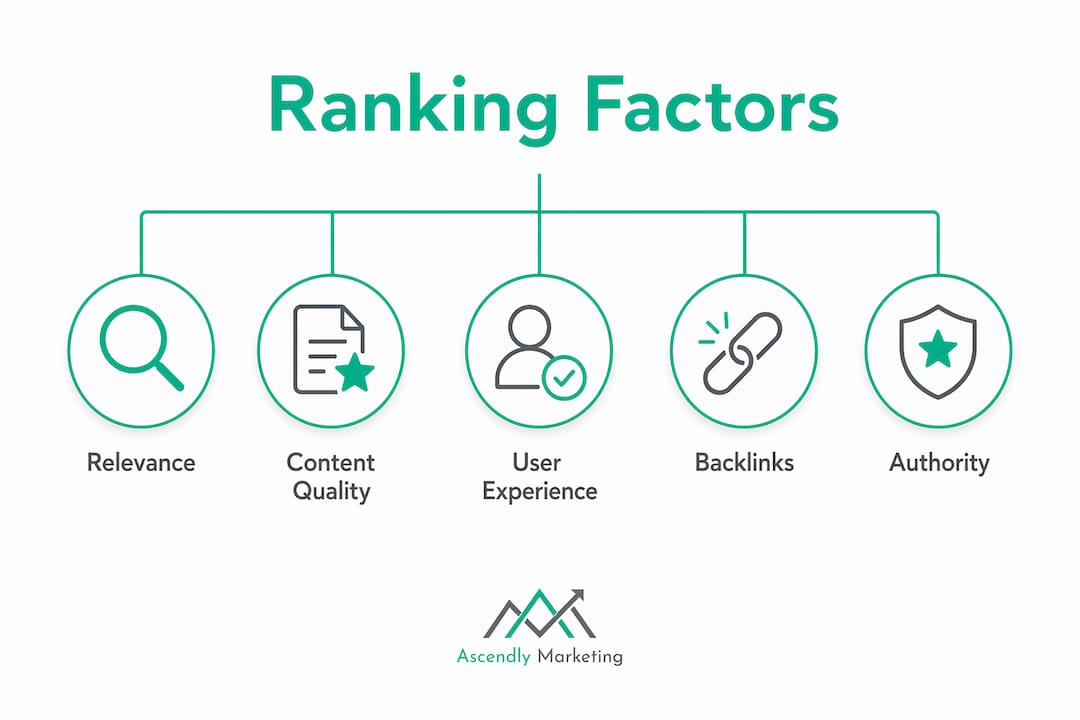

Relevance to search intent
Ranking is not about matching keywords word for word. It is about answering the question a searcher actually has. A page stuffed with the phrase “best CRM software” will lose to a page that genuinely helps someone choose the right CRM, because Google’s systems are trained to recognize whether content satisfies intent. Relevant, helpful content consistently outperforms keyword-heavy pages that don’t solve the reader’s problem.
Content quality and trustworthiness
Google evaluates quality signals at both the page and domain level. This matters more than most people realize. Publishing thin, low-value content anywhere on your site can suppress rankings across pages that are otherwise excellent. Site-wide quality affects ranking, meaning one weak section of your site is not an isolated problem.
User experience signals
Speed, mobile compatibility, and intuitive navigation are not optional niceties. They are direct inputs into ranking. A page that loads slowly on mobile, or that frustrates users into bouncing immediately, sends negative signals. Speed, mobile compatibility, and backlinks form a core bucket that Google weighs heavily when determining position.
Backlinks and authority
When reputable sites link to your content, it signals to Google that your content is worth citing. The quality of those links matters far more than quantity. Ten links from trusted industry publications outperform a hundred links from low-authority directories.
Here is a quick comparison of the major ranking factor categories:
| Factor | What it measures | Business impact |
|---|---|---|
| Relevance | How well content matches query intent | Determines if you appear at all |
| Content quality | Depth, accuracy, and helpfulness | Affects position and click-through rate |
| User experience | Speed, mobile, navigation | Influences dwell time and bounce rate |
| Backlinks | Volume and quality of inbound links | Builds domain authority over time |
| Technical health | Crawlability and index status | Sets the floor for all other efforts |
Pro Tip: Don’t audit your content page by page in isolation. Step back and ask whether your site as a whole communicates expertise and trustworthiness. Google sees your domain as a unit, not just a collection of separate pages.
Common misconceptions about ranking
Several beliefs about search engine ranking cause business owners to make expensive mistakes.
- “Ranking #1 always means more traffic.” Not anymore. Pages can rank highly but attract few clicks when Google surfaces the answer directly in a featured snippet or AI overview. Your rank and your traffic are two separate things.
- “Ranking is consistent.” Your position for the same keyword can change depending on whether someone searches on a phone or desktop, what city they’re in, or even their search history. Rankings are not one fixed number.
- “More content always helps.” Publishing at high volume without purpose dilutes your domain’s quality signals. Reducing low-value pages can actually improve overall ranking by cleaning up the quality picture Google has of your site.
- “Keywords are the whole game.” Two seemingly identical pages can rank differently because Google’s machine learning systems factor in user interaction signals and predictive relevance, not just keyword matching.
There is also a technical reality most business owners never hear about:
Googlebot fetches only the first 2MB of HTML on any given page. Content that appears further down the page may never be processed or ranked at all.
This means that if your most important content is buried below bloated navigation code, scripts, or decorative elements, Google may not even see it. Structure your pages so critical text loads early in the HTML.
How to improve your search engine ranking
Improving your ranking position is not about any single tactic. It is about building the conditions that make Google trust your site. Here is a practical sequence that works:
- Fix technical foundations first. Confirm Googlebot can reach your pages. Server access logs are the most reliable way to diagnose crawl issues that Search Console may not surface immediately. Look for blocked resources, redirect loops, or pages returning error codes.
- Create content built around intent, not volume. Before writing anything, ask what the person searching actually needs. A single, thorough page that fully answers a question outperforms five shallow pages targeting the same topic. You can find proven SEO strategies that demonstrate this approach with real business examples.
- Optimize for mobile and speed. Run your site through Google’s PageSpeed Insights. If your mobile score is under 70, you have a ranking problem, not just a user experience problem.
- Earn backlinks through genuine value. The fastest path to quality backlinks is creating content or tools that people in your industry want to reference. Guest posts, original data, and detailed guides all attract links organically over time.
- Measure beyond rank position. Track impressions, click-through rate, and time on page alongside rankings. These metrics tell you whether your ranking is actually converting into meaningful engagement.
Pro Tip: If you run an e-commerce business, ranking improvement has its own specific playbook. Reviewing e-commerce SEO best practices can save you from applying generic advice that does not translate to product pages.
Tracking and maintaining your ranking
Knowing your current position is only the starting point. What you do with that data separates businesses that plateau from those that grow steadily.
The tools most practitioners rely on include Google Search Console for impression and click data, third-party rank trackers for keyword movement over time, and site audit tools to flag technical issues before they compound into ranking losses.
Beyond tools, the habits matter more:
- Review your Search Console performance report monthly, focusing on queries where impressions are deep, but clicks are low. That gap signals a ranking without real visibility, often due to SERP features.
- Run a technical audit quarterly. Crawl errors, broken internal links, and slow pages accumulate silently.
- Monitor your search engine marketing strategies as a whole, not just organic rankings in isolation, since paid and organic performance often inform each other.
- Track content performance at the page level. If a page is losing ranking steadily, it usually means user intent has shifted, or fresher competitors have entered that space.
| Metric | What it tells you | Recommended check frequency |
|---|---|---|
| Average position | Where you rank across tracked queries | Weekly |
| Impressions | How often pages appear in results | Weekly |
| Click-through rate | Whether your rank converts to visits | Monthly |
| Crawl coverage | Which pages Google has indexed | Monthly |
| Core Web Vitals | Technical health affecting UX and rank | Quarterly |
My honest take after years in this field
I’ve worked with hundreds of business owners who came to us convinced their ranking problem was a keyword problem. What I’ve found, almost without exception, is that it’s a trust problem. Google is trying to answer a user’s question with the most credible, helpful source available. If your site doesn’t clearly demonstrate that credibility across its pages, no amount of keyword optimization closes that gap.
What I’ve also learned is that the obsession with rank position often causes more harm than good. I’ve seen businesses pour resources into reaching position one for a high-volume keyword, only to discover that the traffic converts at a fraction of the rate of traffic from a position four keyword with lower volume but clearer buyer intent. Search engine ranking importance is real, but it has to be measured in business outcomes, not vanity metrics.
The shift to AI-powered search results makes this even more pressing. Google increasingly answers questions directly in the results page. That means content quality, schema markup, and genuine topical authority matter more than positional ranking alone. The businesses I see winning in 2026 are not the ones obsessing over rank. They are the ones building content that earns trust at every level, from the crawl to the click to the conversion.
— Ascendly Marketing
Let Ascendly Marketing put your ranking to work
If this article clarified the fundamentals, the next step is getting a clear picture of where your own site stands and what is holding it back. Ascendly Marketing has been helping businesses build real search visibility since 2013, with a team that covers technical SEO, content strategy, and conversion-focused optimization together rather than in silos.

Whether you are starting from scratch or trying to recover lost ground, our SEO services are built around your actual business goals, not generic checklists. We also offer a detailed organic SEO guide that goes deeper on the strategies covered here. Ready to see what is actually possible for your rankings? Book a free consultation with our team today.
FAQ
What is search engine ranking in simple terms?
Search engine ranking is the position your webpage holds in search results for a specific query. A higher position means more users see your page when they search for relevant terms.
How does Google decide which pages rank higher?
Google evaluates hundreds of signals, including relevance to search intent, content quality, backlink authority, and user experience factors like page speed and mobile compatibility. Machine learning systems also factor in user interaction data, which is why two relevant pages can rank differently even when their content appears similar.
Why does my ranking change so often?
Rankings fluctuate because Google continuously updates its algorithms and because your ranking can vary by device, location, and user context. A position that looks stable in a desktop rank tracker may look very different on mobile.
Does a higher ranking always mean more website traffic?
Not necessarily. Pages with high ranks but low clicks are increasingly common as Google surfaces answers directly in AI overviews and featured snippets. Tracking impressions and click-through rate alongside rank position gives a more accurate picture of actual visibility.
How long does it take to improve search engine ranking?
There is no fixed timeline. Technical fixes like resolving crawl errors can produce results in weeks, while building content authority and earning quality backlinks typically takes three to six months to show meaningful movement. Consistency and domain-level quality are the variables that determine speed most reliably.