
A bad review used to be a customer service problem. Now it can become a revenue problem before your team finishes its first internal Slack thread.
You might be dealing with a burst of one-star reviews, a misleading article that ranks for your brand name, or an executive search result that keeps resurfacing at the worst possible time. In that moment, most companies start searching for the best ORM company and land on the same unhelpful pages: generic rankings, vague promises, and recycled claims.
Skip the listicles. They don’t solve the underlying problem.
The right ORM partner depends on three things: your crisis type, your industry, and your budget. A firm that works well for a restaurant chain may be a poor fit for a B2B software company. A platform that helps a multi-location business manage reviews may be useless if your issue is a search result tied to a founder’s name. This is a matching exercise, not a popularity contest. For ongoing business review monitoring and response support, explore Ascendly’s online reputation management services.
| Provider model | Best fit | Main strength | Main limitation | Buying advice |
|---|---|---|---|---|
| Boutique agency | Executive reputation issues, niche industries, regulator-sensitive cases, cross-border work | High customization and tighter strategic thinking | Limited scale if your issue spans many locations or brands | Choose this when the problem is complex and specific |
| Full-service agency | Larger brands with broad search, review, content, and PR needs | Wider service scope across channels | You can get lost if your account is treated like a standard process | Ask who will actually run the work day to day |
| ORM software or platform | In-house teams, local businesses, multi-location review operations | Fast visibility into reviews, listings, messaging, and analytics | Software won’t create strategy for a crisis on its own | Buy this when your team can execute internally |
Your Reputation is Under Attack: What Now
The usual pattern is ugly and fast.
A customer complaint turns into a review pile-on. A local reporter republishes an accusation without enough context. A former employee posts claims that aren’t easy to verify but are easy to share. Then your sales team notices prospects asking odd questions on calls. Your branded search results start doing damage before anyone on your side has a chance to explain.
That isn’t rare behavior online. Consumer review habits are now standard. 90% of customers read reviews before visiting a business, 85% trust online reviews as much as personal advice, and positive reviews can make shoppers spend 31% more, according to 2024 online reputation management statistics. Once you accept that, ORM stops looking like a cleanup service and starts looking like revenue protection.
ORM is not deletion work
Most business owners begin with the wrong question. They ask, “Can this be removed?”
Sometimes the answer is yes. Often it isn’t. News coverage, forum threads, and legitimate criticism usually stay online. A competent ORM company works on visibility, context, response, and replacement. That means monitoring what spreads, answering where a response helps, publishing stronger assets, and improving what people see first.
Practical rule: If a vendor talks only about takedowns, you’re not hearing a complete ORM strategy.
That broader view is why many companies also end up needing related work such as online reputation repair services, not just one-off review responses.
False narratives move faster than corrections
When a crisis includes manipulated images, fake screenshots, or deceptive social posts, the problem shifts from review management to narrative verification. In those situations, it helps to understand AI Image Detector’s approach to fake news, because visual misinformation can fuel a reputation issue long before legal or PR teams catch up.
A strong ORM partner doesn’t panic. They classify the problem first. Is this a review issue, a search issue, a social issue, a media issue, or a personal reputation issue tied to an executive? That diagnosis drives everything that follows.
Beyond Damage Control: What ORM Services Include
If you’re comparing firms, stop asking for a vague “reputation package.” Ask what work is included.
The core service stack
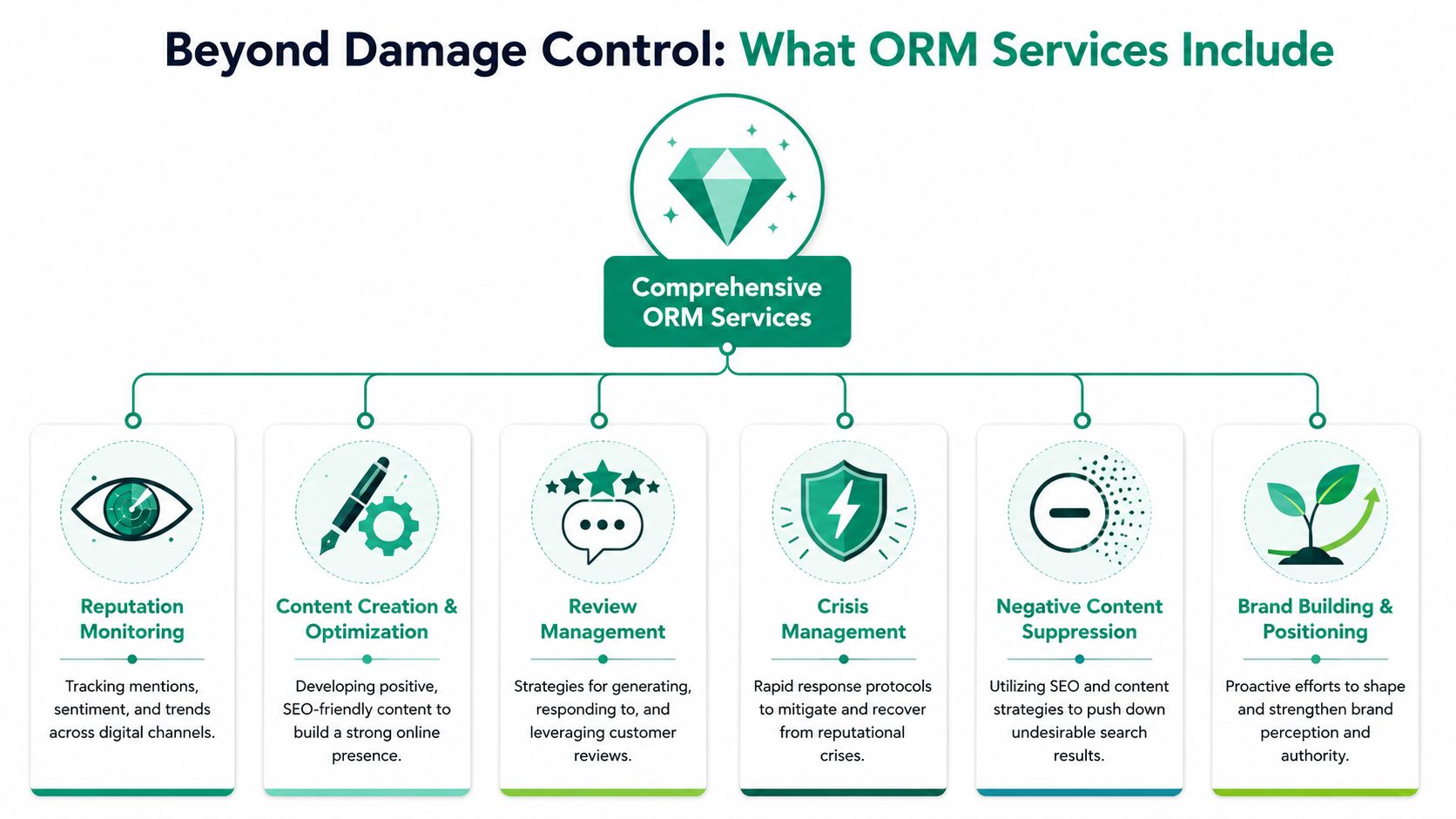
A real ORM program usually includes several moving parts:
- Monitoring and alerting for reviews, search results, brand mentions, and social conversations.
- Review management so your team can respond consistently and encourage more balanced feedback from real customers.
- Content development such as service pages, executive bios, FAQs, thought leadership, and press-style assets that can rank.
- Search work to improve the visibility of positive or neutral assets and reduce the prominence of harmful ones.
- Crisis response for cases where timing, wording, and escalation matter.
- Brand positioning so the company isn’t only reacting. It’s also publishing.
A lot of this overlaps with search engine reputation management, especially when the problem sits on page one of Google and won’t disappear.
Platforms help. They don’t replace strategy.
For software platforms, the market doesn’t really support one universal winner. Neutral comparisons focus on feature breadth rather than a single “best” vendor. They look at review monitoring, listings management, messaging, social engagement, and analytics, with Birdeye’s platform overview in Australia highlighting multi-location systems that unify reputation management, customer engagement, listings, messaging, surveys, and social media in one place.
That matters if you run clinics, franchises, dealerships, or any business with many locations. In those setups, software can bring order fast. But a dashboard isn’t a strategy. It won’t decide whether a damaging article needs a response, whether a founder profile should be rebuilt, or whether your review surge looks unnatural.
Four services buyers underestimate
Review generation
Most companies spend too much time reacting to bad reviews and too little time building a steady flow of legitimate positive ones. ORM firms should have a process for asking at the right moment and routing customers to the right platform.
Response policy
Your team shouldn’t improvise every response. Good vendors help define tone, escalation rules, and who responds where.
The right response doesn’t just answer the complaint. It shows future buyers how your business behaves under pressure.
Content assets
You need more than blog posts. You may need executive pages, media-ready bios, landing pages, customer stories, clarification content, and brand-controlled profiles.
Search result strategy
Negative content suppression is usually a publishing and SEO problem, not a magic trick. If the vendor can’t explain what assets they’ll build and why those assets should rank, keep moving.
Comparing ORM Provider Models
Most buyers compare firms as if they’re all offering the same thing. They’re not. You are usually choosing among specialists, scaled agencies, and software.
Side-by-side differences
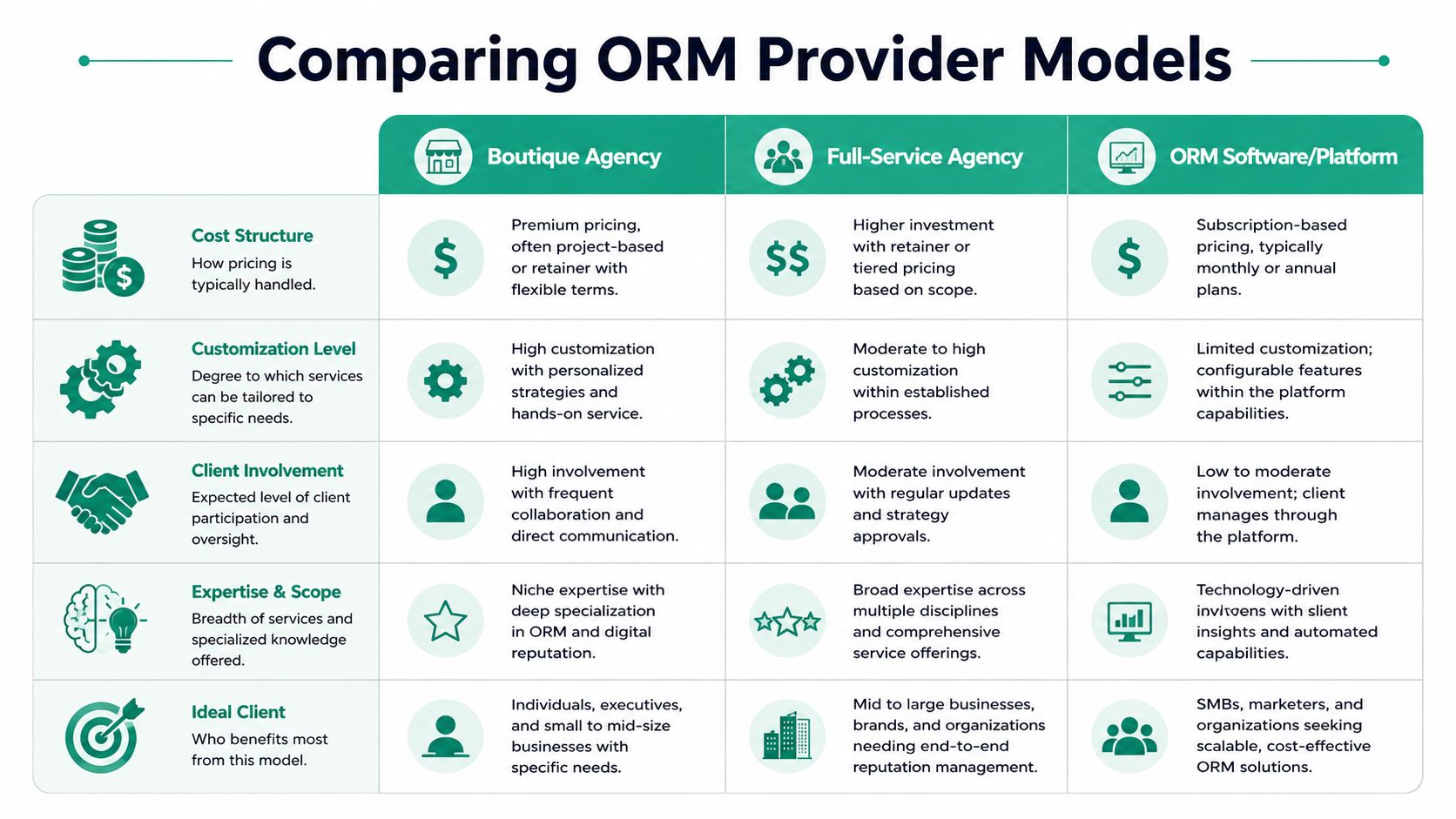
| Model | Cost structure | Customization | Client involvement | Scope | Best for |
|---|---|---|---|---|---|
| Boutique agency | Usually retainer or scoped project | High | Moderate to high | Narrower but deeper | Sensitive cases with nuance |
| Full-service agency | Usually monthly retainer | Moderate to high | Moderate | Broad across channels | Larger brands with complex needs |
| Software platform | Subscription | Low to moderate | High | Operational management | Teams doing execution in-house |
Boutique agencies
A boutique firm is the right call when the problem isn’t generic.
That includes executive reputation issues, legal-adjacent concerns, region-specific language challenges, and industries where one wrong response creates more exposure. Small firms can outperform larger ones because they tend to think through the exact problem instead of forcing it into a standard workflow.
You will probably spend more time with senior people. That’s good. You should want judgment close to the work.
What you won’t get is endless production capacity. If your company has many locations, a large review volume, and broad customer engagement needs, a boutique team can hit limits quickly.
Full-service agencies
A full-service agency makes sense when your reputation issue touches several departments at once.
You may need review operations, content production, SEO support, PR coordination, listings management, and reporting under one roof. That’s where broader agencies can earn their keep. They can combine functions that would otherwise be split across vendors.
The downside is standardization. Some firms sell custom strategy and then deliver a templated process. Ask who writes the strategy, who approves content, and who owns escalation if the situation gets worse.
ORM software platforms
Platforms are operational tools. They are useful when your team already knows what to do and needs infrastructure.
For local and multi-location businesses, software can centralize reviews, listings, surveys, social messaging, and analytics. That’s efficient. If your issue is volume and coordination, software is often enough.
If your issue is narrative control, software isn’t enough.
Buy software when your challenge is management. Hire an agency when your challenge is judgment.
One practical middle ground is a hybrid model. A business can use platform software for day-to-day review operations while bringing in an agency for search reputation, executive branding, or crisis response. That’s often more sensible than expecting one vendor to do everything.
A useful example is Ascendly Marketing, which offers services such as local SEO, website design, and social media marketing. Those capabilities can support reputation-focused work when the issue includes local visibility, owned web assets, and public-facing brand messaging. That’s different from a pure-play ORM platform, and it matters when you’re deciding whether you need software, agency execution, or both.
How to Evaluate an ORM Company
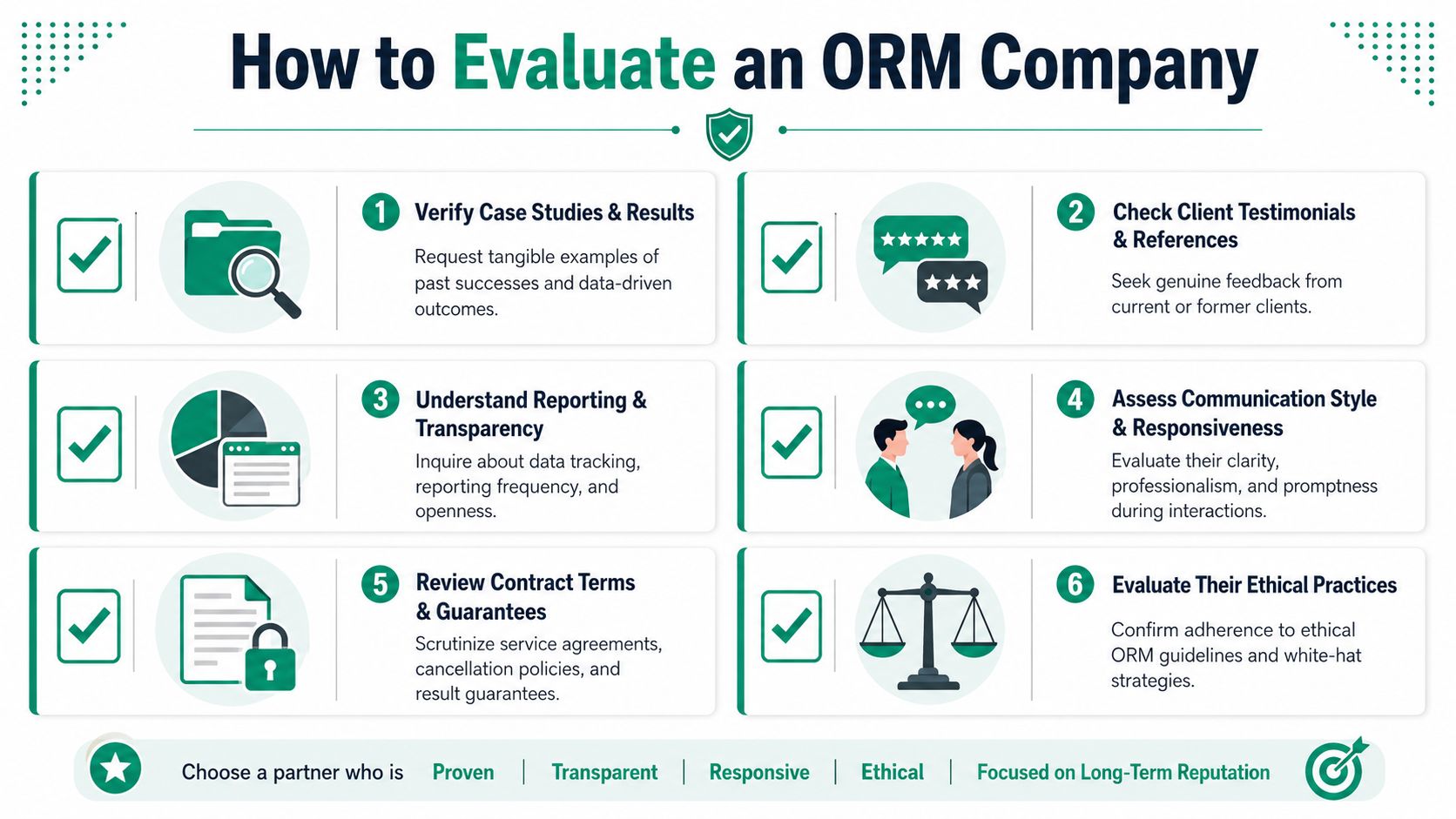
You don’t hire an ORM firm because the sales deck looks polished. You hire one because the process is clear, the scope fits the problem, and the reporting will show whether anything is improving.
Start with relevance, not reputation
The market is full of broad agency lists and generic roundups. If you want a wider view of agencies beyond ORM-specific firms, a directory like this roundup of best internet marketing companies can help you understand provider categories. But don’t confuse visibility with fit.
A better filter is this:
Same problem type
Have they handled review attacks, executive search issues, misleading media coverage, or local listing problems like yours?Same industry pressure
Do they understand healthcare, legal, hospitality, home services, SaaS, franchising, or another market with its own risk patterns?Same operating context
Can they handle a single brand, many locations, or cross-market communication?
Price tells you the engagement type
Professional ORM isn’t cheap because it blends review management, SEO, content work, and reporting over time. Reputable firms typically charge between $3,000 and $15,000 per month, with enterprise campaigns often exceeding $20,000 per month, and campaigns generally run 6 to 12 months, according to Reputation X’s guide to ORM companies. That cost profile reflects ongoing work, not a one-time fix.
If someone offers a suspiciously low quote, they’re usually selling one narrow service and calling it ORM.
If someone quotes a huge fee and can’t break down the work, you’re paying for posture.
What to demand before signing
Use this checklist:
Written methodology
Ask for the exact workstream. Monitoring, review operations, publishing, outreach, SEO, reporting. If they hide behind jargon, move on.Sample reporting
You need to see what their monthly reporting looks like. If the report is mostly activity without business relevance, that’s a bad sign.Asset ownership terms
Clarify who owns domains, profiles, content, and logins created during the engagement.
A broader explanation of why these issues matter shows up in the benefits of online reputation management for businesses, especially when ORM affects trust before a sale even starts.
Here’s a short walkthrough that helps frame what to look for in a provider:
If a vendor can’t explain how they work, they probably don’t have a reliable process. They have a sales script.
Sample ORM Case Studies
Generic agency rankings miss the part that matters most. The right firm depends on the exact problem. Independent guidance on reputation vendors makes that clear: “best” is relative, and buyers should match firms to industry, region, languages, and crisis depth while asking for sector-aligned case studies and written methodology, as noted in this analysis of reputation companies for brands and executives.
Case one: review bombing at a local restaurant
A restaurant owner sees a wave of one-star reviews over a weekend after a social media dispute. Some reviews look unrelated to actual customer visits. Staff members want to fight every review publicly.
The better approach is disciplined. The ORM team documents the pattern, flags questionable posts through platform channels, drafts response rules for legitimate complaints, and sets up a review request process for real customers. At the same time, the business tightens listing accuracy and trains managers on how to respond without escalating.
The key factor here isn’t prestige. It’s platform fluency and local review operations.
Case two: a B2B software company hit by misleading content
A software company notices prospects referencing search results that repeat false claims about its product and leadership. The issue isn’t a ratings problem. It’s a branded search problem mixed with competitor-adjacent noise.
The ORM response is usually content-led. The team builds stronger owned assets, expands executive bios, publishes clarification content, improves high-intent pages, and supports those assets with search work. They may also map which queries matter to deals, because not every negative result deserves the same level of attention.
Buyers often hire the wrong firm. They choose a review platform when they need search strategy and content execution.
Case three: an executive with an old article that won’t go away
An executive changes roles and finds that an old article dominates search results for their name. The article may be accurate, but incomplete. It doesn’t reflect what happened after.
A competent ORM partner doesn’t promise deletion. They build a current digital footprint around the executive: profile pages, bios, interviews, contributed content, speaking references, and updated brand-controlled pages. The objective is to create an accurate present-day record that search engines can surface.
The strongest case study isn’t the biggest brand name. It’s the one that matches your exact headache.
Interview Questions That Reveal the Truth
Sales calls are where weak ORM firms expose themselves. Ask blunt questions and leave silence after each one. The silence usually does the work for you.
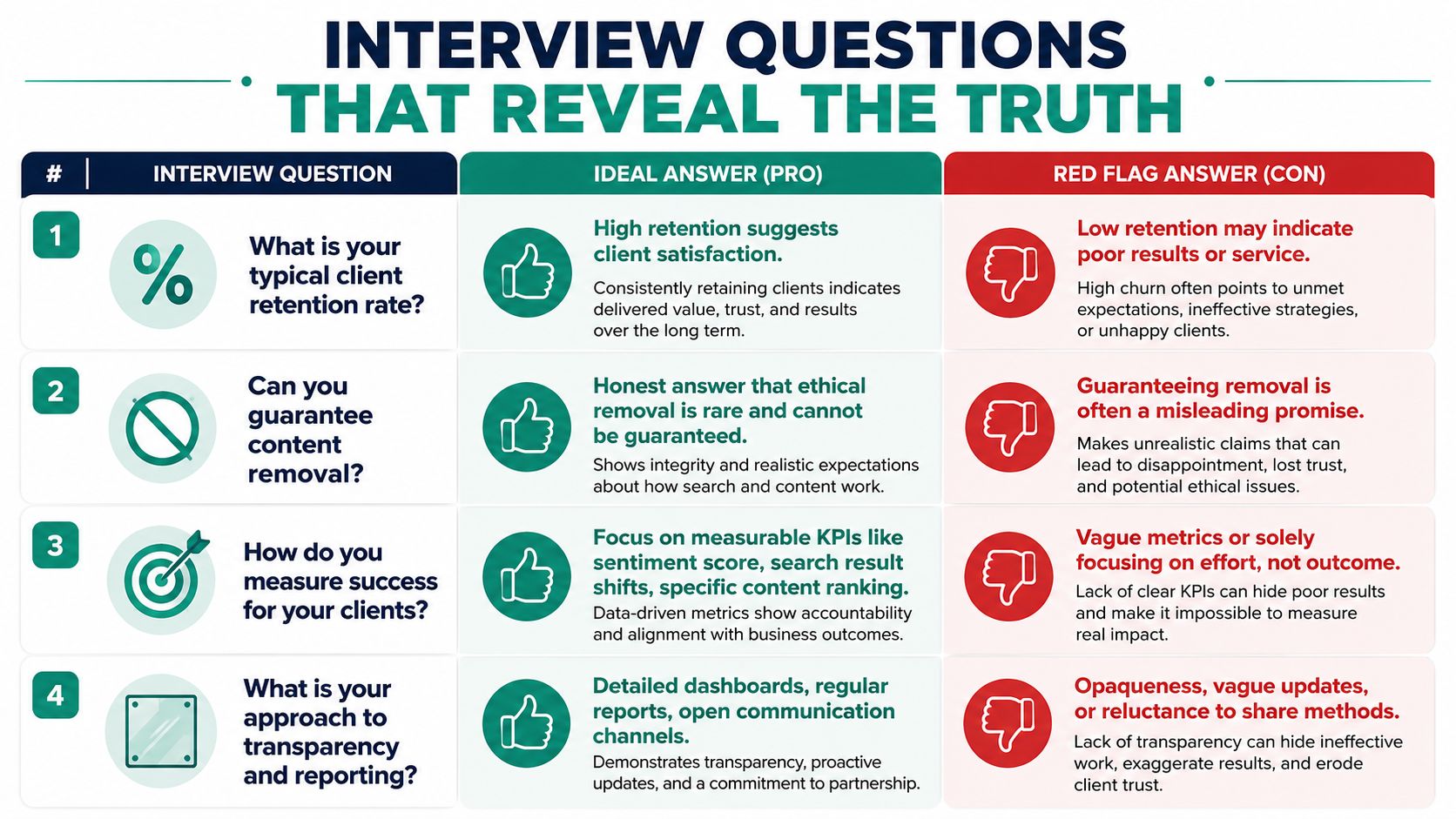
Questions that force real answers
Ask these in plain language:
Walk me through a similar case and the exact process you used.
Good firms can explain sequence, decision points, and tradeoffs. Weak ones drift into buzzwords.What do you do when negative content can’t be removed?
This separates adults from fantasists. A serious answer will focus on response strategy, asset development, and search visibility.What will you report each month that shows meaningful progress?
You want movement tied to the problem, not a pile of vanity charts.Who will do the work after the contract is signed?
If the answer gets fuzzy, expect handoff problems.
Listen for mismatch, not just confidence
Independent benchmarking in technical projects has shown measurable performance differences across tools, and the larger lesson applies here too: success depends on the provider-problem pairing and the strategy used, not just the provider’s brand name, as discussed in Prisma’s benchmarking post on TypeScript ORMs and databases.
That means your interview isn’t about finding the most impressive company. It’s about finding the company built for your situation.
Red flags worth ending the call over
Guaranteed removal claims
That’s usually sales theater.No written process
If they can’t outline the work, they can’t manage it.One-size-fits-all language
The same pitch for a franchise brand and a founder crisis tells you all you need to know.Pressure before diagnosis
A firm that wants a signature before understanding the issue is selling a package, not solving a problem.
Ask fewer soft questions. Ask more operational questions.
A Step-by-Step ORM Hiring Checklist
Use this list before you sign anything.
Internal prep
- Define the problem clearly
Is this a review problem, a search result problem, a social narrative problem, or an executive reputation problem? - Set a real budget range
If your budget doesn’t match the work required, you’ll waste time collecting proposals you can’t use. - List the assets you already control
Website pages, profiles, listings, brand accounts, review platform access, and executive bios.
Vendor shortlist
- Build a mixed list
Include a boutique agency, a broader agency, and a software option if your team can execute internally. - Check fit before the call
Look for industry alignment, problem alignment, and evidence of a method.
Vetting and proposal review
- Request a written methodology
You need workstreams, not broad promises. - Ask for sample reporting
You should know what you’ll see every month before the engagement begins. - Compare ownership terms
Domains, content, and accounts should remain under your control. - Interview the actual team
Not only the salesperson.
Final selection
- Choose the firm that matches the problem
Not the firm with the flashiest pitch. - Prefer clarity over charisma
Clear process beats big claims every time. - Start with a defined scope
The first phase should have obvious priorities and reporting expectations.
If you need help sorting through ORM options without getting trapped in a generic agency pitch, Ascendly Marketing can help you assess the problem, clarify the right service mix, and determine whether you need local SEO support, search reputation work, content improvements, or a broader digital strategy.