
Most advice on buyer personas is wrong in a very specific way. It treats the persona as a branding exercise. You get a name, a job title, a stock-photo face, a few pain points, and a slide that nobody opens after the workshop.
That version doesn’t help a sales rep decide how to open a call. It doesn’t help a marketer choose between two campaign angles. It doesn’t help a founder see which segment deserves budget and which one should be ignored.
Buyer persona development works when it changes decisions. If it doesn’t affect targeting, messaging, qualification, content planning, and handoff between marketing and sales, it isn’t a persona. It’s decoration.
Why Most Buyer Personas Fail
The common failure starts with the wrong raw material. Teams build personas from internal opinion, scattered anecdotes, or old assumptions about who “usually buys.” That sounds efficient. It produces weak targeting.
Modern guidance has moved away from intuition-first targeting for a reason. Salesforce defines buyer personas as semi-fictional profiles built from market research, existing customer data, and interviews, not stereotypes or guesswork, in its guidance on building buyer personas from data and research. That shift changed buyer persona development from a creative exercise into an operating process.
Decorative personas vs usable personas
A decorative persona usually includes:
- Surface traits like age band, title, or company type without any buying context
- Generic pain points such as “wants growth” or “needs efficiency”
- No decision value because nobody can use it to choose a channel, message, or offer
A usable persona looks different. It captures who the buyer is, what role they play in the decision, what objections they raise, how they research, and what would disqualify them. In B2B, that often means documenting authority level, buying-committee position, objections, and preferred research channels, not just role and industry.
Here’s the practical test. Hand the persona to a marketer and a sales rep separately. Ask both of them to build something from it. If the marketer can’t outline campaign messaging and the rep can’t adapt discovery questions, the persona is too vague.
Practical rule: If a persona can’t change daily choices, it won’t change results.
The usual breakdown points
Teams also fail because they stop too early. They collect just enough information to produce a document, then skip validation, activation, and maintenance. The persona becomes fixed while the market keeps moving.
A few patterns show up repeatedly:
| Failure pattern | What it looks like in practice | What it causes |
|---|---|---|
| Stereotype bias | The team assumes motives based on industry, age, or title | Weak messaging and bad lead prioritization |
| No business objective | The persona project starts before anyone defines what decision it should improve | Profiles that sound polished but answer nothing |
| Marketing-only ownership | Sales, product, and customer success never shape or use the output | Fragmented execution |
| No activation | The persona lives in a deck, not in CRM fields, briefs, scripts, or content plans | Zero operational value |
Salesforce also warns against relying on assumptions because they distort targeting and prioritization. That’s the part many teams miss. A weak persona doesn’t just sit there harmlessly. It pushes budget, content, and sales effort toward the wrong audience.
Aligning Personas with Business Goals
Before interviews, before surveys, before CRM exports, decide what the persona must help your business do. Many groups become lax at this point. They say they want to “understand the customer better.” That’s not a business use case. That’s a vague wish.
A stronger starting point sounds like this: we need personas that help sales qualify faster, help marketing improve lead quality, and help content map to real objections in the pipeline. Now the work has edges.
Start with the decision, not the template
Ask a hard question first. Which decisions are currently weak because your team doesn’t understand buyers well enough?
For SMBs and B2B firms, the answer usually sits in one of these areas:
- Targeting choices such as which industries, roles, or account types deserve paid media and outbound attention
- Message strategy including homepage copy, landing page angles, email language, and ad hooks
- Sales qualification, especially when deals stall because reps talk to the wrong stakeholder
- Content planning when teams publish material that attracts traffic but doesn’t support buying decisions
- Retention and expansion when onboarding, support, or account growth messages don’t match customer priorities
If you can’t point to one of those decisions, pause the persona project. Otherwise you’ll end up with a research file that feels smart and changes nothing.
A simple goal-setting filter
Use a short internal brief before any research begins.
Name the business problem
“We’re attracting contacts that don’t move to qualified pipeline” is specific. “We need better marketing” isn’t.Name the team behaviors that should change
Reps may need discovery questions. Paid media managers may need different audience exclusions. Content marketers may need persona-specific briefs.Name the evidence you’ll look for
Don’t reach for invented benchmarks. Look for directional signals in your own funnel, such as better fit in inbound leads, fewer repeated objections, stronger reply quality in outbound, or cleaner handoff between marketing and sales.Name the segment decisions involved
Which customer groups are you comparing? Existing customers versus new logo buyers. Enterprise versus SMB. Multi-location service businesses versus single-site operators.
The fastest way to ruin buyer persona development is to ask broad research questions for a narrow commercial problem.
Questions that keep the work grounded
Good persona work starts with business questions, not audience trivia. Use prompts like these:
- Which buyer type closes fastest, and why do they move faster?
- Where does sales lose momentum in the buying process?
- Which objections block deals that looked qualified at the start?
- What content does the buyer consume before speaking to sales?
- Which accounts generate the healthiest long-term relationships?
Those questions produce a sharper research plan than “What are their challenges?” on its own.
A practical way to keep alignment tight is to document persona use cases in one page. List the campaign decisions, sales conversations, and content choices the persona will support. Teams that need outside support for that planning can use a partner such as Ascendly Marketing, which provides strategy and execution across website, SEO, paid media, content, and lead generation work. In this context, the value isn’t the deliverable itself. It’s the discipline of tying persona outputs to operating choices.
Uncovering Insights with Customer Research
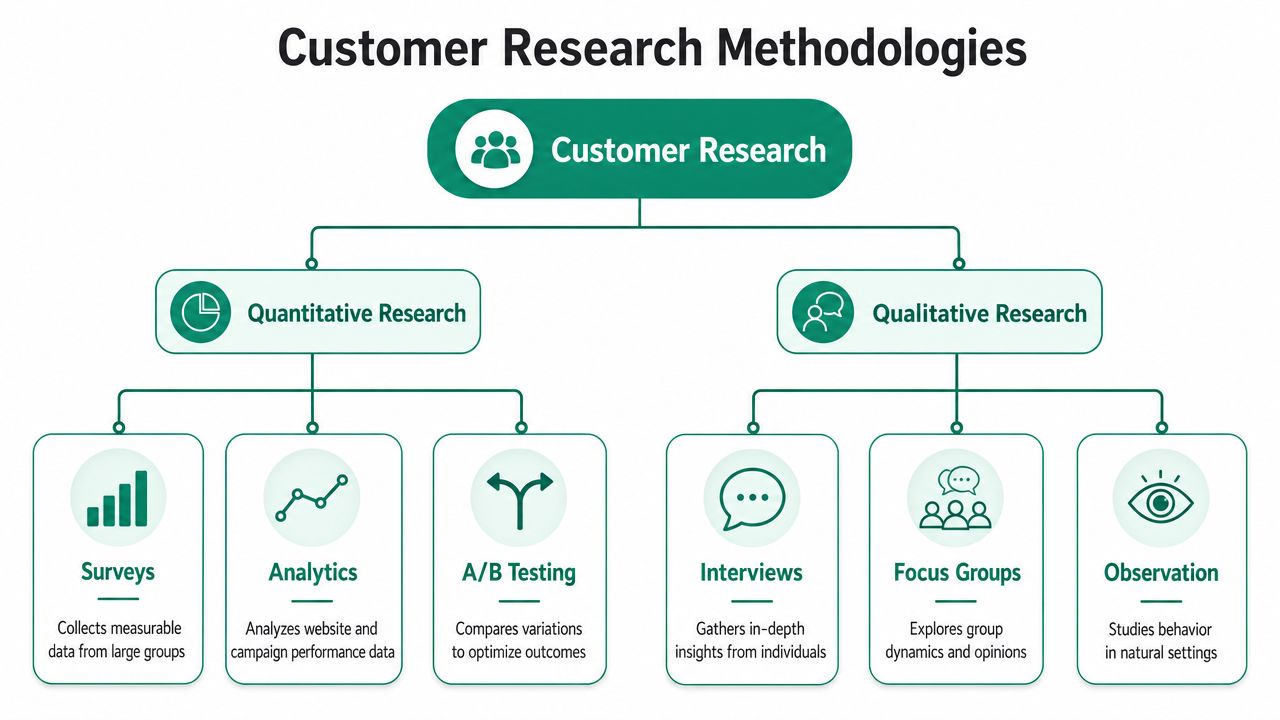
Good persona research uses two lanes at the same time. One lane shows patterns. The other explains them. If you rely only on analytics, you get behavior without motive. If you rely only on interviews, you get stories without scale.
Info-Tech’s buyer persona methodology uses a three-phase process that includes stakeholder alignment, buyer interviews, and activation across teams. It also recommends 2–3 interview sessions of 60 minutes each as a practical early benchmark, and Salesforce reports that 86% of business buyers are more likely to buy when their goals are understood in the same buyer persona and journey methodology reference. That’s a useful reminder that research isn’t academic. It directly affects commercial conversations.
What to pull from quantitative sources
Start with systems you already own. Most companies have enough raw material to spot useful differences between segments before they collect a single new response.
Check these sources:
- CRM records for role, account type, sales stage progression, common objections, loss reasons, and deal notes
- Website analytics for entry pages, content paths, return visits, and conversion points by channel
- Campaign reports for message resonance across paid search, paid social, email, and organic landing pages
- Sales call notes for repeated concerns, internal politics, timing issues, and evaluation criteria
If your team struggles to define who counts as a real lead in the first place, a resource like Identify More Jobs with Pipeline On can help tighten the early qualification lens before you formalize personas.
One more pattern matters. A large portion of the buyer journey now happens without direct sales interaction, which is why digital behavior belongs in persona research. This matters even more when buyers self-educate before they ever fill out a form. The article on how much of the buyer’s journey is digital is useful context for teams that still build personas around sales calls alone.
What to ask in qualitative interviews
Interviews should uncover sequence, motive, and friction. Avoid broad prompts that invite polished answers. “Tell me about your goals” sounds reasonable, but buyers often answer with canned language. Ask for events and decisions instead.
Use prompts like:
- Walk me through what was happening when you started looking for a solution.
- What made the old approach stop working well enough?
- Who else got involved once the search started?
- What nearly kept you from moving forward?
- What information helped you feel confident enough to keep going?
- What felt confusing, risky, or incomplete during evaluation?
Those questions reveal the actual buying path. That’s far more useful than generic demographic enrichment.
Ask for the story of the decision, not a summary of preferences.
Who to interview and how to compare answers
Don’t speak only with happy customers. That creates a flattering persona, not an accurate one. Include buyers who purchased, buyers who hesitated, and buyers who walked away if your team can access them. The gap between those groups often reveals the difference between a strong-fit persona and a weak-fit one.
A simple working grid helps:
| Interview group | What you want to learn |
|---|---|
| Closed customers | Trigger events, confidence builders, internal champions |
| Stalled opportunities | Missing proof, timing issues, process friction |
| Lost deals | Competitive alternatives, hidden objections, fit problems |
Keep the interviews structured enough to compare responses, but loose enough to chase specifics. If five buyers mention "integration risk" and three mention "internal approval friction," you've found language worth carrying into messaging, content, and sales preparation.
From Raw Data to Realistic Persona Profiles
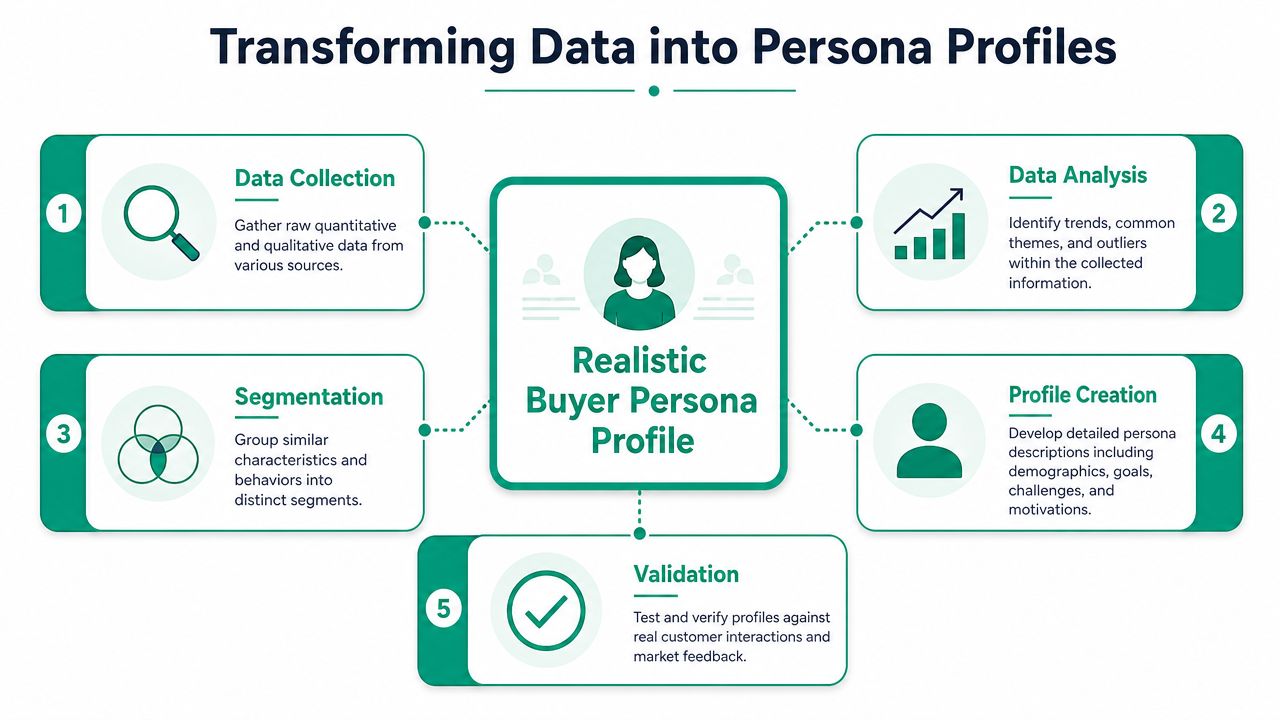
Most persona documents go wrong during synthesis. Teams gather decent data, then flatten it into a generic profile that tries to represent everybody at once. Once that happens, the research loses its edge.
A stronger workflow starts by ranking customer segments by lifetime value, then reviewing the behavioral and demographic traits that separate high-value customers from lower-value ones. Instapage also notes that this process gets stronger when you combine quantitative inputs with qualitative interviews so the persona captures both the what and the why behind buying behavior in its guidance on avoiding buyer persona mistakes.
Build segments before you write profiles
Don't start with names and bios. Start with grouping logic.
Look for clusters based on combinations such as:
- Commercial value tied to retention, expansion potential, or buying consistency
- Buying context like urgent replacement, planned transformation, or exploratory research
- Decision structure including solo decision-maker, committee-led process, or operational evaluator plus executive approver
- Message response where one group reacts to efficiency proof and another needs risk reduction or implementation confidence
That work prevents the classic mistake of treating all "marketing managers" or all "operations leaders" as one audience.
A practical persona template
Once the segments are clear, write profiles that answer working questions. Skip the fluffy biography unless it helps a team act.
A useful persona profile includes:
-
Role and decision position
What authority they have, who influences them, and who can block them. -
Primary goal
The result they need from the purchase. Keep this tied to their job, not a vague aspiration. -
Buying trigger
What event starts the search or pushes a dormant problem into action. -
Key concerns
Risks, objections, constraints, and approval hurdles. -
Research behavior
Where they look, what content format they trust, and how they compare options. -
Message angle that resonates
The framing that gets attention early. -
Disqualifiers
Signs this segment looks similar on paper but isn't a fit in practice.
A persona becomes useful when it helps your team exclude as confidently as it helps them target.
Three profile examples without the fluff
Here is how different persona types can look in practice.
| Business type | Useful persona focus | What teams should capture |
|---|---|---|
| B2B software | The operational buyer inside a committee | Role in evaluation, technical concerns, approval path, proof required for internal buy-in |
| E-commerce | The repeat purchaser with a clear use case | Trigger to buy, product comparison habits, objections around trust or convenience, preferred offer framing |
| Local service business | The high-intent buyer ready to act | Urgency pattern, service-area relevance, confidence signals, preferred contact method |
For a B2B software firm, one persona might be a department leader who feels the pain daily but can’t sign the contract alone. That profile needs committee dynamics and objection patterns. For a local service company, the better persona might center on urgency, trust, and contact preference rather than a deep organizational map.
The final document should be short enough to use and rich enough to guide work. If it takes ten minutes to read before a call, nobody will use it.
Putting Personas to Work in Marketing and Sales
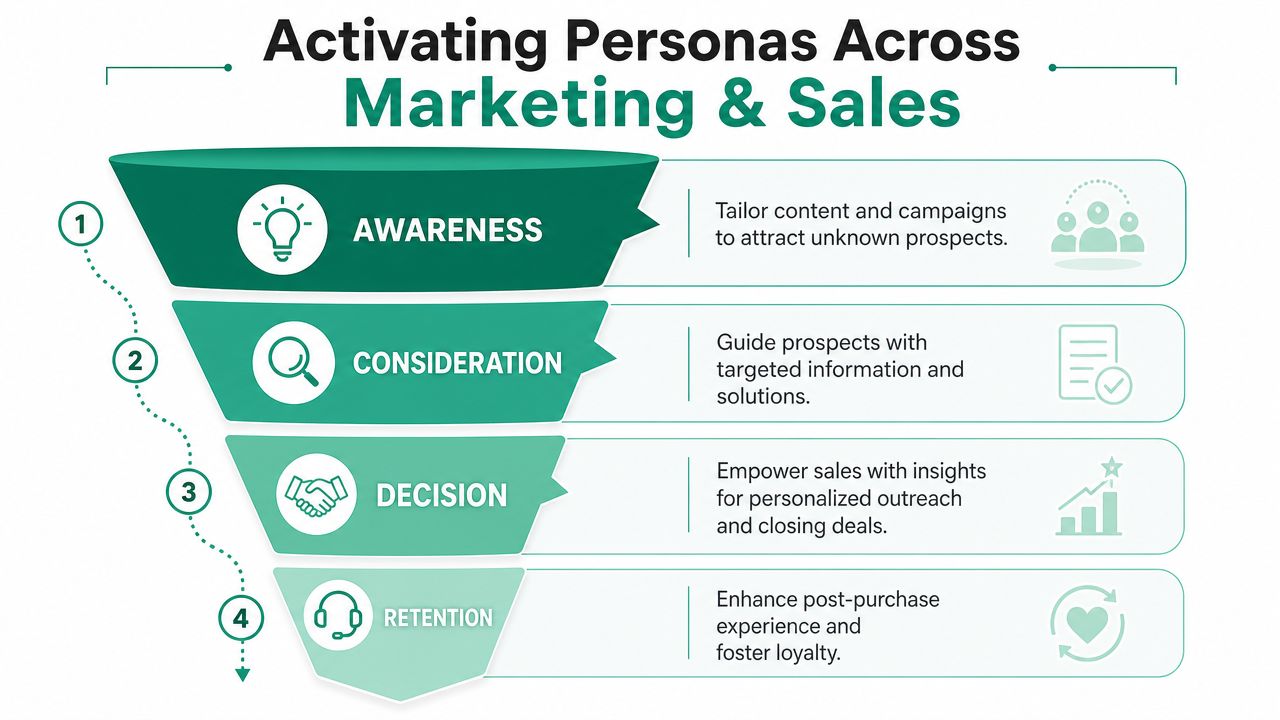
A persona only starts paying off when it enters the workflow. However, many teams then drop the ball. They spend time on research, approve the slides, and then go right back to generic campaigns and sales talk tracks.
That wastes the part that creates value.
Research summarized by Delve.ai shows why activation matters. A buyer-persona statistics roundup reports that 44% of marketers already use buyer personas and another 29% plan to use them within the next 12 months, and it also cites outcomes from other sources: 24% of companies generated more leads using buyer personas, 36% created shorter sales cycles, and 56% generated higher-quality leads according to the roundup’s referenced sources in these buyer persona statistics. The pattern is clear. Personas help when teams use them inside execution.
What activation looks like in marketing
Marketing should translate each persona into choices, not descriptions.
That usually means:
- Channel selection based on where that persona researches and responds
- Message framing matched to buying triggers and objections
- Content planning tied to stage-specific questions, not broad awareness topics
- Landing page structure that reflects the persona’s evaluation criteria
- Audience exclusions that prevent spend on weak-fit traffic
If your team is working on more customized campaign execution for smaller businesses, the piece on why personalized marketing drives SMB engagement and sales connects well with this kind of persona activation.
A simple example: if one buyer persona cares most about implementation risk, your campaign shouldn’t lead with feature depth. It should reduce uncertainty. Your landing page should answer setup questions early. Your retargeting should reinforce proof and ease of adoption.
What activation looks like in sales
Sales teams need persona material in the places they already work. Not in a brand folder. Not hidden in the strategy drive.
Put persona guidance into:
- Discovery call prep so reps know which questions matter by role
- Objection handling notes organized by persona-specific hesitation patterns
- Demo flow with different sections emphasized for different buyers
- Follow-up email templates matched to what each persona needs next
- Lead qualification rules that help reps separate lookalikes from real-fit opportunities
Here is the difference in plain terms. A weak persona says, “This buyer values efficiency.” A useful persona tells the rep, “This buyer needs evidence that switching won’t disrupt current operations, and they usually pull in finance after the first serious conversation.”
A fast activation checklist
Run this test after persona creation:
- Can paid media name one audience to exclude because the persona work exposed poor fit?
- Can content map one asset to each major objection for each active persona?
- Can sales change discovery questions by role or buying context?
- Can marketing ops tag leads by persona hypothesis for later review?
- Can leadership decide which segment deserves more budget next quarter?
If the answer is no across the board, the persona still isn’t operational.
Validating and Evolving Your Buyer Personas
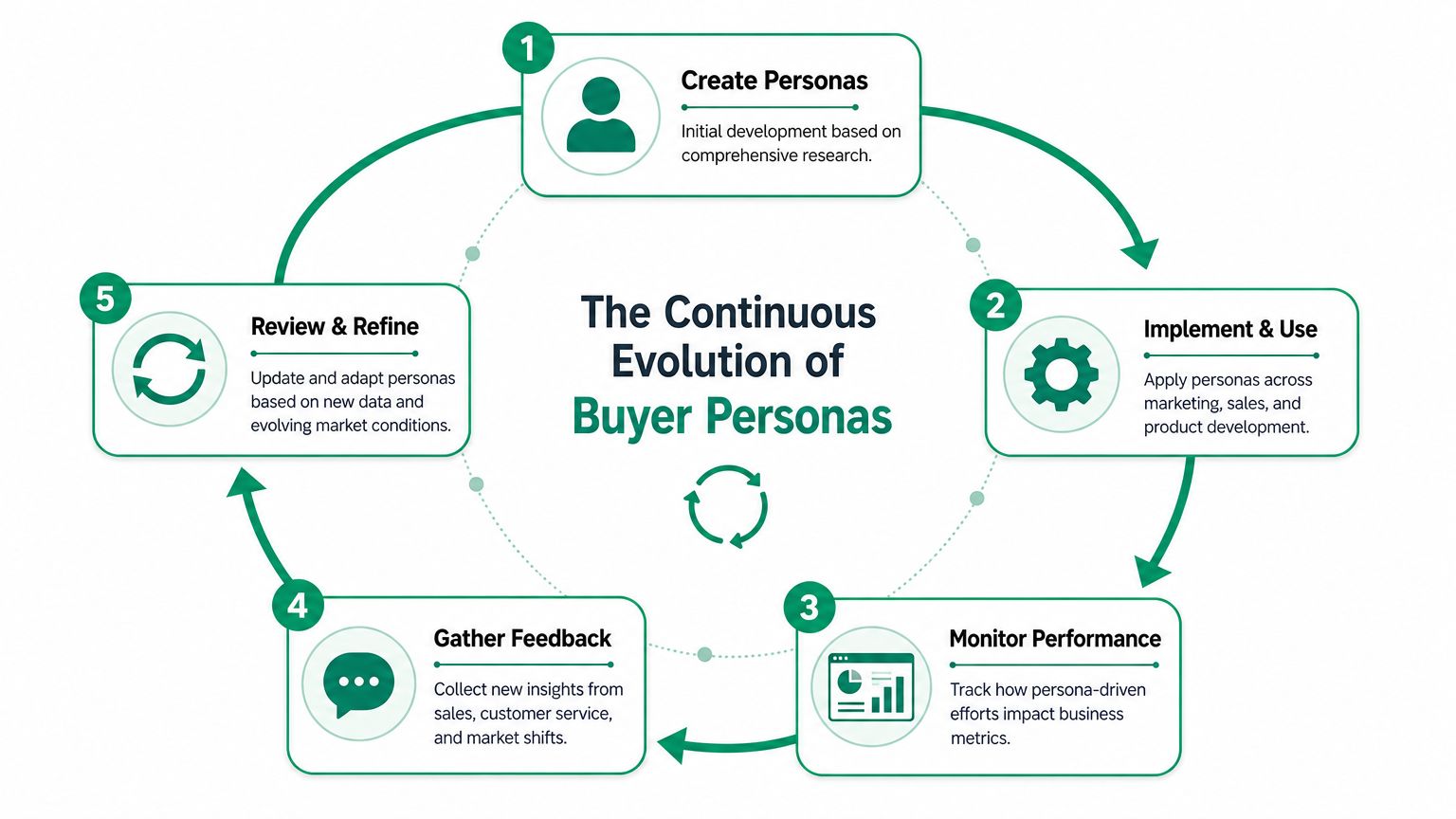
Persona work goes stale faster than teams admit. Markets shift. Offers change. Buyers adopt new evaluation habits. Internal assumptions creep back in. If you don’t review personas against live pipeline behavior, your team starts working from old thinking again.
The simplest fix is a recurring validation loop tied to actual performance and frontline feedback.
What to validate every cycle
Look for operational signals, not vanity detail.
Review:
- Lead quality trends by persona hypothesis
- Sales velocity patterns across segments
- Repeated objections that weren’t documented in the original profile
- Content engagement differences by role, industry, or use case
- Closed-lost notes that show new blockers or poor-fit patterns
The goal isn’t to rewrite every persona each time. It’s to check whether your current profiles still explain what the business is seeing.
A light process that teams will actually use
Keep the maintenance routine simple enough to survive busy quarters.
| Step | What happens |
|---|---|
| Collect field input | Ask sales, customer success, and marketing what they’ve heard repeatedly |
| Review pipeline evidence | Compare active persona assumptions against current opportunities and losses |
| Interview selectively | Revisit a small set of recent customers or prospects when patterns change |
| Update assets | Revise call guides, briefs, CRM notes, and campaign messaging |
| Retest in market | Watch whether the updated persona improves fit and message response |
Treat persona documents like working sales tools. Once they stop matching real conversations, update them.
For teams that want a stronger measurement discipline around this process, the guide on how marketing analytics drives real SMB growth is a useful companion because persona validation works best when it's tied to reporting, not opinion.
Buyer persona development works when it drives better targeting, sharper messaging, and cleaner sales execution. If your team needs help turning research into campaigns, website messaging, and lead generation systems, Ascendly Marketing can support that work with strategy and execution built around measurable business goals.