

TL;DR:
- Brand awareness is the level at which consumers recognize and recall your brand without prompts. It directly influences trust, preference, and revenue growth through repeated exposure and recognition. Consistent marketing efforts over 6 to 12 months build genuine brand equity, not just superficial reach.
Brand awareness is defined as the degree to which consumers recognize and recall your business, products, or services without needing to search for you. It is the foundation every purchase decision rests on. Before a customer trusts you, compares you, or buys from you, they first have to know you exist. Companies like Coca-Cola and Apple have turned this principle into a competitive weapon. Research shows that every 1% increase in brand awareness delivers an average revenue growth of 0.7%. That number tells you brand recognition is not a soft metric. It is a direct driver of revenue.
What is brand awareness and how does it work?
Brand awareness is the extent to which your audience can identify your brand by its name, logo, tone, or product. The industry term you will see in academic and professional marketing contexts is brand salience, which refers to how readily a brand comes to mind in a buying situation. Both terms describe the same core concept: mental availability.

Brand awareness builds brand equity by promoting loyal repeat purchases and advocacy. Think about how people say “Google it” instead of “search for it,” or ask for a “Kleenex” instead of a tissue. Those brands replaced generic terms in everyday language. That is brand awareness working at its highest level.
The mechanism is straightforward. Repeated exposure creates memory structures. Memory structures trigger recognition. Recognition generates trust. Trust shortens the path to purchase. Strong brand awareness gets your brand “in the room” before customers are ready to buy, building trust long before a sales conversation starts.
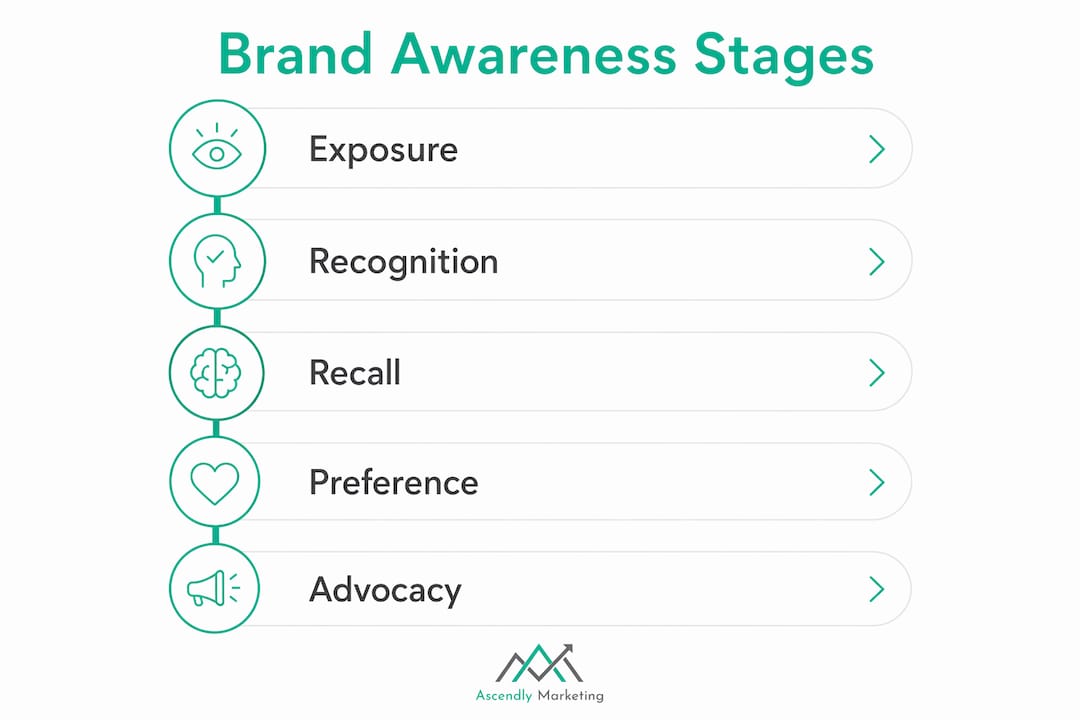
What are the different types and stages of brand awareness?
Brand recognition and recall are not binary. They exist on a spectrum with four distinct stages, each reflecting a deeper level of consumer memory.
The four stages of brand awareness:
- Recognition (aided awareness): The consumer identifies your brand when prompted. Show them your logo or name, and they say, “Yes, I know that company.” This is the entry level. Aided brand awareness means recognition happens only when a cue is provided.
- Recall (unaided awareness): The consumer names your brand from memory without prompting. Ask someone to name a fast food chain, and they say McDonald’s. No cue needed. Unaided awareness is significantly harder to achieve and far more valuable.
- Top-of-mind awareness: Your brand is the first name a consumer mentions in a category. When someone thinks “project management software,” if Monday.com or Asana comes to mind first, that brand owns top-of-mind position. This stage drives the most purchase consideration.
- Brand preference: The consumer not only recalls your brand but actively chooses it over alternatives. This is where awareness converts into loyalty. All three common types of awareness- unaided, aided, and top-of-mind- should be developed together for the best results.
Marketers who focus only on aided awareness are building a fragile foundation. A competitor with stronger unaided recall will win at the moment of purchase, even if your brand has higher overall reach. The goal is to move consumers up this ladder deliberately and consistently.
Why is brand awareness important for business growth?
The importance of brand awareness goes well beyond name recognition. It is a prerequisite for demand generation, trust, and long-term customer relationships.
Consider the numbers. Increasing brand awareness reduces the sales cycle by 18% in B2B and 24% in B2C environments. A shorter sales cycle means lower acquisition costs and faster revenue. For a business owner, that translates directly to margin improvement.
“Brand awareness is not a vanity metric. It is the infrastructure that every other marketing investment runs on. Without it, your ads reach strangers. With it, your ads reach people who already trust you.” — Salesforce Marketing Guide
Familiarity through brand awareness leads consumers to prefer known brands despite cheaper alternatives. This is the trust premium. A buyer choosing between two vendors will default to the one they recognize, even if the unknown option costs less. That preference is worth real money in every sales cycle.
Brand awareness also builds equity over time. Equity is the accumulated value your brand holds in the market, including customer loyalty, perceived quality, and pricing power. Experienced marketers structure brand awareness as a foundational asset underpinning all other brand equity dimensions such as loyalty and preference. You cannot build loyalty without first building recognition.
For small and medium businesses, this matters even more. You are competing against brands with larger budgets. Consistent, targeted awareness efforts let you punch above your weight by owning a specific niche in your customers’ minds. Explore how branding drives revenue for SMBs to see this dynamic in action.
How can businesses measure their brand awareness effectively?
Measuring brand awareness is where most marketers go wrong. Reach and impressions are the most commonly reported metrics. They are also the least meaningful on their own.
Vanity metrics like simple reach mislead marketers. A post reaching 100,000 people means nothing if none of them remember your brand name the next day. True brand equity indicators are behavioral and memory-based.
Pro Tip: Set up a branded keyword tracking report in Google Search Console. A rising trend in branded search queries is one of the clearest signals that your awareness efforts are working.
Here is a comparison of the most common measurement methods:
| Metric | What it measures | Strength | Limitation |
|---|---|---|---|
| Branded search volume | How often people search your brand name | Reflects genuine recall | Requires time to build baseline |
| Direct website traffic | Visitors who type your URL directly | Strong intent signal | Can include existing customers |
| Unaided recall surveys | Unprompted brand naming in a category | Most accurate awareness measure | Costly and time-intensive |
| Aided recall surveys | Recognition when brand is shown | Easy to run and benchmark | Overstates true awareness |
| Social listening | Brand mentions across platforms | Real-time and qualitative | Noisy data without filtering |
Branded search volume, direct traffic, and social listening are the most practical tools for small and medium businesses. They require no external research budget and deliver continuous data. Avoid building your entire measurement strategy around impressions. Use them as a reach indicator only, not as proof of awareness.
What strategies work best to increase brand awareness?
The most effective brand awareness strategies share one characteristic: consistency over time. Trying to “hack” brand awareness with sporadic campaigns usually fails. Reliable memory retention comes from steady presence across the channels your audience uses.
Here are five strategies that produce measurable results:
Publish content your audience actually searches for. A B2B content marketing strategy built around real search queries puts your brand in front of buyers at the exact moment they are looking for answers. HubSpot built a billion-dollar brand largely through this approach.
Stay active on the social platforms your buyers use. Consistent posting, responding to comments, and joining relevant conversations builds familiarity. Showing up consistently with valuable content and engaging authentically in your communities creates trust faster than any single campaign.
Run paid ads for reach, not just conversions. Most businesses use PPC only for bottom-of-funnel conversions. Upper-funnel display and video ads on Google and Meta build awareness at scale. PPC advertising used strategically can introduce your brand to thousands of qualified prospects before they are ready to buy.
Build partnerships and co-marketing relationships. Partnering with complementary brands exposes you to their established audiences. A software company partnering with a consulting firm, for example, gains instant credibility with a pre-qualified audience.
Invest in community and thought leadership. Speaking at industry events, contributing to publications, and participating in online communities builds unaided recall among decision-makers. This is how smaller brands earn top-of-mind status in competitive niches.
Pro Tip: Treat brand awareness like compound interest. The results from month one look small. By month twelve, the accumulated effect of consistent presence produces recognition that no single campaign could buy.
Brand awareness as a long-term investment requires 6–12 months of consistent effort to achieve significant results. Set realistic timelines and measure progress quarterly, not weekly.
Key takeaways
Brand awareness is the single most foundational marketing asset a business can build, because it determines whether customers consider you before they ever reach a sales conversation.
| Point | Details |
|---|---|
| Definition matters | Brand awareness is consumer recognition and recall, not just reach or impressions. |
| Four stages exist | Move buyers from aided recognition through unaided recall to top-of-mind and preference. |
| Revenue impact is real | Every 1% increase in brand awareness delivers an average 0.7% revenue growth. |
| Measure what matters | Use branded search volume, direct traffic, and recall surveys instead of impressions alone. |
| Consistency wins | Steady, long-term presence builds memory structures that one-off campaigns cannot replicate. |
The uncomfortable truth about brand awareness timelines
At Ascendly Marketing, we have worked with business owners since 2013, and the most common mistake we see is expecting brand awareness to behave like a paid lead campaign. Clients want to run a campaign in January and see brand recognition lift by February. That is not how memory works.
Brand awareness is a compound strategy. The first three months of consistent content, social presence, and targeted advertising feel underwhelming. The results look thin. But those early impressions are laying memory structures that compound over time. By month nine or ten, something shifts. Branded searches start climbing. Sales teams report that prospects already know the company name before the first call. The sales cycle shortens.
The other mistake I see constantly is confusing reach-based vanity metrics with real brand equity. A business can have 500,000 impressions on a campaign and zero unaided recall to show for it. Impressions measure exposure. They do not measure memory. The brands that win long-term are the ones tracking branded search trends, running quarterly recall surveys, and measuring direct traffic growth year over year.
My honest recommendation: pick two or three channels, show up on them every single week, and measure the right things. Patience and precision beat budget every time.
— Ascendly Marketing
How Ascendly Marketing can help you build real brand awareness
Building brand awareness that actually moves the needle requires a coordinated strategy across content, SEO, paid media, and social channels. That is exactly what Ascendly Marketing has delivered for clients since 2013.
At Ascendly Marketing, we build brand awareness programs grounded in data, not guesswork. Our team of SEO specialists, content creators, and paid media strategists designs campaigns that build recognition at every stage of the awareness funnel. From branded search growth to unaided recall improvements, we track what actually predicts revenue. If you are ready to turn brand recognition into a measurable business asset, explore our full digital marketing services and book a consultation with our team today.
FAQ
What is brand awareness in simple terms?
Brand awareness is how well consumers recognize and remember your brand without being prompted. It is the foundation of customer trust and purchase decisions.
How does brand awareness affect customer loyalty?
Consumers who recognize and recall a brand are more likely to choose it repeatedly. Familiarity builds trust, and trust converts first-time buyers into loyal customers over time.
What are the best ways to measure brand awareness?
The most reliable methods are branded search volume, direct website traffic, and unaided recall surveys. Avoid relying solely on reach or impressions, as those metrics do not reflect actual memory or preference.
How long does it take to build brand awareness?
Brand awareness typically requires 6–12 months of consistent marketing effort to produce measurable results. Sporadic campaigns rarely create lasting recall.
What is the difference between brand awareness and brand visibility?
Brand awareness measures whether consumers remember your brand. Brand visibility measures how often your brand appears in front of audiences. Visibility creates the opportunity for awareness, but awareness requires repeated exposure to take hold.