

TL;DR:
- Marketing analytics helps SMBs turn raw data into actionable insights for better decisions.
- Key metrics like CAC, LTV, ROAS, CTR, and CVR guide focused growth strategies.
- Using multi-touch attribution models ensures accurate crediting of all customer journey touchpoints.
Most small and medium-sized business owners assume that marketing analytics is the playground of Fortune 500 companies with dedicated data science teams and million-dollar budgets. That assumption is costing them real money. Data-driven decision-making through descriptive, predictive, and prescriptive methodologies transforms raw data into actionable insights that any SMB can apply today. This guide walks you through exactly what marketing analytics is, which numbers move the needle, how to assign credit across your funnel, and how to build a repeatable process that compounds results over time.
Table of Contents
- What is marketing analytics, and why should SMBs care?
- The business impact: Key metrics every SMB should track
- Attribution models: Getting credit right in your funnel
- Practical steps to use marketing analytics for better decisions
- Perspective: What most SMBs miss about marketing analytics
- Take your marketing analytics to the next level
- Frequently asked questions
Key Takeaways
| Point | Details |
|---|---|
| Analytics drives growth | Effective use of marketing analytics empowers better decisions and sustainable SMB growth. |
| Track the right KPIs | Key metrics like CAC, LTV, and ROAS help measure and improve marketing results. |
| Choose smart attribution | Using appropriate attribution models ensures the right channels get credit and budgets are well spent. |
| Take practical steps | Even simple analytics processes unlock big wins when integrated into everyday marketing for SMBs. |
What is marketing analytics, and why should SMBs care?
Marketing analytics is the practice of collecting, measuring, and interpreting data from your marketing activities to guide better decisions. It is not a single tool or a one-time report. Think of it as an ongoing conversation between your campaigns and your bottom line.
There are three distinct methodologies worth knowing:
- Descriptive analytics answers “what happened?” It covers things like last month’s website traffic, email open rates, or ad impressions. This is the most common starting point for SMBs.
- Predictive analytics answers “what will happen?” It uses historical patterns to forecast future outcomes, like projecting which customer segment is most likely to convert this quarter.
- Prescriptive analytics answers “what should we do?” It turns forecasts into specific recommendations, like reallocating budget from underperforming channels to high-converting ones.
Marketing analytics transforms raw data into insights that move an SMB from guessing to knowing. That distinction matters enormously when budgets are tight, and every dollar needs to work harder than it would at a large corporation.
“The businesses that will win over the next decade are not the ones with the biggest budgets. They’re the ones that use their data better than everyone else.”
The data-driven marketing benefits for SMBs are concrete and measurable:
- Better cost control: You stop spending on channels that drain budget without results.
- Improved ROI: You put money where conversion rates are proven, not assumed.
- More precise targeting: You reach the right audience with the right message at the right time.
- Faster iteration: You spot underperformance early and fix it before it becomes expensive.
A well-structured SMB marketing strategy is built on this kind of analytical foundation. Without it, you’re navigating by guesswork in a market that rewards precision.
The business impact: Key metrics every SMB should track
Knowing that analytics matters is one thing. Knowing which numbers to watch is where most SMBs fall short. They either track everything, which creates noise, or track nothing consistently, which creates blind spots. The answer is a focused set of key performance indicators (KPIs) tied directly to business outcomes.
Here are the core metrics every SMB marketing team should understand:
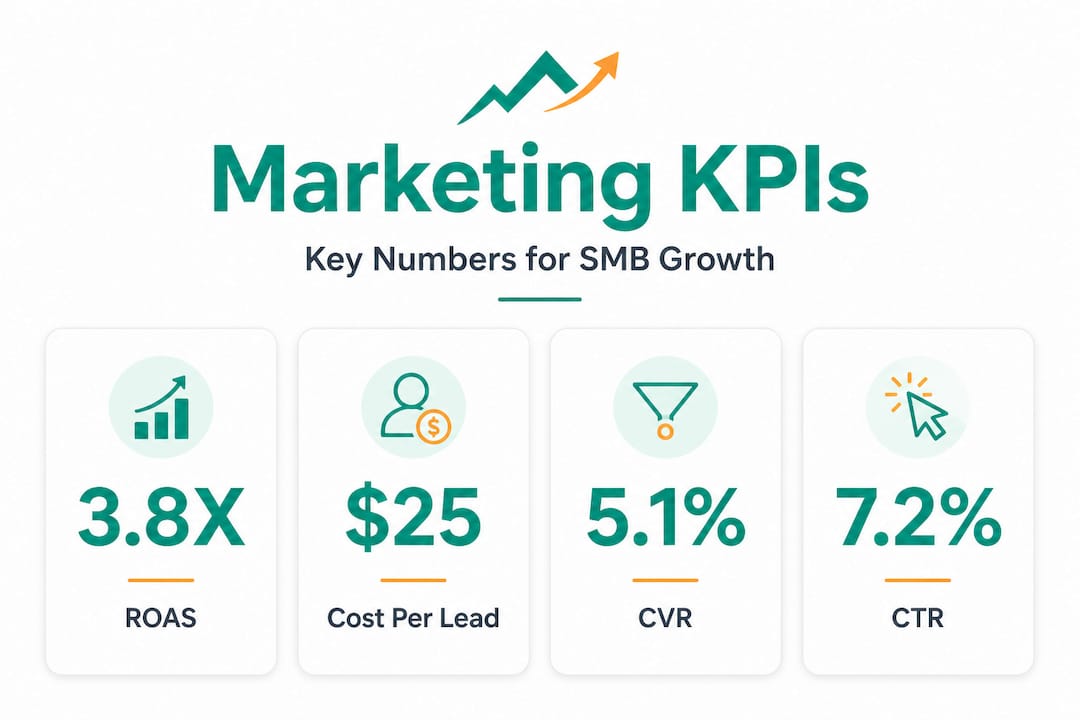
- Customer Acquisition Cost (CAC): What it costs you to win one new customer. A common benchmark sits around $50, though it varies widely by industry.
- Lifetime Value (LTV): The total revenue a customer generates over their entire relationship with your business.
- LTV: CAC ratio: The gold standard relationship between those two numbers. A healthy ratio is 3:1, meaning a customer brings in three times what they cost to acquire.
- Return on Ad Spend (ROAS): Revenue generated per dollar spent on advertising. A 4x ROAS is a commonly cited strong benchmark for paid campaigns.
- Cost Per Lead (CPL): Average cost to generate one qualified lead. For paid search, the average CPL hovers around $70.
- Click-Through Rate (CTR): The percentage of people who click your ad or link after seeing it. Paid search averages around 6.7% across industries.
- Conversion Rate (CVR): The percentage of visitors who take a desired action. Paid search averages approximately 7.5%.
These key marketing KPIs give you a complete picture of both the cost and quality of your marketing effort.
| Metric | What it tells you | Benchmark |
|---|---|---|
| CAC | Cost to acquire one customer | ~$50 |
| LTV | Total customer revenue | Varies by niche |
| LTV: CAC | Health of acquisition economics | 3:1 |
| ROAS | Return per ad dollar | 4x |
| CPL | Cost per generated lead | ~$70 (paid search) |
| CTR | Engagement with ads or content | ~6.7% (paid search) |
| CVR | Rate of desired action taken | ~7.5% (paid search) |
Tracking these numbers reveals stories that raw traffic counts never could. A low CVR tells you there’s a disconnect between what your ad promises and what your landing page delivers. A high CAC paired with a low LTV: CAC ratio signals that your acquisition strategy is unsustainable. Understanding calculating marketing ROI accurately starts with this foundation.
Pro Tip: Never judge a metric in isolation. A spike in CTR is meaningless if CVR tanks at the same time. Always look at the relationship between metrics across a 30- to 90-day window to spot real trends, not noise.
One more thing worth emphasizing: trends beat snapshots every time. A single week of high CPL might reflect a seasonal blip. Three consecutive weeks of rising CPL signal something structural that needs fixing. Train yourself and your team to look at direction, not just the current position.
Attribution models: Getting credit right in your funnel
Attribution is the process of assigning credit for a conversion to the marketing touchpoints that contributed to it. Get this wrong, and you’ll systematically underfund the channels that actually build your business while over-rewarding the ones that just showed up at the finish line.
Here is a breakdown of the five most common attribution models:
- Last-click attribution: 100% of the conversion credit goes to the final touchpoint before the sale. Simple to set up but dangerously misleading.
- First-touch attribution: 100% of credit goes to the first channel that introduced the customer to your brand. Great for understanding awareness, poor for measuring nurturing.
- Linear attribution: Credit is split equally across every touchpoint in the customer journey. More balanced, but treats a casual blog visit the same as a product demo.
- Time-decay attribution: More credit is given to touchpoints closer in time to the conversion. This model respects the natural momentum of a purchase decision.
- Position-based attribution: Also called U-shaped, this model gives 40% credit to the first and last touchpoints each, with the remaining 20% split across middle interactions.
| Model | Credit distribution | Best for | Key weakness |
|---|---|---|---|
| Last-click | 100% to final touch | Simple campaigns | Ignores awareness |
| First-touch | 100% to first touch | Brand awareness focus | Misses nurturing |
| Linear | Equal across all | Multi-step journeys | Treats all touches equally |
| Time-decay | More to recent touches | Short sales cycles | Undervalues early stages |
| Position-based | 40/20/40 split | Full-funnel view | Can still oversimplify |

Last-click attribution overcredits bottom-funnel channels like direct traffic and branded search, while first-touch ignores everything your nurturing sequences accomplished. Multi-touch models (linear, time-decay, position-based) tell a more accurate story, but they require solid data volume to be reliable. Specifically, data-driven attribution works best with 600 or more conversions per month, which many SMBs haven’t yet reached.
So what should you do in the meantime? A hybrid approach. Use last-click for quick campaign optimization decisions while layering in a position-based model to evaluate your broader funnel. AI’s impact on attribution is also reshaping this space rapidly, with machine learning models now able to detect patterns across thousands of touchpoints that humans simply cannot process manually.
Common pitfalls to avoid:
- Switching attribution models mid-campaign and comparing incompatible data
- Choosing a model based on what makes your preferred channel look best
- Ignoring offline touchpoints like phone calls, events, or in-store visits that may influence online conversions
Attribution is not a “set it and forget it” decision. As your customer journey evolves, so should your model. Revisit your attribution setup every six months at minimum.
Practical steps to use marketing analytics for better decisions
Understanding the theory is only half the job. Here is a straightforward action plan to integrate analytics into your daily marketing operations, even if you don’t have a full data team.
Set clear, measurable goals first. Before touching a dashboard, define what success looks like. Is it 20 new leads per month? A 3x ROAS from paid ads? Specific goals determine which metrics you actually need to watch.
Choose five or fewer primary KPIs. Tracking everything means acting on nothing. Pick the metrics most directly tied to your goals and ignore the rest for now. You can always expand your view later.
Integrate your tools into one reporting workflow. At minimum, connect your website analytics, CRM, and ad platforms so data flows into one place. Google Analytics 4, your email platform, and your ad accounts all need to talk to each other.
Establish baselines before running campaigns. If you don’t know your current CVR, you can’t measure whether a new landing page improved it. Spend two to four weeks collecting baseline data before major campaign launches.
Analyze patterns, then act. Look for consistent directional signals, not one-day anomalies. When a pattern holds across three or more data points, treat it as a signal and make a change.
Iterate in small, testable increments. Change one variable at a time so you can clearly see what drove any improvement. Testing a new ad creative at the same time as a new landing page leaves you unable to identify which change helped.
A common pitfall we see often: businesses start tracking 30 different metrics because they read a list like the one in the previous section and add everything at once. The result is paralysis. You spend more time pulling reports than acting on them. Actionable insights for SMBs come from simplicity and consistency, not complexity.
Useful tools worth considering:
- Google Analytics 4 for website behavior and traffic source data
- Google Search Console for organic search performance and keyword visibility
- Meta Ads Manager for social ad performance and audience insights
- HubSpot or similar CRM for tracking leads through the full sales cycle
- Looker Studio for building custom dashboards that combine multiple data sources
For a broader framework, reviewing a digital marketing step-by-step guide helps connect analytics practice to your overall strategy. Similarly, if content is a primary channel for you, a solid content marketing guide will show you exactly which metrics to track for content-specific ROI.
Pro Tip: Block one hour at the start of every month for a structured analytics review. Look at your five KPIs, compare them to the prior month, and write down one insight and one action from each metric. Over time, this habit compounds into a significant competitive advantage.
Perspective: What most SMBs miss about marketing analytics
Here’s something we’ve observed working with growing businesses since 2013: the companies that struggle with analytics seldom have a data problem. They have a strategy alignment problem.
They install Google Analytics, set up a dashboard, watch the numbers change, and then make the same decisions they would have made anyway. The data becomes a post-hoc justification rather than an actual input into planning. Sound familiar?
Most SMBs treat analytics like a scoreboard. They check in after the game to see who won. The businesses that genuinely grow from analytics use it as an engine, checking real-time signals, adjusting tactics mid-campaign, and building feedback loops that make each quarter smarter than the last.
There’s also an uncomfortable trend worth naming. As privacy regulations tighten and third-party cookies disappear, the raw volume of trackable data is actually shrinking. Hybrid models and strategic thinking now matter more than chasing every single click. That means human judgment, customer context, and real relationships become more valuable, not less, as the data landscape shifts.
The SMBs winning right now combine three things: clean measurement of the metrics that matter, genuine business intuition built from years in their market, and disciplined experimentation to test assumptions rather than defend them. No tool replaces that combination. Understanding why analytics wins is less about software and more about building that culture of evidence-based action inside your team.
Ask yourself honestly: are you using analytics as a report card, or as a decision engine?
Take your marketing analytics to the next level
Knowing what to measure and how to act on it is genuinely powerful. But translating analytics insights into optimized campaigns, high-converting pages, and efficient ad spend takes execution, and that’s where many SMBs hit a wall.
At Ascendly Marketing, we’ve spent over a decade helping small and medium-sized businesses stop guessing and start growing with data. Whether you need expert PPC advertising support to maximize ROAS from your paid campaigns or you want to build lasting authority through an organic SEO guide that drives compounding traffic, our team connects analytics directly to action. We build the strategies, run the campaigns, and report the results transparently. Book a consultation with us and let’s turn your data into a real growth engine.
Frequently asked questions
What are the most important metrics for SMB marketing analytics?
The most important are CAC, LTV, LTV: CAC ratio, ROAS, CPL, CTR, and CVR, each reflecting a different dimension of cost and performance. Healthy benchmarks include a 3:1 LTV: CAC ratio and a 4x ROAS for paid advertising.
How can small businesses start using marketing analytics without expert staff?
Start with three to five key metrics tied to your most important goal, use free tools like Google Analytics 4, and review your data monthly to spot directional trends. Analytics becomes actionable when you connect it to a specific business question rather than tracking everything at once.
What’s the difference between last-click and multi-touch attribution?
Last-click gives 100% of conversion credit to the final interaction, which often means overvaluing bottom-funnel channels. Multi-touch models spread credit across the full customer journey, offering a more accurate picture of what’s actually driving growth.
How often should I review marketing analytics to guide strategy?
A monthly review is enough for most SMBs to catch meaningful trends and make informed adjustments. For high-spend paid campaigns or active A/B tests, weekly check-ins help you respond before budget is wasted.