

Most advice on carpet cleaning SEO starts in the wrong place. It starts with rankings, keywords, and traffic charts, then booked jobs show up at the end.
That logic breaks fast in a local service business. A carpet cleaner doesn’t need random visits from people outside the service area, low-intent form fills, or calls from shoppers who were never going to book. The core job of SEO is simpler: get found by the right local prospect, make the phone ring, and turn that lead into work worth taking.
That changes the playbook. Instead of asking, “How do I rank higher?” ask better questions. Which pages generate calls? Which neighborhoods produce jobs that fit your schedule and pricing? Which service pages bring in quote shoppers who waste time? Once you look at carpet cleaning SEO that way, half the standard advice becomes secondary.
Stop Chasing Rankings and Start Booking Jobs
A carpet cleaning company can rank for plenty of terms and still have a weak month. That happens when the business tracks visibility but doesn’t track what happened after the click.
The better model is operational. Measure call tracking, booked-job rate, and average job value, because those numbers show whether your SEO is producing work that makes sense for your schedule and margins, as noted in WebFX’s carpet cleaners SEO guide. Rankings still matter, but only as an upstream signal.
What vanity SEO looks like
You’ve probably seen this pattern before:
- More impressions, same revenue, because the site appears for broad terms that attract information seekers
- More calls, poor lead quality because the page promises too much and filters nothing
- More traffic from outside the service area because the site isn’t built around local intent
- More form fills, fewer booked jobs because the lead handoff is slow or the offer is vague
That’s why carpet cleaning SEO should be tied to the full lead path, not just search positions. If a page brings in calls that don’t convert, that page needs different copy, stronger qualification, or a narrower local focus.
Practical rule: If you can’t connect a page, keyword theme, or Google Business Profile action to booked jobs, you’re not managing SEO. You’re collecting activity.
Use SEO as one part of the local growth system
Good SEO doesn’t sit alone. It works alongside your intake process, your review flow, your service-area choices, and your follow-up. That’s why broader home service marketing strategies matter here. SEO gets the first touch. Your website, phone process, and review profile decide whether that touch becomes revenue.
For a carpet cleaning business, the winning sequence is usually straightforward. Show up locally. Build enough trust to earn the call. Make the next step obvious. Then track whether those calls become booked work.
Build Your Unmissable Local Search Foundation
Carpet cleaning SEO is a local-search discipline first. People usually want someone nearby, and they often search on mobile. One industry guide says roughly 64% of those seeking carpet cleaning services use a mobile device, which is why local relevance, mobile optimization, and fast-loading pages drive discovery in this category, according to Servgrow’s guide for carpet cleaners.
That’s why the first move isn’t publishing a pile of blog posts. The first move is cleaning up your local infrastructure.
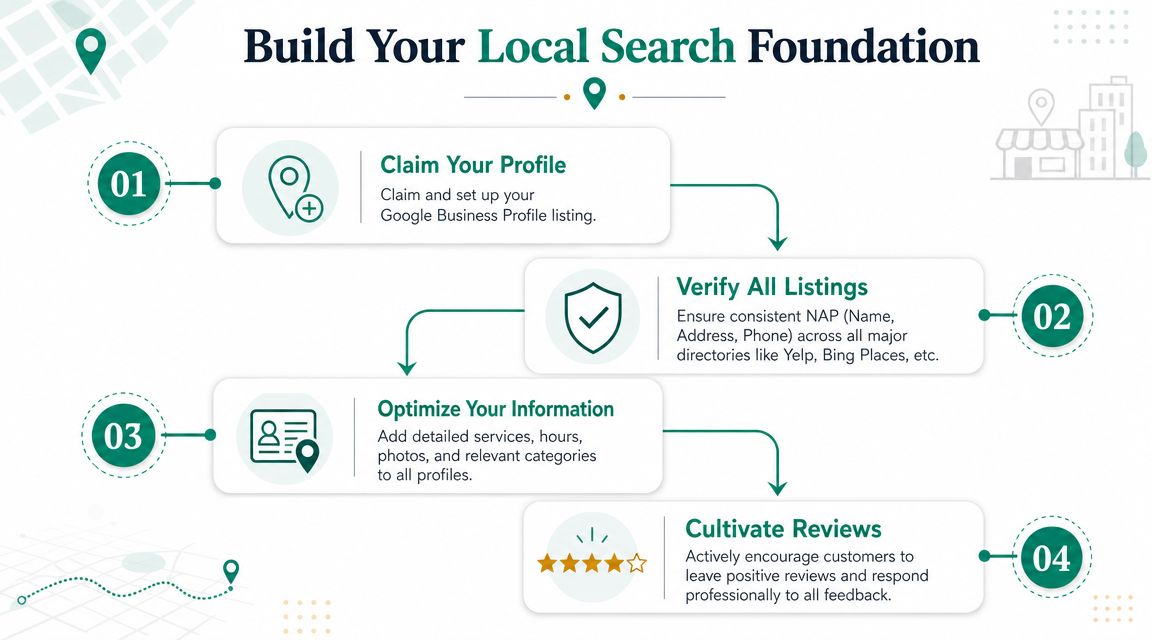
Start with your Google Business Profile
Your Google Business Profile does heavy lifting in carpet cleaning SEO. It often creates the first impression before someone ever visits your site.
The workflow is direct:
- Claim the profile and complete every available field.
- Match your NAP data exactly across your website and profile. NAP means name, address, and phone number.
- Add service areas, hours, and real photos from actual jobs.
- Keep the profile active with weekly updates and review requests.
That sequence comes from a practical workflow outlined in Gushwork’s carpet cleaning SEO article. The useful part isn’t just setup. The useful part is the ongoing activity. Weekly posts, review responses, and fresh photo uploads are part of the ranking and lead-generation system.
Fill the fields that affect trust
A thin profile gets skipped. A complete one gives the customer enough confidence to call.
Focus on these details:
- Service coverage with the cities and areas you serve
- Hours and phone number that match your website exactly
- Real job photos instead of generic stock images
- Service descriptions that reflect what you want to sell more of
- Posts and updates that show the business is active now, not last year
If you’re a service-area business, this matters even more. The profile has to tell both Google and the customer where you work and what kind of jobs you handle.
Clean up your citations next
After the profile, fix your local listings. Your name, address, and phone number should appear the same way everywhere. No extra suite numbers on one site and missing abbreviations on another. No old tracking number sitting on a directory profile from years ago.
Many carpet cleaners get sloppy by updating the website and forgetting the rest of the web.
A clean citations process usually looks like this:
| Task | What to check |
|---|---|
| Business name | Same spelling everywhere |
| Address | Same format on all listings |
| Phone number | One primary number used consistently |
| Website URL | Correct version on every directory |
| Categories | Close match to actual services |
If you need a framework for managing that cleanup, Ascendly’s overview of local citations services shows what a structured citations process should cover.
A mismatched phone number doesn’t just confuse Google. It also sends leads to the wrong line, creates tracking problems, and muddies your reporting.
What doesn’t work here?
Some local SEO tasks look productive but don’t move much:
- Bulk directory submissions with bad data
- Profiles with no fresh photos
- One-time GBP setup with no follow-up
- Fake service areas added just to chase reach
For carpet cleaning SEO, the local foundation wins when it’s accurate, active, and tied to real service coverage.
Optimize Your Website to Convert Visitors into Callers
Your website shouldn’t act like an online brochure. It should act like a dispatcher that routes the right visitor to the right call.
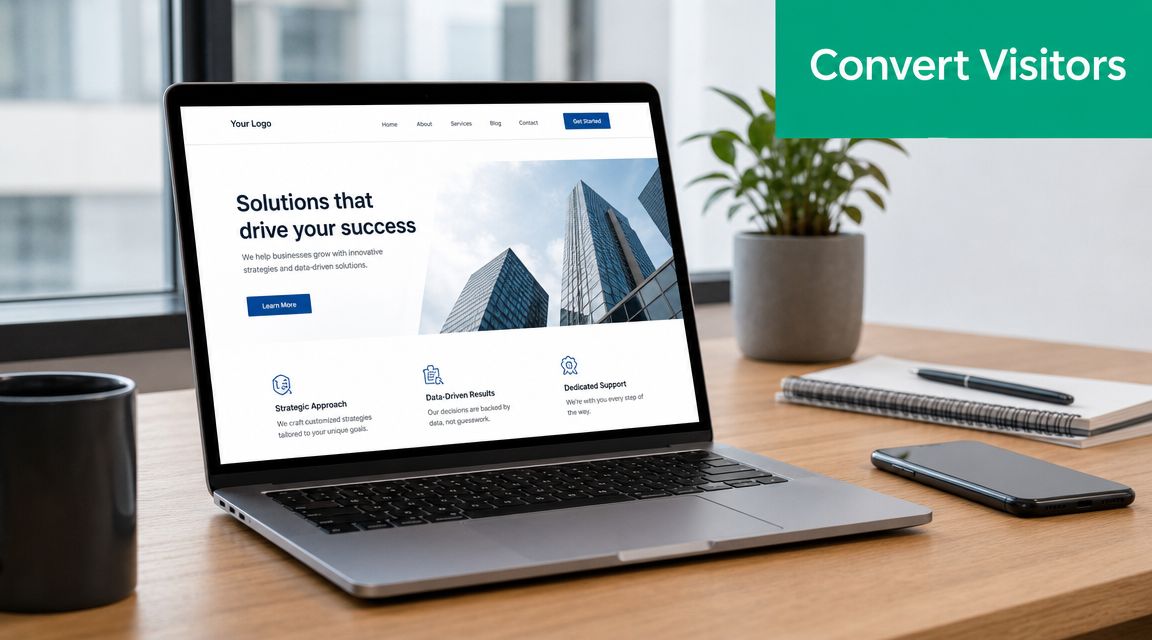
The most impactful move is structural. Build dedicated landing pages for each service and each location, then optimize each page around one search intent with strong mobile usability and clear click-to-call actions, as outlined in SEOptimer’s carpet cleaning SEO guide.
Split service pages from location pages
One page trying to rank for carpet cleaning, upholstery cleaning, pet odor removal, rug cleaning, and every city you serve will usually underperform.
Instead, separate the intent.
Service pages target what the customer wants done.
Examples:
- Carpet cleaning
- Upholstery cleaning
- Pet stain removal
- Commercial carpet cleaning
Location pages target where the customer needs them.
Examples:
- Carpet cleaning in your main city
- Carpet cleaning in surrounding service areas
- Commercial carpet cleaning in nearby business districts
That structure helps the page stay relevant to one search instead of being diluted by five different ones.
Build each page to answer one buying question
A strong service or location page needs a few specific elements:
- Clear headline that matches the service and place
- Short intro that tells the visitor they’re in the right spot
- Visible click-to-call button near the top on mobile
- Real photos from completed work
- Brief service details that remove uncertainty
- Trust elements like recent reviews or before-and-after visuals
- Simple next steps, such as call now or request a quote
Most carpet cleaners don’t need longer copy. They need tighter copy. The page should answer the immediate question: “Can this company handle my job in my area, and how do I contact them now?”
Speed and mobile usability change conversion
SEOptimer notes that a local service website can lose prospects if load times go beyond about three seconds, which is why image compression, responsive design, and hosting quality matter for both user experience and conversions in carpet cleaning SEO.
That means common website habits can hurt lead flow:
- Uploading oversized before-and-after images
- Using sliders and heavy animations
- Burying the phone number
- Making forms too long on mobile
If your pages are image-heavy, compress them. If your mobile menu hides core services, simplify it. If your CTA only appears at the bottom, move it up.
For teams working through page testing and lead flow issues, this guide to conversion rate optimization strategies is useful because it frames site changes around response behavior instead of design preference.
The page doesn’t need to impress another marketer. It needs to help a homeowner call without thinking twice.
Write search snippets that earn the click
Meta titles and descriptions still matter because they shape the click before the visitor sees your page.
A practical title format is:
Primary service + city + business name
Descriptions should stay plain. Mention the service, the area, and the action. Don’t stuff them with repeated keywords.
Later in the build, review this walkthrough for local service websites:
Track page quality, not just pageviews
Traffic alone won’t tell you much. Connect the page to lead outcomes.
A useful review routine includes:
| Metric | Why it matters |
|---|---|
| Calls from the page | Shows direct response |
| Form submissions | Captures non-call leads |
| Booked-job rate | Separates real leads from weak ones |
| Service-area source | Shows whether the page attracts local jobs worth taking |
If one location page gets calls but few booked jobs, you may be reaching the wrong area or setting the wrong expectation. If one service page drives high-value work, that page deserves more visibility and stronger internal links.
Create a Powerful Review and Reputation Engine
Most carpet cleaners treat reviews as something that happens when a happy customer feels generous. That passive approach leaves money on the table.
Reviews are one of the strongest trust signals in local service buying. They affect whether a prospect calls, and they support the local visibility work already happening in your Google Business Profile. More to the point, a review system is easier to control than rankings.
Ask at the point of satisfaction
The best moment to request a review is right after the job, when the customer has seen the result and the crew is still top of mind.
Keep the process simple:
- Send a short text with the review link immediately after completion
- Use one direct ask instead of a long message
- Make the ask part of the closeout process, not an occasional favor
- Follow up once if the customer doesn’t respond
A lot of owners overthink the wording. They don’t need a script that sounds polished. They need a process the office can repeat every day.
Respond in public, not just in private
A review profile without responses looks unattended. A profile with thoughtful replies looks active and accountable.
Do this for both types:
- Positive reviews get a short reply that mentions the service
- Negative reviews get a calm response, a path to offline resolution, and no argument
That public response isn’t for the reviewer alone. It’s for the next prospect comparing three local companies.
For a practical process on getting more review volume without making the ask awkward, this resource on boosting your Google reviews gives a usable framework.
Reviews don’t need to be perfect. They need to be recent, steady, and clearly tied to real service experiences.
Make reputation part of retention too
Reviews feed more than new acquisition. They also reveal where communication breaks, where crews delight customers, and where service expectations need tightening.
That’s why customer feedback should be managed like an operating input, not just a marketing asset. This guide to customer retention for agencies is helpful because it shows how feedback loops improve follow-up and client experience, which applies just as well to local service businesses.
A working review engine is repetitive by design. Finish the job. Send the request. Reply to the review. Learn from the pattern. Repeat.
Achievable Link Building for Local Businesses
Link building sounds technical until you strip away the jargon. For a carpet cleaning company, most useful links come from local relationships, local participation, and local relevance.
That means the easiest wins often happen offline first.
The sponsorship example
A carpet cleaner sponsors a youth sports team. The team posts sponsors on its website. That listing includes the business name and a link.
That’s a local SEO signal, yes. It’s also a real community mention. The same logic applies to school events, neighborhood associations, charity drives, and local business groups. If your company already spends money in the community, ask whether the organization has a sponsor page.
The referral partner example
Now take an apartment complex. Turnover creates recurring cleaning needs. A property manager wants reliable vendors. You build a referral relationship, and the property or management company includes trusted local partners on its website.
That one relationship can do three jobs at once:
- Generate referral business
- Create a relevant local backlink
- Strengthen your commercial service positioning
The same pattern works with real estate agents, flooring stores, moving companies, and interior designers. Not every partner will link. Some will. The outreach still pays off if the relationship is commercially useful.
The local story example
A lot of carpet cleaners ignore local publicity because they assume press coverage is only for larger companies. That’s not true. Community sites, neighborhood publications, and local business blogs often publish short features on sponsorships, charitable involvement, seasonal cleaning tips, or business milestones.
If you want a cleaner process for packaging those announcements, this effective press release SEO guide is a good reference for turning news into search value without sounding forced.
What link building should not become
Don’t turn this into a hunt for random directory links and irrelevant placements. Local links work because they fit the service area and the buyer context.
A workable filter is simple:
| Opportunity | Worth pursuing |
|---|---|
| Local sponsor page | Yes |
| Community organization listing | Yes |
| Referral partner page | Yes |
| Random unrelated blog | Usually no |
| Paid link on a generic site | Usually no |
Link building for carpet cleaning SEO should feel like business development with a search benefit attached. If it feels disconnected from the market you serve, skip it.
Your 90-Day Carpet Cleaning SEO Action Plan
The first 90 days should build a booking system, not a pile of SEO tasks. Carpet cleaning owners lose momentum when they spread effort across rankings, blogs, directories, page tweaks, and review requests without a clear order of operations. The result is familiar. More activity, weak tracking, and no clear answer on whether SEO is producing profitable jobs.
Set the quarter up so every improvement can be traced to calls, qualified leads, and booked work.
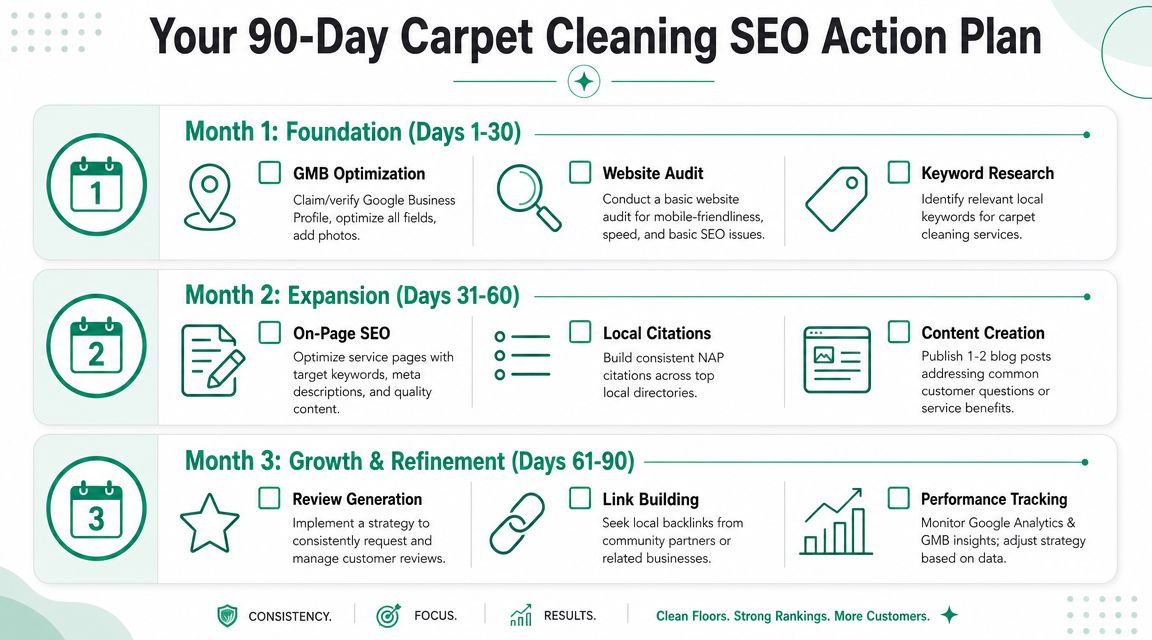
Days 1 through 30
Start with measurement and sales friction.
If you cannot see which pages generate calls, which calls turn into estimates, and which estimates turn into jobs, rankings are just noise. Set up call tracking first. Use a system that records source, landing page, and service area. Then make sure someone on the team tags calls by outcome: booked job, bad fit, spam, price shopper, or missed call. That single step changes how you judge SEO performance.
Then clean up the basics that affect response rate:
- Claim and complete your Google Business Profile
- Fix name, address, and phone consistency across key listings
- Check mobile call paths, especially tap-to-call buttons, quote forms, and page speed
- Install Google Analytics and Google Search Console
- Choose your priority service areas based on revenue potential, close rate, and travel time
- Confirm someone answers the phone during business hours
That last point gets missed all the time. A page can rank, a profile can show, and the lead can still die because the call rolls to voicemail at 2:15 on a Tuesday.
Days 31 through 60
Now build the pages that deserve to receive traffic.
Publish or rewrite the pages tied to real buying intent: core service pages, primary city pages, the homepage, and a contact page built for phone calls. Keep each page focused. A page trying to rank for pet odor removal, tile cleaning, upholstery cleaning, and every city in the county usually converts worse than a page built around one clear job type and one local intent.
This is also the right time to put lead qualification on the page. Add the details that help filter weak inquiries before they call. List service areas clearly. Mention the types of jobs you handle. Show trust signals near the phone number and contact form. If commercial work matters, give it its own path instead of burying it under residential copy.
Run the review process on a schedule, not on memory.
| Task | Weekly cadence |
|---|---|
| Ask for reviews after completed jobs | Ongoing |
| Reply to new reviews | Ongoing |
| Add fresh job photos to GBP | Weekly |
| Publish a GBP update | Weekly |
If the office manager owns this checklist and the technicians know when to trigger the ask, it gets done. If everyone owns it, it usually slips.
Days 61 through 90
Use the third month to cut waste and put more weight behind what is already producing.
Review calls by page and service area. Listen to samples. Check which pages produce booked jobs, which ones attract low-fit leads, and which cities generate calls that are not worth the drive. Then adjust the pages based on what you hear from real prospects. If a page brings in shoppers asking for the cheapest whole-house special, tighten the copy. If a page drives strong calls but few form fills, make the phone option more prominent and simplify the form.
Add local outreach during this phase, but stay selective. Partnerships, local sponsorships, community mentions, and referral relationships are worth more than random placements on generic sites. The goal is better local authority tied to actual business relationships, not a bloated link report.
The scorecard to watch
Keep the scorecard tight. A carpet cleaning business does not need fifty SEO metrics.
- Calls by landing page
- Qualified-call rate
- Booked-job rate
- Average job value by source
- Lead quality by service area
- Missed-call rate
- Google Business Profile actions
- Mobile conversion behavior
That set of numbers shows whether SEO is feeding the schedule with work you want. If calls are up but booked jobs are flat, the problem is usually one of three things: weak qualification, poor call handling, or traffic coming from the wrong pages and areas. That is the ultimate 90-day goal. Build an SEO system that gets found, gets calls, and gets booked.
Frequently Asked Questions About Carpet Cleaning SEO
How long does carpet cleaning SEO take to show results
Some fixes move fast. A cleaned-up Google Business Profile, better mobile call buttons, and clearer service pages can increase calls before rankings shift much.
SEO becomes useful when you can tie those calls to qualified leads and booked jobs. For a carpet cleaning company, that usually means setting up call tracking, asking every caller how they found you, and checking which pages bring in the right jobs. Ranking gains often take longer. Revenue signals show up earlier if the tracking is in place.
Should I pause SEO during the slow season?
No, unless you are fully booked for the period ahead and have no interest in shaping future demand.
The slow season is often the best time to fix problems that are expensive during busy months. Tighten weak service pages, update old city pages, improve your review request process, and clean up your Google Business Profile. That work pays off when demand picks back up. It also helps you avoid buying all your short-term volume through ads when the schedule needs filling.
Is SEO better than Google Ads for carpet cleaners
They solve different problems.
Google Ads can drive calls quickly, especially for emergency spots, same-day openings, or new service launches. SEO usually produces lower-cost lead flow over time, but it needs setup, patience, and consistent improvement. The smart move for many carpet cleaners is to use both, then compare them by booked-job rate, average ticket, and service-area quality.
A lead source that fills the phone with low-fit price shoppers is not winning, even if the click report looks good.
Can I do carpet cleaning SEO myself?
Yes, at least in part. Many owners and office managers can handle review requests and Google Business Profile updates, before-and-after photos, FAQs, and basic page edits.
Where in-house efforts usually stall is in prioritization. It is easy to spend time on blog posts, citation cleanup, or ranking reports, while the core problem is that the wrong pages are attracting the wrong calls. If you do it yourself, stay focused on work that improves qualified leads and booked jobs, not just visibility.
What should I track if I only have time for a few metrics
Keep it tight and revenue-focused:
- Qualified calls
- Booked jobs from organic search and Google Business Profile
- Average job value by lead source
- Missed calls
Those four numbers show whether SEO is helping the business, not just the website. If calls are rising but booked jobs are flat, check lead quality, call handling, and page intent before doing more content or link work.
Do blog posts matter for carpet cleaning SEO
Sometimes. They matter after the core pages are doing their job.
For a local carpet cleaning company, service pages, city pages, Google Business Profile, reviews, and conversion paths usually have more impact than a steady stream of articles. Blog posts help when they answer real buying questions, support a service you want more of, or give your team useful content to share in follow-ups and review requests. They do very little when they exist only to target broad keywords with no local intent.
If a post does not help attract better calls, support a service-area page, or assist the sales process, it is probably not the next best use of time.
If you want help building a carpet cleaning SEO system around booked jobs instead of vanity metrics, Ascendly Marketing works on SEO, website performance, and conversion-focused digital strategy for businesses that need measurable lead generation.